Introduction
The World’s Forgotten Technologies: Brilliant Inventions That Disappeared. Human history is often told as a story of continuous technological progress. We imagine one invention leading naturally to another: simple tools become machines, machines become engines, and engines eventually become computers and artificial intelligence.
But the real story is much less straightforward.
Throughout history, civilizations have developed technologies that were remarkably sophisticated for their time, only for some of their techniques, designs or manufacturing knowledge to disappear. In some cases, the technology itself survived but the precise method used to create it was forgotten. In others, an invention became unnecessary because economic conditions changed, political systems collapsed or a more practical alternative appeared.
Some technologies were rediscovered centuries later. Others remain partly understood. A few are surrounded by myths that make their history more mysterious than the evidence actually supports.
This is why the phrase “lost technology” needs to be used carefully.
Ancient people were not necessarily capable of doing things that modern science cannot explain. Archaeologists and historians have often been able to reconstruct how impressive ancient technologies worked by studying surviving objects, written records, archaeological remains and experimental archaeology.
The more interesting question is not whether ancient people possessed impossible knowledge.
It is how useful knowledge can disappear even when a civilization once mastered it.
The answer can involve war, economic change, the collapse of institutions, the loss of specialist communities, changes in raw materials, declining demand or simply the passage of generations.
From the mysterious workings of the Antikythera mechanism to the remarkable durability of Roman concrete, history contains many examples of technologies that challenge our assumptions about the ancient world.
What Does “Lost Technology” Actually Mean?
A technology can become “lost” in several different ways.
Sometimes the physical object disappears while written descriptions survive.
Sometimes the object survives but the manufacturing process is unknown.
Sometimes people continue making something, but the original technique is gradually changed or simplified.
In other cases, the technology itself disappears because there is no longer a practical reason to maintain it.
This distinction matters.
For example, ancient Roman builders clearly knew how to produce extraordinarily durable concrete. Modern researchers understand many aspects of Roman concrete, but the exact formulations and production methods varied between places and periods. It would therefore be misleading to say that modern engineers have no idea how Roman concrete worked.
Similarly, ancient Greek and Roman engineers created sophisticated mechanical devices, but many of their designs did not develop into continuous technological traditions.
A technology does not need to be completely mysterious to be considered historically “forgotten.”
The most fascinating cases are often those where we know what something did, but only partly understand how people produced it efficiently and consistently.
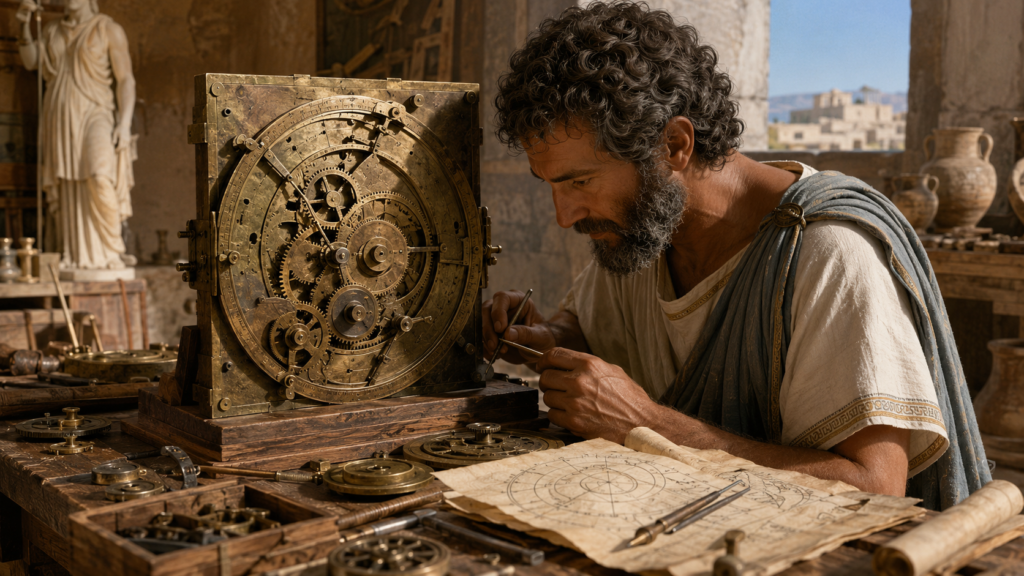
The Antikythera Mechanism: An Ancient Mechanical Computer
One of the most remarkable examples is the Antikythera mechanism, an ancient Greek device discovered in a shipwreck near the Greek island of Antikythera in 1901.
At first, the heavily corroded fragments appeared to be ordinary pieces of metal.
Closer examination revealed something extraordinary.
Inside the fragments were numerous precisely arranged gears.
Researchers eventually determined that the mechanism was designed to model astronomical cycles.
It could represent relationships involving the movements of the Sun and Moon and was connected to the prediction of astronomical phenomena such as eclipses.
The device dates to around the 2nd or early 1st century BCE, although the exact date remains a subject of scholarly discussion.
What makes it extraordinary is not simply its age.
It demonstrates an advanced understanding of gearing, mathematical astronomy and mechanical design.
The mechanism used interlocking gears to represent complex astronomical cycles.
For many years, researchers struggled to understand exactly how it worked because only fragments survived.
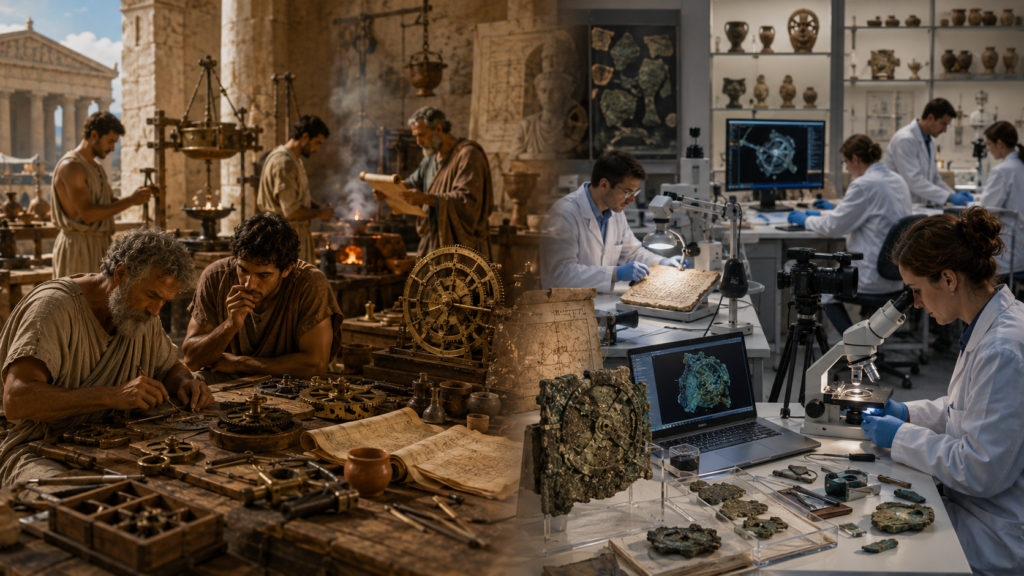
Modern imaging techniques, including high-resolution X-ray studies, have allowed researchers to examine the interior of the fragments without destroying them.
These studies have revealed inscriptions and mechanical details that have helped reconstruct its design.
The Antikythera mechanism does not prove that ancient Greece possessed technology comparable to modern computers.
It was a specialized mechanical calculating device rather than an electronic computer.
But it does demonstrate something important:
Ancient engineers were capable of designing sophisticated precision mechanisms that were far more advanced than the surviving archaeological record once suggested.
The larger mystery is why similar complex geared astronomical mechanisms did not survive in large numbers.
Ancient texts describe other sophisticated mechanical devices, but few physical examples remain.
This raises the possibility that an important tradition of mechanical engineering existed in the ancient Mediterranean and was later lost or transformed.
🔬 CurioReader Science: How Did the Antikythera Mechanism Work?
The Antikythera mechanism used interlocking gears to represent astronomical cycles. Different-sized gears rotated at different speeds, allowing the device to model movements of the Sun and Moon. Unlike modern computers, it used physical mechanical components to perform calculations.
In simple terms: it turned mathematics into mechanical movement.
Roman Concrete: A Material That Outlasted Its Builders
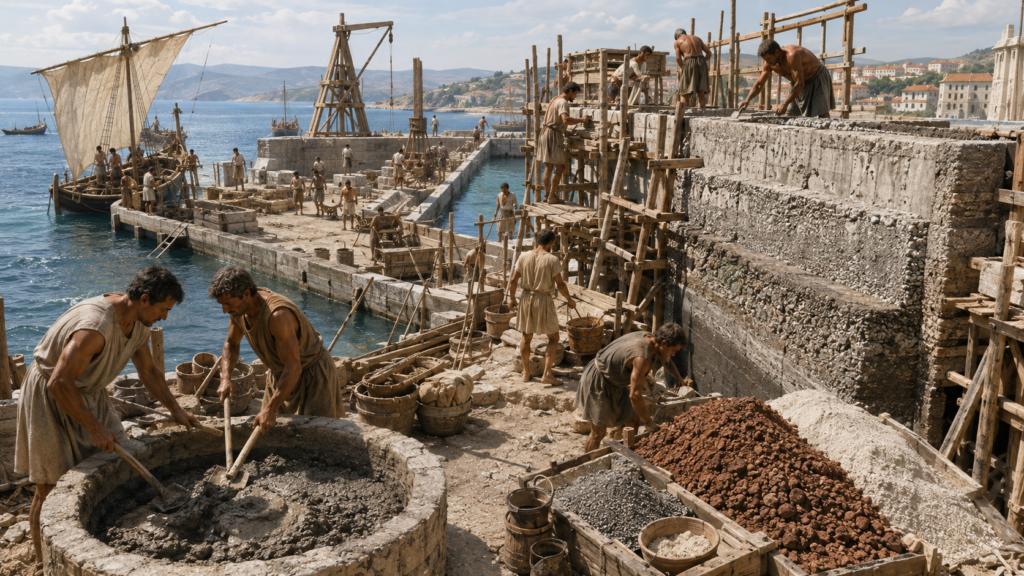
The Romans were extraordinary builders.
Their roads, aqueducts, bridges, harbours, amphitheatres and monumental buildings transformed the landscapes of Europe, North Africa and the Middle East.
One of their most important materials was Roman concrete.
Roman builders used mixtures involving volcanic materials, lime and aggregates to create concrete structures capable of surviving for centuries.
Some ancient harbour structures have remained exposed to seawater for extraordinarily long periods.
This has attracted considerable scientific interest.
Modern researchers have investigated why certain Roman concrete structures appear to become more resilient over time.
Studies have identified chemical and mineral processes that contributed to the durability of some Roman concrete mixtures.
Volcanic ash known as pozzolana played an important role in many Roman formulations.
However, there was no single “Roman concrete recipe.”
Different structures used different materials and techniques depending on local resources and construction requirements.
That is an important distinction from the popular claim that modern engineers have completely “lost” the secret of Roman concrete.
Modern concrete technology is highly advanced and can be engineered for specific applications.
The fascinating historical point is that Roman builders developed material systems that performed remarkably well under particular environmental conditions.
Some of their construction knowledge was not continuously preserved in exactly the same form after the Roman period.
As political and economic systems changed, large-scale Roman construction practices declined in many parts of Europe.
The knowledge did not necessarily vanish overnight.
Instead, specialized techniques, supply networks and construction traditions gradually changed.
This is an excellent example of how technology can disappear through loss of context, rather than through a sudden destruction of knowledge.
🧪 CurioReader Science: Why Was Roman Concrete So Durable?
Roman concrete often used volcanic ash, lime and other materials that reacted chemically over time. In some structures, these reactions helped produce mineral formations that could contribute to long-term durability.
Researchers are still studying exactly how different Roman mixtures behaved.
Ancient builders may not have understood the chemistry—but they knew what worked.
Damascus Steel: The Mystery of Extraordinary Blades
Another famous example comes from the history of metallurgy.
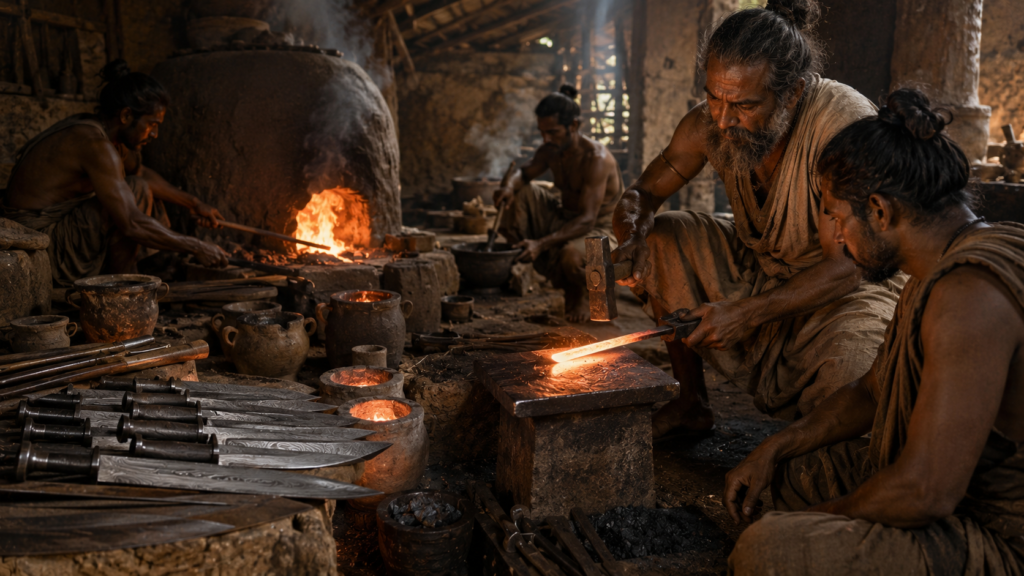
The term Damascus steel is often associated with swords and blades displaying distinctive patterns and exceptional qualities.
Historical accounts describe blades that were strong, sharp and visually striking.
For centuries, Damascus blades became famous across parts of the Middle East and beyond.
The exact historical production traditions associated with what is now called wootz steel involved crucible steelmaking techniques developed in South Asia and traded widely.
The steel could be processed into blades that developed characteristic patterns through their internal structure and forging history.
At some point, the traditional production of the famous historical material declined.
Several factors may have contributed, including changes in raw materials, industrial production methods, changing trade networks and the disruption of specialist manufacturing traditions.
For a long time, researchers and metallurgists attempted to understand why historical blades displayed properties that were difficult to reproduce using simplified modern interpretations.
Modern scientific analysis has revealed that the properties of historical crucible steels could be linked to their chemical composition, carbon content and microscopic structures.
The story therefore illustrates another important lesson.
A “lost technology” may not involve a mysterious substance or impossible process.
It can be the result of specialized knowledge accumulated through generations of craftsmanship.
When the community that maintains that knowledge disappears, reproducing the original result becomes much harder.
⚙️ CurioReader Science: What Makes Steel Strong?
Steel’s properties depend on factors such as its carbon content, heating, cooling and microscopic structure. Ancient metallurgists could influence these properties through carefully controlled production and forging techniques.
Modern materials science allows researchers to examine ancient blades at microscopic levels and reconstruct parts of these processes.
Greek Fire: The Weapon Whose Formula Was Lost
Few historical technologies are surrounded by as much mystery as Greek fire.
The Byzantine Empire used a powerful incendiary weapon, particularly in naval warfare.
Historical sources describe a substance that could be projected toward enemy ships and continue burning under conditions that made it extremely difficult to extinguish.
The Byzantines used the weapon to defend Constantinople and fight naval enemies.
Its exact composition remains unknown.
This is one of the clearest examples of genuinely lost technical knowledge.
Historians have proposed numerous possible ingredients, including petroleum-based substances, sulfur and other combustible materials.
However, there is no surviving recipe that allows researchers to state with certainty exactly how the original weapon was manufactured.
The Byzantines appear to have treated the technology as a closely guarded military secret.
That makes sense from a strategic perspective.
A weapon’s effectiveness depends partly on preventing opponents from understanding how it works.
But secrecy also creates a long-term vulnerability.
If a technique is known only to a small group of specialists, political upheaval, war, death or institutional collapse can destroy the knowledge.
Greek fire therefore demonstrates how secrecy can protect technology in the short term while making it fragile in the long term.
Ancient Automata: Machines That Moved by Themselves
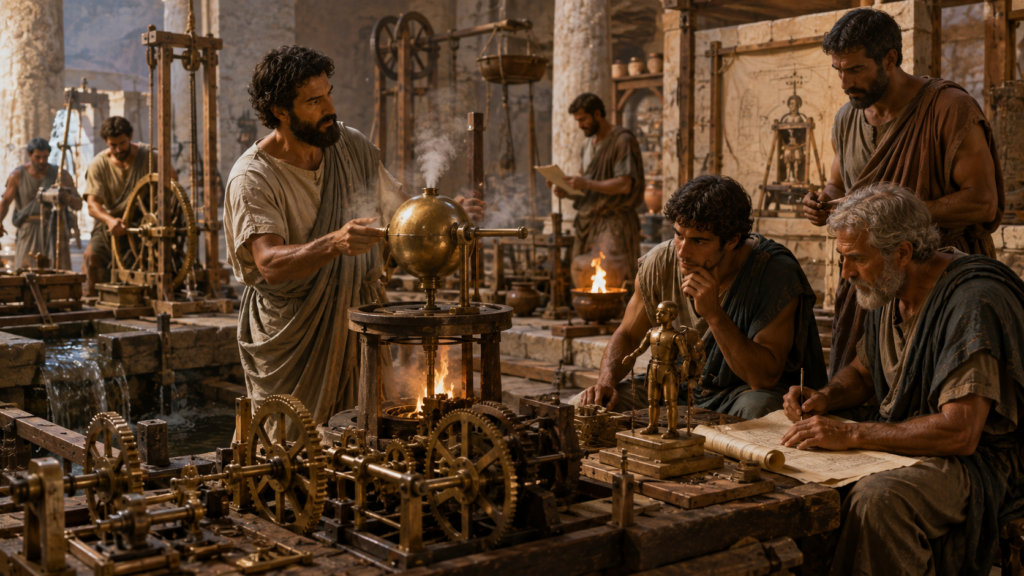
Long before modern robots, ancient engineers created machines capable of performing automated movements.
Greek and Hellenistic inventors designed automata that could move figures, open doors, pour liquids or perform other mechanical actions.
One of the best-known figures associated with this tradition is Hero of Alexandria, who lived during the Roman period.
Hero described mechanisms powered by weights, air pressure, water and steam.
Some devices were designed for entertainment or religious demonstrations.
Others illustrated scientific principles.
These machines were not robots in the modern sense.
They did not possess artificial intelligence or independent reasoning.
Their importance lies in the fact that ancient engineers understood how mechanical systems could produce sequences of automated actions.
The knowledge behind these devices appears in surviving texts, which means the technology was not completely lost.
However, the broader tradition of building complex automata did not develop continuously into modern mechanical engineering.
Some designs disappeared from practical use and had to be rediscovered or reconstructed from historical descriptions.
This raises an interesting question:
Why do useful technologies sometimes fail to become the foundation for future inventions?
The answer often has less to do with technical possibility and more to do with economics.
A clever machine is not necessarily a commercially useful machine.
The Roman Water Screw and Mechanical Innovation
Ancient societies also developed impressive machines for moving water.
The Archimedes screw, traditionally associated with the Greek mathematician and engineer Archimedes, provided a method of lifting water using a rotating helical surface inside a cylinder or trough.
The basic principle remains useful today.
Similar devices have been used for irrigation, drainage and other applications.
The invention illustrates another important point about “forgotten” technology.
Sometimes a technology is never truly lost.
Instead, its original use declines, while the underlying principle survives and is later adapted to new circumstances.
The history of technology is therefore not a simple sequence of inventions disappearing and reappearing.
Ideas can survive in fragments.
A mechanism may be forgotten in one region while continuing elsewhere.
A technique may disappear from written records but remain alive within craftspeople’s traditions.
Or an old principle may be reinvented independently because different societies encounter similar problems.
Why Did These Technologies Disappear?
The examples above reveal several recurring reasons.
Political Collapse
When governments collapse, institutions that support specialized technologies can disappear.
Large construction projects require organized labour, taxation, transportation networks and skilled workers.
If those systems break down, sophisticated technologies may no longer be economically practical.
Loss of Specialists
Some technologies depend on highly trained craftspeople.
A technique might never have been fully written down because experts learned it through years of apprenticeship.
If that chain of teaching is broken, important knowledge can disappear.
Economic Change
A technology can disappear simply because people stop needing it.
If a material becomes expensive or an alternative becomes cheaper, traditional methods may decline.
War and Migration
Conflict can destroy workshops, libraries and infrastructure.
Skilled craftspeople may be killed, displaced or forced to move elsewhere.
Changes in Raw Materials
A manufacturing technique may depend on a particular source of timber, ore, stone, clay or other material.
If the resource becomes unavailable, the technology may decline even if the underlying knowledge survives.
Competition From Better Alternatives
Technology does not always disappear because it fails.
Sometimes it disappears because something else becomes more practical.
A traditional production method may be replaced by a faster or cheaper industrial process.
Over generations, people may stop teaching the older technique.
💡 CurioReader Insight: Knowledge Can Be Fragile
A technology may depend on much more than an invention. It can require skilled workers, raw materials, workshops, trade networks and people capable of teaching the next generation.
Remove those supporting systems, and a technology can disappear—even when people still understand its basic principles.
Forgotten Does Not Always Mean Better
One of the biggest misconceptions surrounding ancient technology is the assumption that anything forgotten must have been superior to modern technology.
That is not necessarily true.
Ancient technologies were often extremely effective within their specific environments.
Roman concrete was valuable for particular construction conditions.
Ancient astronomical mechanisms were impressive mathematical machines.
Traditional metallurgical processes could produce remarkable materials.
But modern engineering benefits from centuries of accumulated scientific knowledge, industrial manufacturing, computer modelling and advanced materials science.
The fact that an ancient technique was sophisticated does not mean modern technology is inferior.
The real lesson is more interesting.
Human technological history is not a straight line.
Some knowledge disappears.
Other knowledge survives.
Some technologies are rediscovered.
And many are reinvented independently.
Understanding that process gives us a more accurate picture of how civilization develops.
Ancient Technologies That Still Puzzle Researchers
The technologies discussed so far are only part of the story. Across the ancient world, engineers and craftspeople developed materials, machines and construction methods that reveal a surprisingly sophisticated understanding of physics, chemistry and practical engineering.
Some of these technologies are not completely mysterious. Researchers understand the basic principles behind them, even when the original manufacturing process remains uncertain. Others are known mainly through archaeological evidence or historical descriptions.
What makes them fascinating is the gap between what survives and what has been forgotten.
The Mysterious Production of High-Quality Ancient Glass
Ancient glassmaking was far more sophisticated than simply melting sand.
Glassmakers in civilizations including Egypt and the Roman world developed techniques for producing coloured, transparent and decorative glass. They controlled ingredients, temperatures and working methods to create vessels, beads, windows and other objects.
Roman glassmakers also developed techniques for producing large quantities of standardized vessels.
Some ancient glass objects demonstrate remarkable craftsmanship.
The difficulty for historians is that glass production changed significantly over time and between regions. Recipes depended on available raw materials, and many specialized techniques were learned through practical experience rather than preserved in detailed written instructions.
Chemical analysis of archaeological glass can reveal where raw materials came from and how objects were manufactured.
Researchers can therefore reconstruct parts of ancient production systems without necessarily recovering every detail.
This is an important pattern in the study of lost technologies.
The physical object can survive even when the knowledge system that produced it has disappeared.
Ancient Steelmaking and the Search for Better Materials
Ancient metalworkers constantly experimented with ways to improve the properties of metals.
Iron was relatively difficult to produce compared with materials such as copper and bronze because it required demanding furnace conditions and careful processing.
Over time, different civilizations developed techniques for producing steels with useful combinations of strength, hardness and flexibility.
The famous traditions surrounding Damascus steel demonstrate how sophisticated these processes could become.
Historical blades associated with crucible steel production sometimes contained distinctive microscopic structures created through their chemical composition and processing.
Modern metallurgical research has been able to identify many of these features.
Yet knowing the chemistry of an ancient material is not necessarily the same as reproducing the entire historical manufacturing tradition.
Temperature control, raw materials, forging practices and the experience of the craftspeople could all affect the final product.
A modern laboratory may understand the ingredients while still having difficulty reproducing exactly how an ancient craftsman achieved a particular result.
This is because traditional manufacturing often contained knowledge that was practical rather than written.
Roman Roads and the Technology of Infrastructure
Ancient Roman roads may not seem like a “lost technology” because their basic construction principles are well understood.
However, the scale and organization behind them are remarkable.
Roman engineers built an enormous network of roads connecting settlements across the empire.
Construction required surveying, planning, excavation, drainage and the transportation of large quantities of materials.
A road was not simply a layer of stones placed on the ground.
Good roads needed foundations and drainage systems capable of dealing with water.
Different regions required different construction approaches depending on geology, climate and available materials.
The Romans also understood the importance of maintaining transportation networks.
Roads supported military movement, trade, communication and administration.
When the Western Roman Empire declined, many roads remained physically present, but the political and economic system that maintained them changed.
This is another example of technological knowledge being connected to institutions.
A technology can survive physically while the system required to maintain it disappears.
The Roman Aqueduct: Engineering Water on a Massive Scale
Roman aqueducts are among the most recognizable examples of ancient engineering.
They transported water from distant sources to towns and cities.
Contrary to a common misconception, aqueducts did not depend entirely on spectacular stone arches.
The essential principle was maintaining a carefully controlled downhill gradient.
Water could then flow naturally from its source toward the destination.
Engineers had to survey the landscape accurately, construct channels, manage pressure and protect the water supply.
Some aqueducts travelled underground for significant distances, while elevated sections were used where necessary.
The system supported fountains, public baths, households and other urban facilities.
Roman aqueduct technology was not simply about moving water.
It required a combination of surveying, hydraulics, construction, administration and maintenance.
After the decline of Roman political power in western Europe, many aqueducts fell into disrepair.
Some were damaged deliberately during conflicts, while others deteriorated because there was no longer a large urban population or centralized government capable of maintaining them.
The lesson is significant:
Infrastructure can be lost even when the underlying engineering principles remain known.
The Ancient Chinese South-Pointing Chariot
Ancient China produced several remarkable mechanical devices, including the legendary south-pointing chariot.
Historical Chinese sources describe a wheeled vehicle equipped with a differential-like mechanical system that allowed a figure mounted on the vehicle to maintain a roughly constant direction relative to the turning motion of the chariot.
The device did not rely on magnetism.
Instead, its proposed operation involved mechanical gearing.
The exact historical development of these devices is complicated because descriptions come from texts written at different periods, and surviving physical examples are absent.
Modern reconstructions have attempted to demonstrate how such a mechanism could have worked.
Whether every historical account describes the same device remains debated.
Nevertheless, the concept is important because it demonstrates sophisticated thinking about gears, relative motion and mechanical control.
It also reminds us that ancient engineers sometimes developed mechanisms whose principles were centuries ahead of what many people might expect.
The Baghdad Battery Debate
One of the most controversial examples often described as “lost technology” is the so-called Baghdad Battery.
The objects, discovered in the region of modern Iraq and generally dated to the early centuries CE, consist of ceramic vessels containing components that have been interpreted by some researchers as resembling simple electrochemical cells.
This has led to claims that ancient people may have understood electricity.
However, the interpretation is highly debated.
There is no conclusive evidence that these objects were actually used as batteries.
Researchers have proposed alternative explanations for their purpose, including storage or other uses.
This distinction is extremely important.
A container that can produce a small electrical potential under certain experimental conditions does not prove that its original creators intentionally designed it as an electrical device.
The Baghdad Battery is therefore better understood as an example of archaeological uncertainty than as proof of an ancient electrical technology.
It demonstrates why extraordinary claims require strong evidence.
Ancient Greek Steam Technology
The ancient world also contained early experiments with steam power.
Hero of Alexandria described a device known as the aeolipile, a rotating machine powered by steam.
Water was heated inside a vessel, producing steam that escaped through angled openings.
The escaping steam generated rotational motion.
The device demonstrates that ancient engineers understood an important physical principle: steam can produce mechanical movement.
However, the aeolipile did not become the foundation of an industrial revolution.
It appears to have been more closely associated with experimentation, demonstration and entertainment than with large-scale industrial machinery.
This is a fascinating example of a technology existing without the economic and social conditions necessary for widespread development.
Knowing that steam can create motion is one thing.
Turning that principle into a practical industrial power system requires metallurgy, fuel supplies, precision manufacturing, economic incentives and demand for mechanical power.
The technology alone was not enough.
💨 CurioReader Science: How Can Steam Move a Machine?
When water is heated, it turns into steam and expands. If that expanding steam is directed through an opening, it can create pressure and movement. Hero of Alexandria’s aeolipile demonstrated this principle thousands of years ago.
The fascinating part isn’t that ancient engineers discovered steam—it is why they didn’t turn it into an industrial power system.
The Antikythera Mechanism and the Problem of Technological Continuity
The Antikythera mechanism also raises a deeper question.
If ancient engineers could build such sophisticated geared astronomical instruments, why don’t we see a continuous archaeological record of similar machines?
Part of the answer may be preservation.
Metal corrodes.
Small mechanical devices can be dismantled and recycled.
Ships sink.
Workshops disappear.
Written technical knowledge may also be lost when libraries, schools or specialist communities disappear.
Another possibility is that sophisticated mechanisms were relatively rare.
A technology does not automatically become widespread simply because it is technically possible.
The mechanism may have been created for specialized astronomical or educational purposes rather than mass production.
This highlights an important principle:
Technological sophistication and technological adoption are not the same thing.
A brilliant invention can remain a niche product if the economic conditions do not encourage its wider use.
Why Ancient Technologies Often Needed More Than Knowledge
It is tempting to think of technology as a collection of instructions.
If someone knows how to build a machine, we assume the machine can always be reproduced.
History shows otherwise.
A technology often depends on an entire ecosystem.
Imagine a complex metalworking technique.
It may require:
- A particular type of ore
- Specialized furnaces
- Reliable fuel
- Skilled workers
- Specific tools
- Experienced craftsmen
- Trade networks
- Buyers willing to pay for the product
Remove several parts of that system and the technology may become impractical.
This helps explain why sophisticated techniques can disappear without anyone deliberately destroying the knowledge.
A civilization can retain the general idea while losing the practical ability to reproduce it at scale.
The Role of Apprenticeship
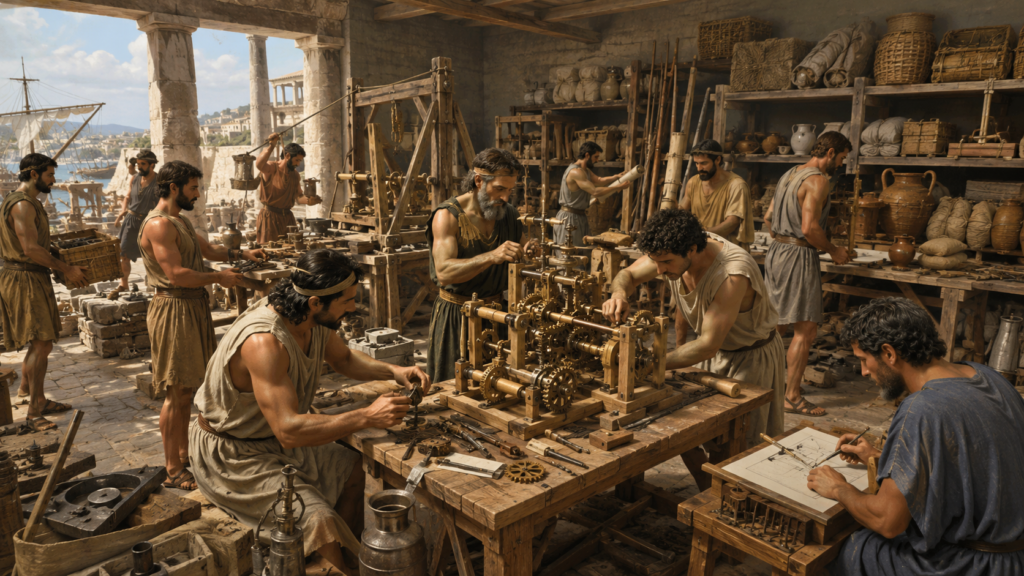
Much ancient technical knowledge was probably transmitted through apprenticeship.
A young craftsperson could spend years learning directly from an experienced specialist.
Not every detail needed to be written down.
The apprentice could learn to judge temperature by observing a furnace, recognize the right consistency of a material or adjust a process based on experience.
These skills are difficult to capture completely in a written recipe.
This type of knowledge is sometimes described as tacit knowledge.
It exists in practice rather than simply in written instructions.
When an apprenticeship tradition disappears, an important part of the technology can disappear with it.
This may explain why some ancient manufacturing techniques are easier to understand through experimentation than through written historical sources alone.
When “Lost” Technology Is Actually Forgotten, Not Impossible
A useful distinction can be made between three categories.
Completely Lost Techniques
In some cases, the original process is genuinely unknown.
Greek fire is a strong example because its exact historical formula has not survived.
Partially Reconstructed Technologies
In other cases, researchers understand the basic principles but cannot confidently reproduce every historical detail.
Certain ancient metallurgical and construction techniques fit into this category.
Technologies That Were Abandoned
Some technologies were never truly lost.
They simply became less useful.
Ancient mechanical devices, particular construction methods and traditional manufacturing processes may disappear because newer approaches are cheaper, faster or easier.
This classification helps separate genuine historical mysteries from exaggerated claims.
What Archaeology Can Reveal
Modern archaeology has transformed our understanding of ancient technology.
Researchers can now combine:
- Archaeological excavation
- Materials science
- Chemical analysis
- 3D scanning
- Experimental archaeology
- Microscopy
- Computer modelling
- Historical documents
A damaged object can sometimes reveal its manufacturing process through microscopic marks.
Residue analysis can identify substances once stored inside containers.
Chemical signatures can reveal the geographic origin of raw materials.
Computer simulations can test whether a proposed ancient machine could actually work.
Experimental archaeologists can then build reconstructions using historically appropriate materials and techniques.
This approach turns ancient technology into something that can be investigated rather than simply admired.
Why Reconstructing Ancient Technology Matters
Reconstructing old technologies is not just about satisfying curiosity.
It can reveal how people lived.
A metal tool can tell researchers about mining, trade and craftsmanship.
An irrigation system can reveal how communities organized agriculture.
A road can reveal patterns of military movement and commerce.
A ceramic vessel can reveal trade networks through the chemical composition of its clay.
Technology is therefore a window into society.
When historians study an ancient invention, they are also studying the people who designed it, the resources they used and the problems they were trying to solve.
That is why forgotten technology is such an important subject.
It is not simply a collection of strange machines.
It is evidence of human adaptation and creativity.
The Most Important Lesson From Forgotten Technologies
The history of technology teaches us that progress is not inevitable.
A civilization can develop an impressive invention and still fail to build an industry around it.
A specialized technique can flourish for generations and then disappear.
A political collapse can interrupt supply chains.
A war can destroy workshops.
A changing economy can make an old process unnecessary.
And sometimes knowledge survives only because one small community continues to practice it.
This makes technological history more complicated—and more interesting—than the idea of a straight line from primitive tools to modern machines.
The modern world has not simply inherited everything that humanity has ever invented.
We have inherited some knowledge, rediscovered some, reinvented some and permanently lost some.
Understanding that history can help us appreciate just how fragile technological knowledge can be.
Technologies That Were Lost, Rediscovered, or Transformed
The examples explored so far reveal an important truth about technological history: inventions do not simply appear, improve forever and remain unchanged.
Some disappear.
Some survive only in written descriptions or archaeological fragments.
Others remain in use but change so significantly that their original form becomes difficult to recognize.
And occasionally, a technology is independently reinvented because later societies face the same problem that earlier civilizations once solved.
This makes the history of forgotten technology much more than a collection of ancient curiosities. It is a story about how knowledge survives, how it disappears and how human societies rebuild what previous generations once knew.
The Knowledge That Survived in Books
Written records are among the most valuable sources for reconstructing historical technologies.
Ancient engineers and scholars sometimes described machines, materials and construction techniques in considerable detail.
Works associated with Vitruvius, for example, provide valuable information about Roman architecture and engineering.
Hero of Alexandria described numerous mechanical devices, including pumps, automata and pneumatic machines.
Chinese technical and agricultural texts also preserved information about engineering, metallurgy and farming.
However, written instructions have limitations.
A description may explain what a machine does without explaining every manufacturing detail.
A text may assume that the reader already possesses specialist knowledge.
Measurements may be expressed using units whose exact historical values are uncertain.
Materials may be described using names that no longer have precise modern equivalents.
And some knowledge may never have been written down at all.
A book can preserve an idea, but it cannot necessarily preserve the entire craft tradition required to reproduce it.
When Rediscovery Becomes Possible
Modern science has given researchers tools that ancient historians could never have imagined.
A corroded metal object can be examined using advanced imaging.
The chemical composition of an ancient material can be measured.
Microscopic structures can reveal how metal was heated or forged.
Computer simulations can test how ancient machines operated.
Archaeologists can reconstruct workshops and manufacturing environments.
Experimental archaeologists can then attempt to reproduce historical technologies under controlled conditions.
This process has produced remarkable discoveries.
Researchers have reconstructed ancient glassmaking techniques, investigated Roman concrete and recreated historical mechanical devices.
In many cases, the goal is not to produce an exact copy.
Instead, researchers ask:
Could this technology actually have worked?
That question is extremely valuable because historical descriptions sometimes contain assumptions that can only be tested through practical experimentation.
Experimental Archaeology: Rebuilding the Past
Experimental archaeology involves recreating ancient objects, buildings or technologies to understand how they were made and used.
Suppose archaeologists discover an ancient bronze tool.
They may know its approximate shape and composition.
But how much effort was required to produce it?
How much fuel did the furnace consume?
How long did the process take?
How skilled did the craftsperson need to be?
Experimental archaeology can help answer these questions.
Researchers can reproduce the object using historically appropriate materials and techniques.
The process can reveal information that cannot be obtained simply by examining the finished artifact.
This is particularly useful for technologies involving complex manufacturing processes.
A finished sword, for example, does not necessarily reveal every stage of the smithing process.
A reconstructed production sequence can provide clues about how ancient craftspeople worked.
Roman Concrete: From Ancient Practice to Modern Research
Roman concrete provides a particularly interesting example of technology being reconsidered rather than simply rediscovered.
For centuries, the surviving remains of Roman structures demonstrated that ancient builders had produced remarkably durable materials.
Modern researchers have increasingly examined the chemical and mineral processes responsible for the longevity of certain Roman concrete structures.
Some studies have identified features such as lime clasts and chemical reactions involving water that may contribute to self-healing behaviour in particular mixtures.
This does not mean modern concrete technology is simply inferior.
Modern concrete is designed for many different applications, and engineers have access to materials, testing methods and structural knowledge unavailable to ancient builders.
Instead, researchers are interested in whether certain principles from historical construction could inspire improvements in modern materials.
This is an excellent example of how studying old technology can contribute to new technology.
The past does not always provide something that should be copied.
Sometimes it provides ideas worth investigating.
Traditional Knowledge Can Be More Fragile Than Machines
A machine is visible.
A skill is often invisible.
This distinction is crucial.
Imagine a craftsperson who knows exactly how to shape a particular material.
They may understand when the material is ready by its colour, sound, texture or resistance.
They may make tiny adjustments that are difficult to describe.
Another craftsperson can learn these techniques through years of observation and practice.
But if the apprenticeship system ends, the knowledge may disappear.
This is one reason traditional crafts can be vulnerable.
A technological tradition can survive for centuries without producing extensive written documentation.
The knowledge exists inside a community.
Once the community disappears, the technology can disappear with it.
This has happened not only in the ancient world but throughout more recent history.
The Loss of Industries, Not Just Inventions
When we talk about forgotten technologies, it is tempting to focus on individual inventions.
But sometimes the real loss is an entire industry.
Consider what is required to manufacture a complex product.
You need raw materials.
You need tools.
You need workshops.
You need skilled workers.
You need transportation.
You need customers.
You need organizations capable of coordinating production.
If several of these disappear, the product may no longer be economically viable.
This helps explain why some technologies declined even though nobody forgot the basic principles.
The Roman world, for example, supported large-scale construction projects because its economy and political institutions could mobilize enormous resources.
When those institutions changed, some technologies became less practical.
The knowledge did not necessarily vanish completely.
The economic ecosystem that supported the technology disappeared.
The Difference Between Invention and Innovation
Another important distinction is between invention and innovation.
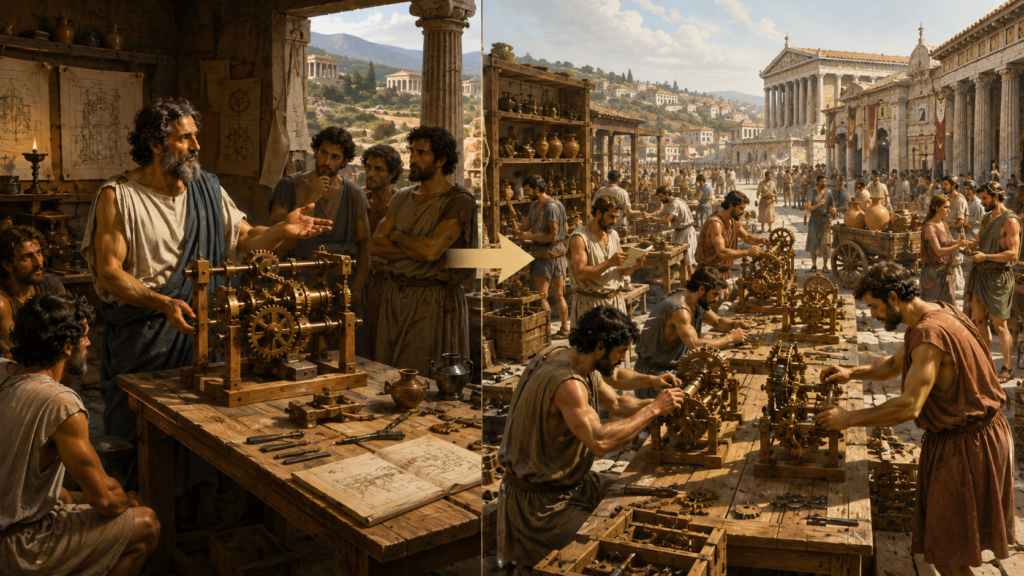
An invention introduces a new device, material or technique.
Innovation occurs when that invention is successfully adopted, improved or integrated into society.
A brilliant machine can therefore exist without becoming historically transformative.
Hero’s steam-powered device is an excellent illustration.
The ancient world demonstrated that steam could create mechanical motion.
But there was no large-scale industrial system capable of turning this principle into steam-powered factories.
Centuries later, different economic and technological conditions allowed steam power to become revolutionary.
The same scientific principle can therefore have very different consequences depending on when and where it appears.
🚀 CurioReader Insight: An Invention Isn’t Always an Innovation
An invention creates a new possibility. Innovation happens when that invention becomes practical and widely adopted.
Ancient history contains many clever machines that never became major industries.
Having the technology is one thing. Having a reason and a system to use it is another.
Why Some Brilliant Ideas Never Became Mainstream
Technological success depends on more than technical performance.
Cost matters.
Availability matters.
Maintenance matters.
User demand matters.
A machine that saves labour but costs an enormous amount to build may not be attractive.
A complicated device that requires highly specialized workers may be unsuitable for ordinary users.
A technology that works in one environment may fail in another.
These factors help explain why ancient inventions did not always lead directly to modern technologies.
The question should not simply be:
“Could ancient people have built this?”
A better question is:
“Why would they build it, and would society have had a reason to adopt it widely?”
That question brings economics and social organization into the history of technology.
When Technologies Are Deliberately Abandoned
Not every forgotten technology disappeared accidentally.
Sometimes societies deliberately abandoned technologies.
A government may prohibit a particular technique.
A new religion or social system may change demand.
A cheaper material may replace an older one.
A military technology may become obsolete.
A trade route may shift.
An environmental resource may become scarce.
In these circumstances, people may stop investing time and resources into maintaining the old system.
Once enough time passes, the original technique can become unfamiliar even if it was once common.
This means technological disappearance can sometimes be understood as a form of selection.
Societies constantly choose which technologies to maintain.
The technologies that remain useful are more likely to survive.
Others gradually disappear.
The Mystery of Greek Fire
Greek fire demonstrates what happens when technical knowledge becomes closely associated with military secrecy.
The Byzantine Empire appears to have developed a powerful incendiary weapon that could be used in naval warfare.
Its precise composition remains uncertain.
Several theories have been proposed, but no surviving source provides a definitive recipe.
The technology may have involved petroleum-based substances and other combustible ingredients, but researchers cannot simply reconstruct the original formula with certainty.
The secrecy surrounding the weapon may have contributed to its disappearance.
This case shows why knowledge needs redundancy.
If only a handful of people understand a technology, the loss of those individuals can potentially destroy the tradition.
Modern scientific and industrial systems therefore place enormous emphasis on documentation, training and replication.
A technology that exists in thousands of independent copies is much harder to lose than one controlled by a tiny group of specialists.
Lost Technology in the Modern World
The concept of forgotten technology may seem like something that belongs entirely to ancient history.
It doesn’t.
Modern societies also lose technologies.
Companies discontinue products.
Manufacturing facilities close.
Specialized machinery becomes obsolete.
Skilled workers retire.
Old software becomes incompatible with modern systems.
Industrial processes disappear when demand declines.
Sometimes technical documentation exists, but the original production environment no longer does.
This means that technological loss is not necessarily a problem of the ancient past.
It is a continuing feature of human civilization.
The difference is that modern societies generally have far better systems for documentation and preservation.
But even detailed documentation cannot guarantee that every process will remain economically practical forever.
🔄 CurioReader Insight: Technology Can Still Be Lost Today
Lost technology isn’t only an ancient problem. Modern manufacturing techniques, specialist skills and software systems can also disappear when industries close, products become obsolete or experienced workers retire.
The tools may change, but the problem of preserving knowledge remains.
What Ancient Technology Can Teach Modern Engineers
Studying historical technology can provide more than historical knowledge.
Ancient engineers often worked with limited resources.
They had to solve problems using locally available materials and relatively simple tools.
That can provide useful inspiration for modern engineering.
Ancient water systems, for example, demonstrate how communities managed water without modern electrical infrastructure.
Traditional buildings can reveal ways of dealing with heat, ventilation and local climate.
Historical agricultural techniques can demonstrate how farmers adapted to difficult environments.
Ancient materials can inspire research into durability and sustainability.
The goal is not to romanticize the past.
Ancient societies faced enormous limitations, and many of their technologies were less efficient than modern alternatives.
But studying how they solved problems can reveal different approaches to engineering.
What We Have Truly Lost
Some ancient technologies remain genuinely mysterious.
The precise composition of Greek fire is one example.
The complete production processes behind certain historical materials may also remain uncertain.
For other technologies, however, the mystery is gradually shrinking.
Scientific analysis continues to reveal how ancient objects were made.
Archaeological discoveries add missing pieces.
Experimental reconstruction tests historical theories.
New discoveries can completely change previous assumptions.
This is why it is better to describe ancient technology as a field of ongoing investigation rather than a collection of unsolved mysteries.
Every new discovery can change the picture.
Why We Should Be Careful With Ancient Technology Claims
The internet is filled with claims about mysterious ancient inventions.
Some are supported by evidence.
Others are exaggerated.
A photograph of an unusual object can easily become the basis for a claim that an ancient civilization possessed technology centuries ahead of its time.
But an unusual artifact does not automatically prove an extraordinary technology.
Researchers need context.
They need dating evidence.
They need comparisons with other archaeological finds.
They need to understand the object’s materials and manufacturing marks.
Most importantly, they need to consider ordinary explanations before extraordinary ones.
This is especially important when discussing claims involving electricity, advanced machines, extraterrestrials or supposed knowledge that contradicts established archaeological evidence.
The real history is already fascinating.
It does not need exaggeration.
The Forgotten Technology of Knowledge Preservation
Perhaps the most important forgotten technology is not a machine at all.
It is the system for preserving knowledge.
Civilizations that want their technological achievements to survive need more than brilliant inventors.
They need schools.
They need apprenticeships.
They need books and records.
They need institutions.
They need people willing to maintain old knowledge while developing new ideas.
When these systems fail, knowledge becomes vulnerable.
A civilization can possess thousands of skilled workers but lose an important technique within a few generations.
This is one reason libraries, archives, museums, universities and scientific institutions are so important.
They create multiple pathways through which knowledge can survive.
What the History of Forgotten Technology Really Tells Us
The most important lesson is not that ancient people were secretly more technologically advanced than modern society.
The evidence does not support such a broad conclusion.
Instead, ancient technological history shows that human ingenuity has always been considerable.
People solved difficult problems with the materials and knowledge available to them.
They built sophisticated machines.
They developed advanced manufacturing techniques.
They constructed enormous infrastructure.
They observed nature carefully.
And sometimes they created technologies that later disappeared.
The modern world is therefore not the endpoint of an uninterrupted technological journey.
It is one stage in a much longer process.
Some ideas from the past have survived.
Some have been rediscovered.
Some have been transformed.
And some may be gone forever.
Key Takeaways
- Technologies can disappear even when their basic principles remain understood.
- Specialized craftsmanship and apprenticeship are important forms of technological knowledge.
- Political and economic changes can destroy the systems that support an industry.
- Written records can preserve ideas but may not preserve every practical manufacturing skill.
- Experimental archaeology helps researchers test how ancient technologies actually worked.
- Roman concrete demonstrates how studying historical materials can inspire modern research.
- The Antikythera mechanism shows that sophisticated mechanical engineering existed in the ancient Mediterranean.
- Greek fire illustrates how secrecy can make technological knowledge vulnerable to permanent loss.
- A technically possible invention does not automatically become a widely adopted innovation.
- Ancient technologies should be studied using archaeological evidence rather than sensational speculation.
- Modern societies can also lose specialized technologies when industries disappear or skills are no longer passed on.
- Preserving knowledge requires institutions, documentation, education and skilled communities.
:::
Frequently Asked Questions
What is a lost technology?
A lost technology is a technological process, technique or manufacturing method that was once used but later disappeared, became significantly altered, or can no longer be reproduced with certainty. In some cases, the object survives while the knowledge needed to make it has been forgotten.
What is the most famous example of lost ancient technology?
The Antikythera mechanism is one of the most famous examples of sophisticated ancient technology. The device, created in ancient Greece, used complex gears to model astronomical cycles. Although researchers understand much of its operation, only fragments survived.
Was Greek fire a real technology?
Yes. Greek fire was a real Byzantine incendiary weapon used particularly in naval warfare. However, its exact composition and manufacturing process have not survived with certainty, making it one of history’s most famous examples of lost technical knowledge.
Did ancient Romans really have better concrete than modern concrete?
Roman builders developed remarkably durable concrete mixtures, particularly for certain structures exposed to harsh environments. Researchers have identified some of the chemical and mineral processes involved, but this does not mean modern concrete technology is inferior or that there was one universal Roman concrete recipe.
Why do technologies disappear?
Technologies can disappear for many reasons, including political collapse, war, economic changes, loss of skilled workers, shortages of raw materials, changes in trade networks and the introduction of cheaper or more practical alternatives.
Can a technology disappear even if people know how it works?
Yes. Knowing the basic principle behind a technology is different from maintaining the complete manufacturing system needed to produce it. A process may require specialized materials, tools, skilled craftspeople and supply networks that are no longer available.
What happened to ancient craftsmanship?
Some traditional crafts survived for centuries, while others declined when demand changed or specialist communities disappeared. Many techniques were passed from teacher to apprentice rather than through detailed written instructions, making them vulnerable to being lost.
What is the Antikythera mechanism used for?
The Antikythera mechanism was an ancient Greek geared device used to represent astronomical cycles. Research suggests it could model movements involving the Sun and Moon and help track astronomical phenomena such as eclipses.
Was the Baghdad Battery actually a battery?
That remains uncertain. The objects known as the Baghdad Battery have been interpreted by some researchers as possible early electrochemical cells, but there is no conclusive evidence that they were deliberately designed or used as batteries. Alternative explanations have also been proposed.
Did ancient people have technology more advanced than modern technology?
There is no evidence that ancient civilizations possessed technology broadly comparable to modern computers, electronics or advanced industrial systems. However, ancient societies developed remarkably sophisticated technologies within their own historical environments, particularly in engineering, metallurgy, construction, astronomy and mechanics.
Why wasn’t ancient steam technology used to start the Industrial Revolution?
Ancient engineers demonstrated that steam could produce mechanical movement, but widespread industrialization required much more than the basic idea. It also required suitable fuels, advanced metallurgy, precision manufacturing, economic incentives, transportation networks and strong demand for mechanical power.
Can modern scientists recreate lost ancient technologies?
In some cases, yes. Archaeologists and researchers use surviving objects, historical records, chemical analysis, microscopy, computer modelling and experimental archaeology to reconstruct ancient technologies. However, some details may remain uncertain because the original materials or practical knowledge have disappeared.
Are all ancient technology mysteries genuine?
No. Some are genuine archaeological questions, while others are exaggerated or based on incomplete evidence. Claims that ancient civilizations possessed impossible or extraterrestrial technology generally lack credible archaeological support. The strongest conclusions come from physical evidence, historical records and reproducible research.
Why is preserving technological knowledge important?
Technological knowledge can depend on skilled people, institutions and practical traditions. Documentation, education, apprenticeships and research help ensure that valuable knowledge survives across generations. Without these systems, even sophisticated techniques can disappear.
Can modern technology also become lost?
Yes. Modern industries can disappear when products become obsolete, companies close, manufacturing moves elsewhere or specialized skills are no longer taught. Modern societies have better documentation systems than most ancient civilizations, but specialized knowledge can still become difficult or impossible to reproduce.
What can we learn from ancient technologies?
Ancient technologies demonstrate how people solved complex problems using the resources available to them. Studying them can improve our understanding of history, encourage new engineering ideas and remind us that technological progress is not always a straight line.
What is the biggest lesson from lost technologies?
Perhaps the most important lesson is that knowledge is fragile. An invention can survive only when people continue to use it, teach it, document it and adapt it to changing circumstances. Human civilization has preserved enormous amounts of knowledge, but history also shows how easily specialized skills can disappear.
Further Reading & Resources
Continue your learning journey with more expert guides and insightful articles from CurioReader. Explore related topics below to deepen your understanding and discover new perspectives.
Related CurioReader Articles
- Ancient China’s Greatest Inventions That Changed the World.
- Ancient Egypt: Life Along the Nile.
- Ancient Greece: The Birthplace of Democracy.
Recommended External Resources