What is artificial Intelligence
This is the Complete Guide to Artificial Intelligence Every day, you probably use Artificial Intelligence dozens of times without realizing it. When Netflix recommends a movie, Google answers your search, or your phone unlocks with your face, AI is already working behind the scenes. But what exactly is Artificial Intelligence, and why has it become one of the world’s most important technologies?
Artificial Intelligence (AI) is a type of technology that allows computers and machines to perform tasks that normally require human intelligence. These tasks include understanding language, recognizing images, solving problems, learning from experience, and making decisions. In simple words, AI helps machines “think” and act in a smart way.
Unlike traditional computer programs that follow fixed instructions, AI systems can learn from data. This means they can improve their performance over time without being manually updated again and again.
For example, when you use YouTube or Netflix, AI studies what videos you watch and suggests similar content you might like. When you search on Google, AI helps show the most relevant results based on your query. Even spam filters in your email use AI to detect unwanted messages and move them away automatically.
Another common example is voice assistants like Siri, Alexa, or Google Assistant. When you speak to them, AI helps the system understand your voice, interpret your request, and respond with useful answers. Similarly, face recognition in smartphones uses AI to identify your face and unlock the device securely.
AI is not a single tool or software. It is a combination of different technologies such as machine learning, deep learning, and data processing systems working together. These technologies allow AI to detect patterns in large amounts of data and make predictions or decisions based on what it has learned.
However, it is important to understand that AI does not think or feel like humans. It does not have emotions, awareness, or consciousness. It simply follows patterns and mathematical models created by humans.
Today, AI is used in many areas of life, including healthcare, education, business, transportation, and entertainment. For instance, doctors use AI to help detect diseases earlier, and online stores use AI to recommend products based on customer preferences.
In short, Artificial Intelligence is making computers smarter and more helpful in everyday life, and it is becoming one of the most important technologies shaping the modern world.

A Brief History of Artificial Intelligence
The story of Artificial Intelligence (AI) is a journey from simple ideas to powerful systems that can now learn, understand, and even create. Over the years, AI has grown step by step, shaped by breakthroughs, setbacks, and major technological progress.
🧠 1950s – Where It All Began
The idea of AI started in the 1950s when scientists began wondering whether machines could “think” like humans. In 1950, Alan Turing introduced the famous Turing Test, a way to measure if a machine can behave intelligently like a person. A few years later, in 1956, the term Artificial Intelligence was officially introduced at the Dartmouth Conference, marking the birth of AI as a field of study.
🧩 1960s–1970s – Early Ideas and Simple Programs
During this period, researchers created early AI systems that could solve basic math problems, follow logical rules, and even play simple games. These systems showed promise, but they were still very limited because computers at the time were not powerful enough to handle complex tasks.
❄️ 1980s – The “AI Winter”
After early excitement, progress slowed down. AI systems were not meeting expectations, and funding for research dropped. This difficult phase became known as the AI Winter, when interest in AI reduced due to slow development and disappointing results.
📊 1990s–2000s – The Rise of Machine Learning
AI made a strong comeback with the rise of machine learning. Instead of manually programming rules, computers began learning from data. This shift helped improve technologies like search engines, spam filters, and speech recognition systems, making AI more practical and useful.
🚀 2010s – The Deep Learning Revolution
Things changed dramatically in the 2010s with deep learning. Thanks to powerful computers and huge amounts of data, AI systems became much more accurate at recognizing images, understanding speech, and translating languages. A major milestone was when AlphaGo defeated a world champion in the game of Go, showing how advanced AI had become.
🤖 2020s–2026 – The Age of Generative AI
In the 2020s, AI entered a new era with generative AI, capable of creating text, images, music, and even videos. Tools like AI chatbots and assistants became part of everyday life, helping with work, learning, and communication. By 2026, AI is deeply integrated into almost every industry and continues to grow rapidly.
🌍 Today and Beyond
AI is still evolving at a fast pace. Today’s focus is not just on making AI more powerful, but also on making it safer, more reliable, and more responsible for human use.
In short, AI has moved from simple experiments in the 1950s to advanced intelligent systems in 2026 that are changing how we live and work every day.
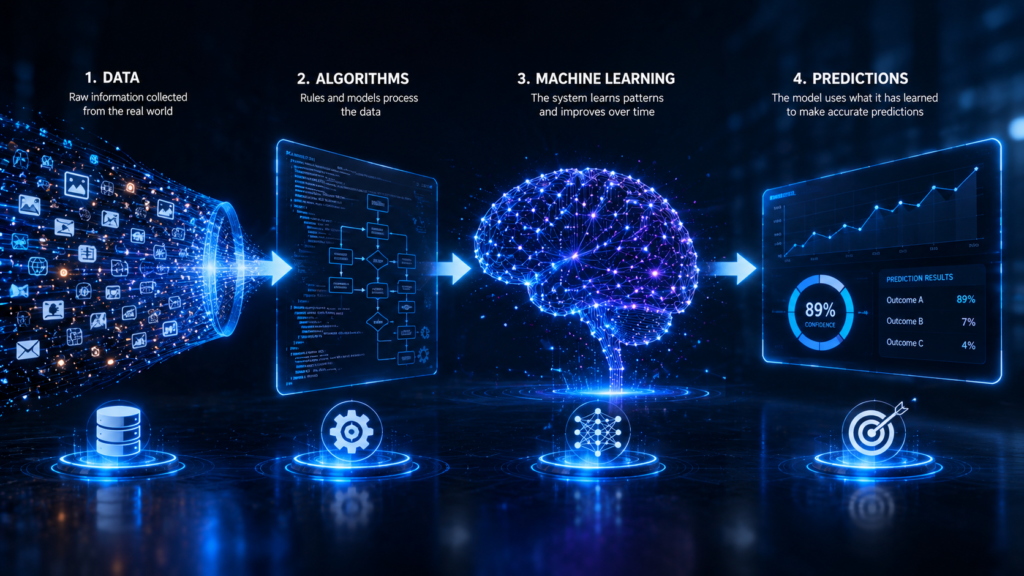
How Artificial Intelligence Works
Artificial Intelligence might sound complicated at first, but the way it works is actually quite simple. At its core, AI learns from information, finds patterns, and then uses what it has learned to make decisions or predictions. Instead of being manually programmed for every possible situation, it improves by studying real-world data over time.
Here’s a clear step-by-step breakdown of how it works:
📊 1. Collecting Data
- AI begins by gathering large amounts of information.
- This information is called data.
- It can come from many sources like text, images, videos, audio, or numbers.
- Example: Photos of animals, online searches, or shopping history.
🧹 2. Preparing the Data
- Before AI can learn, the data is cleaned and organized.
- This step removes errors and irrelevant information.
- Better-quality data helps AI learn more accurately.
⚙️ 3. Using Algorithms (Learning Rules)
- AI relies on algorithms, which are simple step-by-step instructions.
- These instructions guide how the system processes and understands data.
- You can think of them as the “learning method” behind AI.
📚 4. Machine Learning (Learning from Experience)
- This is the stage where AI actually starts learning.
- With machine learning, the system studies patterns in data.
- Example: It learns to detect spam emails by analyzing past examples.
- The more examples it sees, the better it becomes.
🔍 5. Recognizing Patterns
- Once trained, AI can identify patterns in new information.
- Example: Recognizing faces in photos or understanding spoken language.
- This ability is what makes AI feel “smart.”
🎯 6. Making Predictions and Decisions
- AI uses everything it has learned to make predictions.
- Example: Suggesting videos on YouTube or recommending products online.
- It tries to show the most relevant result for each user.
🔁 7. Getting Better Over Time
- Many AI systems continue learning even after training.
- As they receive new data, they become more accurate and helpful.
- Example: Better recommendations the more you use an app.
🤖 Simple Real-Life Example
- You search for “best phone under budget.”
- AI looks at your location, interests, and popular choices.
- It quickly shows results that match what you are looking for.
✔️ In Short
AI works like a cycle:
Data → Preparation → Algorithms → Machine Learning → Pattern Recognition → Predictions → Improvement
This simple learning process is what makes Artificial Intelligence so powerful and widely used in the apps and services we rely on every day.
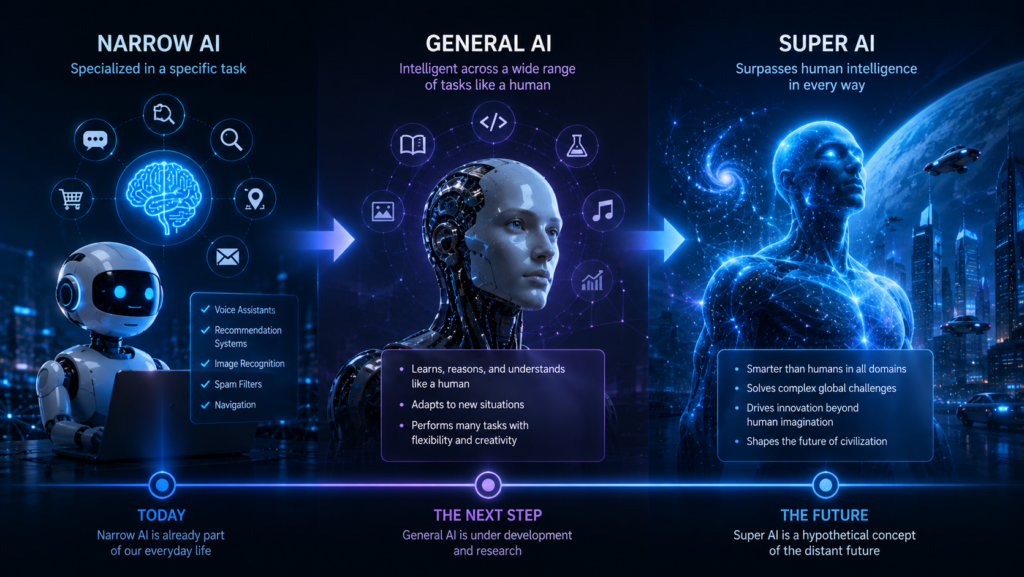
Types of Artificial Intelligence
Artificial Intelligence (AI) is not just one single system—it actually comes in different types depending on how capable and advanced it is. These types help us understand what AI can do today and what it might be able to do in the future. Broadly, AI is divided into three main categories: Narrow AI, General AI, and Super AI.
🟢 1. Narrow AI (Weak AI)
Narrow AI is the type of AI we use every day. It is designed to do one specific task really well, but it cannot go beyond that task or think like a human.
Key points:
- Built for a single purpose or task
- Works very well within its limits
- Cannot perform unrelated tasks
Real-world examples:
- Siri, Alexa, and Google Assistant
- YouTube and Netflix recommendation systems
- Google Maps for navigation
- Email spam filters
👉 For example, Google Maps is excellent at giving directions, but it cannot answer emails or create videos. That’s Narrow AI in action.
🟡 2. General AI (Strong AI)
General AI is a more advanced and still theoretical form of AI. It refers to machines that could think, learn, and perform any intellectual task just like a human being.
Key points:
- Can handle multiple types of tasks
- Can learn new skills without special programming
- Still not fully developed in real life
Possible examples:
- A robot that can cook, drive, teach, and talk like a human
- A system that can learn any subject on its own, just like a person
👉 Unlike Narrow AI, General AI would not be limited to one area. It would be flexible and adaptable across many tasks.
🔴 3. Super AI
Super AI is a future concept where machines would become even more intelligent than humans. It is still hypothetical and does not exist yet, but it is often discussed in science and technology.
Key points:
- Not yet developed (theoretical idea)
- Would be smarter than humans in all areas
- Could think, learn, and make decisions better than people
Possible examples (future concept):
- AI solving major global problems like climate change or diseases faster than humans
- Machines excelling in creativity, science, and decision-making beyond human ability
✔️ In Short
- Narrow AI: Smart at one specific task (used today)
- General AI: Human-like intelligence (still not achieved)
- Super AI: Smarter than humans (future possibility)
As AI continues to evolve, these categories help us understand where we are today—and where technology might take us in the future.
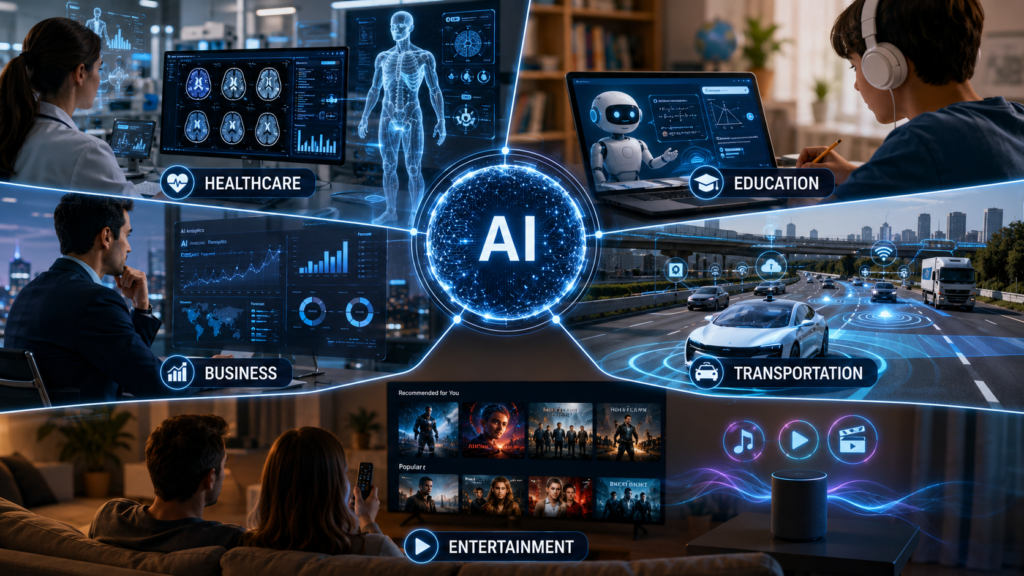
Real-Life Applications of Artificial Intelligence
Artificial Intelligence (AI) is no longer something limited to research labs or science fiction—it is already a part of everyday life. Whether you are using your phone, watching a movie, traveling, or even visiting a hospital, AI is quietly working in the background to make things easier, faster, and more efficient. Let’s look at how AI is used in different real-world areas.
🏥 Healthcare
AI is making a big difference in healthcare by helping doctors and medical staff work more accurately and quickly.
- AI can help detect diseases early by analyzing medical scans like X-rays and MRIs.
- Virtual health assistants can answer basic medical questions and guide patients.
- Doctors use AI tools to support diagnosis and suggest treatment options.
- Hospitals use AI to organize patient records and improve hospital efficiency.
👉 For example, AI can scan an X-ray image and highlight possible problem areas for a doctor to review.
🎓 Education
AI is changing the way students learn by making education more personalized and flexible.
- Learning platforms adjust lessons based on a student’s progress.
- AI tutors help explain difficult topics anytime, anywhere.
- Translation tools make learning easier across different languages.
- Automated systems help teachers with grading and assessments.
👉 For example, apps like Duolingo use AI to adapt lessons based on how well you are learning.
🚗 Transportation
AI plays an important role in making travel safer and more efficient.
- Navigation apps like Google Maps use AI to suggest the fastest routes.
- Self-driving cars use AI to understand roads, traffic, and obstacles.
- Ride-sharing apps use AI to connect drivers and passengers quickly.
- Smart traffic systems help reduce congestion in busy cities.
👉 For example, Google Maps can predict traffic and suggest better routes in real time.
🎬 Entertainment
AI helps make entertainment more personal and enjoyable.
- Streaming platforms recommend movies and shows based on your interests.
- Music apps create personalized playlists.
- AI is used to create special effects in movies and video games.
- Creative tools can generate music, art, and even videos.
👉 For example, Netflix suggests shows based on what you have already watched.
💼 Business
Businesses use AI to improve productivity, customer service, and decision-making.
- Chatbots answer customer questions 24/7.
- AI helps companies understand customer behavior and improve marketing.
- Sales predictions are made using AI-based analysis.
- Repetitive office tasks are automated to save time.
👉 For example, Amazon uses AI to recommend products based on your browsing history.
✔️ In Short
AI is already part of our daily lives—in healthcare, education, transportation, entertainment, and business. It helps people save time, make better decisions, and improve efficiency. As technology continues to grow, AI will become even more important in shaping the future of how we live and work.
Benefits of Artificial Intelligence
Artificial Intelligence (AI) offers many practical advantages that are already making life easier and more efficient. From everyday apps to large industries, AI helps people work smarter, save time, and improve results. Here are the key benefits explained in a simple and natural way.
⚡ 1. Improved Efficiency
- AI can complete tasks much faster than traditional methods.
- It can quickly process large amounts of data without getting tired or slowing down.
- Businesses use AI to make faster and better decisions.
👉 For example, AI can scan and analyze thousands of customer records in just a few seconds.
🤖 2. Automation of Repetitive Work
- AI is very good at handling repetitive and routine tasks.
- This reduces the need for humans to do the same work again and again.
- People can then focus on more important and creative tasks.
👉 For example, chatbots can automatically answer common customer questions anytime.
🎯 3. Higher Accuracy
- AI systems follow data and patterns carefully, which helps reduce mistakes.
- They are especially useful in areas where precision is important.
- This leads to more reliable and consistent results.
👉 For example, AI can help doctors detect diseases from medical scans with greater accuracy.
⏱️ 4. Saves Time
- AI completes tasks in much less time compared to manual work.
- It delivers fast results, whether it’s searching information or analyzing data.
- This helps improve productivity in daily life and work.
👉 For example, search engines use AI to instantly show the most relevant answers.
💡 5. Encourages Innovation
- AI helps create new ideas, tools, and technologies.
- It supports the development of smarter apps, systems, and services.
- Many industries are improving and evolving because of AI-driven innovation.
👉 For example, AI is used in building self-driving cars and intelligent virtual assistants.
✔️ In Short
Artificial Intelligence provides several important benefits:
- It improves efficiency
- It automates repetitive tasks
- It increases accuracy
- It saves valuable time
- It supports innovation and new technology
When used properly, AI can be a powerful tool that improves productivity and helps create smarter solutions across many areas of life.
Challenges and Risks of Artificial Intelligence
Artificial Intelligence (AI) is powerful and useful, but like any technology, it also comes with certain challenges. These risks don’t mean AI should be avoided—instead, they highlight why it needs to be used carefully and responsibly. Understanding these issues helps us use AI in a balanced and informed way.
💼 1. Job Displacement
- One of the biggest concerns is that AI can replace some routine jobs.
- Tasks that are repetitive or rule-based can often be automated.
- This may affect roles in areas like customer support, data entry, and basic office work.
👉 For example, chatbots can now handle simple customer queries that were previously managed by human agents.
At the same time, AI also creates new job opportunities in fields like AI development, data analysis, and digital innovation.
🔒 2. Privacy Concerns
- AI systems often rely on large amounts of user data to function well.
- This raises questions about how personal information is collected and stored.
- If not properly managed, there is a risk of data misuse or exposure.
👉 For example, streaming platforms use your watch history to recommend content, which means your activity is being tracked.
That’s why strong data protection and privacy rules are very important.
⚖️ 3. Bias in AI Systems
- AI learns from data created by humans, and that data can sometimes contain bias.
- If the training data is not balanced, AI may produce unfair or inaccurate results.
- This can affect important decisions in areas like hiring, lending, or approvals.
👉 For example, an AI hiring tool trained on biased data may unintentionally prefer certain groups over others.
This is why developers must carefully test and improve AI systems.
📱 4. Over-Reliance on Technology
- As AI becomes more helpful, people may start depending on it too much.
- This could reduce independent thinking or problem-solving in some situations.
- If AI systems fail, it can also cause confusion or disruption.
👉 For example, if a navigation app stops working, people who rely only on it may struggle to find directions.
✔️ Keeping a Healthy Balance
AI works best when it supports human abilities rather than replacing them completely. With proper rules, ethical use, and awareness, many of these risks can be reduced.
✔️ In Summary
The main challenges of AI include:
- Changes in some job roles due to automation
- Concerns about privacy and personal data
- Bias in AI-driven decisions
- Over-dependence on technology
By understanding these risks, we can use AI more wisely and ensure it benefits people while minimizing potential problems.
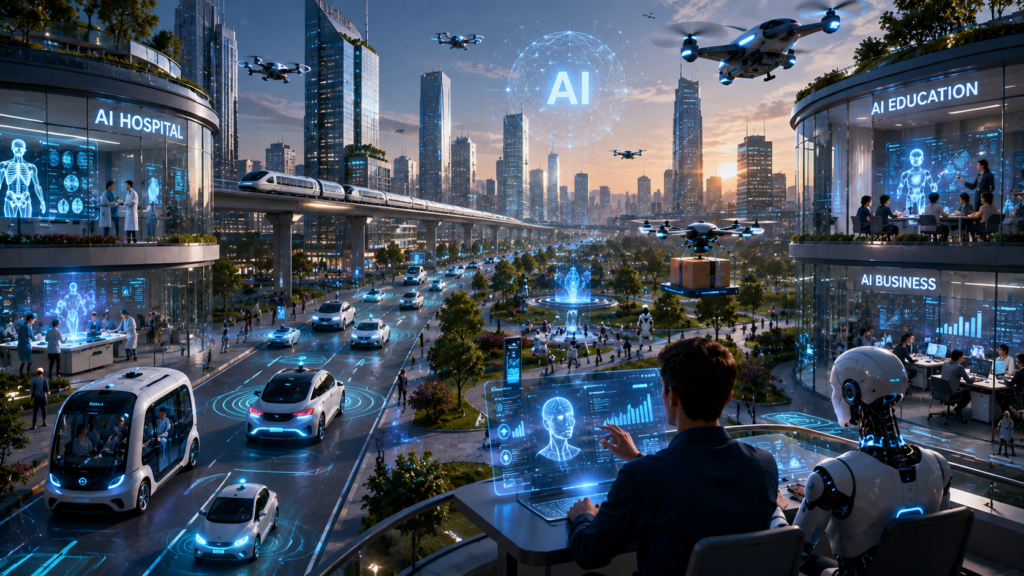
The Future of Artificial Intelligence
The future of Artificial Intelligence (AI) is expected to be both exciting and highly impactful. Over the next 10 to 20 years, AI will likely become more advanced, more natural to interact with, and even more deeply integrated into our daily lives. Instead of feeling like separate tools, AI systems may become a normal part of how we live, work, and make decisions.
🏥 Healthcare Advancements
- AI is expected to bring major improvements in healthcare and medical services.
- It may help detect diseases earlier and more accurately than before.
- Doctors could use AI to design more personalized treatment plans for patients.
- AI may also speed up medical research and the discovery of new medicines.
👉 For example, future AI systems might analyze health patterns and alert people about potential health risks before any clear symptoms appear.
🚗 Autonomous Systems
- Self-driving technology is likely to become more advanced and widely used.
- AI-powered vehicles could reduce accidents caused by human mistakes.
- Delivery drones and smart robots may handle transport and logistics tasks.
- Cities may use AI to improve traffic flow and public transportation systems.
👉 For example, autonomous vehicles may safely transport passengers in specific environments without a human driver.
📱 AI in Everyday Life
- AI will become even more common in daily routines.
- Smart assistants may better understand natural speech and even emotional tone.
- Homes could become smarter, automatically adjusting lighting, temperature, and security.
- AI may also help with learning, shopping, scheduling, and personal planning.
👉 For example, your AI assistant might manage your daily schedule, remind you of tasks, and suggest useful recommendations based on your habits.
💡 More Creative and Intelligent AI
- Future AI systems may become more creative and capable in many areas.
- They could help design art, write content, compose music, and support scientific research.
- Instead of replacing humans, AI may act more like a helpful partner in creativity and problem-solving.
✔️ A Balanced Future
Even though AI offers huge potential, its growth will need careful management. Ethical use, safety guidelines, and responsible development will be important to ensure it benefits everyone fairly. The focus will likely remain on using AI to support humans rather than replace them.
✔️ In Summary
In the coming years, AI is expected to:
- Improve healthcare and medical research
- Power autonomous systems like self-driving vehicles and smart logistics
- Become a natural part of everyday life through smart assistants and automation
- Support creativity, learning, and innovation across many fields
Overall, the future of AI is not just about machines becoming smarter—it’s about how humans and AI can work together to create a more efficient, helpful, and connected world.
Key Takeaways
- AI learns from data rather than fixed instructions.
- Machine learning is one branch of AI.
- Today’s AI is Narrow AI.
- AI is widely used across industries.
- AI offers benefits but also raises ethical challenges.
Frequently Asked Questions (FAQs)
1. What is artificial intelligence in simple words?
Artificial Intelligence (AI) is a technology that enables computers and machines to perform tasks that usually require human intelligence. This includes understanding language, recognizing images, solving problems, and making decisions. In simple terms, AI helps machines learn from data so they can improve over time and perform useful tasks without being manually programmed for every situation.
2. How does artificial intelligence work?
AI works by collecting data, learning from it, and finding patterns. It uses algorithms (step-by-step instructions) to process information and generate results. Through machine learning, AI improves its performance as it is exposed to more data. For example, streaming platforms learn what you like to watch and then recommend similar content based on your behavior.
3. What are some examples of artificial intelligence in daily life?
AI is already part of everyday life, often without people noticing. Some common examples include voice assistants like Siri and Alexa, navigation apps like Google Maps, email spam filters, and recommendation systems on YouTube and Netflix. Even social media feeds and online shopping suggestions use AI to personalize what you see based on your activity.
4. What are the main types of artificial intelligence?
AI is generally divided into three types: Narrow AI, General AI, and Super AI. Narrow AI is designed for specific tasks, such as voice assistants or recommendation systems. General AI is a future idea where machines can think and learn like humans across many tasks. Super AI is a hypothetical form that could be smarter than humans, but it does not exist yet.
5. Is artificial intelligence dangerous?
AI is not dangerous on its own, but it can create challenges if not used responsibly. Concerns include job changes, privacy issues, and biased decisions made by systems trained on imperfect data. However, with proper rules and ethical use, AI can be a safe and highly beneficial technology that supports humans in many areas of life.
6. What is the difference between AI and machine learning?
Artificial Intelligence is the broader field of creating smart machines that can perform human-like tasks. Machine learning is a part of AI that allows systems to learn from data and improve over time without being explicitly programmed. In simple terms, AI is the big concept, and machine learning is one of the key methods used to build it.
7. Can artificial intelligence replace human jobs?
AI can automate some repetitive and routine jobs, especially in areas like data entry and basic customer support. However, it also creates new job opportunities in fields like AI development, data science, and technology management. In most cases, AI is designed to assist humans and improve productivity rather than fully replace human workers.
8. What is generative AI?
Generative AI is a type of artificial intelligence that can create new content such as text, images, music, and videos. It learns patterns from existing data and uses that knowledge to generate original outputs. Examples include AI tools that write articles, create images from prompts, or help with creative tasks.
9. How is artificial intelligence used in education?
AI is widely used in education to make learning more personalized and efficient. It can suggest lessons based on a student’s progress, provide virtual tutoring, and translate learning materials into different languages. Teachers also use AI tools to automate grading and manage classroom tasks, making education more flexible and accessible.
10. What is the future of artificial intelligence?
The future of AI is expected to bring major improvements in healthcare, transportation, education, and everyday life. We may see smarter medical systems, more advanced self-driving technology, and more helpful personal assistants. While AI will continue to grow quickly, responsible use and ethical guidelines will be important to ensure it benefits everyone fairly.
Conclusion
Artificial Intelligence (AI) has become one of the most influential technologies shaping the modern world. In this guide, we explored what AI is, how it works, its history, different types, real-world applications, key benefits, and the challenges it brings. From everyday tools like voice assistants and recommendation systems to advanced uses in healthcare, education, and business, AI is already deeply embedded in our daily lives.
We also saw how AI works behind the scenes using data, algorithms, and machine learning to recognize patterns and make decisions. While it offers major advantages such as saving time, improving efficiency, and driving innovation, it also comes with important challenges like privacy concerns, bias, and changes in the job market. Understanding both the benefits and risks is important for using AI wisely.
As we move further into 2026 and beyond, AI will continue to evolve and become even more integrated into how we live, learn, and work. It is no longer just a future idea—it is something we interact with every day.
Ultimately, Artificial Intelligence is not about replacing humans, but about supporting us and making life more efficient and connected. The more we understand it, the better we can use it to create a smarter and more helpful future for everyone.
Enjoyed this article? Continue exploring CurioReader with these related guides and expand your knowledge on this topic.
What Is Artificial Intelligence? A Beginner’s Guide
Explore these trusted resources for additional information and further reading on this topic.