Introduction
Ancient Greece: The Birthplace of Democracy. Ancient Greece is remembered as one of history’s most influential civilizations. While famous for its mythology, Olympic Games, and magnificent temples, Greece’s greatest contribution may be the idea of democracy a system of government in which citizens participate in making decisions.
Between roughly 800 BCE and 146 BCE, the Greek world became a center of political innovation, philosophy, science, literature, and art. Many of the ideas first developed there continue to shape governments, education, and culture around the world today.
The Geography of Ancient Greece
Ancient Greece was located in southeastern Europe, surrounded by the Aegean, Ionian, and Mediterranean Seas. Its mountainous landscape divided the region into many independent city-states, each with its own government, laws, and traditions.
The sea connected these city-states through trade, exploration, and cultural exchange, helping Greek ideas spread across the Mediterranean.
The Rise of Democracy
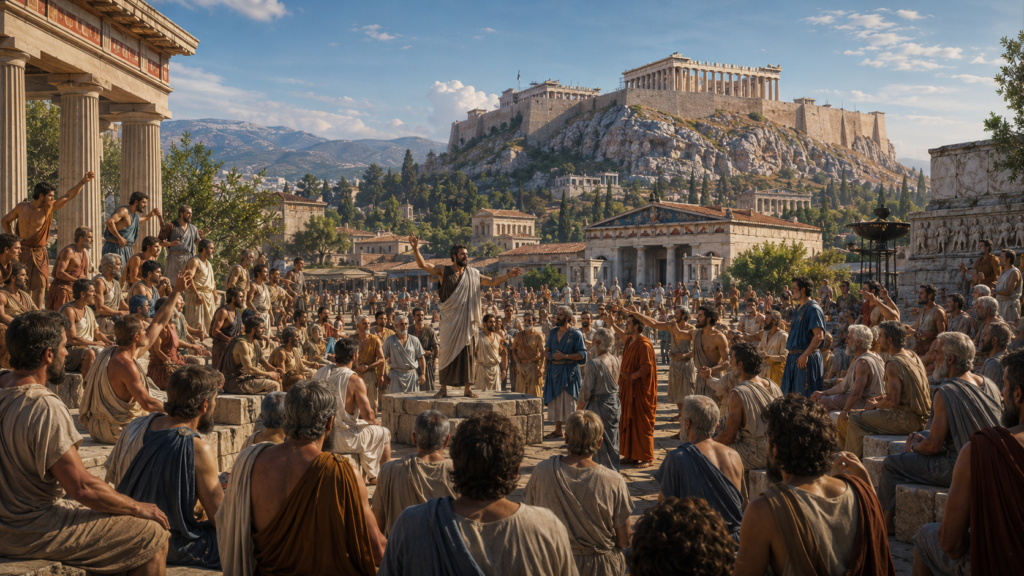
The city of Athens became the birthplace of democracy during the 5th century BCE.
Unlike kingdoms ruled by a single monarch, Athenian democracy allowed many male citizens to vote on important laws and public policies. Citizens gathered in assemblies where they debated issues and participated directly in government.
Although women, enslaved people, and foreigners could not vote, Athens introduced the revolutionary idea that government should involve the participation of ordinary citizens rather than absolute rulers.
Modern democratic nations have expanded these principles to include equal voting rights for all eligible citizens.
Athens and Sparta
Ancient Greece was not a single nation but a collection of independent city-states.
Athens
Athens became known for:
- Democracy
- Philosophy
- Education
- Art and architecture
- Literature
It encouraged debate, learning, and civic participation.
Sparta
Sparta followed a very different path.
Its society focused on:
- Military discipline
- Physical fitness
- Loyalty to the state
- Courage in battle
Spartan boys began military training from a young age, creating one of the ancient world’s most respected armies.
Together, Athens and Sparta represent two contrasting models of society that continue to fascinate historians.
Philosophy and Great Thinkers
Ancient Greece produced some of history’s greatest philosophers.
Socrates
Socrates encouraged people to question assumptions and think critically rather than accepting ideas without examination.
Plato
A student of Socrates, Plato founded one of the earliest institutions of higher learning, the Academy, and wrote influential works on politics, ethics, and education.
Aristotle
Aristotle studied science, biology, ethics, politics, and logic. His ideas shaped education and scientific thinking for centuries.
Their teachings remain part of university courses around the world.
Culture, Science, and Innovation
The Greeks made lasting contributions far beyond politics.
They advanced:
- Mathematics
- Astronomy
- Medicine
- Drama and theatre
- Architecture
- History writing
- Olympic sports
Magnificent buildings such as the Parthenon showcased remarkable engineering and artistic achievement. Greek tragedies and comedies laid the foundations of modern theatre.
Greek Mythology
Religion was deeply woven into everyday life. Greeks believed powerful gods and goddesses lived on Mount Olympus.
Some of the best-known figures include:
- Zeus
- Athena
- Poseidon
- Apollo
- Artemis
- Hera
These myths explained natural events, celebrated heroic deeds, and taught moral lessons. They continue to inspire books, films, and works of art today.
The Lasting Legacy of Ancient Greece
Although Ancient Greece eventually came under Roman rule, its ideas spread throughout Europe and beyond.
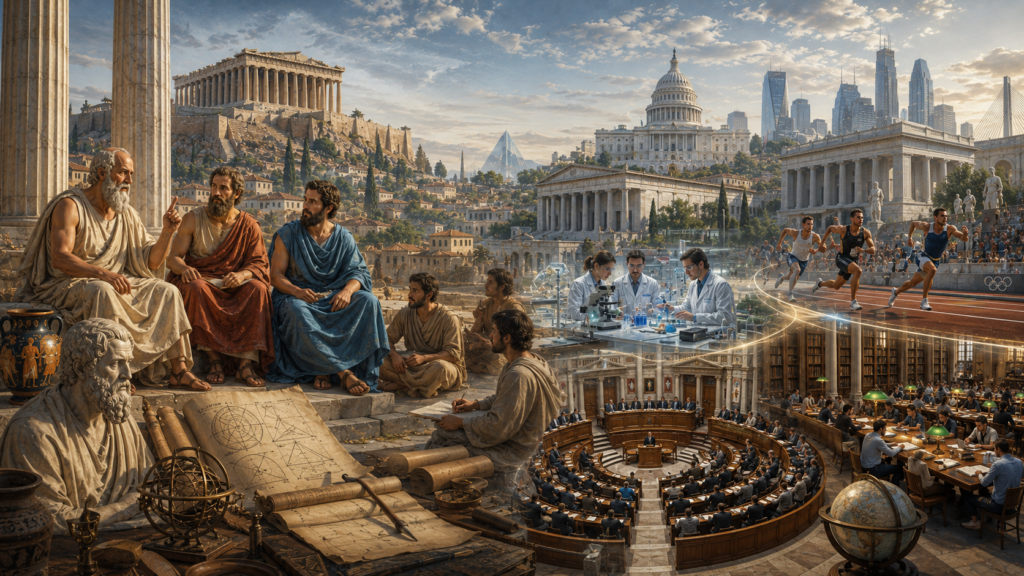
Modern democracies, scientific inquiry, philosophy, architecture, and the Olympic Games all owe much to the achievements of the ancient Greeks.
Their belief in education, reason, and civic participation continues to influence societies across the globe.
Key Takeaways
- Ancient Greece consisted of many independent city-states.
- Athens introduced one of the world’s earliest democratic systems.
- Sparta became famous for its military society.
- Greek philosophers transformed human thinking.
- Greek achievements continue to influence politics, science, education, and culture.
Frequently Asked Questions
Why is Ancient Greece called the birthplace of democracy?
Athens developed one of the earliest systems in which eligible citizens could directly participate in government decisions.
Was Ancient Greece one country?
No. It consisted of many independent city-states, including Athens, Sparta, Corinth, and Thebes.
Who were the most famous Greek philosophers?
Socrates, Plato, and Aristotle are considered the three most influential philosophers of Ancient Greece.
What is Ancient Greece best known for?
Ancient Greece is famous for democracy, philosophy, the Olympic Games, mythology, architecture, and scientific thought.
Conclusion
Ancient Greece transformed the course of history through ideas rather than conquest alone. Its experiments with democracy, pursuit of knowledge, and celebration of reason created a legacy that continues to shape the modern world. From the debates of ancient Athens to today’s democratic institutions, the influence of Ancient Greece remains as relevant as ever.
Further Reading & Resources
Continue your learning journey with more expert guides and insightful articles from CurioReader. Explore related topics below to deepen your understanding and discover new perspectives.
Related CurioReader Articles
- Ancient China’s Greatest Inventions That Changed the World.
- Ancient Egypt: Life Along the Nile.
- Ancient Greece: The Birthplace of Democracy.
Recommended External Resources