Introduction
What Is Artificial Intelligence? Artificial intelligence, usually called AI, has become one of the most talked-about technologies in the world. From chatbots and image generators to recommendation systems, self-driving technology, fraud detection and voice assistants, AI is increasingly becoming part of everyday life.
But what exactly is artificial intelligence?
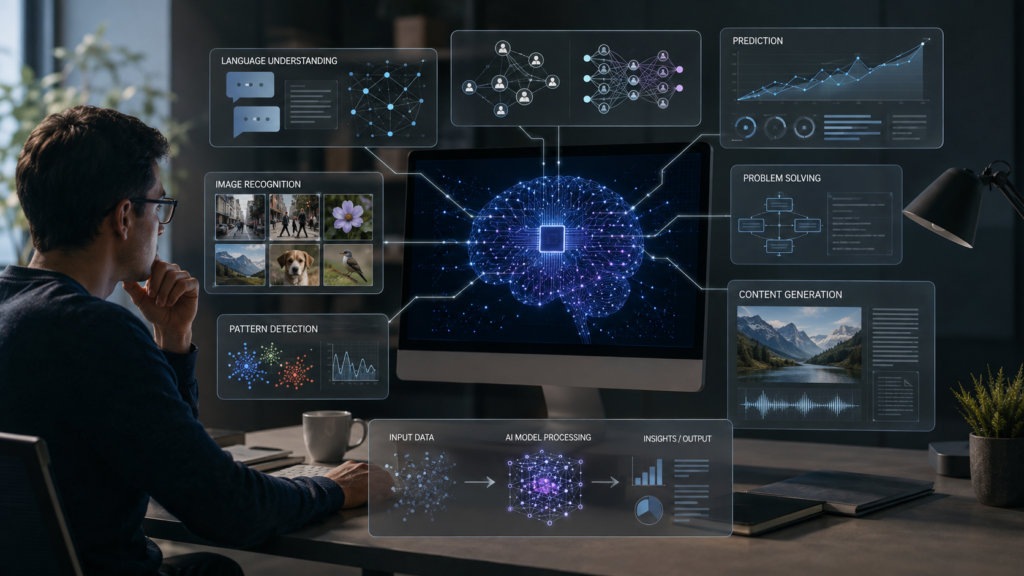
At its simplest, artificial intelligence is the field of creating computer systems that can perform tasks that normally require some form of human intelligence. These tasks can include recognizing patterns, understanding language, making predictions, solving problems, learning from information and generating content.
AI is not a single technology or a single type of computer program. It is a broad field containing many different approaches and applications.
Some AI systems are designed for very specific tasks, such as identifying spam emails or recommending products. Others, particularly modern generative AI systems, can perform a wide range of language, reasoning and content-creation tasks.
Understanding AI is becoming increasingly important because the technology is changing how people work, study, communicate and create.
This beginner’s guide explains what artificial intelligence is, how it works, the major types of AI, how machine learning fits into the picture, where AI is being used, what its benefits and limitations are, and what the future may look like.
What Is Artificial Intelligence?
Artificial intelligence refers to computer systems designed to perform tasks that are associated with human intelligence.
These tasks may include:
- Learning from data
- Recognizing images and speech
- Understanding language
- Identifying patterns
- Making predictions
- Solving problems
- Recommending information
- Generating text, images, audio or video
- Supporting decisions
A traditional computer program generally follows instructions explicitly written by a programmer.
For example, a simple calculator follows mathematical rules provided by its software.
Many modern AI systems work differently.
Instead of programming every possible response manually, developers can train systems using large amounts of data. The system learns patterns from that information and uses those patterns to produce predictions or outputs.
This difference is one of the foundations of modern AI.
However, AI does not necessarily think or understand the world in exactly the same way humans do.
A system may produce an impressive answer without possessing human consciousness, emotions or personal experiences.
That distinction is important when discussing what AI can and cannot do.
A Brief History of Artificial Intelligence
The idea of creating machines that imitate aspects of human intelligence is much older than today’s AI systems.
Scientists and mathematicians began seriously exploring machine intelligence during the 20th century as computers became increasingly capable.
The term artificial intelligence became established as a field of research during the 1950s.
In 1956, researchers gathered at the Dartmouth Summer Research Project on Artificial Intelligence, an event widely regarded as an important milestone in the formal development of AI as a research field.
Early researchers were optimistic about the possibility of creating machines capable of solving complex problems.
However, progress was slower than many early predictions suggested.
Computers had limited processing power, data was scarce compared with today’s standards, and researchers had not yet developed many of the techniques used by modern AI.
AI research experienced periods of reduced funding and interest, sometimes called AI winters.
The field eventually accelerated as computing power increased, large datasets became available and new machine-learning techniques were developed.
The growth of the internet also produced enormous quantities of digital information that could be used to train and evaluate AI systems.
By the 2010s, advances in neural networks and specialized computer hardware produced major improvements in areas such as image recognition, speech recognition and natural-language processing.
The emergence of modern generative AI then brought artificial intelligence into mainstream public attention.
How Does AI Work?
AI systems can work in different ways, depending on their design.
At a broad level, many modern AI systems involve three important ingredients:
Data + Algorithms + Computing Power
Data
Data provides examples from which an AI system can learn patterns.
For an image-recognition system, the data might contain millions of images.
For a language model, training data can include very large collections of text and other information.
The quality and suitability of the data matter enormously.
Poor-quality or biased data can contribute to unreliable or biased results.
Algorithms
An algorithm is a set of computational procedures used to process information and solve a problem.
Machine-learning algorithms allow systems to identify patterns in data and improve their performance through training.
Computing Power
Modern AI can require substantial computing resources.
Advanced systems may be trained using large numbers of specialized processors operating for extended periods.
Once trained, a model can be used to process new information and generate predictions or outputs.
💡 CurioReader Insight: AI is not powered by “magic.” Behind impressive AI applications are mathematical models, training data, algorithms, computer hardware and carefully engineered software systems.
What Is Machine Learning?
Machine learning is one of the most important branches of artificial intelligence.
Instead of programming a computer with every rule needed to solve a problem, machine-learning systems can identify patterns from examples.
Imagine teaching a computer to distinguish between pictures of cats and dogs.
A traditional approach would attempt to program rules describing every possible cat and dog.
That would be extremely difficult.
A machine-learning approach can instead provide the system with many labelled examples.
During training, the model adjusts its internal parameters to become better at distinguishing the patterns associated with each category.
Once trained, it can analyze a new image and estimate whether it is more likely to contain a cat or a dog.
Machine learning is now used in areas such as:
- Fraud detection
- Medical image analysis
- Recommendation systems
- Search engines
- Speech recognition
- Weather forecasting
- Financial modelling
- Cybersecurity
- Advertising
Deep Learning and Neural Networks
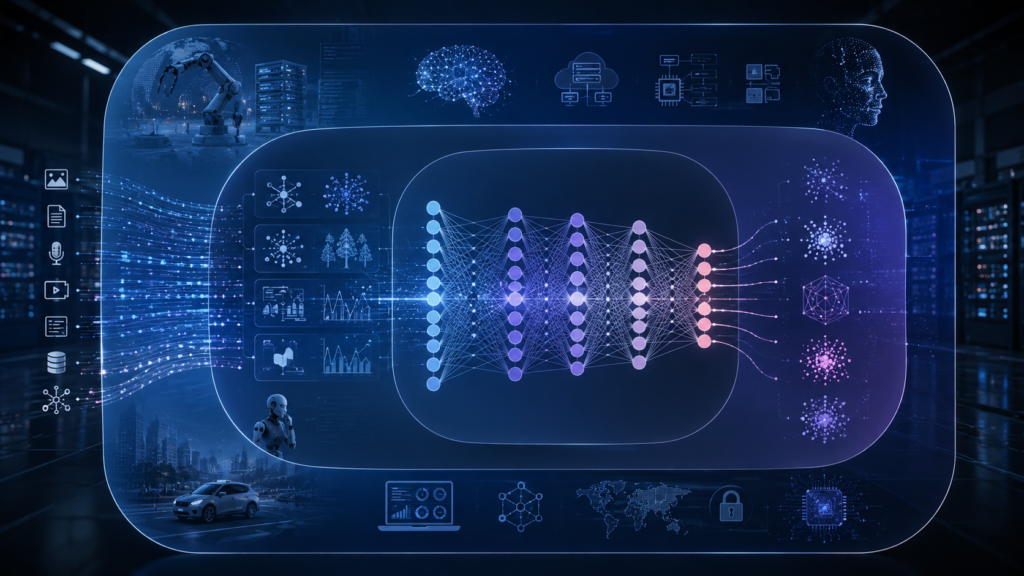
Deep learning is a type of machine learning that uses artificial neural networks with many layers.
These networks are loosely inspired by the way biological neural networks process information, although artificial neural networks are not replicas of the human brain.
Deep-learning systems can identify increasingly complex patterns as information moves through their layers.
For example, an image-recognition system might learn simple visual features at earlier stages and increasingly complex combinations of those features at later stages.
Deep learning became particularly important because it could achieve major improvements in tasks involving images, speech and language when combined with large datasets and powerful computing hardware.
Many modern AI applications rely on deep-learning techniques.
What Is Generative AI?
One of the most visible developments in recent years is generative AI.
Generative AI systems are designed to create new content based on patterns learned during training.
Depending on the system, they can generate:
- Text
- Images
- Computer code
- Audio
- Music
- Video
Large language models are a major example.
A language model processes sequences of language and learns statistical relationships between words, phrases and other elements of text.
When a user provides a prompt, the model generates a response based on patterns learned during training and additional system instructions.
Image-generation systems work differently but follow the same broad idea of learning patterns from large amounts of training data and generating new outputs based on a user’s request.
Generative AI has made AI accessible to millions of people who may never have used machine-learning tools directly before.
Artificial Narrow Intelligence
Most AI systems available today can be described as narrow AI, sometimes called artificial narrow intelligence.
Narrow AI is designed to perform specific tasks or a limited range of tasks.
Examples include:
- Voice assistants
- Recommendation algorithms
- Spam filters
- Facial-recognition systems
- Translation software
- Navigation systems
- AI writing tools
- Image-generation tools
A chess-playing AI may be extremely powerful at chess but cannot automatically perform the wide range of tasks that a human can.
Similarly, an image-classification system may be excellent at recognizing objects but may have no meaningful ability to perform unrelated tasks.
This is an important distinction.
Today’s AI can be extraordinarily capable while still being specialized.
What Is Artificial General Intelligence?
Artificial general intelligence (AGI) is a hypothetical form of AI capable of performing a broad range of intellectual tasks at a level comparable to humans or potentially beyond.
Unlike narrow AI, an AGI system would theoretically be able to transfer knowledge and skills between many different types of problems.
AGI remains a subject of intense research and debate.
There is no universally agreed definition of exactly what capabilities would qualify as AGI, and claims about when it might be achieved vary widely.
Therefore, AGI should not be confused with ordinary AI applications currently available.
The existence, timeline and eventual characteristics of AGI remain open questions.
Where Is AI Used Today?
Artificial intelligence is already present in many areas of everyday life.
Healthcare
AI can help analyze medical images, identify patterns in health data, support research and assist healthcare professionals with certain tasks.
AI does not replace medical professionals, and high-stakes applications require careful validation and oversight.
Education
AI can help students practice concepts, generate explanations, organize information and receive personalized learning support.
Teachers can also use AI for administrative and educational tasks.
However, students need to verify AI-generated information because AI systems can make mistakes.
Business
Companies use AI for customer service, forecasting, document processing, marketing analysis, fraud detection and workflow automation.
AI can reduce the amount of time people spend on repetitive tasks.
Transportation
AI is used in navigation, traffic prediction, driver-assistance technologies and the development of autonomous vehicles.
Entertainment
Streaming platforms and online services use algorithms to recommend films, music, videos and other content based on user behaviour.
Cybersecurity
AI can help identify unusual network activity, detect potential threats and analyze large volumes of security information.
Attackers can also use AI, creating a continuing technological competition between defenders and criminals.
The Benefits of Artificial Intelligence
AI can provide significant advantages when used responsibly.
Automation
AI can automate repetitive processes, allowing people to spend more time on tasks requiring judgment, creativity or interpersonal skills.
Speed
AI can process enormous quantities of information much faster than humans in many situations.
Pattern Recognition
Machine-learning systems can identify patterns that may be difficult for people to detect in large datasets.
Accessibility
AI tools can assist people with translation, speech recognition, image description and other accessibility-related tasks.
Scientific Research
AI can help researchers analyze complex datasets, model systems and identify promising areas for further investigation.
Personalization
AI can provide personalized recommendations and learning experiences based on individual behaviour and preferences.
However, these benefits do not mean AI is automatically beneficial in every situation.
Its results depend on how the technology is designed, trained and used.

The Limitations of AI
Artificial intelligence has impressive capabilities, but it also has important limitations.
AI Can Make Mistakes
AI-generated information can be incorrect.
Some generative AI systems may produce convincing statements that are unsupported or factually wrong.
This is sometimes described as an AI hallucination.
Users should therefore verify important information, particularly in areas such as medicine, law, finance and current events.
AI Can Reflect Bias
AI systems learn from data.
If training data contains biases or does not adequately represent certain groups, the resulting system can reproduce or amplify those problems.
Developers therefore need to evaluate AI systems carefully.
AI Does Not Automatically Understand Context Like Humans
AI can process enormous amounts of information, but it does not necessarily possess human common sense, lived experience or genuine understanding.
A response that sounds confident may still be inappropriate or incorrect.
AI Can Be Misused
AI can be used for beneficial purposes, but it can also support scams, misinformation, impersonation, cyberattacks and other harmful activities.
Responsible use is therefore essential.
AI and Human Creativity
The rise of generative AI has created an important debate about creativity.
AI can now generate images, stories, music, designs and videos in seconds.
This creates enormous opportunities for creators, but it also raises concerns.
Will people stop learning traditional creative skills?
Could overreliance on AI weaken human creativity?
The answer depends largely on how people use the technology.
AI can be treated as a creative assistant rather than a replacement for creative thinking.
A designer can use AI to explore ideas but still develop the final concept.
A writer can use AI for brainstorming while maintaining their own voice.
An artist can experiment with AI-generated references while continuing to develop drawing and design skills.
The most valuable approach is often collaboration.
Humans provide goals, judgment, emotion, experience and creative direction.
AI can provide speed, variation and computational assistance.
🎨 CurioReader Insight: The goal should not be to compete with AI at everything it can do. Human creativity becomes more valuable when people learn how to use AI while continuing to develop the skills that make their work original.

AI and Jobs
AI is also changing the workplace.
Some jobs may become partially automated, while other roles may change rather than disappear completely.
Tasks involving repetitive data processing, routine writing, basic customer support and document analysis are particularly likely to be affected by automation.
At the same time, new roles can emerge around AI development, implementation, evaluation, governance and human-AI collaboration.
The future of work is therefore unlikely to be simply “AI versus humans.”
In many industries, the more realistic scenario is humans working with AI systems.
Workers who understand how to use AI effectively may be able to improve productivity while maintaining responsibility for decisions and outcomes.
AI Ethics and Responsible Use
As AI becomes more powerful, ethical questions become increasingly important.
Major issues include:
- Privacy
- Data protection
- Bias
- Copyright
- Transparency
- Misinformation
- Accountability
- Employment
- Security
For example, if an AI system makes an important decision, who is responsible when the decision is wrong?
If an AI-generated image resembles an artist’s work, what rights should the artist have?
If a company uses AI to process customer information, how should private data be protected?
These questions do not have simple technological solutions.
They require cooperation between developers, governments, businesses, researchers and the public.
How to Use AI Responsibly
For everyday users, responsible AI use begins with understanding its limitations.
A few practical principles can help.
Verify important information.
Do not automatically assume that an AI-generated answer is correct.
Protect private information.
Avoid entering sensitive personal, financial or confidential business information into AI services unless you understand how that information is handled.
Keep humans involved in important decisions.
AI can provide recommendations, but high-impact decisions should receive appropriate human review.
Use AI to strengthen skills rather than replace learning.
Students, writers, designers and professionals should continue developing their own knowledge.
Be transparent when appropriate.
In academic, professional or creative environments, follow the relevant rules about disclosing AI assistance.
What Does the Future of AI Look Like?
Artificial intelligence is likely to become increasingly integrated into everyday software and devices.
AI assistants may become more capable of handling complex workflows.
Businesses may use AI more extensively for analysis and automation.
Scientists may use AI to accelerate research.
Creative professionals may incorporate AI into design and production workflows.
Robotics may also become increasingly sophisticated as AI systems improve their ability to perceive and interact with physical environments.
At the same time, governments and organizations will need to address safety, privacy, copyright, security and accountability.
The future of AI is therefore not determined by technology alone.
It will also depend on the decisions people make about how AI should be developed and used.
Key Takeaways
- Artificial intelligence is the field of creating computer systems capable of performing tasks associated with human intelligence.
- AI can recognize patterns, process language, make predictions, solve problems and generate content.
- Machine learning is an important branch of AI that allows systems to learn patterns from data.
- Deep learning uses multi-layer neural networks and powers many modern AI applications.
- Generative AI can create text, images, audio, video and code.
- Most current AI systems are specialized rather than genuinely general-purpose human-like intelligence.
- AI is used in healthcare, education, business, transportation, entertainment and cybersecurity.
- AI can improve productivity and help people process large amounts of information.
- AI can also make mistakes, reflect biases and be misused.
- Human judgment remains important when AI is used for significant decisions.
- AI can support creativity without replacing the need for human skills.
- Responsible AI use requires attention to privacy, accuracy, security and ethics.
Frequently Asked Questions
What is artificial intelligence in simple terms?
Artificial intelligence is technology that enables computers to perform tasks that normally require human intelligence, such as recognizing patterns, understanding language, making predictions and generating content.
Is AI the same as machine learning?
No. Machine learning is a branch of artificial intelligence. AI is the broader field, while machine learning is one approach used to create AI systems.
What is generative AI?
Generative AI refers to AI systems capable of creating new content, including text, images, audio, video and computer code.
Is ChatGPT artificial intelligence?
Yes. ChatGPT is an AI system based on large language models designed to process and generate natural-language responses.
Can AI think like a human?
Current AI systems can perform many tasks associated with human intelligence, but they should not automatically be assumed to think or experience the world like humans. Human consciousness and subjective experience are different questions from computational capability.
Will AI replace humans?
AI may automate some tasks and change many jobs, but it is unlikely that every human role will simply disappear. In many situations, AI is more likely to change how people perform their work and create new forms of human-AI collaboration.
Can AI make mistakes?
Yes. AI systems can produce incorrect information, misunderstand context or generate outputs that appear convincing but are inaccurate.
Why is AI sometimes biased?
AI systems learn from data and other design choices. If the underlying data or development process contains biases, the system can reproduce or sometimes amplify them.
Is artificial general intelligence available today?
There is no universally accepted definition or agreed test for AGI, and claims about whether current systems qualify vary. The concept generally refers to AI with broad, flexible intellectual capabilities comparable to humans across many different tasks.
Should people trust AI?
AI should be treated as a useful tool rather than an unquestionable authority. For important information or decisions, users should verify outputs and apply appropriate human judgment.
Conclusion
Artificial intelligence has evolved from a specialized area of computer science into one of the most influential technologies of the modern era.
At its core, AI is about developing computer systems that can perform tasks associated with human intelligence. These systems can recognize patterns, process language, make predictions, analyze information and generate new content.
Machine learning and deep learning have dramatically expanded what computers can accomplish, while generative AI has made these capabilities accessible to ordinary users.
Today, AI is already being used across healthcare, education, business, transportation, entertainment, science and cybersecurity.
Yet understanding AI also requires understanding its limitations.
AI can make mistakes.
It can reflect biases in data.
It can produce convincing but inaccurate information.
It can be misused.
And despite its impressive capabilities, today’s AI should not automatically be treated as equivalent to human intelligence, consciousness or creativity.
The most useful way to think about AI is as a powerful technology that can extend human capabilities when used carefully.
A student can use it as a learning assistant.
A researcher can use it to analyze information.
A business can use it to automate repetitive work.
A designer can use it to explore creative possibilities.
A programmer can use it to accelerate development.
But humans still need to provide goals, judgment, responsibility and critical thinking.
The future will therefore not be determined simply by how powerful AI becomes.
It will also depend on how people choose to use it.
Learning about artificial intelligence today is no longer just an interest for computer scientists. It is becoming an important form of digital literacy for students, workers, business owners, creators and everyday technology users.
AI is already changing the world.
The important question is not simply what AI can do.
It is what we choose to do with it.
Further Reading & Resources
Continue your learning journey with more expert guides and insightful articles from CurioReader. Explore related topics below to deepen your understanding and discover new perspectives.
Related CurioReader Articles
Recommended External Resources