Chapter One – The Journey Begins
The Last Letter Home is a historical fiction story inspired by the courage of New Zealand soldiers during the Second World War. While the military events are based on history, the characters and their personal journeys are fictional.
May 1941
Dear Mum,
By the time this letter reaches Canterbury, I’ll probably be somewhere across the sea. The officers haven’t told us exactly where we’re headed, only that we’ll be sailing soon. They say a soldier doesn’t need to know everything—only where to stand and when to move. I suppose that’s true, though I’d still like to know where the next sunrise will find us.
Please don’t worry about me. Training has been hard, but it’s made me stronger than I ever thought I could be. My boots finally fit properly, and I’ve almost stopped tripping over my own rifle. Tom says that’s a sign I’ve become a real soldier, though I think he’s just relieved I no longer fall into him during drills.
Tell Grace I’m still waiting for the day she admits I can shoot better than she can. And if Sarah asks whether I’ve remembered my promise, tell her I haven’t forgotten a single word.
Every night before lights out, I think about home—the sound of the wind across our paddocks, Rusty barking at the sheep for no good reason, and the kettle whistling in the kitchen. Funny how the smallest things become the biggest comforts once they’re gone.
I’ll write again as soon as I can.
Your loving son,
Jim
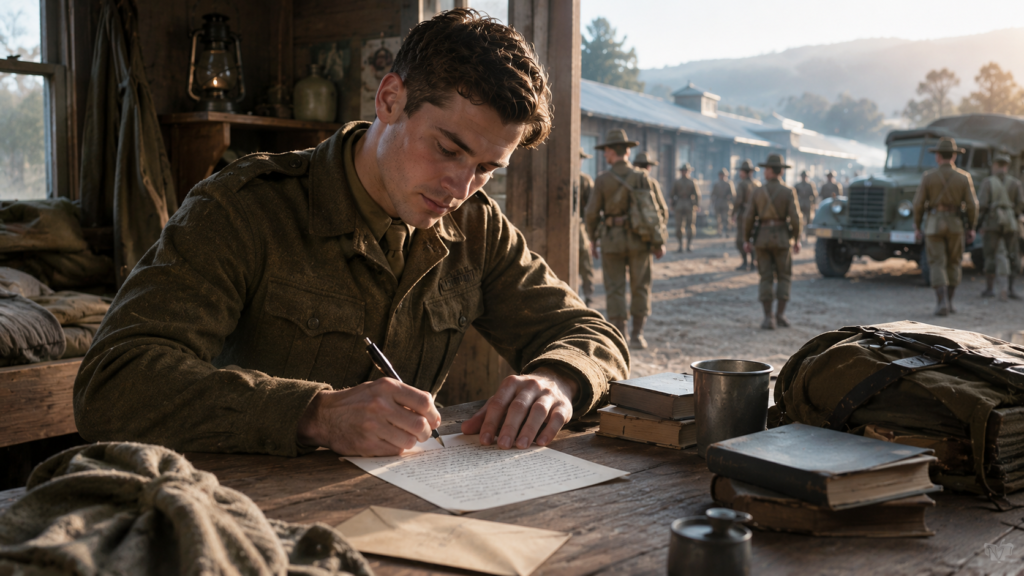
Jim Walker folded the letter with slow, careful hands.
Unlike some of the others in the barracks, he never hurried his writing. Every sentence mattered. His mother couldn’t read the words herself anymore, but he knew Grace would sit beside her at the kitchen table and read each line aloud. He wanted every sentence to sound as though he were sitting there with them.
He slipped the letter into its envelope, wrote the familiar Canterbury address, and ran his thumb gently across the paper.
Home.
The word alone carried more weight than his army pack.
Outside, whistles echoed across the camp.
“Walker!” a voice called.
Jim tucked the envelope into his breast pocket and stepped into the cool morning air.
Rows of timber barracks stretched across the training camp, their roofs still glistening with dew. Soldiers hurried between buildings, some carrying rifles, others mugs of steaming tea. Boots thudded against the packed earth while sergeants barked orders that rolled across the parade ground like distant thunder.
“You’re late,” Tom Bennett grinned, though Jim was anything but.
Tom always claimed someone was late, even when they arrived before everyone else.
“You’ve been saying that since the first day.”
“And one day I’ll be right.”
Jim shook his head, unable to stop himself smiling.
Tom had been his neighbour back in Canterbury for nearly fifteen years. They had learned to ride horses together, chased escaped sheep across muddy hills, and more than once been chased by an angry ram that seemed to have a particular dislike for young boys.
When enlistment posters began appearing in town, they hadn’t spoken much about it.
Neither needed to.
One morning they simply walked into the recruiting office together.
Captain Richard Hughes was already waiting on the parade ground.
Unlike many officers, he rarely needed to raise his voice. His calm manner somehow demanded more attention than shouting ever could.
The men formed neat ranks.
Hughes walked slowly along the line, his sharp eyes studying every face.
“You’ve completed your training.”
A ripple of satisfaction moved through the formation.
“You arrived here as farmers, mechanics, clerks, teachers, labourers, and students.”
He paused.
“You leave here as soldiers of New Zealand.”
No one cheered.
The words settled over the men with quiet pride.
“You’ve learned discipline.”
“You’ve learned teamwork.”
“You’ve learned how to survive.”
He looked towards the distant hills beyond the camp.
“Soon, you’ll learn what war truly means.”
Silence followed.
Even Tom stopped smiling.
Captain Hughes continued.
“Our destination has now been confirmed.”
Every man straightened instinctively.
“You’ll be departing for Egypt within days to join the New Zealand Expeditionary Force.”
A murmur swept through the ranks.
Egypt.
The name sounded impossibly distant.
For Jim, it might as well have been another planet.
He had barely travelled beyond the South Island before joining the army. Now he was preparing to leave New Zealand itself.
The thought stirred equal measures of excitement and unease.
After dismissal, the soldiers drifted across the camp in small groups.
“So…” Tom finally said.
“Egypt.”
Jim nodded.
“I never thought I’d see it.”
“I never thought I’d leave Canterbury,” Tom admitted.
They walked in silence for a while.
Nearby, recruits laughed as they packed equipment into wooden crates. Others posed for photographs beside military trucks, smiling with the confidence only young men could wear before seeing war.
Jim watched them thoughtfully.
“Do you think it’ll be like the newspapers?”
Tom snorted.
“If it is, we’ll all come home looking handsome in perfectly pressed uniforms.”
Jim laughed.
“I don’t think mud cares much about newspapers.”
“Nor Sergeant McKenzie.”
“Especially Sergeant McKenzie.”
For a few precious moments, the weight of the coming journey lifted.
The familiar banter reminded Jim of evenings repairing fences together, sharing stories beneath wide Canterbury skies while Rusty slept nearby after another long day herding sheep.
Those memories felt surprisingly close.
And impossibly far away.
As the afternoon sun climbed higher, Jim returned to the barracks to finish packing.
His belongings occupied only a small corner beside his bunk.
Two neatly folded uniforms.
A shaving kit.
A Bible given by the local church before he left.
Extra socks carefully knitted by Mary during the last winter before her eyesight faded completely.
Finally, he reached into the bottom of his locker.
Wrapped carefully in a handkerchief lay an old silver pocket watch.
It had belonged to his father.
John Walker had carried it through another war many years earlier before illness claimed him long after he returned home.
Jim opened the cover.
The hands continued their steady rhythm.
Tick.
Tick.
Tick.
He smiled faintly.
“Still keeping better time than me,” he whispered.
Gently, he slipped the watch into his pocket.
Some things weren’t carried because they were useful.
Some things reminded a man who he was.
Outside, a military truck rumbled past, its engine echoing across the camp.
The next stage of the journey had begun.
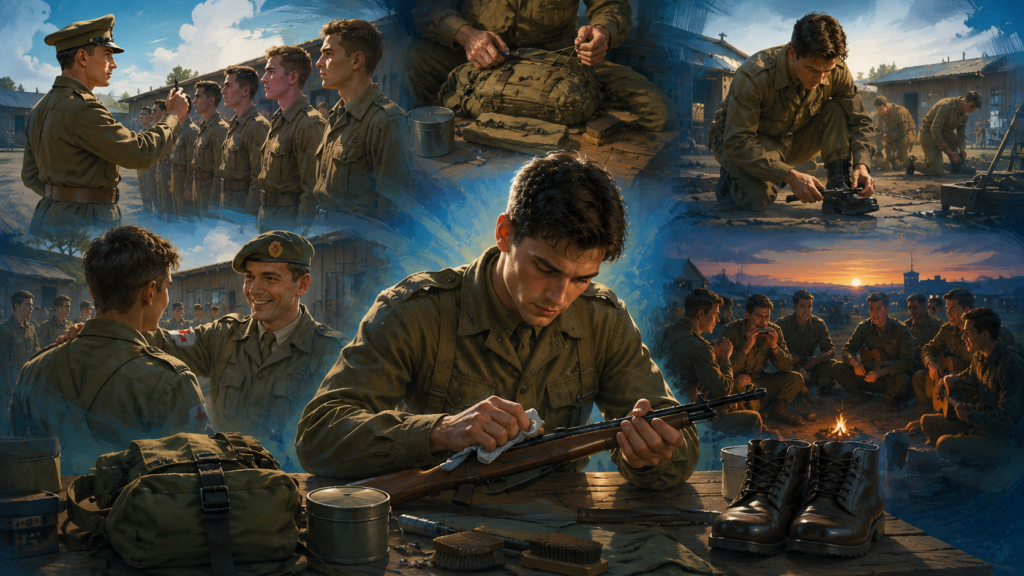
The rest of the afternoon disappeared beneath a whirlwind of inspections, equipment checks, and shouted orders.
Every rifle was cleaned until its metal reflected the afternoon sun. Every pack was unpacked, examined, and packed again. Boots were polished despite the dust that settled on them minutes later.
Captain Hughes believed discipline began with the smallest details.
“War doesn’t forgive carelessness,” he often reminded them. “Neither will I.”
Jim had come to respect the captain. He never demanded perfection for the sake of appearances. Every lesson had a purpose, and every mistake became another opportunity to learn before facing a real battlefield.
As the men formed another line outside the supply depot, Corporal Daniel Fraser walked between them carrying a medical satchel over one shoulder.
Unlike most of the instructors, Fraser greeted every soldier with a quiet smile.
“Walker.”
“Corporal.”
Fraser looked Jim over.
“You’ve put on a bit of weight since you arrived.”
“I’ll take that as a compliment.”
“It is.”
He tapped Jim’s shoulder.
“Means you’re finally eating enough.”
Tom leaned across from the next position.
“I’ve been helping with that.”
Fraser raised an eyebrow.
“You?”
“I make sure he never leaves anything on his plate.”
Jim laughed.
“He steals half of it.”
“Sharing,” Tom corrected.
“That’s called sharing.”
Corporal Fraser chuckled before moving down the line.
“Look after each other,” he said quietly.
“Out there, your mates will keep you alive far more often than doctors will.”
The words lingered with Jim long after Fraser had disappeared into another row of soldiers.
That evening, the camp seemed unusually calm.
Training was officially complete.
For the first time in weeks, no one was running obstacle courses or crawling beneath barbed wire.
Instead, small groups gathered outside the barracks, talking quietly beneath a sky slowly turning orange.
Jim and Tom sat on a wooden crate overlooking the parade ground.
Neither spoke for several minutes.
They simply watched the camp.
A few soldiers kicked a football across an open field.
Someone nearby played a harmonica.
Another group sang an old folk song that drifted softly through the cool evening air.
It reminded Jim of community gatherings back in Canterbury.
The difference was that no one here knew when—or if—they would attend another one.
Tom finally broke the silence.
“You ever think we’d end up here?”
Jim smiled.
“I thought I’d spend my whole life fixing fences.”
“You still might.”
“If the sheep haven’t escaped by the time I get back.”
“They’ve probably taken over the farm by now.”
Jim laughed.
“Mum would never allow it.”
“No.”
Tom nodded thoughtfully.
“She always did know how to keep things in order.”
Jim looked towards the fading horizon.
“She was already losing her sight before I enlisted.”
Tom remained quiet.
“I hated leaving.”
“I know.”
“I kept thinking…”
Jim paused.
“…what if she needs me?”
Tom picked up a small stone and tossed it across the dusty ground.
“My old man said something before I left.”
“What?”
“He said there comes a time when a man has to trust the people he loves.”
Jim looked at him.
“If you keep worrying about what’s happening back home, you’ll never be able to do what’s needed over here.”
The words settled between them.
Jim knew Tom was right.
Grace was growing into a capable young woman.
Sarah visited almost every day.
Together, they would never let Mary face life’s challenges alone.
Still…
Knowing that didn’t make leaving any easier.
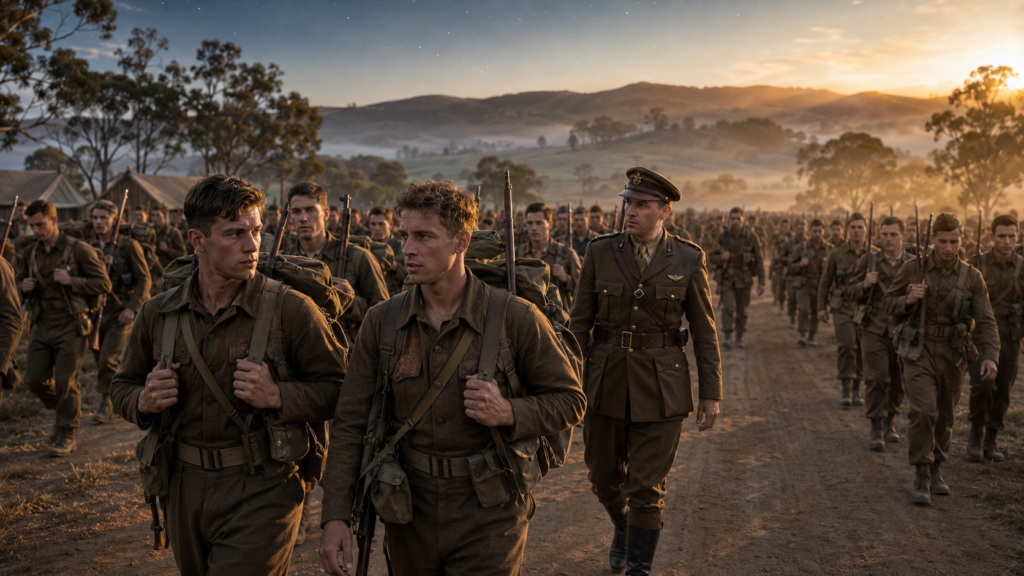
The following morning began before sunrise.
A bugle echoed through the camp while stars still shimmered faintly overhead.
Within minutes, hundreds of boots pounded across the parade ground.
One final route march.
Nearly twenty kilometres.
Full packs.
Rifles.
No complaints.
Captain Hughes walked alongside them for much of the journey.
Not in front.
Not behind.
Among them.
It was another lesson.
A leader shared the burden.
As dawn painted the hills with soft gold, Jim found himself remembering mornings on the farm.
He could almost smell damp grass after rain.
Hear sheep calling across the paddocks.
Feel Rusty’s tail brushing against his boots as they walked together toward the shearing sheds.
Those memories arrived unexpectedly.
Clearer than ever.
Home had never seemed so beautiful.
When the march finally ended, exhausted soldiers collapsed wherever they could find shade.
Tom stretched out beneath a large eucalyptus tree.
“I’ve decided.”
Jim sat beside him.
“About what?”
“When this war ends…”
Tom closed his eyes dramatically.
“…I’m never walking anywhere again.”
Jim chuckled.
“You’ll ride a horse?”
“No.”
“A truck?”
“No.”
“A bicycle?”
Tom opened one eye.
“I’m going to convince someone to invent a machine that carries people everywhere.”
Jim laughed.
“That sounds lazy.”
“It sounds brilliant.”
“Well, if anyone could think of such a thing, it’d probably be you.”
Tom grinned.
“And you’ll still be fixing fences.”
“Probably.”
“Married?”
Jim’s smile softened.
“I hope so.”
“Sarah?”
Jim nodded.
“There was never anyone else.”
Tom folded his hands behind his head.
“You know…”
“When this is all over…”
“We’ll build our houses next to each other.”
Jim looked across the open paddocks beyond the camp.
“Our kids will probably end up chasing the same sheep we did.”
“And getting chased by the same ram.”
“The very same one.”
“I swear that animal is immortal.”
Both men burst into laughter.
Neither realised how precious those ordinary conversations would become.
Late that afternoon, Captain Hughes assembled the company once more.
His face was serious.
“Your transport leaves at first light tomorrow.”
Silence settled immediately.
“You have this evening to finish your preparations.”
“Write your letters.”
“Clean your equipment.”
“Get some rest.”
He paused.
“When you board that ship…”
“…you’ll no longer be recruits.”
“You’ll be New Zealand soldiers serving far from home.”
The captain removed his hat briefly.
“I am proud to serve alongside every one of you.”
It was the first time Jim had seen emotion in the officer’s voice.
No grand speech followed.
None was needed.
The men understood exactly what tomorrow meant.
They were leaving not only New Zealand…
…but also the certainty of the lives they had always known.
As the sun disappeared behind the distant hills, Jim reached into his pocket and touched his father’s silver watch.
Its steady ticking echoed softly in the growing silence.
Tick.
Tick.
Tick.
Time never waited for anyone.
Tomorrow, neither would history.
That evening, the camp settled into an unusual silence.
The laughter that had echoed between the barracks over the past weeks had faded, replaced by quiet conversations and the occasional scrape of boots on wooden floors. Every man seemed lost in his own thoughts.
Some polished their rifles one last time.
Others reread letters from home.
A few simply sat on their bunks, staring into the distance.
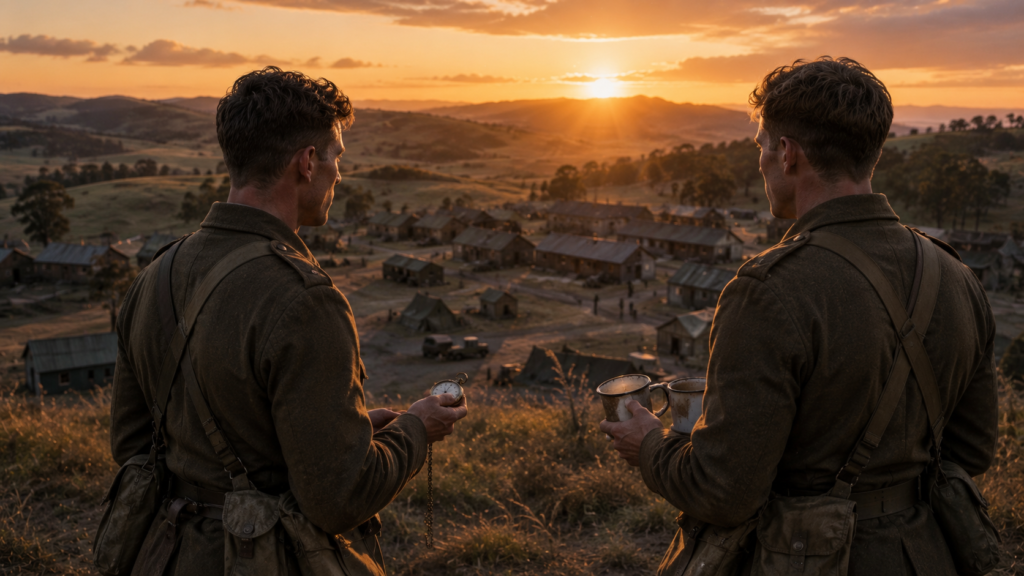
Jim climbed the small rise behind the barracks, carrying only his father’s pocket watch.
The training camp stretched below him, rows of weathered buildings glowing softly beneath the last light of day. Beyond them, the rolling New Zealand countryside disappeared into the horizon.
He stood there for several minutes without speaking.
The evening breeze carried the familiar scent of damp earth and pine trees.
He closed his eyes.
For a moment, he wasn’t a soldier preparing to leave for war.
He was simply Jim Walker…
…walking across the paddocks before sunrise.
He could almost hear Rusty barking impatiently as sheep wandered too close to the creek.
He pictured Grace laughing as she tried to outrun the old sheepdog.
He imagined Sarah standing beneath the kōwhai tree, brushing loose strands of hair behind her ear while pretending not to watch him repair another broken fence.
And he saw his mother sitting on the farmhouse veranda.
Even though blindness had taken her sight, he knew she would still turn her face toward the evening breeze, recognising every sound the farm offered.
Home was more than a place.
It was every person waiting there.
A quiet voice interrupted his thoughts.
“Mind if I join you?”
Tom climbed the hill carrying two enamel mugs.
“I managed to rescue these before someone else claimed them.”
Jim accepted one gratefully.
“Tea?”
Tom nodded.
“Strong enough to wake the dead.”
Jim took a careful sip and immediately grimaced.
“I think it nearly did.”
Tom burst into laughter.
“I told you it was strong.”
The two friends stood side by side, watching the last sunlight disappear beyond the hills.
“I’ve been thinking,” Tom said after a while.
“Dangerous habit.”
“So I’ve been told.”
Tom smiled before growing serious.
“If anything happens to either of us…”
Jim turned to him.
“…the other one looks after the family.”
Jim didn’t answer immediately.
Instead, he stared across the countryside.
“I was hoping neither of us would have to.”
“So was I.”
The silence between them carried an understanding that words couldn’t improve.
Finally, Jim extended his hand.
“It’s a promise.”
Tom gripped it firmly.
“It’s a promise.”
Neither man realised how important that promise would one day become.
Before lights out, the soldiers were given one final hour to themselves.
Jim returned to his bunk and opened the small notebook he had carried since leaving Canterbury.
Inside were simple things.
The date the first lamb had been born that spring.
A list of repairs still needed on the western fence.
The measurements for a new sheep pen he had planned to build after harvest.
Between the pages rested a small photograph.
Sarah.
She wasn’t posing.
Someone had taken the picture while she was laughing at something beyond the camera.
Jim smiled.
He remembered the afternoon clearly.
It had been taken during the annual community picnic just weeks before he enlisted.
He carefully returned the photograph to its place before reaching for another object wrapped inside a handkerchief.
A silver locket.
Its twin rested safely around Sarah’s neck.
He remembered placing it gently into her hands beneath the old kōwhai tree.
“I don’t have much to give you,” he’d said.
She had smiled.
“I wasn’t waiting for jewellery.”
“I know.”
“Then why this?”
He had looked down, suddenly unable to find the right words.
“So you’ll always have something to remind you that I’ll come home.”
She had opened the locket.
Inside was a tiny photograph of Jim.
She looked back at him.
“When you come back…”
“…what happens then?”
Jim had smiled.
“I’ll replace it with a ring.”
Sarah hadn’t cried.
She simply slipped the locket around her neck and whispered the words he would carry with him every day afterward.
“No matter how long it takes…”
“…this farm will always be the first place you’ll come home to.”
Jim closed the notebook.
Some promises were stronger than fear.
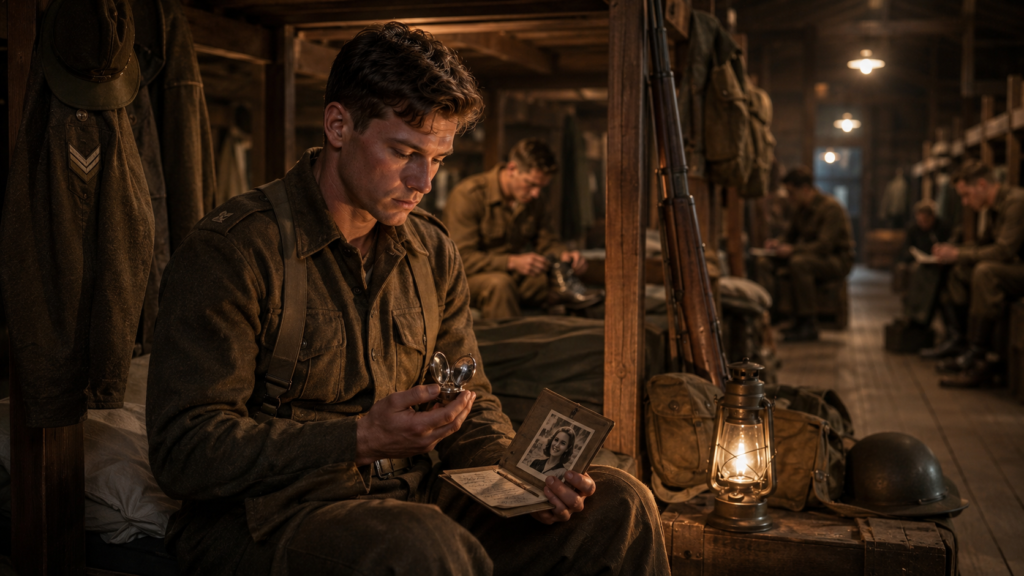
Long before dawn, the camp came alive.
Lanterns flickered between the barracks.
Orders echoed through the darkness.
Packs were hoisted onto shoulders.
Rifles checked one final time.
The soldiers climbed aboard waiting military trucks that would carry them to the railway station.
Jim looked back once.
The training camp had become strangely familiar.
Only weeks earlier, it had seemed intimidating.
Now it felt like the last piece of home he would see for a long time.
The convoy rolled slowly through sleeping countryside.
Morning mist drifted across open fields.
Farmhouses appeared briefly before disappearing behind lines of trees.
Jim watched every mile pass by in silence.
He wasn’t trying to memorise the road.
He was memorising New Zealand.
The colour of the hills.
The shape of distant mountains.
The endless green paddocks.
The wooden fences stretching across the countryside.
Things he had barely noticed before now felt precious.
At the railway station, families crowded behind the barriers.
Children waved little New Zealand flags.
Wives embraced husbands.
Parents held onto sons for a few moments longer than necessary.
Jim searched the crowd instinctively.
He knew his family couldn’t be there.
The journey from Canterbury had simply been too far.
Part of him was relieved.
Goodbyes had never come easily.
Captain Hughes stood beside the train as each soldier boarded.
He shook every man’s hand.
No speeches.
No ceremony.
Only quiet respect.
When Jim stepped forward, the captain held his gaze for a moment.
“You’ve done well, Walker.”
“Thank you, sir.”
“Remember your training.”
“I will.”
“And remember why you’re fighting.”
Jim nodded.
“For home, sir.”
Captain Hughes smiled faintly.
“Exactly.”
Jim climbed aboard.
The whistle sounded.
Slowly, the train pulled away.
No one spoke.
Most simply watched through the windows as New Zealand slipped quietly past.
Tom eventually broke the silence.
“Next stop…”
He paused.
“…Egypt.”
Jim looked out across the passing countryside one final time.
Somewhere beyond those distant hills…
…Mary would soon hear his first letter.
Grace would read every word.
Sarah would smile at the promise he’d asked Grace to pass on.
Rusty would still be waiting faithfully at the front gate.
Jim rested a hand over the envelope inside his jacket.
He had no idea what lay ahead.
He only knew one thing with absolute certainty.
No matter how far the war carried him…
His heart would always know the way home.
Historical Note Behind The Last Letter Home
This chapter is set during the early stages of New Zealand’s mobilisation for the Second World War. Thousands of New Zealand men enlisted in the 2nd New Zealand Expeditionary Force (2NZEF), undergoing military training before departing by ship for the Middle East. Many served first in Egypt, where they continued training before taking part in campaigns across Greece, Crete, and North Africa.
Although Jim Walker and the other main characters are fictional, their experiences reflect those of many young New Zealanders who left farms, towns, and families to serve far from home. Letters were often the only connection between soldiers and those waiting anxiously in New Zealand, making wartime correspondence one of the most treasured possessions a family could receive.
Further Reading & Resources
Continue your learning journey with more expert guides and insightful articles from CurioReader. Explore related topics below to deepen your understanding and discover new perspectives.
Related CurioReader Articles
Recommended External Resources