Introduction
The Complete Guide to Human Psychology: Why do two people react differently to the same situation? Why do we sometimes make irrational decisions even when we know better? What influences our emotions, habits, relationships, and personality?
The answers to these questions lie in human psychology—the scientific study of how people think, feel, and behave.
Psychology influences almost every aspect of our daily lives. It shapes how we learn new skills, build relationships, manage stress, make financial decisions, respond to challenges, and even how we perceive ourselves. Whether you’re negotiating at work, encouraging a child, choosing what to buy, or trying to develop a healthier habit, psychological principles are often at work behind the scenes.
For many people, psychology seems mysterious or complicated. Some associate it only with therapy or mental illness, while others believe it’s simply “reading people’s minds.” In reality, psychology is a broad scientific discipline that helps explain why humans behave the way they do. It combines research from biology, neuroscience, sociology, and behavioural science to better understand the human experience.
Learning basic psychology isn’t just interesting—it can also improve your everyday life. It can help you communicate more effectively, understand your emotions, recognize thinking errors, develop healthier habits, and build stronger relationships. Perhaps most importantly, it encourages greater self-awareness, allowing you to understand not only others but yourself as well.
In this guide, you’ll explore the foundations of human psychology, discover how the mind works, learn what shapes behaviour, and uncover practical insights that you can apply in everyday life. While psychology cannot explain every human action, it provides valuable tools for understanding ourselves and the people around us.
🧠 Did You Know? Your brain processes millions of pieces of information every second, but your conscious mind is aware of only a tiny fraction. Much of your behaviour is influenced by mental processes that happen automatically without you realizing it.
What Is Human Psychology?
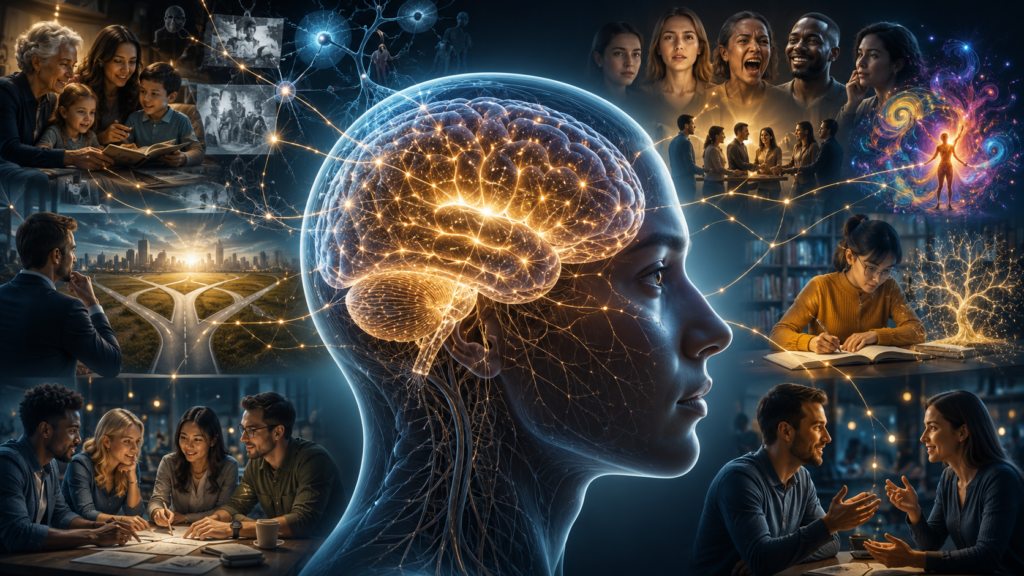
Human psychology is the scientific study of the mind and behaviour. It explores how people think, feel, learn, remember, make decisions, develop relationships, and respond to the world around them.
Rather than focusing on a single aspect of human behaviour, psychology examines the complex interaction between biological, emotional, cognitive, social, and environmental factors. It seeks to answer questions such as:
- Why do people behave differently in similar situations?
- How are personalities formed?
- What motivates human behaviour?
- How do emotions influence decisions?
- Why do habits develop?
- How do people learn and remember information?
Psychologists use observation, experiments, surveys, and scientific research to better understand these questions. Their findings help improve education, healthcare, workplaces, relationships, sports, and many other areas of society.
Although psychology often overlaps with neuroscience and biology, it focuses primarily on understanding behaviour and mental processes rather than only studying the physical brain.
A Brief History of Psychology
People have been fascinated by the human mind for thousands of years. Ancient philosophers such as Socrates, Plato, and Aristotle debated questions about memory, emotion, learning, and human nature long before psychology became a formal science.
Modern psychology emerged in the late nineteenth century when researchers began studying human behaviour through scientific observation and experimentation. Over time, psychology developed into a diverse field with many specialized branches, each focusing on different aspects of the human experience.
Today, psychology continues to evolve as researchers combine traditional behavioural science with advances in neuroscience, genetics, artificial intelligence, and technology.
🌟 CurioReader Insight: Psychology isn’t about finding one simple explanation for human behaviour. Instead, it recognizes that our thoughts and actions are influenced by many interacting factors, including our biology, experiences, environment, and relationships.
Major Branches of Psychology
Psychology is a broad discipline with many specialized areas. Some of the most well-known branches include:
Cognitive Psychology
Studies how people think, learn, remember, solve problems, and make decisions.
Developmental Psychology
Examines how people grow and change throughout life, from infancy to old age.
Social Psychology
Explores how other people influence our behaviour, attitudes, and decisions.
Personality Psychology
Investigates why individuals have different personality traits and behavioural patterns.
Educational Psychology
Focuses on learning, teaching methods, motivation, and improving educational outcomes.
Industrial and Organizational Psychology
Applies psychological principles to workplaces, leadership, teamwork, employee wellbeing, and productivity.
Clinical Psychology
Studies emotional, behavioural, and psychological difficulties and how evidence-based approaches can help improve wellbeing.
💡 CurioReader Tip: You don’t need to become a psychologist to benefit from psychology. Understanding a few core principles can improve communication, decision-making, learning, and relationships in everyday life.
Psychology vs. Psychiatry
These two terms are often confused, but they describe different professions.
Psychology focuses on understanding behaviour, thoughts, emotions, and mental processes through scientific research and evidence-based practice.
Psychiatry is a branch of medicine. Psychiatrists are medical doctors who specialize in diagnosing and treating mental health conditions and, in many countries, can prescribe medication.
Both professions often work together, but they have different training and responsibilities.
How the Human Mind Works
The human mind is incredibly complex. Every day, it helps us perceive the world, process information, make decisions, solve problems, regulate emotions, and interact with others—all while performing countless automatic tasks in the background.
Although scientists continue to study exactly how the mind works, several well-established concepts help explain why we think and behave as we do.
Conscious and Unconscious Thinking
Some of your thoughts are completely conscious.
For example, when you solve a maths problem, decide what to cook for dinner, or plan a holiday, you’re deliberately thinking about those choices.
However, much of your mental activity happens automatically.
Without conscious effort, your brain:
- Recognizes familiar faces.
- Understands language.
- Maintains your balance.
- Interprets emotions from facial expressions.
- Predicts what may happen next.
These unconscious processes allow you to function efficiently without becoming overwhelmed by every tiny decision.
🧠 Did You Know? Many everyday decisions are influenced by unconscious mental shortcuts. These automatic processes help us respond quickly but can sometimes lead to biased or inaccurate judgments.
Memory: More Than Just Remembering
Memory isn’t like a video recording that perfectly stores every event.
Instead, your brain actively builds, organizes, and reconstructs memories over time.
Psychologists generally describe three stages of memory:
Sensory Memory
Briefly holds information gathered through your senses.
Short-Term (Working) Memory
Temporarily stores information you’re actively using, such as remembering a phone number long enough to dial it.
Long-Term Memory
Stores knowledge, skills, experiences, and personal memories over extended periods.
Every time you recall a memory, your brain reconstructs it rather than replaying it exactly as it happened. This is one reason why memories can change over time.
Emotions Shape Thinking
Many people imagine that emotions and logic are completely separate.
In reality, they work together constantly.
Emotions help us:
- Recognize danger.
- Build relationships.
- Learn from experiences.
- Prioritize important information.
- Make decisions more efficiently.
However, intense emotions such as fear, anger, or excitement can sometimes influence our judgment and lead to impulsive decisions.
Learning to recognize emotions without allowing them to completely control our behaviour is an important part of emotional intelligence.
⚠️ Common Mistake: Believing that good decisions are made using logic alone. In reality, both emotion and reasoning play important roles in healthy decision-making.
Attention Is a Limited Resource
Every day, your brain receives far more information than it can consciously process.
Attention acts as a filter, helping you focus on what appears most important while ignoring less relevant information.
This explains why distractions make it harder to concentrate. Every interruption forces your brain to shift attention, reducing mental efficiency.
Protecting your attention has become increasingly important in today’s digital world, where notifications, advertisements, and constant information compete for your focus.
🔬 Science Says: Research consistently shows that focused attention improves learning, memory, and decision-making, while frequent task switching reduces performance and increases mental fatigue.
Habits Save Mental Energy
Imagine having to consciously think about every step involved in brushing your teeth, tying your shoes, or driving a familiar route.
Fortunately, your brain converts repeated behaviours into habits.
Habits allow everyday tasks to become automatic, freeing mental resources for more complex thinking.
This is one reason both good and bad habits can become difficult to change—they operate with very little conscious effort once they’re established.
🌟 CurioReader Insight: Your brain isn’t designed to make every decision from scratch each day. It constantly looks for ways to automate repeated behaviours, making habits one of the most powerful influences on everyday life.
📌 Quick Summary
- Psychology studies thoughts, emotions, and behaviour using scientific methods.
- The human mind combines conscious thinking with many automatic mental processes.
- Memory is an active process rather than a perfect recording.
- Emotions and logic work together to influence decisions.
- Attention is limited and easily affected by distractions.
- Habits help your brain conserve mental energy by automating repeated behaviours.
Why We Think the Way We Do
Have you ever looked back on a decision and wondered, “Why did I do that?” Human thinking isn’t always as logical as we’d like to believe. Our decisions are shaped by past experiences, emotions, beliefs, personality, and the environment around us.
Rather than carefully analyzing every choice, the brain often relies on mental shortcuts, known as heuristics, to save time and energy. These shortcuts help us make quick decisions but can also lead to predictable thinking errors called cognitive biases.
Understanding these influences helps us become more aware of our own thinking and make better decisions.
The Influence of Past Experiences
Every experience leaves an impression on the brain. Childhood, education, family values, successes, failures, and personal relationships all shape how we interpret new situations.
For example, someone who had positive experiences speaking in public may feel confident giving presentations, while someone who had an embarrassing experience may feel anxious about the same task.
Past experiences don’t determine our future, but they influence how we perceive it.
Cognitive Biases
Our brains constantly simplify information to make decision-making faster. While useful, this process sometimes leads to biased thinking.
Some common cognitive biases include:
- Confirmation Bias – Looking for information that supports existing beliefs while ignoring conflicting evidence.
- Availability Bias – Judging how common something is based on how easily examples come to mind.
- Anchoring Bias – Relying too heavily on the first piece of information received.
- Overconfidence Bias – Believing our judgments are more accurate than they actually are.
Recognizing these biases doesn’t eliminate them completely, but it helps us make more thoughtful decisions.
🧠 Did You Know? Even trained experts are affected by cognitive biases. Awareness reduces their impact, but no one is completely immune.
Personality Shapes Perspective
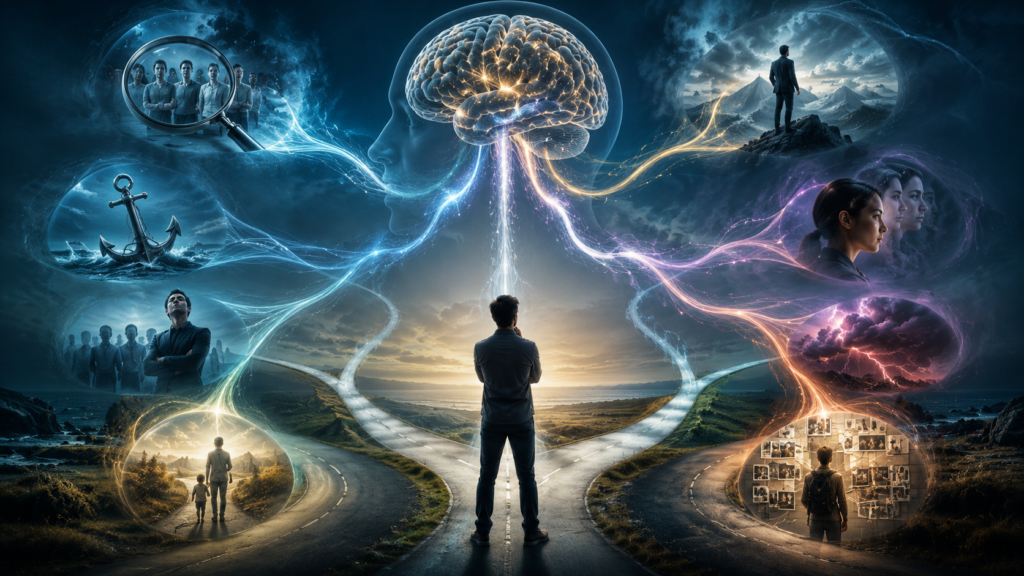
Every individual has a unique combination of personality traits.
Some people naturally enjoy social interaction, while others prefer quiet reflection. Some embrace new experiences, while others value routine and stability.
Neither approach is inherently better. Personality influences how we respond to situations, solve problems, communicate, and manage emotions.
Understanding personality differences can improve teamwork, friendships, and family relationships by encouraging empathy instead of judgment.
The Power of Environment
Our surroundings influence behaviour more than many people realize.
The people we spend time with, the media we consume, our workplace, culture, and daily routines all affect how we think and act.
For example:
- Healthy environments often encourage healthy habits.
- Positive role models influence motivation.
- Supportive communities improve confidence and resilience.
Changing your environment can sometimes be easier than relying on willpower alone.
💡 CurioReader Tip: If you’re trying to build a new habit, adjust your environment to support it. Small changes—like keeping books visible or turning off unnecessary notifications—can make good habits easier to maintain.
📌 Quick Summary
- Past experiences influence current behaviour.
- Cognitive biases affect everyone.
- Personality shapes how we see the world.
- Our environment has a powerful impact on our decisions and habits.
Understanding Human Behaviour
Human behaviour is driven by a combination of biological needs, emotions, goals, social influences, and learned experiences. Understanding these factors helps explain why people often behave differently in similar situations.
Motivation
Motivation is the force that encourages us to take action.
Some motivation comes from external rewards such as money, recognition, or grades.
Other motivation comes from within—personal satisfaction, curiosity, or the desire to grow.
Although external rewards can be helpful, long-term success often depends on intrinsic motivation because it remains even when rewards disappear.
🌟 CurioReader Insight: Lasting motivation usually comes from connecting your actions to a meaningful purpose rather than relying only on external rewards.
Emotions and Behaviour
Emotions influence nearly every decision we make.
Fear may encourage caution.
Joy encourages connection.
Curiosity drives learning.
Frustration may motivate change—or lead to impulsive decisions.
Healthy emotional awareness involves recognizing emotions without allowing them to completely control behaviour.
Social Influence
Humans are naturally social creatures.
We often adjust our behaviour based on the people around us, sometimes without realizing it.
Examples include:
- Following social norms.
- Copying the behaviour of others.
- Seeking approval.
- Feeling pressure to conform.
Understanding social influence helps us make more independent and thoughtful decisions.
Body Language
Communication isn’t limited to words.
Facial expressions, posture, gestures, and eye contact often communicate emotions more effectively than speech.
Although body language varies across cultures, paying attention to non-verbal communication can improve relationships and reduce misunderstandings.
Habits Drive Daily Life
Many daily actions occur automatically because repeated behaviours become habits.
Good habits make positive choices easier.
Poor habits can continue long after we recognize they aren’t beneficial.
Fortunately, habits can change through consistent practice and small, manageable improvements.
🔬 Science Says: Behavioural research suggests that changing the environment supporting a habit is often more effective than relying solely on willpower.
📌 Quick Summary
- Motivation explains why people take action.
- Emotions strongly influence behaviour.
- Social environments affect decision-making.
- Body language communicates important information.
- Habits shape much of everyday life.

Improving Your Psychological Well-being
Psychological well-being isn’t about being happy all the time. It involves developing healthy ways to understand yourself, manage challenges, and maintain meaningful relationships.
Build Self-Awareness
Self-awareness is the ability to recognize your thoughts, emotions, strengths, and areas for improvement.
Simple practices such as journaling, reflecting on experiences, or asking for constructive feedback can improve self-awareness over time.
Develop Emotional Intelligence
Emotional intelligence involves:
- Recognizing emotions.
- Managing emotional responses.
- Understanding other people’s feelings.
- Building positive relationships.
People with strong emotional intelligence often communicate more effectively and resolve conflicts more successfully.
Adopt a Growth Mindset
A growth mindset is the belief that abilities can improve through learning and effort.
Instead of saying:
“I’m just not good at this.”
Try asking:
“What can I learn to improve?”
This simple shift encourages persistence and continuous learning.
⚠️ Common Mistake: Believing that failure defines your ability. In reality, mistakes provide valuable feedback that helps you grow.
Manage Stress in Healthy Ways
Stress is a normal part of life, but chronic stress can affect both physical and mental well-being.
Healthy strategies include:
- Regular exercise.
- Adequate sleep.
- Relaxation techniques.
- Talking with trusted friends or family.
- Maintaining realistic expectations.
Seeking professional support is also appropriate when stress becomes difficult to manage.
💡 CurioReader Tip: Taking short breaks during busy days often improves focus and emotional resilience more than working continuously without rest.
📌 Quick Summary
- Self-awareness supports personal growth.
- Emotional intelligence strengthens relationships.
- A growth mindset encourages learning.
- Healthy stress management improves overall well-being.

Psychology in Everyday Life
Psychology isn’t limited to classrooms or research laboratories—it influences everyday experiences.
Understanding basic psychological principles can help you:
- Learn new skills more effectively.
- Build stronger relationships.
- Communicate clearly.
- Make better financial decisions.
- Improve workplace teamwork.
- Become a more informed consumer.
- Recognize manipulation and misinformation.
- Develop healthier habits.
The more you understand human behaviour, the more confidently you can navigate everyday situations.
Common Psychology Myths
Myth 1: Psychology Is Mind Reading
Psychologists cannot read minds. Psychology uses scientific research to understand patterns of human behaviour rather than predicting every individual’s thoughts.
Myth 2: Emotions Are a Sign of Weakness
Emotions are a natural part of being human. Learning to understand and regulate emotions is healthier than ignoring them.
Myth 3: Personality Never Changes
Although core personality traits tend to remain relatively stable, people continue learning, adapting, and developing throughout life.
Myth 4: Intelligence Determines Success
Success depends on many factors, including perseverance, opportunity, emotional intelligence, communication, learning habits, and resilience—not intelligence alone.
🧠 Did You Know? Psychological research consistently shows that lifelong learning and adaptability contribute significantly to personal and professional success.
Frequently Asked Questions
Is psychology a science?
Yes. Modern psychology uses scientific research, observation, experimentation, and evidence-based methods to understand behaviour and mental processes.
Can psychology help in everyday life?
Absolutely. Understanding psychology can improve communication, relationships, learning, decision-making, leadership, and self-awareness.
What’s the difference between psychology and neuroscience?
Psychology studies behaviour and mental processes, while neuroscience focuses on the structure and function of the brain and nervous system. The two fields often work together.
Can personality change over time?
Yes. While some personality traits remain relatively stable, life experiences, education, and personal growth can influence behaviour and attitudes throughout life.
Key Takeaways
Understanding human psychology helps explain why we think, feel, and behave the way we do.
Remember these key ideas:
- Human behaviour results from many interacting influences.
- Thoughts, emotions, memory, and habits shape everyday decisions.
- Cognitive biases affect everyone.
- Self-awareness and emotional intelligence improve relationships.
- Healthy habits and supportive environments encourage positive behaviour.
- Psychology provides practical insights that can improve learning, communication, and decision-making.
🌟 CurioReader Insight: Understanding psychology isn’t about changing who you are. It’s about understanding yourself well enough to make better choices and build stronger relationships.
Conclusion
Human psychology is one of the most fascinating fields of study because it helps explain the thoughts, emotions, motivations, and behaviours that shape our everyday lives. While no single theory can fully explain every human action, psychology provides valuable tools for understanding ourselves and the people around us.
By learning how the mind works, recognizing common thinking patterns, and developing greater self-awareness, we become better equipped to communicate effectively, manage emotions, build meaningful relationships, and make thoughtful decisions.
The journey to understanding human psychology is also a journey toward understanding yourself. Every new insight offers an opportunity to grow, adapt, and approach life’s challenges with greater confidence and empathy.
🚀 Your Next Step: This week, observe one of your daily habits or decisions and ask yourself, “What thoughts, emotions, or experiences influenced this?” Small moments of reflection can lead to meaningful personal growth.
Further Reading & Resources
Continue your learning journey with more expert guides and insightful articles from CurioReader. Explore related topics below to deepen your understanding and discover new perspectives.
Related CurioReader Articles
- What Happens After Death? Exploring Science, Philosophy, and Faith.
- Why Do We Dream? The Science Behind Dreams and Sleep.
Recommended External Resources