How Greenhouses Work
A greenhouse may look like a simple glass or plastic structure, but it is actually a carefully designed environment that allows people to control many of the conditions plants need to grow.
Outside, plants are exposed to constantly changing weather. Temperature can rise and fall, rain may be unpredictable, strong winds can cause damage, and pests and diseases can spread freely. A greenhouse creates a physical barrier between plants and much of this outside environment while still allowing sunlight to reach them.
The basic idea is simple: capture useful sunlight, manage heat and moisture, and create conditions that encourage healthy plant growth.
What Is a Greenhouse?
A greenhouse is a structure with transparent or translucent walls and a roof that allows sunlight to enter while creating a more controlled environment for plants.
Greenhouses can be very small, such as structures used in home gardens, or extremely large commercial facilities covering many hectares.
The materials used for the covering can include glass, plastic film or rigid plastic panels such as polycarbonate.
Although their designs vary, greenhouses generally provide growers with greater control over factors such as:
- Temperature
- Humidity
- Water
- Light
- Air circulation
- Growing conditions
- Protection from weather and some pests
This control is one of the main reasons greenhouses are useful in agriculture and horticulture.
How Sunlight Enters a Greenhouse
Sunlight provides the main source of energy for most greenhouse plants.
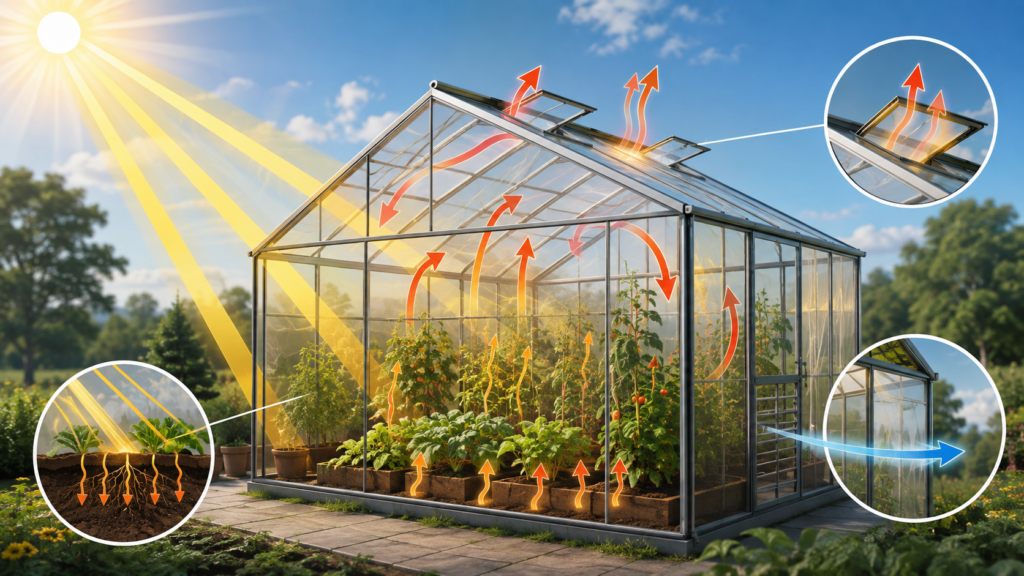
When sunlight reaches the greenhouse, some of it passes through the transparent covering and reaches the plants, soil, containers, benches and other surfaces inside.
Plants use sunlight for photosynthesis, the process through which they convert light energy into chemical energy that supports their growth.
But plants don’t absorb all the incoming energy.
Some sunlight is absorbed by surfaces inside the greenhouse. These surfaces become warmer and transfer heat to the surrounding air and other objects.
This is one reason the temperature inside a greenhouse can become higher than outside, particularly when sunlight is strong.
🔬 Science Background: The warming of a greenhouse involves several forms of energy transfer. Solar radiation enters through the covering, surfaces absorb energy and warm up, and heat is then transferred through radiation, conduction and moving air.
Why Does a Greenhouse Become Warm?
People often say that a greenhouse becomes warm because the glass “traps heat.”
This is a useful simplified explanation, but the actual process is more complicated.
Sunlight can pass through the greenhouse covering. Once inside, energy is absorbed by plants, soil and other surfaces. These surfaces warm up and transfer energy to their surroundings.
The enclosure also restricts the free movement of air.
In an open field, warm air can move away easily and be replaced by cooler air. Inside a greenhouse, the structure limits this exchange unless doors, windows, vents or fans are used.
As a result, heat can accumulate.
This is why a greenhouse can become surprisingly hot on a sunny day, even when the outdoor temperature is relatively comfortable.
The Greenhouse Covering Matters
The covering is one of the most important parts of the structure.
Different materials allow different amounts of light to pass through and have different insulation, durability and cost characteristics.
Glass has excellent light-transmission properties and can remain useful for many years. It is traditionally associated with permanent greenhouses.
Plastic film is lightweight and relatively inexpensive. It is widely used in agricultural structures but generally needs replacement more frequently than rigid materials.
Polycarbonate panels are lightweight and durable and can provide useful insulation, particularly when constructed with multiple layers.
The choice depends on the climate, crop, budget, structure and desired level of environmental control.
Managing Temperature
Plants generally grow best within particular temperature ranges.
If temperatures become too low, growth may slow and sensitive plants can be damaged.
If temperatures become too high, plants can experience heat stress, excessive water loss and other problems.
Greenhouses therefore need methods of controlling temperature.
Simple structures may rely mostly on natural ventilation.
More sophisticated facilities can use:
- Roof vents
- Side vents
- Fans
- Heating systems
- Cooling systems
- Shade screens
- Evaporative cooling
- Automated climate controls
Natural ventilation is particularly useful because warm air tends to rise.
Vents positioned higher in the structure can allow hot air to escape while cooler outside air enters through lower openings.
This can reduce the temperature without requiring large amounts of mechanical energy.
🌱 CurioReader Insight: A greenhouse isn’t simply a place where plants are kept warm. Its real advantage is the ability to manage environmental conditions according to what the plants actually need.
Humidity and Air Circulation
Temperature is only one part of the growing environment.
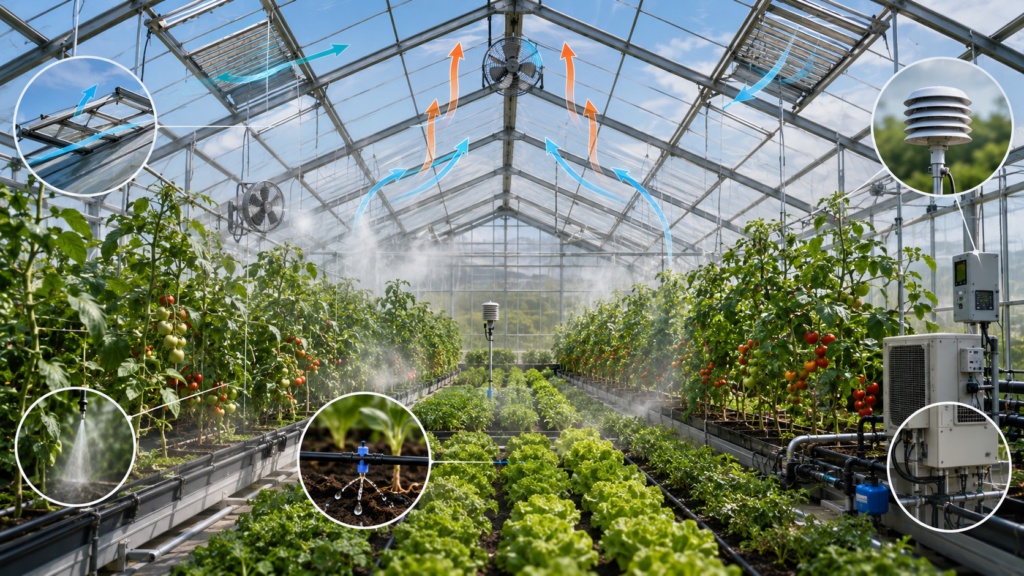
Plants also release water vapour into the air through transpiration. In an enclosed structure, this moisture can accumulate.
High humidity can encourage certain fungal diseases and other plant problems, particularly when air circulation is poor.
Good ventilation therefore serves several purposes.
It can:
- Remove excess heat
- Reduce excessive humidity
- Improve air movement
- Help manage disease risk
- Provide fresh air
- Create more stable growing conditions
This illustrates why simply sealing a greenhouse is not enough.
The same structure that protects plants from outside conditions must also provide a way to remove excess heat and moisture.
Water Management
Greenhouses can give growers greater control over how plants receive water.
Outdoor crops may depend heavily on rainfall, but greenhouse crops can receive water according to a planned schedule.
Common systems include:
- Drip irrigation
- Micro-irrigation
- Automated watering
- Moisture sensors
- Recirculating water systems
Drip irrigation, for example, can deliver water directly to the growing area near plant roots.
This can reduce unnecessary water loss compared with less targeted methods.
However, a greenhouse is not automatically water-efficient. Good resource management depends on the irrigation system, crop requirements, climate and management practices.
Light Can Be Managed Too
Sunlight is essential, but too much sunlight can sometimes be harmful.
During periods of intense sunlight, greenhouse temperatures can rise quickly and plants may experience excessive heat or light stress.
Growers can use shade cloths or screens to reduce incoming sunlight when necessary.
In some commercial greenhouses, artificial lighting is also used.
This can supplement natural sunlight during darker periods or provide more consistent conditions for certain crops.
Advanced facilities may monitor light intensity and adjust lighting automatically.
This creates another level of environmental control.
Different Types of Greenhouses
Not all greenhouses are designed for the same purpose.
Home greenhouses are usually small and may be used to grow vegetables, flowers, herbs or seedlings.
Commercial greenhouses can be enormous and are designed for efficient crop production.
Research greenhouses allow scientists to study plants under carefully controlled conditions.
High-tech greenhouses may combine sensors, computer systems, automated irrigation, climate control, heating, cooling and artificial lighting.
Some modern facilities are effectively controlled agricultural environments rather than traditional gardens.
❓ Did You Know? Greenhouses are also important scientific research environments. Researchers can use them to study how plants respond to temperature, light, water availability, nutrients and other environmental conditions.
Technology Is Changing Greenhouses
Technology has significantly expanded what a greenhouse can do.
Sensors can monitor:
- Temperature
- Humidity
- Soil moisture
- Light levels
- Carbon dioxide concentration
- Other environmental conditions
Computer systems can then use this information to control equipment.
For example, if the temperature rises above a chosen level, automated vents may open. If humidity becomes excessive, ventilation may increase. Irrigation systems can deliver water according to programmed schedules or sensor readings.
Some advanced greenhouses can therefore operate as highly controlled ecosystems.
The underlying principle, however, remains remarkably simple.
Plants need suitable conditions to grow, and greenhouses give people greater control over those conditions.
From a small backyard structure to a highly automated commercial facility, the same basic concepts apply: sunlight enters, plants use light and water, heat and moisture must be managed, and the environment is adjusted to support healthy growth.
But controlling the growing environment is only part of the story.
The bigger question is why this technology matters.
Greenhouses can extend growing seasons, protect crops from difficult weather, support food production, improve growing efficiency and allow crops to be produced in environments where outdoor agriculture would be much more difficult.
Why Greenhouses Matter
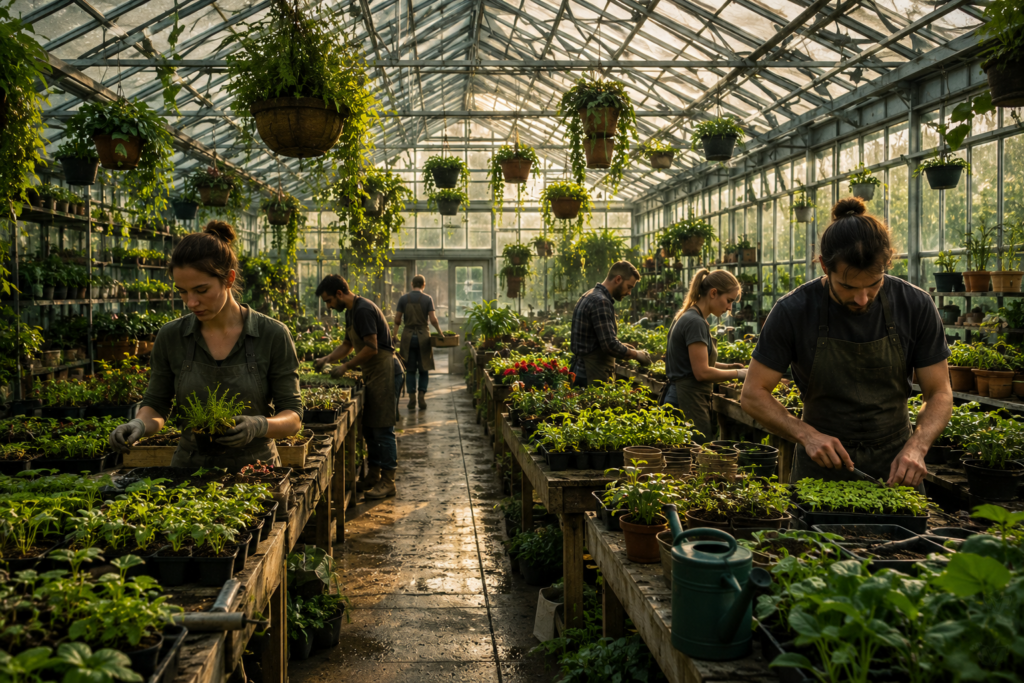
Greenhouses are often associated with gardening, but their importance extends far beyond growing a few plants under glass.
They have become valuable tools for agriculture, horticulture, scientific research and food production because they allow people to reduce their dependence on outdoor weather conditions.
A greenhouse cannot completely eliminate environmental challenges, and it is not automatically more sustainable than outdoor farming. However, when designed and managed appropriately, it can provide growers with greater control over the conditions that influence plant growth.
Extending the Growing Season
One of the simplest benefits of a greenhouse is that it can extend the period during which plants can be grown.
Outdoor growing is strongly influenced by seasons.
Cold temperatures can prevent certain plants from growing during winter, while frost can damage sensitive crops. A greenhouse provides a protected environment that can allow growers to begin cultivation earlier or continue production later than would normally be possible outdoors.
For gardeners, this can mean starting seedlings earlier in the year.
For commercial growers, extending the growing season can provide additional opportunities to produce crops outside their normal outdoor growing period.
The exact benefit depends on the greenhouse design, local climate, crop and level of environmental control.
🌱 CurioReader Insight: A greenhouse doesn’t necessarily create a completely artificial growing season. Instead, it can provide enough protection and environmental control to make growing possible during periods when outdoor conditions would otherwise be unsuitable.
Growing Food in Difficult Climates
Agriculture is highly dependent on climate.
Some crops require warm conditions, while others perform better in cooler environments. Extreme temperatures, frost, excessive rainfall and strong winds can all make outdoor cultivation more difficult.
Greenhouses can reduce exposure to some of these conditions.
A protected structure can shield plants from:
- Strong winds
- Heavy rainfall
- Frost
- Some temperature extremes
- Certain pests
- Physical weather damage
This doesn’t mean greenhouse farming can make any crop grow anywhere.
Energy, water, soil or growing media, sunlight and other resources are still required.
However, environmental control can expand the range of conditions in which particular crops can be cultivated.
Supporting Reliable Food Production
One of the biggest challenges facing agriculture is producing food consistently despite changing environmental conditions.
A field crop can be affected by drought, storms, frost or excessive rainfall.
Greenhouses provide a degree of protection from these external conditions.
For commercial growers, this can make production more predictable.
Instead of depending entirely on outdoor weather, growers can monitor and adjust conditions inside the growing environment.
This is particularly valuable for crops that have specific temperature or humidity requirements.
📊 Agricultural Background: Greenhouse production is a form of protected cultivation. Rather than leaving crops completely exposed to the surrounding environment, growers create a controlled or partially controlled growing space.
More Precise Water Management
Water is another area where greenhouse cultivation can provide advantages.
Outdoor agriculture can lose water through evaporation, runoff and inefficient irrigation.
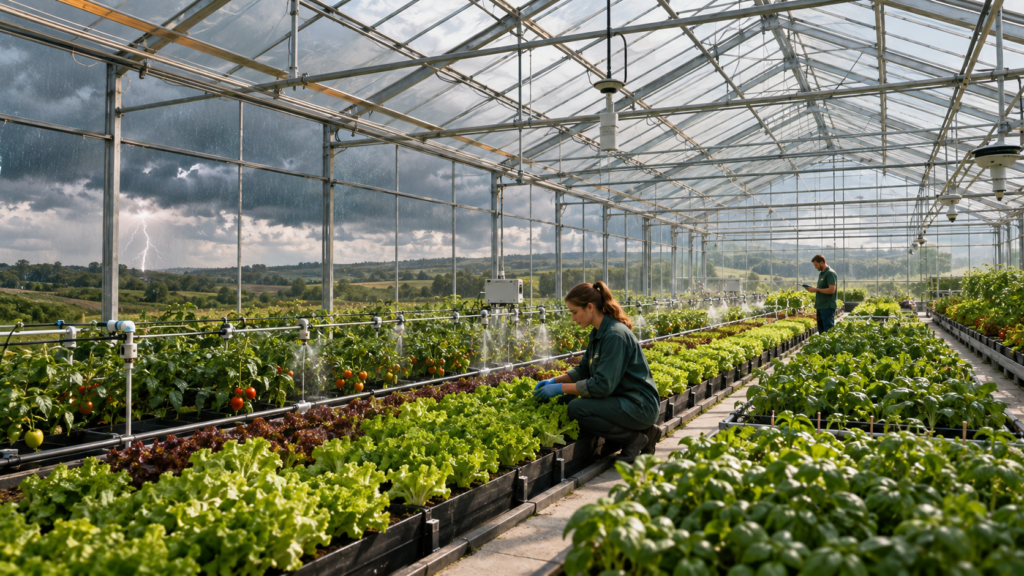
Inside a greenhouse, irrigation can be more precisely controlled.
Drip systems can deliver water close to plant roots, while sensors can help determine when additional irrigation may be required.
Some advanced systems collect and reuse water.
This can potentially reduce water consumption, particularly when compared with less efficient irrigation practices.
However, water savings are not guaranteed.
A greenhouse with poorly designed irrigation or excessive watering can still waste large amounts of water.
The important factor is how the system is managed.
Protecting Plants From Pests and Diseases
Greenhouses create a physical barrier between crops and the outside environment.
This can make it more difficult for some pests to reach plants.
Screens, controlled entrances and sanitation practices can provide additional protection.
However, greenhouses are not pest-proof.
In fact, once certain pests or diseases enter a greenhouse, the controlled environment can sometimes provide favourable conditions for them to spread.
This is why greenhouse management can involve:
- Monitoring plants
- Controlling humidity
- Maintaining air circulation
- Removing infected material
- Cleaning equipment
- Managing entry points
- Using appropriate pest-management strategies
The enclosed environment gives growers greater control, but it also requires careful management.
Producing Crops More Consistently
Traditional outdoor agriculture is strongly influenced by seasonal weather.
A greenhouse can make production more predictable by allowing growers to control important environmental factors.
For example, a commercial greenhouse may regulate temperature and irrigation according to the crop’s growth stage.
This can help create more consistent growing conditions.
In some cases, controlled environments can also improve the uniformity of crops.
For commercial agriculture, consistency can be important because food markets require reliable supplies and predictable quality.
Greenhouses and Scientific Research
Greenhouses are not only agricultural production facilities.
They are also important research environments.
Scientists can use greenhouses to investigate how plants respond to different conditions.
For example, researchers might study the effects of:
- Temperature
- Water availability
- Light intensity
- Nutrients
- Carbon dioxide
- Soil conditions
- Plant diseases
A controlled environment makes it easier to change one or more variables while observing how plants respond.
This can be particularly valuable when studying plant physiology, crop improvement and responses to environmental stress.
❓ Did You Know? A greenhouse can function as a kind of experimental environment for plants. Researchers can manipulate growing conditions while observing how different varieties respond.
Greenhouses in Urban Agriculture
Greenhouses can also support food production in places where traditional farmland is limited.
Urban agriculture uses available spaces within or around cities to grow food.
Depending on the location, this may include:
- Rooftops
- Small plots
- Community gardens
- Indoor growing facilities
- Vertical farming structures
- Small commercial greenhouses
Growing food closer to consumers can potentially reduce the distance some products need to travel, although the overall environmental impact depends on how the food is produced, transported and stored.
Urban greenhouses can also provide educational and community benefits.
They can help people understand where food comes from and how plants respond to environmental conditions.
High-Tech Greenhouses
The modern greenhouse is increasingly becoming a technology platform.
Advanced commercial facilities can use sensors and automated systems to monitor growing conditions continuously.
A computer system may receive information about temperature, humidity, light and moisture and adjust equipment accordingly.
For example:
Temperature rises
↓
Sensors detect the change
↓
Ventilation or cooling activates
↓
Internal conditions are adjusted
This type of automation can reduce the need for constant manual intervention.
Some facilities also use cameras and data analysis to monitor plant health and identify potential problems.
The combination of agriculture and technology is creating increasingly sophisticated controlled-environment agriculture systems.
Are Greenhouses Environmentally Friendly?
This question doesn’t have a simple yes-or-no answer.
Greenhouses can offer environmental advantages in some situations, but they can also have environmental costs.
Potential benefits include:
- More precise irrigation
- Reduced exposure to weather-related crop losses
- Efficient use of growing space
- Controlled application of nutrients
- Potentially higher productivity per unit of land
- Local production of certain crops
But greenhouse operations can also require significant resources.
Heating may consume energy.
Cooling can require electricity.
Artificial lighting can increase energy demand.
Construction requires materials.
Plastic coverings eventually need replacement.
The environmental performance of a greenhouse therefore depends heavily on its design, location, energy source, crop and management system.
🔬 Science Background: A greenhouse should be evaluated as a complete production system. High crop productivity does not automatically mean low environmental impact; energy, water, materials, transport and waste all contribute to the overall footprint.
Solar Energy and Greenhouses
The use of renewable energy can potentially reduce some of the environmental costs associated with greenhouse production.
Solar panels, for example, can provide electricity for pumps, sensors, lighting and other equipment.
However, renewable energy systems also require materials and investment.
The most effective approach is usually to combine several strategies:
- Reduce unnecessary energy demand
- Improve insulation
- Use natural ventilation when possible
- Make efficient use of sunlight
- Use renewable energy where practical
- Monitor energy consumption
- Match environmental controls to actual crop requirements
The goal is not simply to add technology.
It is to use technology intelligently.
The Future of Greenhouses
The greenhouse of the future may look very different from the traditional glass structures that people imagine.
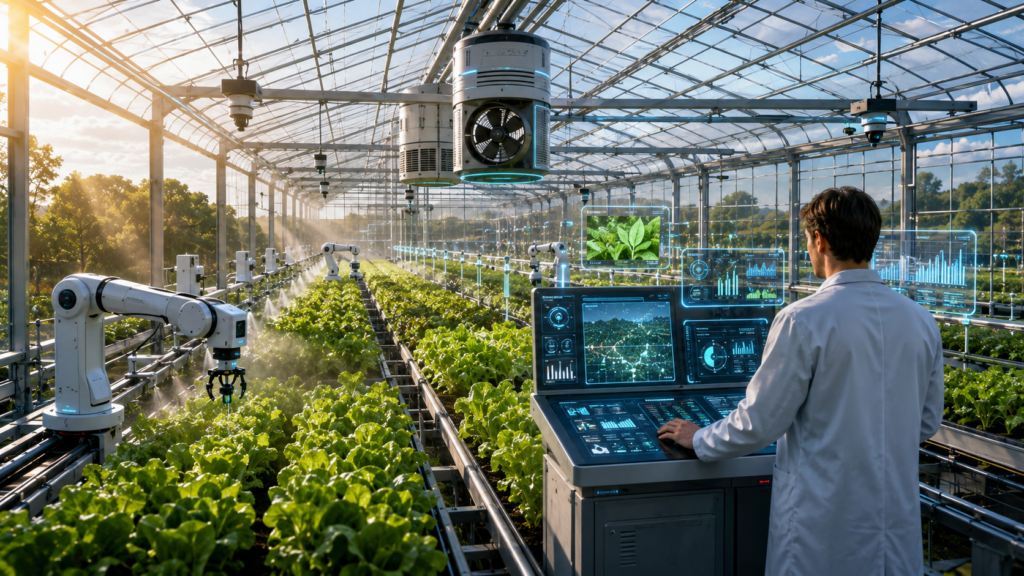
Artificial intelligence, robotics, sensors and automation are increasingly influencing controlled-environment agriculture.
Future systems may become better at detecting plant stress before it becomes obvious to humans.
Robotic systems may assist with harvesting, monitoring or maintenance.
Sensors may continuously measure growing conditions.
AI systems could analyze large quantities of environmental and plant data to help growers make decisions.
However, technological sophistication does not eliminate the fundamental requirements of plants.
They still need appropriate light, water, nutrients, temperature and other conditions.
Technology simply provides better tools for managing those requirements.
🤖 CurioReader Technology Insight: The future of greenhouse farming is likely to involve a combination of biological knowledge and digital technology. The objective isn’t to replace understanding of plants, but to use data and automation to manage their environment more precisely.
Greenhouses Are Tools, Not Magic Solutions
It is easy to view greenhouses as a perfect answer to agricultural challenges.
They are not.
They require investment, maintenance, energy and careful management.
A greenhouse can protect plants from certain environmental problems, but it can also create new challenges.
Excessive heat can develop quickly.
Humidity can become difficult to manage.
Pests can still enter.
Equipment can fail.
Energy costs can become significant.
The best greenhouse systems therefore balance protection, productivity, resource use and environmental impact.
Key Takeaways
- Greenhouses provide greater control over the environment in which plants grow.
- They can extend growing seasons and protect crops from some weather conditions.
- Controlled irrigation can improve water management.
- Greenhouses can support more predictable crop production.
- They are valuable environments for agricultural and scientific research.
- Urban greenhouses can contribute to local food production.
- Modern facilities increasingly use sensors, automation and data analysis.
- Greenhouses are not automatically environmentally friendly; their impact depends on energy, water, materials and management.
- Future greenhouse systems are likely to combine agriculture with AI, robotics, sensors and advanced automation.
- The fundamental purpose remains the same: creating suitable conditions for healthy plant growth.
Frequently Asked Questions
Do greenhouses work in winter?
Yes, greenhouses can allow plants to grow during colder periods, but their effectiveness depends on the climate, greenhouse design and crop. In very cold conditions, additional heating or insulation may be necessary.
Do plants grow faster in a greenhouse?
They can, when the greenhouse provides favourable conditions such as suitable temperature, light, water and nutrients. However, simply placing a plant inside a greenhouse does not automatically make it grow faster.
Do greenhouses use a lot of water?
Water use varies considerably. Well-designed irrigation systems can deliver water efficiently, while poorly managed systems can waste water. Factors such as crop type, climate and irrigation technology all matter.
Can any plant be grown in a greenhouse?
No. Different plants have different environmental requirements. A greenhouse can provide greater control, but it cannot eliminate the biological requirements of a crop.
Are greenhouses better for the environment than outdoor farming?
Not necessarily. Greenhouses can improve resource efficiency in some situations, but heating, cooling, artificial lighting, construction materials and other inputs can increase environmental impacts. The overall result depends on how the greenhouse is designed and operated.
Conclusion
Greenhouses demonstrate how a relatively simple idea can become an important agricultural technology.
By placing plants inside a structure that allows sunlight to enter while providing greater environmental control, growers can influence temperature, humidity, irrigation, light and protection from external conditions.
That control has important consequences.
It can extend growing seasons, protect valuable crops, support food production, provide controlled environments for research and make it possible to cultivate plants under conditions that would otherwise be challenging.
Modern technology is taking the concept even further.
Sensors can monitor the growing environment. Automated systems can adjust ventilation and irrigation. Data analysis can help identify problems. Artificial intelligence and robotics may eventually allow greenhouse operations to become even more precise and efficient.
But the fundamental principle has remained unchanged.
Plants need the right conditions to grow, and greenhouses give people greater control over those conditions.
The future challenge will be making that control as efficient and sustainable as possible.
A successful greenhouse is therefore not simply a structure that keeps plants warm.
It is a carefully managed system that balances sunlight, water, temperature, air, energy, technology and biology.
And that is why greenhouses matter—not because they allow us to completely control nature, but because they give us a practical way to work with it.
Further Reading & Resources
Continue your learning journey with more expert guides and insightful articles from CurioReader. Explore related topics below to deepen your understanding and discover new perspectives.
Related CurioReader Articles
Recommended External Resources