Introduction
The Future of Smartphones: 15 Mobile Technology Trends Changing the Way We Live. Over the past two decades, smartphones have evolved from simple communication devices into powerful pocket-sized computers that shape nearly every aspect of modern life. They have transformed the way we communicate, work, learn, shop, travel, entertain ourselves, and even monitor our health. For many people, a smartphone is no longer just a convenience—it has become an essential tool for everyday living.
The pace of innovation has accelerated dramatically in recent years. Improvements are no longer limited to faster processors or sharper displays. Today’s smartphones are becoming increasingly intelligent, powered by artificial intelligence (AI), advanced camera systems, sophisticated sensors, satellite communication, and seamless integration with other smart devices. As mobile technology continues to evolve, smartphones are becoming more proactive, personalized, and capable than ever before.
Looking ahead, the future of smartphones is likely to be shaped by a combination of hardware innovation, software intelligence, sustainability, and connectivity. Technologies that once seemed futuristic—such as real-time language translation, AI-powered assistants, foldable displays, and satellite messaging—are already finding their way into consumer devices. Emerging developments in augmented reality, on-device AI, advanced battery technology, and next-generation wireless networks promise to push the boundaries even further.
This article explores 15 major mobile technology trends that are expected to shape the next generation of smartphones. Rather than focusing on a particular brand or model, we’ll examine the technologies themselves, how they work, why they matter, and how they may change the way we live, work, and interact with the world.
CurioReader Insight: The biggest smartphone innovations today are increasingly driven by software rather than hardware. Artificial intelligence, advanced computing, and intelligent software are transforming existing hardware into devices that can understand context, automate tasks, and adapt to individual users.
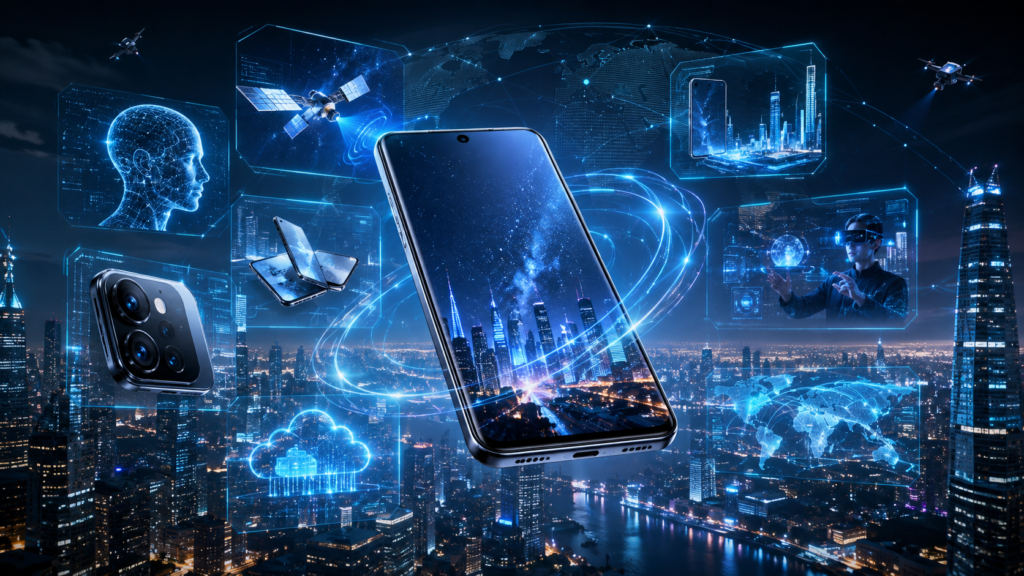
Why Smartphone Technology Continues to Evolve
Smartphones have become one of the most competitive areas of consumer technology. Every year, manufacturers introduce new features designed to improve performance, convenience, and user experience.
Several factors continue driving innovation:
- Growing demand for faster performance.
- Advances in artificial intelligence.
- Improvements in semiconductor manufacturing.
- Better battery technology.
- Expansion of 5G networks.
- Increased focus on privacy and security.
- Integration with wearable devices.
- Consumer demand for longer-lasting, more sustainable products.
Unlike earlier generations of smartphones, today’s innovations focus less on dramatic hardware changes and more on creating devices that understand users, anticipate needs, and perform complex tasks automatically.
For example, modern smartphones can:
- Translate conversations in real time.
- Remove unwanted objects from photographs.
- Detect potential security threats.
- Optimize battery usage automatically.
- Identify songs, plants, or landmarks using AI.
- Assist with writing, summarizing, and organizing information.
These capabilities are becoming possible because smartphones now contain specialized processors designed specifically for artificial intelligence.
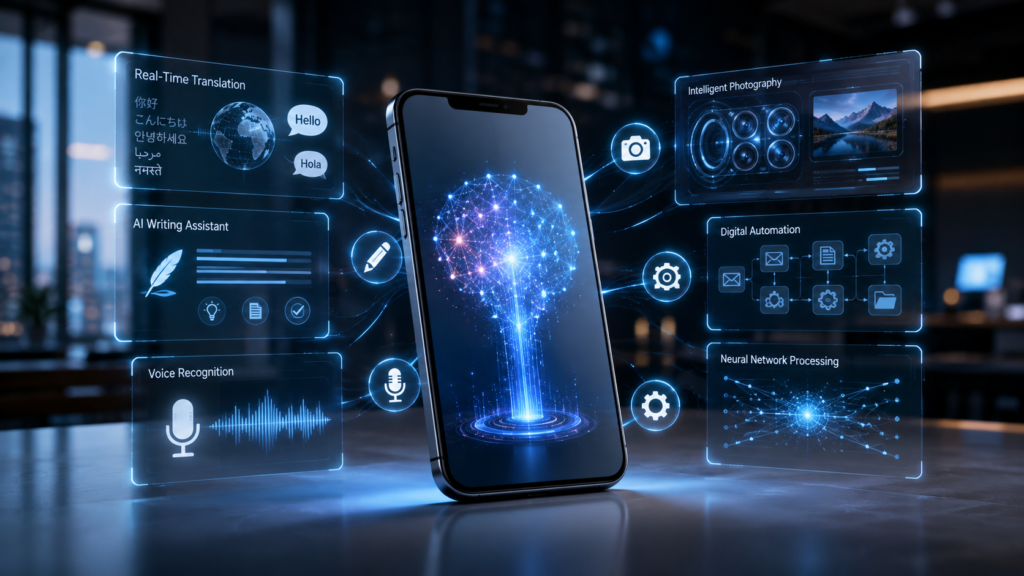
Did You Know? Modern flagship smartphones can perform trillions of AI operations every second using dedicated Neural Processing Units (NPUs). These specialized processors allow many AI features to run directly on the device without sending personal information to remote servers.
Trend 1: Artificial Intelligence Becomes the Heart of Smartphones
Artificial intelligence is no longer just an optional feature—it is rapidly becoming the central technology powering the next generation of smartphones.
Rather than requiring users to manually perform every task, AI enables smartphones to recognize patterns, understand context, and assist with everyday activities more intelligently.
This shift marks one of the biggest transformations in mobile technology since the introduction of touchscreen smartphones.
What Is On-Device AI?
In the past, many AI-powered features relied heavily on cloud computing. Photos, voice recordings, and text were often sent to remote servers for processing before results were returned to the device.
Today, many smartphones perform these tasks directly on the device itself.
This approach is known as on-device AI.
Instead of transmitting personal information across the internet, the smartphone’s processor performs AI calculations locally.
This offers several important advantages:
- Faster responses.
- Improved privacy.
- Reduced internet dependence.
- Lower latency.
- Better energy efficiency for certain tasks.
As smartphone processors become more powerful, on-device AI is expected to become standard across many mobile applications.
AI-Powered Personal Assistants
Virtual assistants are evolving far beyond simple voice commands.
Future AI assistants are expected to:
- Understand natural conversations.
- Remember user preferences.
- Organize schedules automatically.
- Suggest reminders based on context.
- Summarize emails and documents.
- Draft messages.
- Provide intelligent travel recommendations.
- Assist with learning and productivity.
Rather than waiting for commands, future assistants may proactively suggest useful actions based on a user’s habits and current situation.
For example, if traffic conditions worsen before an appointment, an AI assistant might recommend leaving earlier without being asked.
AI in Photography
Smartphone photography has undergone remarkable changes thanks to artificial intelligence.
Today’s cameras do much more than capture light.
AI now helps smartphones:
- Recognize scenes automatically.
- Adjust exposure.
- Improve color accuracy.
- Reduce image noise.
- Enhance portraits.
- Stabilize video.
- Remove unwanted objects.
- Recover details in low-light images.
This process, often called computational photography, combines multiple images with AI processing to produce photographs that would be difficult—or impossible—to capture using hardware alone.
As AI continues improving, smartphone cameras are expected to deliver increasingly professional-quality results while requiring less manual adjustment from users.
Technology Spotlight: Computational photography combines camera hardware with sophisticated software algorithms. Instead of relying solely on a single photograph, smartphones often capture multiple images in rapid succession and merge them using AI to improve sharpness, color, and dynamic range.
AI for Productivity
Artificial intelligence is also transforming smartphones into powerful productivity tools.
Modern AI features increasingly support:
- Writing assistance.
- Grammar improvement.
- Document summarization.
- Voice transcription.
- Meeting notes.
- Email organization.
- Language translation.
- Smart search.
Many of these tasks now happen almost instantly, reducing the time needed to complete everyday work.
Students, professionals, researchers, and business owners are likely to benefit from increasingly intelligent mobile productivity tools in the coming years.
AI and Privacy
As AI becomes more capable, protecting user privacy becomes increasingly important.
Technology companies are investing in methods that process sensitive information without unnecessarily transmitting personal data.
Examples include:
- On-device speech recognition.
- Local facial recognition.
- Offline image analysis.
- Private AI assistants.
- Secure data processing environments.
Balancing convenience with privacy will remain one of the most important challenges in future smartphone development.
Future Outlook: Industry analysts expect smartphones to evolve into highly personalized AI companions capable of understanding routines, preferences, and context while maintaining stronger privacy protections through increased on-device processing.
Trend 2: Foldable and Rollable Displays
For many years, smartphone design remained relatively unchanged—a flat rectangular screen with incremental improvements each generation.
Foldable displays have begun changing that pattern.
Instead of increasing screen size by making devices physically larger, manufacturers have developed flexible display technologies that allow phones to fold into more compact forms while expanding into tablet-sized screens when needed.
These devices aim to combine portability with productivity.
Some models fold like a book, while others use a clamshell design that becomes significantly smaller when closed.
Researchers and manufacturers are also exploring rollable displays, where flexible screens extend outward from the phone’s body when additional display space is required.
Although still an emerging technology, rollable smartphones demonstrate how future devices may adapt dynamically to different tasks.
Benefits of Foldable Smartphones
Foldable technology offers several potential advantages.
Users can enjoy:
- Larger screens for multitasking.
- Improved productivity.
- Better gaming experiences.
- More immersive video viewing.
- Enhanced digital reading.
- Easier portability compared with traditional tablets.
Business professionals may particularly benefit from larger workspaces while traveling, allowing documents, presentations, and video conferences to be viewed more comfortably.
However, foldable technology continues evolving, and manufacturers are working to improve durability, reduce visible screen creases, lower costs, and extend battery life.
Historical Perspective: When touchscreen smartphones first appeared in the late 2000s, flexible displays were largely experimental technologies found only in research laboratories. Today, foldable devices are commercially available, demonstrating how quickly mobile engineering continues to advance.
Quick Summary
So far, we’ve explored two of the most influential trends shaping the future of smartphones:
- Artificial intelligence is becoming the core technology behind smarter, faster, and more personalized mobile experiences.
- On-device AI improves privacy, speed, and efficiency by processing information locally.
- Computational photography is transforming smartphone cameras into intelligent imaging systems.
- Foldable displays are redefining smartphone design by combining portability with larger workspaces.
- Rollable display technology may represent the next stage in mobile hardware innovation.
Trend 3: Smarter Smartphone Cameras
For many people, the camera has become the single most important feature when choosing a new smartphone. From capturing family memories and creating social media content to attending virtual meetings and scanning important documents, smartphone cameras now serve purposes that once required several separate devices.
Modern smartphone photography is no longer defined only by the number of megapixels. Instead, manufacturers combine advanced camera hardware with powerful software and artificial intelligence to produce images that are sharper, brighter, and more detailed than ever before.
Today’s flagship smartphones are capable of taking professional-looking photographs in situations that were once extremely challenging, including low-light environments, fast-moving subjects, and high-contrast scenes.
As a result, smartphones have become the primary camera for millions of people around the world.
CurioReader Insight: Image quality depends on much more than megapixels. Sensor size, lens quality, image processing, and artificial intelligence often have a greater impact on the final photograph than resolution alone.
Computational Photography
One of the biggest breakthroughs in smartphone imaging is computational photography.
Unlike traditional cameras that rely mainly on optics, smartphones use advanced software to improve every image before it is saved.
When you press the shutter button, many smartphones actually capture multiple photographs within a fraction of a second.
Artificial intelligence then analyzes these images to:
- Improve sharpness.
- Reduce digital noise.
- Recover shadow details.
- Enhance colors.
- Balance exposure.
- Increase dynamic range.
- Reduce motion blur.
The final image is often a combination of several photographs merged into one optimized result.
This explains why modern smartphones can produce excellent photos even though their camera sensors remain much smaller than those found in professional cameras.
Larger Camera Sensors
While software plays an increasingly important role, hardware continues to improve as well.
Manufacturers are introducing:
- Larger image sensors.
- Better optical stabilization.
- Wider apertures.
- Improved lens coatings.
- Faster image processors.
Larger sensors collect more light, allowing cameras to perform better in challenging lighting conditions.
Benefits include:
- Less image noise.
- Better background blur.
- Improved night photography.
- More natural colors.
- Greater detail.
These improvements help smartphones capture clearer images without requiring users to understand complex camera settings.
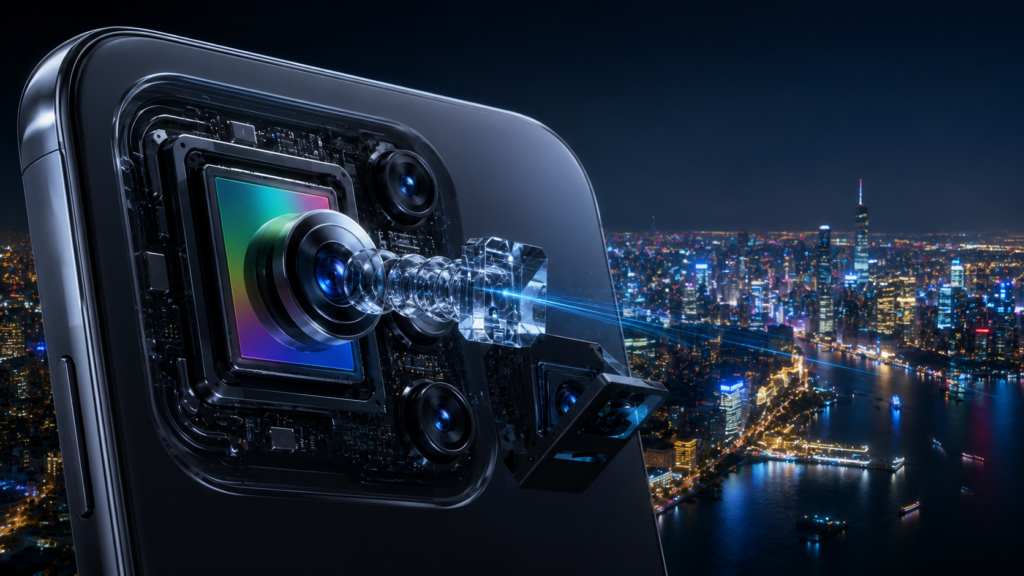
Periscope Zoom Technology
Traditional smartphone cameras are limited by the thin design of modern devices.
To overcome this challenge, manufacturers developed periscope telephoto lenses.
Instead of positioning the lens vertically, light is redirected through a prism before traveling horizontally inside the phone.
This innovative design allows much greater optical zoom while maintaining a slim profile.
Periscope cameras are especially useful for:
- Wildlife photography.
- Sports events.
- Concerts.
- Travel photography.
- Architectural details.
Unlike digital zoom, which simply enlarges an image, optical zoom preserves far more detail.
AI Video Enhancement
Photography is only part of the story.
Video recording has also improved dramatically.
Artificial intelligence now assists with:
- Automatic subject tracking.
- Video stabilization.
- Background noise reduction.
- HDR video.
- Real-time lighting adjustments.
- Cinematic depth effects.
- Automatic subtitles.
- Voice enhancement.
These features enable users to create professional-looking videos directly from their smartphones without specialized equipment.
Technology Spotlight: Some flagship smartphones now record 8K video, capture high-frame-rate slow motion, and stabilize footage using both optical hardware and AI-powered software simultaneously.
Photography Beyond the Camera
Artificial intelligence continues working even after the photo has been taken.
Modern editing tools allow users to:
- Remove unwanted objects.
- Replace distracting backgrounds.
- Improve facial expressions.
- Correct perspective.
- Sharpen blurry photos.
- Restore old images.
- Automatically organize photo libraries.
Many of these editing features operate with just a single tap, making advanced photo editing accessible to everyone.
Myth vs. Fact
| Myth | Fact |
|---|---|
| More megapixels always produce better photos. | Image quality depends on sensor size, optics, lighting conditions, and image processing as well as resolution. |
| Smartphone cameras will completely replace professional cameras. | Smartphones excel in convenience and computational photography, while dedicated cameras continue to offer advantages for specialized photography. |
| AI creates fake photographs. | Most smartphone AI enhances images by improving exposure, sharpness, and color while preserving the original scene, although some editing features can generate or modify content. |
Looking Beyond Today’s Smartphones
Although artificial intelligence, flexible displays, and advanced cameras dominate current innovation, they represent only the beginning of a much broader transformation.
Future smartphones are expected to become increasingly intelligent companions rather than simple communication devices.
Researchers are exploring technologies that could allow phones to:
- Anticipate user needs.
- Understand complex conversations.
- Interact naturally across multiple devices.
- Perform sophisticated tasks without constant user input.
- Operate more efficiently while consuming less power.
Instead of opening individual apps for every activity, future smartphones may complete many everyday tasks through intelligent assistants that understand context and preferences.
For example, rather than manually planning a trip, an AI-powered phone could compare travel options, organize your itinerary, suggest accommodation, translate conversations, and update your schedule automatically.
The Growing Smartphone Ecosystem
Smartphones no longer operate independently.
They increasingly function as the central hub connecting an expanding ecosystem of smart devices.
Many users already synchronize their phones with:
- Smartwatches.
- Wireless earbuds.
- Tablets.
- Laptops.
- Smart televisions.
- Smart home devices.
- Connected vehicles.
- Health monitoring devices.
As ecosystems become more integrated, users will experience smoother transitions between devices without needing to repeat tasks manually.
For example:
- Begin writing a document on your phone and finish it on your laptop.
- Unlock your car using your smartphone.
- Control home lighting with voice commands.
- Automatically transfer photos to cloud storage or home computers.
- Monitor fitness information across multiple devices.
Future ecosystems are expected to become even more seamless through artificial intelligence and improved wireless communication.
Did You Know? The average person now spends several hours each day using a smartphone, making it one of the most frequently used pieces of technology in modern life. As mobile ecosystems expand, smartphones are becoming the digital control center for many everyday activities.
Challenges Facing Smartphone Innovation
Despite remarkable progress, smartphone manufacturers continue facing several important challenges.
Battery Limitations
Although processors become faster every year, battery technology evolves more gradually.
Balancing powerful features with all-day battery life remains one of the industry’s biggest engineering challenges.
Privacy
As smartphones collect more information to provide personalized experiences, protecting user privacy becomes increasingly important.
Manufacturers are investing heavily in:
- On-device processing.
- Data encryption.
- Secure hardware.
- Permission controls.
- Privacy-focused AI.
Maintaining user trust will remain essential as AI capabilities continue expanding.
Sustainability
Consumers are becoming more aware of environmental issues.
Future smartphones are increasingly expected to:
- Last longer.
- Receive extended software updates.
- Use recycled materials.
- Be easier to repair.
- Reduce electronic waste.
- Improve energy efficiency.
Sustainability is becoming an important area of innovation alongside performance.
Affordability
Advanced technologies often increase manufacturing costs.
One challenge for the industry is making innovations accessible across both premium flagship devices and more affordable smartphones.
Over time, many features that begin in flagship models gradually become available in mid-range and budget devices.
Future Outlook
Future Outlook: The next decade is likely to shift smartphone innovation away from simply making devices faster toward making them significantly smarter. Artificial intelligence, seamless ecosystems, sustainable design, and context-aware computing are expected to define the next generation of mobile experiences.
Key Takeaways
The first three technology trends reveal that the future of smartphones is being shaped by a combination of intelligent software and advanced hardware.
Key points include:
- Artificial intelligence is becoming the core technology behind modern smartphones.
- On-device AI improves privacy, speed, and efficiency while enabling powerful offline features.
- Foldable and future rollable displays are redefining how smartphones balance portability with productivity.
- Computational photography combines hardware and AI to produce outstanding images in a wide range of conditions.
- Larger sensors, periscope zoom lenses, and AI-powered video processing continue narrowing the gap between smartphones and dedicated cameras.
- Smartphones are evolving into intelligent ecosystems that connect seamlessly with other devices.
- Future innovation will increasingly focus on personalization, sustainability, privacy, and user experience rather than hardware specifications alone.
Trend 4: Better Batteries for Longer-Lasting Smartphones
Battery technology has become one of the most important areas of smartphone innovation. While processors, cameras, and displays have advanced rapidly, battery improvements have traditionally been more gradual. Today’s users expect their smartphones to support demanding activities such as AI processing, gaming, video streaming, navigation, and high-speed mobile connectivity—all while lasting an entire day on a single charge.
To meet these expectations, manufacturers are developing batteries that store more energy, charge more efficiently, and remain healthier over a longer lifespan.
Rather than relying solely on increasing battery size, engineers are improving battery chemistry, charging algorithms, power management systems, and processor efficiency.
CurioReader Insight: The future of smartphone batteries is not just about making them larger. Smarter software, more efficient processors, and improved battery chemistry are working together to deliver longer battery life without significantly increasing the size or weight of modern devices.
Silicon-Carbon Batteries
One of the most promising developments is the introduction of silicon-carbon battery technology.
Traditional lithium-ion batteries use graphite as one of their primary materials. Silicon-carbon batteries partially replace graphite with silicon-based materials, allowing more energy to be stored within a similar physical space.
Potential advantages include:
- Higher energy density.
- Longer battery life.
- Reduced charging frequency.
- Slimmer smartphone designs.
- Better performance in cold temperatures.
Although this technology is still expanding across the smartphone industry, many experts believe it represents one of the most significant battery improvements in recent years.
Smarter Battery Management
Artificial intelligence now plays an important role in battery optimization.
Modern smartphones continuously analyze usage patterns and automatically adjust power consumption.
Examples include:
- Reducing background activity for unused apps.
- Lowering processor speed during light workloads.
- Adjusting display brightness automatically.
- Optimizing charging speed.
- Learning daily charging routines.
Some smartphones delay charging the final 20% of the battery until shortly before users typically unplug their devices, helping reduce long-term battery wear.
Longer Battery Lifespan
Consumers increasingly keep smartphones for several years rather than replacing them annually.
As a result, manufacturers are placing greater emphasis on maintaining battery health over time.
Software now helps minimize unnecessary battery stress by:
- Managing charging temperatures.
- Preventing excessive overcharging.
- Optimizing fast charging.
- Monitoring battery condition.
These improvements help batteries retain their capacity through hundreds of charging cycles.
Technology Spotlight: Battery health depends not only on charging speed but also on temperature. Excessive heat remains one of the biggest factors affecting long-term battery performance, which is why modern smartphones carefully monitor charging temperatures.
Trend 5: Ultra-Fast Charging
Running out of battery is becoming less of an inconvenience thanks to rapid advances in charging technology.
Several smartphone manufacturers now offer charging systems capable of delivering hours of usage after only a short charging session.
The goal is not simply to increase charging speed but to do so safely while preserving long-term battery health.
Wired Fast Charging
Modern charging systems intelligently adjust charging speed throughout the charging process.
Rather than maintaining maximum power continuously, smartphones gradually reduce charging speed as the battery approaches full capacity.
This approach helps:
- Reduce heat.
- Improve battery longevity.
- Increase charging efficiency.
Many smartphones now include intelligent charging modes that balance speed with long-term battery preservation.
Wireless Charging
Wireless charging continues improving each year.
Advantages include:
- Greater convenience.
- Reduced cable wear.
- Cleaner desk setups.
- Easier charging in vehicles.
- Improved waterproof device designs.
Newer wireless charging systems also provide faster charging speeds than earlier generations while becoming more energy efficient.
Reverse Wireless Charging
Some smartphones can now share power with other compatible devices.
Examples include:
- Wireless earbuds.
- Smartwatches.
- Another smartphone.
Although relatively slower than traditional charging, reverse wireless charging provides a useful emergency backup when accessories run low on battery.
Did You Know? Modern smartphones constantly communicate with compatible chargers to determine the safest charging speed. Intelligent charging systems automatically adjust power delivery depending on battery temperature, charge level, and device usage.
Trend 6: Satellite Communication Expands Connectivity
One of the newest developments in smartphone technology is the ability to communicate through satellites rather than relying entirely on mobile phone towers.
Although satellite communication has existed for decades, it was traditionally limited to specialized satellite phones used in remote regions.
Today, several modern smartphones have begun integrating satellite connectivity into consumer devices.
Initially designed for emergency situations, this technology is expected to expand significantly over the coming years.
Emergency Messaging
The first generation of satellite-enabled smartphones primarily supports emergency communication.
If users lose access to mobile networks while hiking, traveling, or experiencing natural disasters, compatible devices may allow emergency messages to be sent through satellites.
This capability provides an additional layer of safety in remote locations where cellular coverage is unavailable.
Future Satellite Services
As satellite networks continue expanding, smartphones may eventually support:
- Two-way messaging.
- Basic voice communication.
- Remote navigation assistance.
- Emergency weather alerts.
- Disaster coordination.
- Global location services.
Although these services are still developing, they have the potential to improve connectivity for millions of people living or traveling outside traditional mobile coverage areas.
Benefits of Satellite Connectivity
Potential advantages include:
- Improved emergency communication.
- Greater travel safety.
- Better disaster resilience.
- Connectivity in remote wilderness areas.
- Reduced dependence on terrestrial mobile towers.
Satellite communication is expected to complement—not replace—traditional mobile networks.
CurioReader Insight: Satellite connectivity is not designed to replace 5G. Instead, it fills the coverage gaps where conventional mobile towers cannot easily provide service, creating a more connected world.

Trend 7: From 5G to the Future of 6G
Wireless communication continues evolving at an extraordinary pace.
The rollout of 5G networks has already improved mobile internet speeds, reduced latency, and increased network capacity in many parts of the world.
However, researchers are already working on technologies that could eventually become 6G.
While 6G remains under development, its goals extend far beyond simply increasing download speeds.
What 5G Has Changed
Compared with previous generations of mobile networks, 5G offers several advantages:
- Faster downloads.
- Lower communication delays.
- Better support for connected devices.
- Improved video streaming.
- Enhanced cloud gaming.
- More reliable connections in crowded areas.
These improvements help support emerging technologies such as augmented reality, autonomous systems, and advanced mobile AI.
Looking Toward 6G
Although international standards are still being developed, researchers envision that future 6G networks could enable:
- Even lower latency.
- Greater energy efficiency.
- AI-native communication systems.
- Advanced holographic communication.
- More immersive extended reality experiences.
- Smarter integration between physical and digital environments.
Commercial deployment remains several years away, but research is progressing rapidly across universities, governments, and technology companies.
Historical Perspective: When 3G networks became widely available in the early 2000s, activities such as high-definition video streaming, cloud gaming, and real-time AI translation on smartphones seemed almost impossible. Less than two decades later, these capabilities are becoming increasingly common thanks to advances in mobile networks and computing power.
Quick Summary
The next generation of smartphone hardware is focused on improving reliability, endurance, and connectivity.
Key developments include:
- Silicon-carbon batteries offering higher energy density.
- AI-powered battery management extending battery lifespan.
- Faster and safer wired and wireless charging technologies.
- Satellite communication improving emergency connectivity.
- Continued expansion of 5G alongside research into future 6G networks.
- Smarter power management reducing energy consumption.
- Greater emphasis on balancing performance, safety, and sustainability.
Trend 8: Smarter Biometric Security
As smartphones store increasing amounts of personal information—including financial records, health data, passwords, and private conversations—security has become one of the industry’s highest priorities.
Traditional passwords are gradually being complemented, and in some cases replaced, by biometric technologies that verify a person’s identity using unique physical characteristics.
Modern smartphones combine sophisticated hardware with artificial intelligence to provide faster, more secure authentication while keeping the process convenient for users.
CurioReader Insight: The strongest smartphone security isn’t based on a single feature. Modern devices combine biometrics, encryption, secure hardware, and intelligent software to create multiple layers of protection.
Facial Recognition
Facial recognition technology has advanced significantly over the past decade.
Instead of relying only on a front-facing camera, many premium smartphones use advanced sensors that create a detailed three-dimensional map of the user’s face.
These systems can:
- Adapt to changes in appearance.
- Work in low-light conditions.
- Improve recognition speed.
- Reduce the risk of unauthorized access.
Manufacturers continue refining these systems to balance convenience with security.
Fingerprint Recognition
Fingerprint authentication remains one of the most popular smartphone security features.
Recent innovations include:
- Ultrasonic fingerprint sensors.
- Optical in-display sensors.
- Larger scanning areas.
- Faster recognition speeds.
These technologies allow users to unlock devices quickly while maintaining strong security.
The Rise of Passkeys
Passwords have long been a weak point in digital security because they can be forgotten, reused, or stolen.
An emerging alternative is passkeys, which use cryptographic methods combined with biometric authentication or trusted devices to verify identity.
Potential advantages include:
- Greater protection against phishing.
- No complex passwords to remember.
- Faster sign-in.
- Improved account security.
Many technology companies are actively supporting passkeys as part of the future of secure authentication.
AI-Powered Security
Artificial intelligence is increasingly helping smartphones detect unusual activity.
Examples include:
- Identifying suspicious login attempts.
- Detecting malware.
- Warning users about fraudulent messages.
- Recognizing scam phone calls.
- Monitoring unusual account behavior.
Rather than replacing traditional security measures, AI acts as an additional layer of protection.
Technology Spotlight: Many modern smartphones include dedicated security chips or secure processing environments that isolate sensitive information—such as fingerprints, facial recognition data, and encryption keys—from the rest of the operating system.
Trend 9: Smartphones Become Personal Health Companions
Smartphones are expanding beyond communication and entertainment to support personal health and wellness.
When combined with wearable devices, modern smartphones can help users better understand aspects of their daily health and fitness.
While smartphones are not substitutes for professional medical advice or diagnosis, they increasingly provide useful tools for tracking everyday health information.
Activity Tracking
Many smartphones can monitor:
- Daily steps.
- Walking distance.
- Calories burned (estimated).
- Physical activity.
- Exercise sessions.
This information encourages users to maintain more active lifestyles.
Sleep Monitoring
When paired with compatible wearable devices or supported sensors, smartphones can provide insights into sleep habits, including:
- Sleep duration.
- Bedtime consistency.
- Sleep stages (depending on the device).
- Nighttime movement.
Understanding sleep patterns may help users build healthier routines.
Heart and Wellness Features
Some smartphone ecosystems now support features such as:
- Heart rate monitoring (through compatible wearables).
- Blood oxygen estimation (on supported devices).
- Electrocardiogram (ECG) capabilities (on selected products where approved).
- Stress monitoring.
- Breathing exercises.
- Mindfulness reminders.
These tools are intended to support personal wellness rather than replace professional healthcare.
Emergency Safety Features
New smartphones increasingly include safety functions such as:
- Emergency SOS.
- Fall detection (through compatible wearables).
- Crash detection (on supported devices).
- Emergency location sharing.
- Medical information access from the lock screen.
These innovations demonstrate how smartphones are becoming important safety companions as well as communication devices.
Did You Know? Many smartphone health features require approval from health regulators before being marketed for specific medical purposes. As a result, available features may vary between countries and devices.
Trend 10: Smarter Displays
The smartphone display is the primary way people interact with their devices.
Recent advances have focused on creating displays that are brighter, smoother, more energy-efficient, and easier to view in different lighting conditions.
Adaptive Refresh Rates
Earlier smartphones typically refreshed the screen at a fixed rate.
Modern displays can now automatically adjust refresh rates depending on what the user is doing.
For example:
- Reading an e-book may use a lower refresh rate to save battery.
- Scrolling through social media may increase refresh rates for smoother movement.
- Gaming may activate the highest supported refresh rate.
This intelligent adjustment balances performance with battery efficiency.
Brighter OLED Displays
Display technology has advanced rapidly.
Modern OLED panels provide:
- Higher contrast.
- Deeper blacks.
- Better color accuracy.
- Improved outdoor visibility.
- Greater energy efficiency.
Increasing peak brightness also makes smartphones easier to use in direct sunlight.
More Durable Screens
Manufacturers continue improving display durability through:
- Stronger protective glass.
- Better resistance to scratches.
- Improved drop protection.
- More durable flexible displays.
While no screen is completely unbreakable, newer materials continue improving everyday durability.
Eye Comfort Technologies
Smartphones increasingly include features designed to reduce eye strain during prolonged use.
Examples include:
- Adaptive brightness.
- Blue light reduction modes.
- Automatic color temperature adjustment.
- Dark mode.
- Flicker reduction technologies.
Although healthy screen habits remain important, these features may improve viewing comfort for many users.
CurioReader Insight: The future of smartphone displays isn’t simply about making screens brighter or sharper. Intelligent displays will increasingly adapt to users, balancing image quality, battery life, and viewing comfort automatically.
Smartphones Are Becoming Context-Aware
One of the biggest long-term trends is the shift from reactive smartphones to context-aware devices.
Instead of waiting for user commands, future smartphones are expected to understand situations and respond proactively.
Examples may include:
- Suggesting departure times based on traffic.
- Automatically silencing notifications during meetings.
- Translating conversations while traveling.
- Recommending reminders based on location.
- Adjusting settings depending on activities.
Artificial intelligence makes this possible by recognizing patterns while respecting user privacy through increased on-device processing.
Challenges for Future Mobile Technology
Although innovation continues rapidly, several important challenges remain.
Privacy
As smartphones become more intelligent, protecting personal information becomes increasingly important.
Future devices must continue improving:
- Data encryption.
- Permission management.
- On-device AI.
- Secure cloud integration.
Sustainability
Manufacturers face growing pressure to reduce environmental impact.
Areas receiving increased attention include:
- Recycled materials.
- Longer software support.
- Repairability.
- Lower carbon emissions.
- Responsible recycling programs.
Digital Well-Being
As smartphones become more capable, encouraging healthy technology habits is becoming equally important.
Many operating systems already include:
- Screen time reports.
- Focus modes.
- App usage limits.
- Notification controls.
- Bedtime reminders.
Future software may provide even smarter tools to help users maintain a healthier balance between digital and offline life.
Future Outlook: The smartphone of tomorrow will not simply be faster or more powerful—it will become increasingly aware of its surroundings, more personalized, more secure, and better integrated into every aspect of daily life while placing greater emphasis on privacy, sustainability, and user well-being.
Key Takeaways
The middle stage of smartphone evolution is being driven by technologies that improve reliability, security, health, and user experience.
Key developments include:
- Silicon-carbon batteries and AI power management are extending battery life.
- Ultra-fast charging is becoming safer and more intelligent.
- Satellite communication is expanding connectivity beyond traditional mobile networks.
- Research into 6G is laying the groundwork for future wireless technologies.
- Biometric authentication and passkeys are improving smartphone security.
- Smartphones are becoming valuable companions for everyday health and wellness.
- Modern displays intelligently balance visual quality with energy efficiency.
- Artificial intelligence is helping smartphones become increasingly context-aware and personalized.
Trend 11: Augmented Reality Moves into Everyday Life
For many years, Augmented Reality (AR) was viewed as an experimental technology mainly associated with gaming and entertainment. Today, improvements in smartphone processors, cameras, sensors, and artificial intelligence are transforming AR into a practical tool for education, shopping, navigation, healthcare, and business.
Unlike Virtual Reality (VR), which immerses users in a completely digital environment, Augmented Reality overlays digital information onto the real world. Using the smartphone’s camera and sensors, AR applications can recognize objects, measure distances, display interactive information, and place realistic virtual objects within physical surroundings.
As smartphones become more powerful, AR is expected to become a standard feature rather than a novelty.
CurioReader Insight: Augmented Reality enhances the real world instead of replacing it. This makes it especially useful for everyday tasks where digital information can improve decision-making without disconnecting users from their surroundings.
Shopping Before You Buy
One of the fastest-growing uses of AR is online shopping.
Instead of imagining how a product might look in your home, consumers can now use their smartphones to visualize items before making a purchase.
Examples include:
- Viewing furniture inside a room.
- Trying on glasses virtually.
- Previewing paint colors on walls.
- Testing makeup shades digitally.
- Seeing how decorations fit into a living space.
These features help reduce uncertainty and improve customer confidence.
Navigation and Travel
Future navigation systems are expected to move beyond traditional maps.
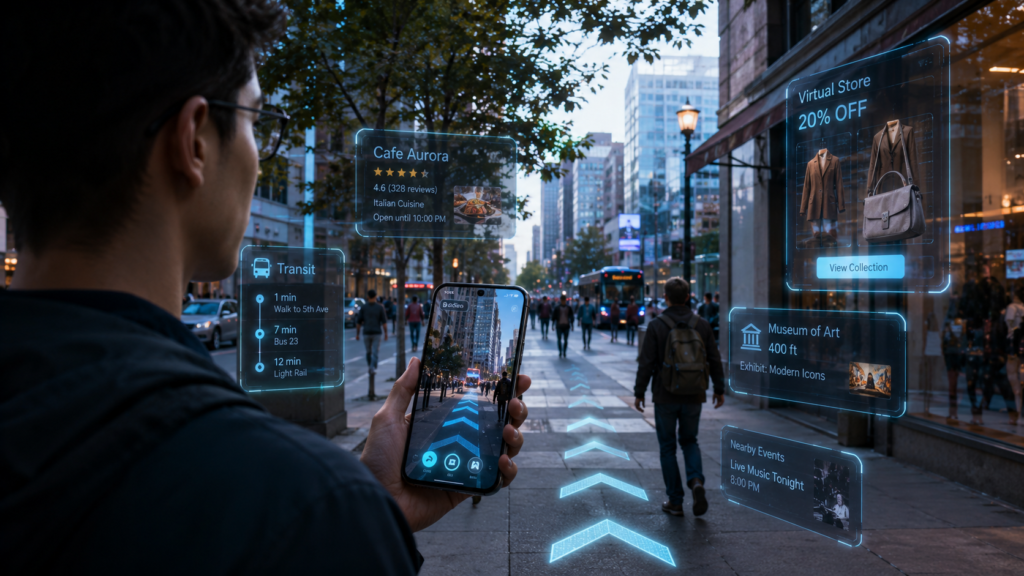
AR navigation may display:
- Directional arrows on real streets.
- Building names.
- Public transport information.
- Tourist attractions.
- Restaurant details.
- Indoor navigation for airports and shopping centers.
Instead of constantly looking down at a map, users may simply follow digital guidance overlaid on the real world.
Education and Learning
Augmented Reality also offers exciting possibilities for education.
Students can interact with three-dimensional models of:
- The human body.
- Historical landmarks.
- Planets and stars.
- Animals.
- Engineering designs.
- Chemical molecules.
Interactive visualization often makes complex concepts easier to understand than static images alone.
Business and Industry
Businesses are increasingly exploring AR for:
- Equipment maintenance.
- Employee training.
- Product demonstrations.
- Architecture.
- Interior design.
- Remote technical support.
As smartphone hardware continues improving, many professional AR tools may become widely accessible without requiring expensive specialized equipment.
Technology Spotlight: Modern smartphones use cameras, gyroscopes, accelerometers, GPS, depth sensors, and artificial intelligence simultaneously to accurately position digital objects within the real world.
Trend 12: Sustainable Smartphone Design
As smartphone ownership continues growing worldwide, manufacturers face increasing pressure to reduce environmental impacts.
Consumers are becoming more interested in devices that are:
- Longer lasting.
- Easier to repair.
- More energy efficient.
- Built from recycled materials.
- Supported with software updates for many years.
Sustainability is rapidly becoming one of the defining trends in mobile technology.
Recycled Materials
Many manufacturers now incorporate recycled materials into smartphone production.
These may include:
- Aluminum.
- Glass.
- Rare earth elements.
- Plastics.
- Packaging materials.
Using recycled resources reduces demand for newly extracted raw materials while lowering environmental impacts.
Longer Software Support
In the past, smartphones often received software updates for only a few years.
Today, many manufacturers are extending support significantly.
Longer software support offers several benefits:
- Improved security.
- Better performance.
- New features.
- Longer device lifespan.
- Reduced electronic waste.
Keeping smartphones useful for longer helps consumers save money while reducing unnecessary upgrades.
Repairability
Repairability has become an increasingly important issue.
Consumers and governments alike are encouraging manufacturers to design products that are easier to repair rather than replace.
Improvements include:
- Easier battery replacement.
- Better spare-part availability.
- Repair manuals.
- Modular components.
- More durable construction.
Extending the life of smartphones is one of the most effective ways to reduce electronic waste.
Energy Efficiency
Modern smartphone processors are becoming dramatically more efficient.
Instead of consuming more electricity to deliver higher performance, engineers now focus on completing tasks using less energy.
Benefits include:
- Longer battery life.
- Reduced heat.
- Lower charging frequency.
- Improved sustainability.
This efficiency is particularly important as artificial intelligence becomes more demanding.
Did You Know? Millions of smartphones are replaced every year even though many remain functional. Extending a device’s useful life through software updates, repairs, and battery replacements can significantly reduce electronic waste.
Trend 13: Smartphones Replace More Traditional Computers
The line between smartphones and personal computers continues to blur.
Modern flagship smartphones already possess processing power that rivals many laptops used only a few years ago.
Combined with external displays, keyboards, cloud services, and advanced operating systems, smartphones are increasingly capable of performing tasks once reserved for desktop computers.
Desktop Modes
Several smartphone platforms now support desktop-style interfaces.
When connected to an external monitor, users can:
- Open multiple application windows.
- Use a keyboard and mouse.
- Edit documents.
- Browse the web.
- Participate in video conferences.
- Manage spreadsheets.
- Create presentations.
For many users, especially those with basic computing needs, smartphones are becoming genuine productivity devices.
Cloud Computing
Cloud services further strengthen this transition.
Instead of storing everything locally, users can access:
- Documents.
- Photos.
- Videos.
- Business applications.
- Educational resources.
- AI services.
This allows work to continue seamlessly across smartphones, tablets, and computers.
Mobile Productivity
Modern smartphones already support:
- Professional document editing.
- Graphic design.
- Video editing.
- Programming tools.
- Financial management.
- Online collaboration.
- Remote desktop access.
As processors become more powerful and software continues improving, smartphones may increasingly serve as primary computing devices for many users.
Historical Perspective: Early smartphones were designed mainly for calls, text messages, and email. Today, many flagship devices contain processors with billions of transistors, powerful graphics capabilities, and artificial intelligence hardware that rival or exceed the performance of older personal computers.
Smartphones and Artificial Intelligence Work Together
One of the defining characteristics of future smartphones is that hardware and artificial intelligence will become increasingly inseparable.
Rather than launching individual applications for every task, users may simply describe what they want.
For example:
“Plan my business trip.”
The smartphone could automatically:
- Compare flights.
- Suggest hotels.
- Organize transportation.
- Translate local information.
- Add appointments to the calendar.
- Estimate travel time.
- Prepare expense summaries.
This represents a shift from app-centered computing toward AI-centered computing, where intelligent assistants coordinate multiple services on behalf of users.
Future Outlook: The smartphone of the future may function less like a collection of individual apps and more like a highly intelligent personal assistant capable of understanding goals, coordinating information, and completing complex tasks with minimal user input.
Quick Summary
The next generation of smartphones is expanding far beyond communication devices.
Key developments include:
- Augmented Reality becoming practical for shopping, education, navigation, and business.
- Sustainable design reducing environmental impact through longer-lasting products and recycled materials.
- Desktop-class productivity allowing smartphones to replace traditional computers for many everyday tasks.
- Cloud computing making information available across multiple devices.
- Artificial intelligence becoming the central interface for interacting with mobile technology.
Trend 14: Smarter Connected Ecosystems
The future of smartphones extends far beyond the device itself. Increasingly, smartphones are becoming the central hub of a much larger digital ecosystem, seamlessly connecting with smartwatches, tablets, laptops, vehicles, home appliances, televisions, and even healthcare devices.
Rather than operating as separate products, these devices are designed to work together, creating a smoother and more connected user experience.
A task started on one device can often continue on another with little or no interruption.
Examples include:
- Beginning an email on a smartphone and finishing it on a laptop.
- Instantly transferring photos to a tablet for editing.
- Unlocking a car using a digital key stored on a smartphone.
- Receiving notifications across multiple devices.
- Controlling smart home lighting, security cameras, and thermostats from one application.
As wireless technologies continue improving, these connections are expected to become even faster, more secure, and increasingly automated.
CurioReader Insight: In the future, people may spend less time switching between devices because the devices themselves will communicate intelligently, allowing work and entertainment to move seamlessly from one screen to another.
Smart Homes
Smartphones already serve as remote controls for many smart home devices.
Users can:
- Lock or unlock doors.
- Monitor security cameras.
- Adjust room temperatures.
- Turn lights on and off.
- Control smart speakers.
- Schedule household appliances.
Artificial intelligence is expected to make these systems even more personalized by learning user preferences and automating routine tasks.
Connected Vehicles
Modern vehicles are becoming increasingly integrated with smartphones.
Current capabilities include:
- Digital car keys.
- Navigation synchronization.
- Music and podcast streaming.
- Hands-free communication.
- Remote vehicle monitoring.
- Battery or fuel status updates.
- Climate control before entering the vehicle.
Future vehicles may interact even more closely with smartphones, supporting predictive maintenance, personalized driving settings, and intelligent travel planning.
Wearable Technology
Wearable devices continue expanding beyond fitness tracking.
Future smartwatches, smart rings, and other wearable devices are expected to work closely with smartphones to provide:
- Health monitoring.
- Secure authentication.
- Contactless payments.
- Emergency alerts.
- Personalized notifications.
Rather than replacing smartphones, wearables are becoming valuable companions that extend mobile capabilities.
Did You Know? The average connected household now contains dozens of internet-enabled devices, ranging from televisions and speakers to security systems and kitchen appliances. Smartphones increasingly act as the central control point for this expanding ecosystem.
Trend 15: What Could Smartphones Look Like by 2035?
Predicting the future of technology is never certain, but current research provides clues about where smartphone innovation may be heading.
Instead of focusing only on faster processors or better cameras, future smartphones are expected to become more intelligent, more sustainable, and more seamlessly integrated into everyday life.
Several developments appear particularly promising.
AI-First Smartphones
Artificial intelligence is likely to become the primary interface between users and their devices.
Rather than opening multiple applications manually, users may simply describe what they want to accomplish.
The smartphone could then coordinate several services automatically while maintaining privacy through on-device processing whenever possible.
Adaptive Interfaces
Future displays may adapt dynamically to different situations.
Examples could include:
- Expanding when additional workspace is needed.
- Automatically adjusting layouts based on tasks.
- Optimizing brightness and color for surrounding conditions.
- Displaying contextual information only when relevant.
Flexible display technologies may continue evolving beyond today’s foldable devices.
New Battery Technologies
Researchers are exploring battery technologies that could provide:
- Greater energy density.
- Faster charging.
- Improved safety.
- Longer lifespan.
- Reduced environmental impact.
Although commercial adoption takes time, future batteries may significantly reduce concerns about daily charging.
Greater Sustainability
Environmental responsibility is expected to remain a major priority.
Future smartphones may feature:
- Increased use of recycled materials.
- Easier repairs.
- Modular components.
- Lower energy consumption.
- Longer software support.
- Reduced electronic waste.
Manufacturers, governments, and consumers all have roles to play in encouraging sustainable technology.
Deeper Human–AI Collaboration
Rather than replacing human decision-making, smartphones are likely to become increasingly capable assistants.
Future devices may help users:
- Organize complex schedules.
- Learn new skills.
- Translate conversations naturally.
- Improve accessibility.
- Manage personal productivity.
- Analyze large amounts of information.
Human creativity and judgment will remain essential, while AI handles routine and repetitive tasks.
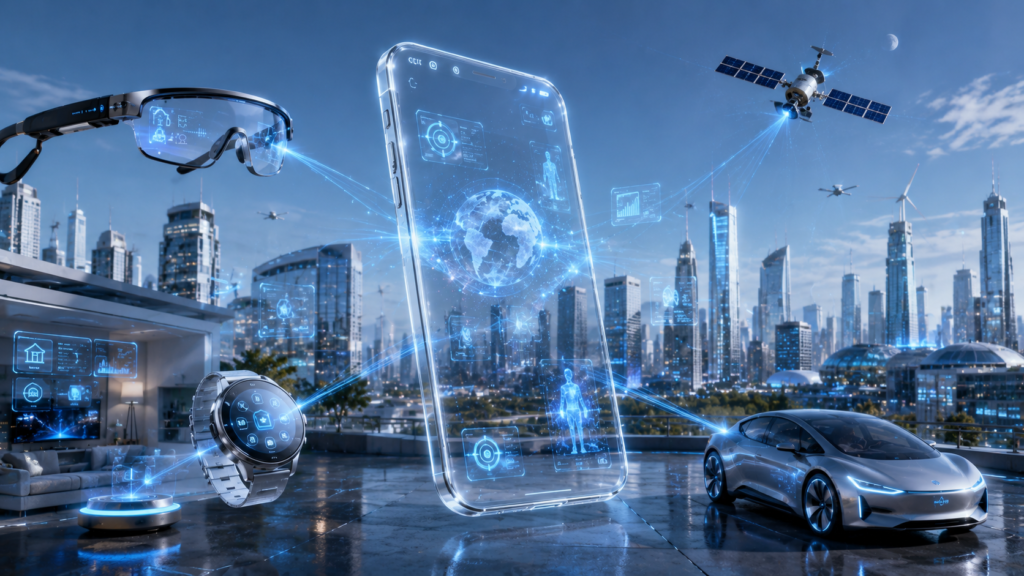
Future Outlook: The smartphone of 2035 may no longer be viewed simply as a communication device. Instead, it could function as a secure digital companion that understands context, coordinates multiple technologies, and supports users across work, education, travel, health, and everyday life.
Challenges That Will Shape the Future
While the future of smartphones is exciting, several important challenges will influence how mobile technology develops.
Privacy and Data Protection
As smartphones become more intelligent, protecting personal information becomes increasingly important.
Manufacturers will continue investing in:
- Stronger encryption.
- On-device AI.
- Secure hardware.
- Transparent privacy controls.
- Responsible data management.
Building trust will remain just as important as developing new features.
Cybersecurity
The growing importance of smartphones makes them attractive targets for cybercriminals.
Future devices will require continuous improvements in:
- Malware protection.
- Secure authentication.
- Fraud detection.
- Software updates.
- Identity verification.
Security will remain a continuous process rather than a one-time feature.
Digital Well-Being
Although smartphones provide enormous benefits, maintaining a healthy balance between technology and everyday life remains important.
Many operating systems already include tools that encourage healthier digital habits, such as:
- Screen time monitoring.
- Focus modes.
- Notification management.
- Bedtime reminders.
- App usage reports.
Future AI systems may help users build healthier technology habits without reducing productivity.
Accessibility
Technology should be useful for everyone.
Future smartphones are expected to include even more accessibility features, including:
- Improved voice control.
- Better live captioning.
- Enhanced screen readers.
- AI-powered image descriptions.
- Real-time language translation.
- Personalized accessibility settings.
These innovations help ensure that technology becomes more inclusive for people with diverse needs.
Myth vs. Fact
| Myth | Fact |
|---|---|
| Smartphones have reached their limit and will not improve significantly. | Innovation is increasingly shifting toward AI, sustainability, connectivity, battery technology, and software rather than dramatic hardware changes alone. |
| Foldable phones will replace every traditional smartphone. | Foldables are one option among many. Conventional smartphones are likely to remain popular for years because different users have different needs and preferences. |
| Artificial intelligence will replace smartphone users. | AI is designed to assist users by automating repetitive tasks and providing useful recommendations, while people continue making important decisions. |
Frequently Asked Questions
Will smartphones replace laptops?
For many everyday tasks such as web browsing, document editing, communication, and media consumption, smartphones are becoming increasingly capable. However, many professionals will continue using laptops and desktop computers for specialized workloads requiring larger displays, advanced software, or greater processing power.
Is artificial intelligence the biggest smartphone trend?
Yes. Artificial intelligence is becoming the foundation for many other innovations, including photography, productivity, battery optimization, security, language translation, accessibility, and personalized user experiences.
Will foldable smartphones become the standard?
Foldable technology is expected to continue improving, but traditional smartphone designs are also likely to remain popular. Consumers will benefit from having more choices rather than one universal design.
Are smartphones becoming more environmentally friendly?
Many manufacturers are investing in recycled materials, longer software support, repairability, and improved energy efficiency. While progress continues, sustainability remains an ongoing challenge for the industry.
What is the most important smartphone technology of the future?
Although opinions differ, many experts believe that on-device artificial intelligence will have the greatest long-term impact because it influences nearly every aspect of how smartphones function.
Key Takeaways
- Artificial intelligence is transforming smartphones into intelligent digital companions.
- Foldable displays and advanced camera systems are redefining mobile hardware.
- Better batteries, fast charging, and satellite communication are improving everyday reliability.
- Stronger biometric security and passkeys are making smartphones safer.
- Health monitoring and accessibility features are expanding the role of smartphones beyond communication.
- Connected ecosystems are creating seamless experiences across multiple devices.
- Sustainability, repairability, and longer software support are becoming industry priorities.
- The smartphone of the future will be more personalized, context-aware, and deeply integrated into daily life.
Conclusion
Smartphones have come a long way from their origins as simple communication devices. Today they combine powerful computing, advanced photography, artificial intelligence, global connectivity, and sophisticated software into devices that fit comfortably in a pocket. The next generation of smartphones will continue this transformation by becoming more intelligent, more sustainable, and more closely connected to every aspect of modern life.
The fifteen trends explored in this guide illustrate that future innovation is no longer driven solely by faster processors or higher-resolution screens. Instead, progress increasingly depends on intelligent software, on-device AI, improved privacy, seamless connectivity, sustainable engineering, and meaningful integration across digital ecosystems.
While it is impossible to predict every technological breakthrough, one thing is clear: smartphones will remain central to how people communicate, work, learn, create, and manage everyday life. Understanding these emerging trends helps consumers make informed purchasing decisions while providing valuable insight into the technologies shaping the future of mobile computing.
Whether you are a technology enthusiast, student, business professional, or everyday smartphone user, the future promises devices that are not only more capable but also more intuitive, secure, and responsive to individual needs. As innovation continues, smartphones are likely to become even more powerful companions that help people navigate an increasingly connected world.
Further Reading & Resources
Continue your learning journey with more expert guides and insightful articles from CurioReader. Explore related topics below to deepen your understanding and discover new perspectives.
Related CurioReader Articles
Recommended External Resources