Major Air Crash Disasters Since 1950: The Accidents That Changed Aviation Safety. Commercial aviation has transformed the way people travel. What was once an expensive and relatively limited form of transportation became a global system capable of carrying billions of passengers across continents every year. But that transformation was accompanied by a long and difficult learning process.
Since the beginning of the jet age, major aircraft disasters have exposed weaknesses in aircraft design, maintenance, pilot training, air traffic control, airport operations, aviation security and organizational decision-making. Each accident has raised difficult questions about what went wrong—and, more importantly, what could be changed to prevent a similar event from happening again.
Some disasters resulted from technical failures. Others involved weather, human factors, navigation, communication, maintenance or combinations of several problems. A number of major aviation tragedies were also deliberate acts rather than accidents, requiring the industry to rethink security as well as flight safety.
The history of aviation safety is therefore not simply a history of aircraft crashes. It is a history of investigation, engineering, regulation, training and learning from failure.
✈️ Aviation Safety Background: The International Civil Aviation Organization (ICAO) describes aviation safety as a continuously evolving process in which risks must be identified and mitigated. Its historical framework shows how aviation safety gradually expanded from a strong focus on technical failures toward broader attention to human factors, organizational issues and proactive safety management.
This article looks at major air crash disasters from 1950 to the present, not simply by ranking them according to the number of lives lost, but by examining why they mattered to aviation history.
We will travel from the early jet age through the expansion of mass air travel in the 1960s and 1970s, the major safety and security lessons of the 1980s, the increasingly sophisticated aircraft of the 1990s and 2000s, and the complex human-machine challenges revealed by accidents in the 2010s and beyond.
Some of the cases are remembered because they were among the deadliest disasters in aviation history. Others are particularly important because they exposed a previously poorly understood technical or operational risk.
Together, they reveal a remarkable pattern.
Air travel has become dramatically safer, but that progress was built partly on lessons learned from previous failures.
Modern aviation operates within an increasingly sophisticated global safety system involving regulators, airlines, manufacturers, airports, air traffic organizations, investigators and international bodies. ICAO’s current safety strategy focuses on continuous improvement and identifies major risks such as loss of control in flight, controlled flight into terrain, runway events and mid-air collisions.
The improvement is significant. In 2025, commercial airlines carried nearly 5 billion passengers across approximately 38 million flights, while ICAO reported 85 accidents and four fatal accidents among the scheduled commercial operations covered by its statistics.
Yet aviation safety can never be treated as a finished achievement.
Every generation of aircraft introduces new technologies, new operating environments and new challenges. As automation, increasingly complex aircraft systems, data-driven safety management and emerging aviation technologies develop, the industry must continue identifying risks before they become disasters.
🧠 CurioReader Insight: The most valuable lesson from an aviation disaster is not simply discovering what failed. It is understanding why the failure occurred, how the system responded, and what changed afterward.
The stories that follow are therefore not intended to sensationalize tragedy.
They are stories about how aviation learned.
From structural failures in early jet aircraft to modern questions about automation and human decision-making, each case provides a window into a particular stage of aviation’s evolution.
And taken together, they help answer a much bigger question:
How did one of the world’s most complex transportation systems become dramatically safer—and what can the disasters of the past still teach us about the risks of the future?
The Early Jet Age — 1950s and 1960s
The 1950s marked a dramatic transformation in commercial aviation. Aircraft were becoming faster, higher-flying and capable of carrying passengers across much greater distances. Jet engines promised a new era of rapid international travel.
But the transition from piston-powered aircraft to early jet airliners also introduced problems that engineers were still learning to understand.
Some of the most important aviation lessons of this period came from the de Havilland Comet, the world’s first commercial jet airliner to enter regular service. Its early accidents revealed a danger that had not been fully understood: repeated pressurization could eventually weaken an aircraft’s structure.
The Comet and the Beginning of the Jet Age
The de Havilland Comet entered airline service in 1952. Its pressurized cabin, swept-wing design and jet engines represented a major technological step forward.
Passengers could travel at much higher altitudes and considerably faster speeds than with many earlier airliners.
But the same technology that made high-altitude jet travel possible created new engineering challenges.
An aircraft flying at high altitude needs a pressurized cabin because the outside air is too thin for normal human breathing. This means the aircraft’s fuselage repeatedly experiences a pressure difference between the inside and outside.
Every flight therefore places the pressurized structure through another cycle of stress.
At the time, engineers understood structural fatigue in general terms, but the specific effects of repeated cabin pressurization on a large jet airliner’s structure were not yet fully understood.
That knowledge would come at a terrible cost.
🔬 Engineering Background: Aircraft structures can experience fatigue when repeated loading creates tiny cracks that gradually grow over time. The Comet disasters helped aviation engineers understand that pressurization cycles could be a critical source of structural fatigue, particularly around areas where stress was concentrated.
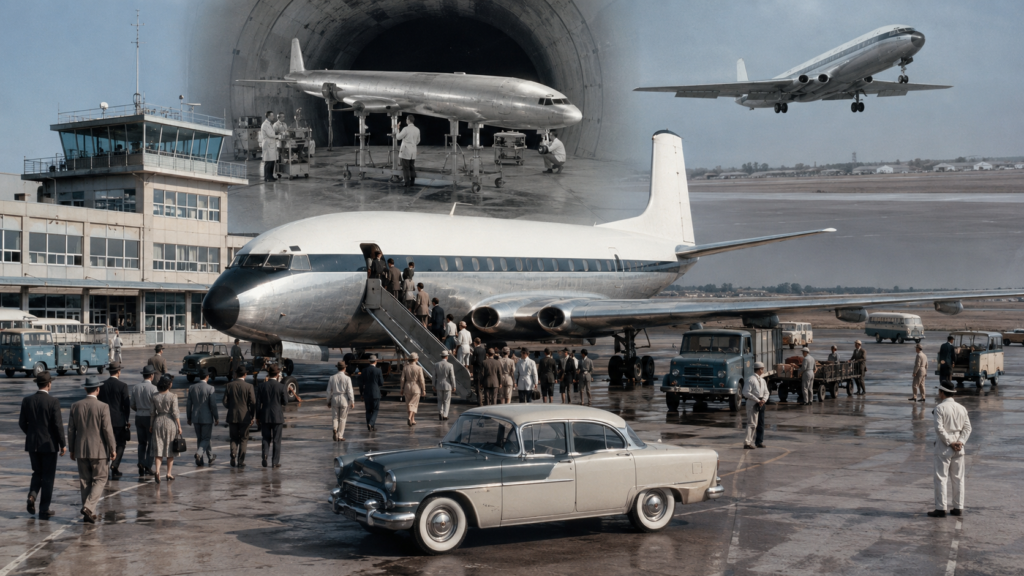
BOAC Flight 781 — 1954
On January 10, 1954, BOAC Flight 781 was flying from Rome toward London when the Comet aircraft broke apart in mid-air over the Mediterranean Sea.
All 35 people aboard were killed.
At the time, the cause was not immediately obvious.
The aircraft had been operating at high altitude, and investigators faced the difficult task of determining why an apparently advanced jet aircraft had suddenly suffered catastrophic structural failure.
The investigation eventually focused attention on the aircraft’s pressurized fuselage.
The wreckage was recovered from the sea, and investigators examined the structure for evidence of what had happened.
The investigation identified evidence of structural fatigue.
But the investigation was complicated because the technology itself was relatively new.
There was limited operational experience with pressurized jet aircraft, and engineers were still learning how repeated pressurization affected the structure over time.
The Comet’s large square-shaped passenger windows were also associated with areas of concentrated stress around their corners.
This became an important lesson in aircraft structural design.
South African Airways Flight 201
The Comet story became even more serious only a few months later.
On April 8, 1954, South African Airways Flight 201, another Comet, broke apart during a flight from Rome to Cairo.
All 21 people aboard were killed.
The accident reinforced concerns about structural fatigue.
Two catastrophic Comet accidents in a short period made it increasingly difficult to regard the earlier disaster as an isolated event.
The aircraft’s design had to be reconsidered.
The Comet fleet was temporarily grounded while investigators and engineers searched for answers.
The investigation ultimately contributed to a much deeper understanding of how repeated pressurization could produce fatigue cracks in an aircraft’s fuselage.
The UK Air Accidents Investigation Branch later identified the 1954 Comet disasters as particularly influential investigations because they contributed to a fuller understanding of the effects of pressurization on aircraft fuselages.
What the Comet Disasters Changed
The Comet accidents had consequences far beyond one aircraft model.
They changed how aircraft structures were tested and designed.
Engineers began paying much greater attention to:
- Metal fatigue
- Stress concentration
- Pressurization cycles
- Fuselage design
- Window and door geometry
- Structural testing
- Crack detection
- Aircraft inspection intervals
The basic lesson was profound.
An aircraft could appear structurally sound and still contain a tiny defect that could grow over time.
This changed the philosophy of aircraft safety.
Instead of asking only:
“Can this structure withstand the maximum expected load?”
engineers increasingly had to ask:
“What happens after thousands of repeated cycles?”
That distinction remains fundamental to modern aircraft design.
🛡️ CurioReader Safety Insight: The Comet disasters demonstrated that safety isn’t only about surviving one extreme event. Engineers must also understand how materials behave after repeated exposure to stress over an aircraft’s entire operating life.
The 1960s: Learning to Manage Increasingly Complex Aircraft
By the 1960s, jet aviation was expanding rapidly.
Aircraft were becoming larger, faster and more sophisticated.
Cockpits contained increasingly complex instruments, while air traffic was becoming more crowded as commercial aviation expanded.
The industry was also developing better systems for investigating accidents.
Accident investigation was becoming less about simply determining what had happened and more about understanding why it had happened.
This distinction would become increasingly important as accidents began to involve combinations of technical, operational and human factors.
United Airlines Flight 389 — 1965
On August 16, 1965, United Airlines Flight 389, a Boeing 727, crashed into Lake Michigan while approaching Chicago.
All 30 people aboard were killed.
The aircraft had been conducting an instrument approach in poor visibility.
The investigation concluded that the crew had failed to maintain the required altitude and that the aircraft descended below the intended altitude without recognizing the error in time.
The accident highlighted an important challenge of the developing jet age:
Aircraft were becoming more capable, but crews still had to accurately interpret instruments and maintain awareness of their position and altitude.
Modern aircraft could travel at high speed, and mistakes during an instrument approach could develop very quickly.
The lesson was not simply that pilots needed to be more careful.
It demonstrated the importance of:
- Accurate navigation
- Instrument interpretation
- Crew coordination
- Altitude awareness
- Clear approach procedures
- Effective cockpit instruments
The United Airlines accident database and later investigations of similar accidents helped establish a much broader understanding of the dangers of controlled flight into terrain and loss of situational awareness. The NTSB’s historical database documents aviation investigations dating from 1962 onward.
The Growing Importance of Human Factors
As aircraft became more technologically sophisticated, aviation safety researchers increasingly recognized that accidents could not always be explained by a broken component.
A pilot could receive correct information but misunderstand it.
A warning could be technically accurate but poorly designed.
A crew could have the necessary instruments but fail to recognize what they were indicating.
An aircraft could be mechanically sound but still be placed into a dangerous situation.
This introduced the aviation industry to a much broader concept:
human factors.
Human factors examines how people interact with machines, procedures, information and other people.
It includes issues such as:
- Workload
- Communication
- Fatigue
- Decision-making
- Situational awareness
- Training
- Cockpit design
- Procedures
This field would become increasingly important in the decades that followed.
A New Philosophy of Accident Investigation
The early jet age also helped establish a principle that remains central to aviation safety:
An accident should be investigated to prevent recurrence, not simply to assign blame.
Modern accident investigation involves reconstructing the sequence of events using evidence such as:
- Aircraft wreckage
- Flight data
- Cockpit recordings
- Radar information
- Weather data
- Air traffic communications
- Maintenance records
- Training records
- Human-performance analysis
The UK’s Air Accidents Investigation Branch, for example, describes investigations involving detailed wreckage examination, metallurgy, flight-simulator work, flight-recording data, radar and radio evidence.
This evidence-based approach became increasingly important as aviation systems grew more complicated.
Instead of asking only:
“Who made the mistake?”
investigators increasingly asked:
“What combination of conditions allowed this accident to occur?”
That question produces much more useful safety lessons.
From Mechanical Failure to System Failure
The Comet accidents were dominated by a structural engineering problem.
Other accidents of the 1960s increasingly demonstrated that aviation accidents could emerge from interactions between:
Aircraft + crew + weather + navigation + procedures + environment
This was the beginning of a much broader understanding of aviation safety.
A pilot could make a mistake because an instrument was confusing.
An instrument could be confusing because of cockpit design.
A crew could misunderstand an instruction because of communication procedures.
A navigation error could become catastrophic because the aircraft was moving at very high speed.
In other words, accidents were increasingly understood as system failures rather than isolated mistakes.
🧠 CurioReader Insight: One of aviation safety’s most important developments was the shift from looking for a single cause toward understanding the chain of events that allowed an accident to happen.
Why the 1950s and 1960s Matter
The early jet age established many principles that remain central to aviation today.
Engineers learned more about structural fatigue.
Aircraft manufacturers improved testing.
Airlines developed better operating procedures.
Cockpits became increasingly sophisticated.
Accident investigators developed more systematic methods.
Regulators strengthened requirements.
And the industry gradually learned that aviation safety depends on multiple layers of protection.
The Comet disasters were particularly influential because they showed that a technologically advanced aircraft could contain a structural vulnerability that was not obvious during normal operation.
The accidents of the 1960s added another dimension: humans interacting with increasingly complex machines.
The industry was learning that preventing crashes required more than building stronger aircraft.
It required understanding the entire aviation system.
And as passenger numbers increased and airports became busier, a new generation of disasters would reveal another challenge.
Aircraft would no longer be operating in isolation.
They would increasingly share crowded airports and increasingly complex airspace.
That would become especially clear in the 1970s, when several major disasters demonstrated the importance of communication, airport procedures, human factors and aircraft design.
The 1970s — When Aviation Became Mass Transportation
By the 1970s, commercial aviation had entered a new stage.
Jet aircraft were carrying increasing numbers of passengers across the world, international routes were expanding, and airports were becoming much busier. Flying was no longer an extraordinary experience reserved for a relatively small number of travellers. It was becoming a major form of mass transportation.
But this growth also created new safety challenges.
Aircraft were operating in increasingly crowded airspace and airports. Crews had to coordinate with air traffic controllers while managing sophisticated aircraft systems. At the same time, manufacturers were developing larger aircraft capable of carrying hundreds of passengers.
Several major disasters during this period demonstrated that aviation accidents could result from interactions between technology, human decisions, communication and operating procedures.
Turkish Airlines Flight 981 — 1974
On March 3, 1974, Turkish Airlines Flight 981, a McDonnell Douglas DC-10, crashed shortly after departing Paris Orly Airport.
All 346 people aboard were killed.
The accident became one of the most important aircraft-design and maintenance cases of the decade.
The aircraft’s rear cargo door had opened after takeoff. The resulting decompression caused severe structural damage, including damage to the aircraft’s control systems, and the aircraft became uncontrollable.
The investigation identified problems with the cargo-door design and the way the locking mechanism could indicate that the door was secure when it was not properly locked.
This was a critical lesson.
A system should not merely prevent a dangerous condition.
It should also make it difficult for an operator to mistakenly believe that the system is safe when it isn’t.
🔧 Engineering Insight: Good safety design considers human interaction. A mechanism that can appear correctly secured when it is actually unsafe creates a dangerous opportunity for error.
The disaster led to changes in cargo-door design and procedures and contributed to greater attention to the way aircraft systems communicated their condition to crews and ground personnel.
It was an early demonstration of an increasingly important aviation principle:
Safety depends on both engineering and human understanding of engineering.
The Tenerife Airport Disaster — 1977
If there is one accident that demonstrates the importance of communication in aviation history, it is the Tenerife airport disaster.
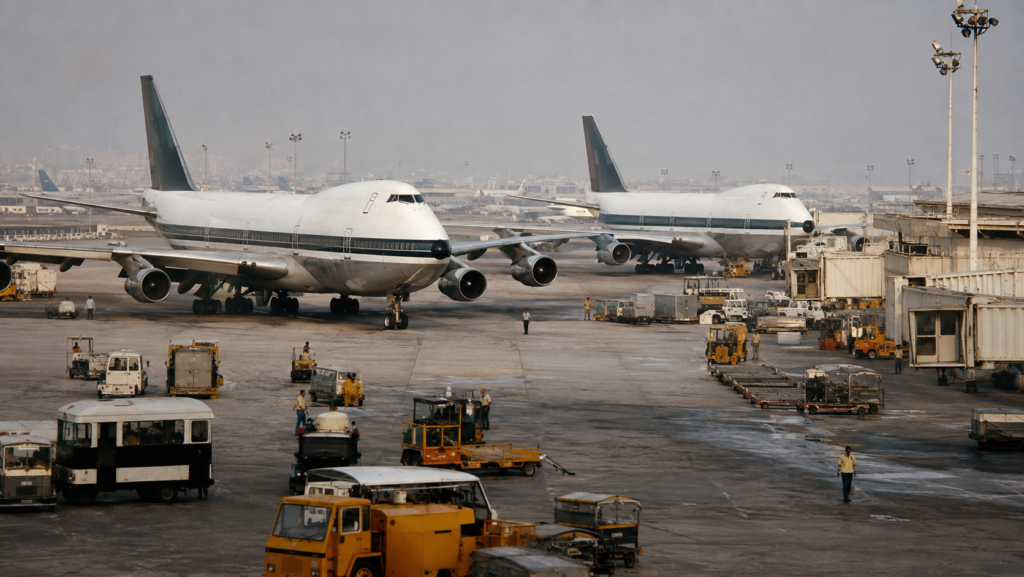
On March 27, 1977, two Boeing 747 aircraft collided on the runway at Los Rodeos Airport on Tenerife in the Canary Islands.
The aircraft were:
- KLM Flight 4805
- Pan Am Flight 1736
A total of 583 people were killed, making it the deadliest accident in aviation history in terms of lives lost in an aircraft accident.
The circumstances were unusual.
The airport was experiencing congestion, and several aircraft had been diverted there because of a bomb threat at another airport in the Canary Islands.
The large Boeing 747s were therefore operating in an environment that was not ideal for such heavy traffic.
Then fog reduced visibility.
The situation became increasingly difficult.
How the Collision Happened
The KLM aircraft was preparing for departure.
The Pan Am aircraft was taxiing along the runway, attempting to reach the appropriate exit.
Because of the poor visibility, the crews could not see each other.
Communication between the aircraft and air traffic control became critical.
The KLM captain initiated the takeoff without having received the required clearance to do so.
At the same time, the Pan Am aircraft was still on the runway.
The two aircraft collided.
The consequences were catastrophic.
✈️ Aviation Safety Background: The Tenerife investigation highlighted the importance of precise radio phraseology, clear communication, situational awareness and confirmation of runway status. Modern aviation procedures place enormous emphasis on avoiding ambiguity during critical phases of flight.
Why Tenerife Changed Aviation
The Tenerife disaster was not simply a story about one pilot making one mistake.
The accident involved a chain of circumstances:
Airport congestion
↓
Diverted aircraft
↓
Poor visibility
↓
Communication difficulties
↓
Ambiguous radio messages
↓
Aircraft occupying the runway
↓
Takeoff initiated
↓
Collision
This sequence demonstrates why modern accident investigation increasingly examines the whole system rather than searching for one person to blame.
Following the disaster, aviation placed greater emphasis on:
- Standardized phraseology
- Clear communication
- Crew coordination
- Situational awareness
- Cockpit resource management
- Runway safety
- Confirmation of takeoff clearance
The accident became a landmark case in the development of Crew Resource Management (CRM).
CRM recognizes that safe flight operations depend on effective use of all available resources, including the knowledge and observations of other crew members.
A captain may have enormous experience, but a safe cockpit also requires other crew members to be able to question, challenge and communicate concerns.
The Rise of Crew Resource Management
Before the development of modern CRM, cockpit culture in some airlines could be strongly hierarchical.
The captain was the senior authority.
Other crew members might be reluctant to challenge a decision.
But aviation accidents demonstrated the dangers of this approach.
A second pilot might notice something important.
A flight engineer might identify an abnormal condition.
A cabin crew member might observe a problem.
A controller might recognize a developing conflict.
Safety depends on these observations being communicated effectively.
CRM therefore promoted a more cooperative approach.
The objective wasn’t to weaken the authority of the captain.
It was to ensure that useful information reaches the person making the decision.
🧠 CurioReader Insight: Aviation safety improved when the cockpit became less about hierarchy and more about effective teamwork. The best decision is more important than whose idea it was.
American Airlines Flight 191 — 1979
The 1970s also produced another important aircraft-design and maintenance lesson.
On May 25, 1979, American Airlines Flight 191, a McDonnell Douglas DC-10, crashed shortly after takeoff from Chicago O’Hare International Airport.
All 271 people aboard were killed, along with two people on the ground.
The accident involved the separation of the aircraft’s left engine and associated pylon assembly during takeoff.
The resulting damage affected critical flight systems and the aircraft’s ability to climb and turn safely.
The investigation found that maintenance procedures had contributed to damage in the pylon structure.
This accident demonstrated another important principle:
Maintenance is part of aircraft design safety.
An aircraft can be engineered with extremely strong components, but improper maintenance procedures can introduce vulnerabilities that were not present in the original design.
Why Maintenance Matters
Modern aircraft undergo extensive maintenance throughout their operating lives.
Maintenance involves far more than simply replacing worn parts.
Technicians must:
- Follow detailed procedures
- Use appropriate equipment
- Inspect components
- Record work accurately
- Verify completed tasks
- Understand the consequences of maintenance actions
A maintenance procedure that is faster or easier isn’t necessarily safer.
If a procedure places excessive loads on a component, damages an attachment point or creates an undetected defect, the consequences may appear much later.
American Airlines Flight 191 demonstrated how maintenance-related damage could contribute to catastrophic failure.
It also reinforced the importance of designing maintenance procedures so that they minimize the possibility of accidental damage.
The Broader Lesson of the 1970s
The major aviation disasters of this decade revealed several different categories of risk.
The Turkish Airlines disaster highlighted aircraft design and cargo-door safety.
Tenerife highlighted communication, human factors and runway safety.
American Airlines Flight 191 highlighted maintenance and structural integrity.
These accidents were different, but together they demonstrated something important.
There is no single component called “aviation safety.”
Safety is created through many interconnected layers.
Aircraft design
The aircraft must be designed to tolerate failures and prevent dangerous conditions.
Maintenance
The aircraft must remain airworthy throughout its operational life.
Pilots
Crews must understand the aircraft and respond appropriately to changing conditions.
Air traffic control
Controllers must maintain safe separation and provide clear instructions.
Airports
Runways, taxiways, signage and procedures must support safe aircraft movement.
Regulations
Standards must establish minimum safety requirements.
Organizations
Airlines and aviation authorities must create systems that encourage safe decision-making.
🛡️ CurioReader Safety Insight: Aviation safety is a system of defenses. A major accident can occur when several weaknesses line up and the available layers of protection fail at the same time.
From Individual Errors to System Thinking
The 1970s helped accelerate a major shift in aviation safety thinking.
Instead of asking only:
“Who made the mistake?”
investigators increasingly asked:
“Why did the system allow this mistake to produce a catastrophe?”
That question is much more useful.
For example, a pilot may misunderstand a radio message.
But why was the message ambiguous?
Why was the cockpit environment confusing?
Why was the runway occupied?
Why wasn’t there another effective barrier preventing the takeoff?
Similarly, if maintenance damages an aircraft component, investigators can ask:
Why was that maintenance method used?
Was the procedure clear?
Was the equipment appropriate?
Was the work independently checked?
Did the organization understand the risk?
This approach recognizes that human beings will make mistakes.
The goal of safety engineering is therefore not to create a world in which humans never make errors.
That is unrealistic.
The goal is to create systems in which ordinary human errors do not automatically become catastrophic accidents.
A Decade of Hard Lessons
By the end of the 1970s, aviation had learned several painful lessons.
Aircraft needed safer structural designs.
Cargo systems needed stronger safeguards.
Cockpit communication needed greater precision.
Flight crews needed better teamwork.
Runway operations required stronger controls.
Maintenance procedures needed careful engineering.
Accident investigations needed to examine organizational factors as well as physical failures.
These lessons would influence aviation for decades.
And although the industry was becoming safer, the 1980s would introduce another collection of challenges.
Some accidents would involve severe weather and aircraft performance.
Others would expose the dangers of onboard fire.
And aviation security would become an increasingly important part of the safety equation.
The industry was learning that protecting passengers meant more than preventing mechanical failure.
It meant protecting the entire aviation system—from the aircraft and cockpit to the airport, maintenance organization and security environment.
The 1980s — Fire, Weather and Aviation Security
The 1980s brought another stage of development in commercial aviation. Aircraft and navigation systems were becoming more sophisticated, but major accidents continued to reveal weaknesses that had not been fully understood.
The disasters of this decade demonstrated that aviation safety involved far more than preventing mechanical failures. Weather, aircraft configuration, emergency evacuation, airport operations and security threats could all create serious risks.
Several accidents became important case studies because they changed how airlines, airports, regulators and manufacturers approached these risks.
Air Florida Flight 90 — 1982
On January 13, 1982, Air Florida Flight 90, a Boeing 737, crashed shortly after takeoff from Washington National Airport.
The aircraft had been operating in severe winter weather, with snow and freezing conditions affecting operations.
The aircraft failed to gain sufficient altitude after takeoff and struck the 14th Street Bridge before entering the Potomac River.
The accident killed 74 people aboard the aircraft and four people on the bridge.
The investigation identified several contributing factors, including the effects of snow and ice on the aircraft and problems associated with the crew’s decisions and engine performance.
The accident demonstrated the importance of preventing contamination of critical aircraft surfaces before takeoff.
Even a relatively thin layer of ice or snow can significantly alter the aerodynamic characteristics of a wing.
❄️ Aviation Science Insight: Aircraft wings are designed around precise aerodynamic shapes. Ice, snow or frost can disturb airflow and reduce lift while increasing drag, making takeoff performance significantly more difficult.
The disaster reinforced the importance of:
- Aircraft de-icing
- Pre-flight inspections
- Weather assessment
- Takeoff performance calculations
- Crew coordination
- Careful decision-making in severe winter conditions
It also demonstrated that an accident can develop from several relatively small problems occurring at the same time.
British Airtours Flight 28M — 1985
On August 22, 1985, British Airtours Flight 28M suffered an engine failure during its takeoff from Manchester Airport.
The Boeing 737 rejected its takeoff and stopped on the runway.
The aircraft had not crashed in the conventional sense.
But a fire developed rapidly.
The accident became one of the most important aviation disasters in the history of aircraft evacuation and cabin-fire safety.
Of the 137 people aboard, 55 died.
The accident investigation found that the failure of the left engine led to a rupture of the fuel system and a major fire.
The consequences were made worse by the rapid spread of fire and difficulties passengers encountered while attempting to escape.
This changed how aviation authorities and manufacturers thought about survivability.
An aircraft does not necessarily have to remain completely undamaged for passengers to survive.
In many accidents, the difference between life and death can depend on how quickly people can evacuate.
The Importance of Evacuation
Before the 1980s, aviation safety naturally focused heavily on preventing crashes.
But accidents such as British Airtours 28M demonstrated another important question:
What happens after an accident begins?
Aircraft therefore need to be designed not only to resist failures but also to allow passengers to escape rapidly when necessary.
This requires:
- Accessible emergency exits
- Clear evacuation procedures
- Adequate emergency lighting
- Cabin crew training
- Fire-resistant materials
- Passenger awareness
- Procedures for managing blocked exits
The accident contributed to changes in aviation safety thinking and helped reinforce the importance of rapid evacuation and cabin-fire protection.
🛡️ CurioReader Safety Insight: Safety doesn’t end when an accident occurs. The design of the aircraft and the actions of the crew can determine whether an otherwise survivable accident becomes fatal.
Air India Flight 182 — 1985
The same year also brought one of the deadliest acts of violence involving a commercial aircraft.
On June 23, 1985, Air India Flight 182, a Boeing 747 flying from Canada toward India, was destroyed by a bomb over the Atlantic Ocean.
All 329 people aboard were killed.
Unlike the accidents discussed earlier, this was not a conventional aviation accident.
It was a deliberate act of terrorism.
That distinction is important because the safety response was fundamentally different.
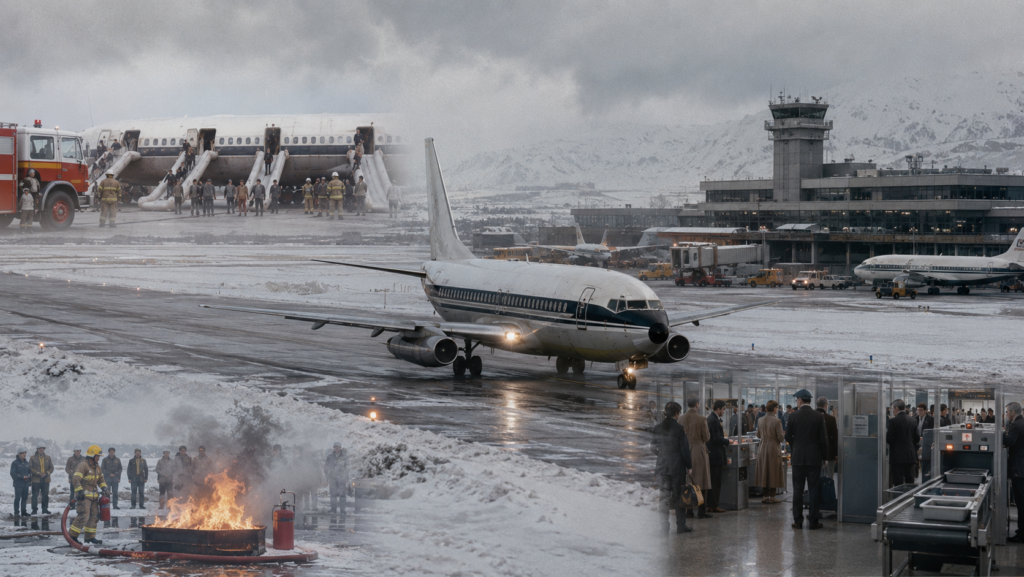
The disaster exposed weaknesses in aviation security, particularly in the systems used to identify and prevent dangerous items from being placed aboard aircraft.
It demonstrated that aviation safety had to consider not only:
What can go wrong accidentally?
but also:
What could someone deliberately cause to happen?
This led to greater international attention to:
- Passenger and baggage screening
- Airport security
- Explosive detection
- Intelligence sharing
- Security procedures
- Protection against deliberate attacks
Pan Am Flight 103 — 1988
On December 21, 1988, Pan Am Flight 103 was destroyed by an explosive device while flying over Lockerbie, Scotland.
All 259 people aboard were killed, along with 11 people on the ground.
Again, this was not an accident caused by aircraft failure or pilot error.
It was a deliberate attack.
The disaster had major consequences for international aviation security.
It demonstrated the potential vulnerability created when an explosive device could enter the aviation system without being detected.
The response extended beyond the aircraft itself.
It involved:
- Airport security
- Baggage screening
- Passenger-baggage reconciliation
- Intelligence
- International cooperation
- Security standards
- Explosive detection technology
The broader lesson was significant.
An airline’s safety system cannot protect passengers if dangerous threats can bypass the airport before the aircraft even leaves the ground.
Aviation Safety Became Broader Than Aircraft Safety
By the end of the 1980s, the definition of aviation safety had expanded considerably.
It was no longer enough to build an aircraft that could withstand mechanical stresses.
A safe aviation system needed to address several layers.
Aircraft
The aircraft must be designed to tolerate failures and protect passengers.
Crew
Pilots and cabin crew must be trained to recognize and manage emergencies.
Airport
Runways, taxiways, terminals and emergency services must support safe operations.
Maintenance
Aircraft must be inspected and maintained correctly.
Air traffic control
Aircraft must be safely separated and provided with accurate information.
Security
Airports and airlines must protect aircraft from deliberate threats.
This increasingly interconnected approach would become one of the defining characteristics of modern aviation safety.
The Growing Importance of Human Factors
The accidents of the 1980s also reinforced the importance of human factors.
A technically advanced aircraft can still be involved in an accident if:
- Information is misunderstood
- Procedures are poorly followed
- Communication breaks down
- Workload becomes excessive
- Warning signs are ignored
- Crew members fail to coordinate effectively
The industry increasingly recognized that human performance needed to be considered when designing aircraft, procedures and training.
This was not about blaming pilots for accidents.
It was about designing systems that recognize human limitations.
People become tired.
People can misunderstand information.
People can become overloaded.
People can make incorrect assumptions.
A resilient aviation system therefore creates multiple layers of protection against predictable human errors.
From Prevention to Survivability
Another important development during this period was the growing distinction between accident prevention and accident survivability.
Prevention asks:
How can we stop the accident from happening?
Survivability asks:
If the accident happens anyway, how can we give people the best possible chance of surviving?
Both questions are essential.
For example, an aircraft might suffer an engine failure.
If the aircraft remains controllable, the crew may land safely.
If a fire occurs after landing, effective evacuation procedures may save lives.
If an emergency occurs in flight, robust aircraft systems and crew training may prevent it from becoming catastrophic.
Modern aviation therefore relies on multiple defensive layers.
🧠 CurioReader Insight: The safest systems assume that failures are possible. They try to prevent failures, but they also prepare for detection, containment, emergency response and recovery.
Why the 1980s Matter
The disasters of the 1980s expanded the understanding of what aviation safety really meant.
Air Florida 90 demonstrated the danger of winter weather, aircraft contamination and difficult cockpit decisions.
British Airtours 28M highlighted the importance of fire protection and rapid evacuation.
Air India 182 and Pan Am 103 demonstrated that aviation security had to protect passengers from deliberate attacks as well as accidental failures.
These events contributed to a broader philosophy:
Aviation safety is not one system. It is a network of systems working together.
Aircraft design, pilot training, cabin procedures, airport operations, maintenance, security and regulation all contribute to the final level of safety.
And when one layer fails, another should ideally provide protection.
A New Generation of Safety Thinking
By the end of the decade, commercial aviation had accumulated decades of hard-earned knowledge.
Engineers understood aircraft structures better than they had in the early jet age.
Airlines had developed more sophisticated training programs.
Cockpit teamwork was receiving greater attention.
Aircraft emergency procedures had improved.
Airport security was becoming more advanced.
Accident investigation was becoming increasingly systematic.
But the industry still faced a fundamental challenge.
As aircraft became more sophisticated, the interactions between people and technology also became more complicated.
The next decades would introduce increasingly computerized aircraft, more advanced automation and new flight-control systems.
These technologies would prevent countless accidents.
But they would also create new questions:
How should pilots interact with automated systems?
What happens when sensors provide incorrect information?
How much should a crew trust automation?
What happens when several systems behave unexpectedly at the same time?
Those questions would become particularly important in the 1990s and 2000s, when aviation entered an era of increasingly sophisticated digital systems and highly automated flight decks.
The 1990s — Technology, Automation and Human Decision-Making
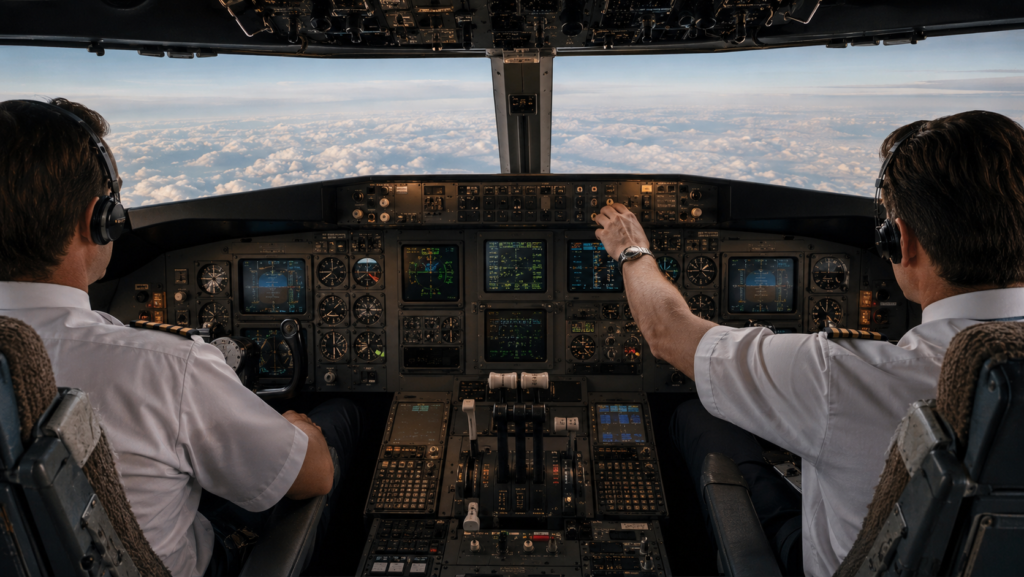
By the 1990s, commercial aviation had entered a highly computerized era. Flight decks were becoming increasingly digital, aircraft systems were more sophisticated, and pilots had access to information and automation that earlier generations could not have imagined.
These developments greatly improved aviation safety. Yet they also introduced a new challenge.
Pilots were no longer simply operating machines. They were increasingly managing complex automated systems.
Several major accidents during this period demonstrated the continuing importance of human factors, flight-control systems, weather, crew coordination and situational awareness.
United Airlines Flight 232 — 1989
Although it occurred at the very end of the 1980s, United Airlines Flight 232 is too important to leave out of this transition into the modern era.
On July 19, 1989, United Airlines Flight 232, a McDonnell Douglas DC-10, suffered a catastrophic failure of its tail-mounted engine while flying from Denver to Chicago.
The failure caused fragments from the engine to penetrate and disable all three of the aircraft’s hydraulic systems.
Hydraulic power was essential for controlling major flight surfaces.
With the normal hydraulic systems unavailable, the aircraft became extraordinarily difficult to control.
Yet something remarkable happened.
The crew did not simply lose control and crash immediately.
They worked together with a DC-10 instructor pilot who happened to be travelling as a passenger and attempted to control the aircraft using the remaining available engine thrust.
The crew eventually attempted an emergency landing at Sioux City, Iowa.
The aircraft crashed during the landing attempt, but 185 of the 296 people aboard survived.
The accident became an extraordinary example of crew coordination and emergency response under almost impossible circumstances.
✈️ Aviation Safety Insight: An accident investigation is not only about understanding why people died. It can also reveal why some people survived. United 232 demonstrated how teamwork, training, communication and improvisation can create a chance of survival even after multiple systems have failed.
The accident became an important case study in Crew Resource Management, demonstrating that effective teamwork can be critical when normal procedures no longer provide an answer.
USAir Flight 427 — 1994
On September 8, 1994, USAir Flight 427, a Boeing 737, crashed near Pittsburgh International Airport while approaching the airport.
All 132 people aboard were killed.
The accident became one of the most significant investigations into aircraft flight-control systems of its era.
Investigators eventually determined that an unexpected movement of the aircraft’s rudder contributed to the loss of control.
The investigation took years and involved extensive testing and analysis.
The accident highlighted the importance of understanding how flight-control systems behave under unusual conditions.
It also demonstrated another feature of modern accident investigation:
Finding the cause can take years when the evidence is complex.
Investigators may need to reconstruct aircraft behaviour from flight recorders, wreckage, simulations, component testing and other evidence.
The lessons can eventually lead to modifications in aircraft systems and procedures.
When Technology Becomes Part of the Human-Factor Problem
The increasing use of automation created a new relationship between pilots and aircraft.
Automation could perform tasks more accurately and consistently than humans in many circumstances.
But pilots still needed to understand what the aircraft was doing.
This created a potential problem.
If automation behaves unexpectedly, a pilot who has become heavily dependent on it may have difficulty recognizing what is happening or taking control quickly.
This doesn’t mean automation is unsafe.
In fact, modern automation has contributed enormously to aviation safety.
The lesson is more subtle:
Automation changes the nature of human responsibility rather than eliminating it.
Pilots increasingly needed to become managers of automated systems as well as direct operators of aircraft.
American Airlines Flight 1420 — 1999
On June 1, 1999, American Airlines Flight 1420 attempted to land at Little Rock National Airport during severe thunderstorms.
The aircraft, a McDonnell Douglas MD-82, overran the runway after landing.
There were 139 people aboard, and the accident resulted in 11 fatalities.
The investigation examined several contributing factors, including severe weather, the crew’s decision to continue the approach, workload, time pressure and runway conditions.
The accident demonstrated how quickly an apparently manageable landing can become dangerous when multiple risks accumulate.
The crew was dealing with:
- Severe thunderstorms
- Strong winds
- Heavy rain
- A rapidly changing situation
- Time pressure
- The need to land safely
No single factor completely explains the accident.
Instead, the risks interacted.
The Importance of Situational Awareness
Situational awareness means understanding what is happening around you, what is likely to happen next, and what that means for your decisions.
It is particularly important during rapidly changing situations.
A pilot may have the correct instruments and information but still develop an incomplete understanding of the situation.
This can happen when:
- Workload becomes excessive
- Weather changes quickly
- Multiple warnings appear
- Communication becomes difficult
- Attention becomes focused on one problem
- Time pressure influences decisions
Aviation training increasingly emphasized recognizing these conditions.
The objective was to prevent pilots from becoming so focused on completing a task that they failed to recognize a broader threat.
🧠 CurioReader Insight: In complex environments, the most dangerous moment may not be when one system fails. It can be when several manageable problems appear simultaneously and the crew’s attention becomes overloaded.
The Growing Role of Accident Data
By the 1990s, accident investigators had increasingly powerful tools.
Flight data recorders could provide detailed information about aircraft behaviour.
Cockpit voice recorders preserved communications and cockpit sounds.
Radar data could help reconstruct an aircraft’s movement.
Computer simulations could reproduce flight conditions.
Laboratory testing could examine failed components.
This meant investigators could reconstruct accidents with increasing precision.
The purpose wasn’t simply to produce a historical explanation.
The findings could lead to:
- Aircraft modifications
- New pilot training
- Revised procedures
- Improved warning systems
- Better maintenance requirements
- Changes in air traffic procedures
- Regulatory action
This created an important feedback loop:
Accident → Investigation → Finding → Safety recommendation → Industry change
That cycle is one of the foundations of modern aviation safety.
Aviation Was Becoming Safer—but Risk Was Changing
The 1990s did not represent the end of aviation accidents.
Instead, they showed that the nature of aviation risk was changing.
Aircraft were becoming more reliable.
Computers were improving.
Navigation was becoming more precise.
Cockpit automation was expanding.
Yet human interaction with these systems was becoming increasingly important.
This created new questions about:
Automation dependency
How should pilots respond when automated systems behave unexpectedly?
Human-machine interaction
Are cockpit systems communicating information in ways humans can easily understand?
Training
Are pilots prepared for rare failures rather than only normal operations?
Crew coordination
Can crew members effectively challenge decisions and share information?
Workload
Can pilots maintain situational awareness when several problems occur simultaneously?
These questions would become even more important in the 2000s.
From Mechanical Problems to Complex Interactions
Compare the aviation disasters of the early jet age with those occurring decades later.
The Comet disasters demonstrated the dangers of structural fatigue.
The 1970s highlighted cargo-door design, communication and runway safety.
The 1980s expanded attention to weather, fire, evacuation and security.
The 1990s increasingly demonstrated the interaction between:
Humans + computers + automation + aircraft systems + environment
The aircraft itself was no longer simply a machine controlled directly by a pilot.
It had become a highly integrated system.
That brought enormous benefits.
But it also meant that pilots needed a sophisticated understanding of what the aircraft’s systems were doing.
A Critical Lesson About Automation
One of the most important lessons from the transition into modern aviation is that automation should support human decision-making rather than replace human understanding.
A pilot who understands the aircraft’s systems can recognize unusual behaviour.
A pilot who understands the limitations of automation can intervene when necessary.
A pilot who maintains manual flying skills can respond when automated systems become unavailable or unreliable.
This is why modern aviation training continues to balance automation with fundamental flying skills and emergency procedures.
The goal isn’t to reject technology.
It is to use technology intelligently.
🤖 Technology Insight: The safest relationship between humans and automation is not blind trust or complete rejection. It is informed cooperation—people understand what the system is doing, what it cannot do, and when human intervention is necessary.
What the 1990s Taught Aviation
The decade reinforced several important principles.
Technology can prevent accidents
Better systems can reduce human workload and detect dangerous conditions.
Technology can also introduce new challenges
More complex systems require pilots to understand automation and system interactions.
Teamwork matters
United 232 demonstrated how effective crew coordination can improve survival during an extraordinary emergency.
Weather remains powerful
Even advanced aircraft cannot eliminate the risks created by severe weather.
Situational awareness matters
Pilots must understand the overall situation rather than focusing on isolated problems.
Investigation drives improvement
Detailed accident investigations can reveal weaknesses that would otherwise remain hidden.
Entering the 21st Century
By the end of the 1990s, aviation had become vastly more sophisticated than it had been in the early jet age.
Aircraft were safer.
Navigation was more precise.
Flight decks were increasingly computerized.
Air traffic management had improved.
Emergency procedures had become more sophisticated.
Yet the basic challenge remained.
Humans still had to operate the system.
The 2000s would demonstrate this in several dramatic ways.
The decade would bring the loss of Concorde, the transformation of aviation security after the September 11 attacks, and eventually one of the most extensively studied modern aviation disasters: Air France Flight 447.
These events would show that even highly automated aircraft operating within an advanced aviation system could still encounter unexpected combinations of technical problems, human responses and environmental conditions.
The industry had learned how to build better aircraft.
The next challenge was learning how humans and increasingly intelligent machines could work safely together when the unexpected happened.
The 2000s — Automation, Security and New Lessons
The beginning of the 21st century brought another transformation in aviation.
Aircraft had become highly sophisticated, digital flight systems were increasingly common, and international air travel had become deeply integrated into modern life. Yet the 2000s also demonstrated that aviation safety could never be considered a finished achievement.
The decade brought several very different tragedies. Some involved deliberate attacks rather than accidents. Others revealed vulnerabilities in aircraft design and human interaction with increasingly automated systems.
Together, they showed that aviation safety had become a much broader discipline involving technology, security, human factors, training, regulation and organizational decision-making.
Concorde Air France Flight 4590 — 2000
On July 25, 2000, Air France Flight 4590, a Concorde supersonic passenger aircraft, crashed shortly after takeoff from Charles de Gaulle Airport near Paris.
All 109 people aboard were killed, along with four people on the ground.
The accident began with a relatively small object on the runway.
A strip of metal that had fallen from another aircraft was struck by Concorde’s tyre during its takeoff roll.
The tyre failed, and fragments were thrown upward.
These fragments damaged a fuel tank, resulting in a major fuel leak and fire.
The aircraft attempted to continue its takeoff but was unable to climb safely.
The accident was a powerful example of how a small event can initiate a much larger chain of failures.
🔬 CurioReader Science & Engineering Insight: In complex systems, the size of the initial problem does not necessarily determine the size of the final consequence. A small component or external object can become catastrophic when it affects a critical part of the system.
The accident led to significant changes to Concorde’s tyres, wheels and fuel-tank protection.
However, Concorde’s commercial career was already approaching its end, and the aircraft was eventually retired in 2003.
September 11, 2001 — Aviation Security Changes Forever
The attacks of September 11, 2001, were fundamentally different from the accidents discussed elsewhere in this article.
They were deliberate acts of terrorism, not conventional aircraft accidents.
Four commercial passenger aircraft were hijacked, and the attacks resulted in the deaths of nearly 3,000 people.
The aviation consequences were enormous.
Before September 11, aviation security already involved passenger screening, baggage controls and restrictions on dangerous items.
After the attacks, the entire security environment changed.
Governments and aviation authorities introduced or strengthened measures involving:
- Passenger screening
- Baggage screening
- Cockpit security
- Identification procedures
- Airport security
- Intelligence sharing
- International cooperation
- Security training
In the United States, the Transportation Security Administration (TSA) was created in response to the need for a substantially strengthened aviation and transportation security system.
The International Civil Aviation Organization also strengthened international aviation-security standards and cooperation.
The lesson was clear:
Aviation safety must protect against both accidental failures and deliberate attacks.
Safety and Security Are Related but Different
It is useful to distinguish these concepts.
Aviation safety generally concerns preventing accidents and reducing the consequences of unintentional events.
Aviation security concerns protecting civil aviation against deliberate acts of unlawful interference.
They overlap, but they are not identical.
An engine failure is a safety problem.
A dangerous object entering an aircraft intentionally is a security problem.
Aviation organizations therefore need systems for both.
🛡️ CurioReader Insight: Aviation became safer not only by building more reliable aircraft, but also by recognizing that threats can originate outside the aircraft itself.
Air France Flight 447 — 2009
Near the end of the decade, another accident demonstrated the complexity of modern aviation.
On June 1, 2009, Air France Flight 447 was flying from Rio de Janeiro to Paris when the Airbus A330 crashed into the Atlantic Ocean.
All 228 people aboard were killed.
The aircraft was operating at cruise altitude when its pitot tubes became affected by ice crystals, causing inconsistent airspeed indications.
The autopilot and related automatic systems subsequently disengaged.
The aircraft entered a high-altitude aerodynamic stall.
The crew did not successfully recognize and recover from the developing situation.
The aircraft descended into the Atlantic.
The accident became one of the most important modern case studies in automation, pilot training, airspeed information and human-machine interaction.
When Automation Disconnects
Air France 447 demonstrated a difficult problem.
The aircraft was highly automated.
The pilots normally relied on sophisticated systems to help manage the flight.
But when the airspeed information became unreliable, the aircraft’s automation could no longer continue operating normally.
The autopilot disconnected.
The crew suddenly had to manage the aircraft manually in unusual conditions at high altitude.
This created a major difference between the normal operating environment and the emergency environment.
The aircraft had not simply “stopped working.”
Instead, several things happened in sequence:
Pitot-tube icing
↓
Unreliable airspeed information
↓
Autopilot disengagement
↓
Manual flight
↓
Pilot confusion and incorrect control inputs
↓
Aerodynamic stall
↓
Loss of control
↓
Impact with the ocean
The accident demonstrated how a technical problem can become much more serious when humans have difficulty interpreting what the aircraft is doing.
Understanding an Aerodynamic Stall
A stall does not mean that an aircraft’s engines have stopped.
It occurs when the wing exceeds its critical angle of attack and can no longer produce sufficient lift to maintain controlled flight.
A stall can happen at many speeds and under different circumstances.
At high altitude, however, recovery can be particularly challenging because the aircraft has less excess energy and performance margin than it might have at lower altitude.
✈️ Aviation Science Background: A stall is fundamentally an aerodynamic condition rather than an engine failure. An aircraft can have fully functioning engines and still stall if the wings are flown beyond their critical angle of attack.
Air France 447 became an important example of why pilots need to understand fundamental aircraft behaviour even when automated systems normally perform much of the work.
The Human-Machine Relationship
Air France 447 raised a broader question that had been developing throughout the previous decades:
How should humans interact with increasingly automated aircraft?
Automation can:
- Reduce workload
- Improve precision
- Maintain flight parameters
- Provide warnings
- Reduce certain types of human error
But automation also creates new challenges.
Pilots need to understand:
- What the automated system is doing
- Why it is doing it
- What information it is using
- When it may disengage
- What happens when its inputs become unreliable
- How to take control effectively
The goal is not to make pilots fight against automation.
The goal is to ensure that pilots remain capable of understanding and controlling the aircraft when automation can no longer perform as expected.
🤖 Technology Insight: Automation is most useful when the human operator understands both its capabilities and its limitations. The more sophisticated the system becomes, the more important that understanding can be.
What the 2000s Taught Aviation
The major events of this decade reinforced several important principles.
Small failures can create large consequences
The Concorde accident demonstrated how a relatively small piece of runway debris could initiate a catastrophic sequence.
Aviation security is essential
The September 11 attacks demonstrated that aircraft must be protected against deliberate threats as well as accidental failures.
Automation changes pilot responsibilities
Air France 447 demonstrated the importance of maintaining manual flying skills and understanding aircraft behaviour when automated systems become unavailable or provide confusing information.
Human factors remain critical
Even highly automated aircraft depend on humans to interpret information and make decisions.
Accident investigation continues to evolve
Modern investigations increasingly combine flight-data analysis, simulator testing, engineering research, human-factors analysis and organizational investigation.
A More Complex Definition of Aviation Safety
By the end of the 2000s, aviation safety had become far more sophisticated than it had been in 1950.
The industry was no longer focused solely on:
“Can the aircraft fly safely?”
It was asking much broader questions:
- Can the aircraft detect failures?
- Can pilots understand what is happening?
- Can automation fail safely?
- Can passengers evacuate quickly?
- Can airports prevent dangerous objects from reaching aircraft?
- Can security systems prevent deliberate attacks?
- Can organizations recognize emerging risks?
- Can investigators learn from accidents?
- Can regulators turn those lessons into improved standards?
This represented a major evolution.
Safety had become a system-wide discipline.
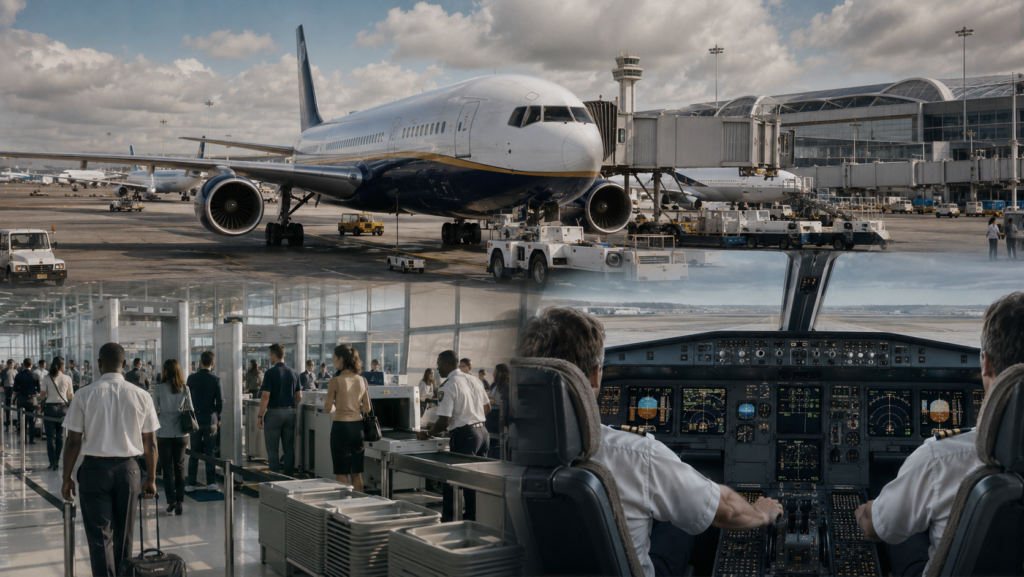
The Continuing Importance of Human Skills
One of the most interesting lessons from the 2000s is that more automation did not make human expertise irrelevant.
In some ways, it made understanding even more important.
When everything works normally, automated systems can handle many tasks.
But unusual situations are exactly when pilots may need to take over.
This creates an apparent paradox:
The better automation becomes, the less frequently pilots may need certain manual skills—and the more important those skills can become when automation fails.
This is why aviation training continues to include abnormal and emergency scenarios.
Pilots need to be prepared for events they may never experience during normal operations.
From the 1950s to the 2000s
Looking across the decades reveals how aviation safety evolved.
1950s
Engineers learned critical lessons about structural fatigue and pressurization.
1960s
Navigation, instrumentation and human factors became increasingly important.
1970s
Communication, runway safety, aircraft design and maintenance received greater attention.
1980s
Fire protection, evacuation, weather and aviation security became major concerns.
1990s
Digital systems, automation, situational awareness and crew coordination became increasingly important.
2000s
The industry faced increasingly complex interactions between automation, human decision-making and security.
The aircraft had become dramatically more sophisticated.
But one thing had not changed.
People still had to make decisions.
The Safety Lessons Were Accumulating
Every major accident added another layer of knowledge.
The Comet disasters improved understanding of structural fatigue.
Tenerife reinforced communication and crew coordination.
British Airtours strengthened attention to evacuation and fire safety.
The Concorde accident highlighted runway debris and fuel-tank protection.
September 11 transformed aviation security.
Air France 447 highlighted automation and manual-flight challenges.
These lessons didn’t remain isolated.
They became part of a growing body of aviation knowledge.
That is one reason modern commercial aviation is dramatically safer than it was during the early decades of the jet age.
🧠 CurioReader Insight: Aviation safety is cumulative. Today’s safety procedures often exist because engineers, pilots, investigators and regulators learned something from yesterday’s failures.
The industry entered the 2010s with aircraft that were safer and more sophisticated than ever.
Yet the next decade would demonstrate that technological progress could also create new risks.
The Boeing 737 MAX accidents involving Lion Air Flight 610 and Ethiopian Airlines Flight 302 would raise difficult questions about flight-control software, pilot information, aircraft certification, training and corporate decision-making.
At the same time, other accidents would continue to reveal the importance of weather, human factors, maintenance and organizational culture.
The story of aviation safety was therefore far from finished.
It was entering another chapter—one in which software and automated systems would become just as important to aviation safety as engines, wings and mechanical components.
The 2010s — Software, Automation and the Human Factor
The 2010s introduced a new category of aviation safety challenges.
Modern aircraft were equipped with sophisticated computers, sensors and automated flight-control systems. These technologies could improve efficiency and safety, but they also meant that software could become a critical part of the chain between a pilot’s actions and an aircraft’s behaviour.
Several accidents during this period demonstrated that aviation safety could no longer be understood only through engines, wings and mechanical components.
The interaction between software, aircraft systems, pilots, training, certification and organizational decision-making had become equally important.
AirAsia Flight 8501 — 2014
On December 28, 2014, Indonesia AirAsia Flight 8501, an Airbus A320-216, crashed into the Java Sea while flying from Surabaya to Singapore.
All 162 people aboard were killed.
The accident followed a sequence involving repeated warnings from a system associated with the aircraft’s rudder travel limiter.
The crew responded to the recurring problem, but after an electrical interruption the aircraft’s flight-control configuration changed. The subsequent sequence of events resulted in the aircraft entering an upset condition and ultimately a prolonged stall.
The investigation highlighted several interacting factors, including technical problems, maintenance history, crew responses and the management of the aircraft after the flight-control system changed.
This was another reminder that modern aircraft accidents rarely fit neatly into one category.
A technical fault can create a situation.
Human actions can influence what happens next.
And the design of the system determines what options are available to the crew.
🔬 Aviation Systems Insight: In a complex aircraft, the consequences of a technical fault depend partly on how the crew is informed about it and what the aircraft allows them to do in response.
Germanwings Flight 9525 — 2015
On March 24, 2015, Germanwings Flight 9525 crashed into the French Alps while flying from Barcelona to Düsseldorf.
All 150 people aboard were killed.
This was not a conventional mechanical or weather-related accident.
The investigation concluded that the aircraft was deliberately flown into terrain by the co-pilot.
The tragedy raised difficult questions about aviation security, cockpit access, medical confidentiality, pilot health assessment and how airlines should respond when concerns about a crew member exist.
It is important to treat this case differently from accidental crashes.
The underlying cause was not an aircraft-system failure.
Instead, it highlighted the challenge of managing human behaviour within a safety-critical system.
The accident contributed to changes in European cockpit-access procedures and renewed discussion about how aviation organizations identify and manage risks associated with pilot fitness.
🛡️ CurioReader Safety Insight: Aviation safety must account for both technical failures and human behaviour. The two require different preventive strategies, but both can have consequences for an entire aircraft.
Lion Air Flight 610 — 2018
One of the most consequential aviation accidents of the decade occurred on October 29, 2018.
Lion Air Flight 610, a Boeing 737 MAX 8, crashed into the Java Sea shortly after departing Jakarta.
All 189 people aboard were killed.
The accident became a major international aviation safety case because of the interaction between the aircraft’s automated flight-control system and the information available to the flight crew.
The aircraft was equipped with a system called the Maneuvering Characteristics Augmentation System (MCAS).
MCAS was designed to provide automatic flight-control inputs under particular flight conditions.
The accident investigation found that erroneous angle-of-attack sensor information contributed to repeated MCAS activation.
The system repeatedly commanded nose-down trim.
The pilots attempted to respond, but the aircraft eventually entered an unrecoverable dive.
This exposed a critical issue.
The aircraft’s software was not operating in isolation.
It was receiving information from sensors.
That information influenced the software.
The software influenced the aircraft.
The pilots then had to interpret the resulting behaviour.
The safety chain therefore looked something like:
Sensor information
↓
Flight-control software
↓
Automatic aircraft response
↓
Pilot interpretation
↓
Pilot response
A weakness anywhere in that chain could become important.
Ethiopian Airlines Flight 302 — 2019
Only a few months later, another Boeing 737 MAX was lost.
On March 10, 2019, Ethiopian Airlines Flight 302 crashed shortly after takeoff from Addis Ababa.
All 157 people aboard were killed.
The accident had important similarities to Lion Air 610.
Erroneous angle-of-attack information contributed to activation of MCAS, which repeatedly commanded nose-down movement.
The two accidents resulted in the worldwide grounding of the Boeing 737 MAX.
Investigations into both crashes led to extensive scrutiny of:
- MCAS
- Sensor inputs
- Flight-control logic
- Pilot information
- Pilot training
- Aircraft certification
- Safety analysis
- Manufacturer-regulator communication
The issue therefore extended far beyond one software function.
It raised a fundamental question about modern aircraft:
How much should an automated system be allowed to do without the pilot fully understanding how it operates?
When Software Becomes a Flight-Critical Component
For much of aviation history, people naturally thought of aircraft failures in physical terms.
An engine could fail.
A wing could break.
A landing gear component could malfunction.
A door could open.
But modern aircraft increasingly depend on software.
Software can determine:
- How flight-control inputs are interpreted
- How warnings are generated
- How automation responds
- How sensors influence aircraft behaviour
- How pilots receive information
- What protections are automatically activated
This creates enormous benefits.
It can prevent dangerous conditions and reduce pilot workload.
But it also means that software design becomes part of aviation safety.
🤖 Technology Insight: As aircraft become more computerized, software engineering becomes aviation engineering. A software decision can ultimately influence the physical behaviour of an aircraft.
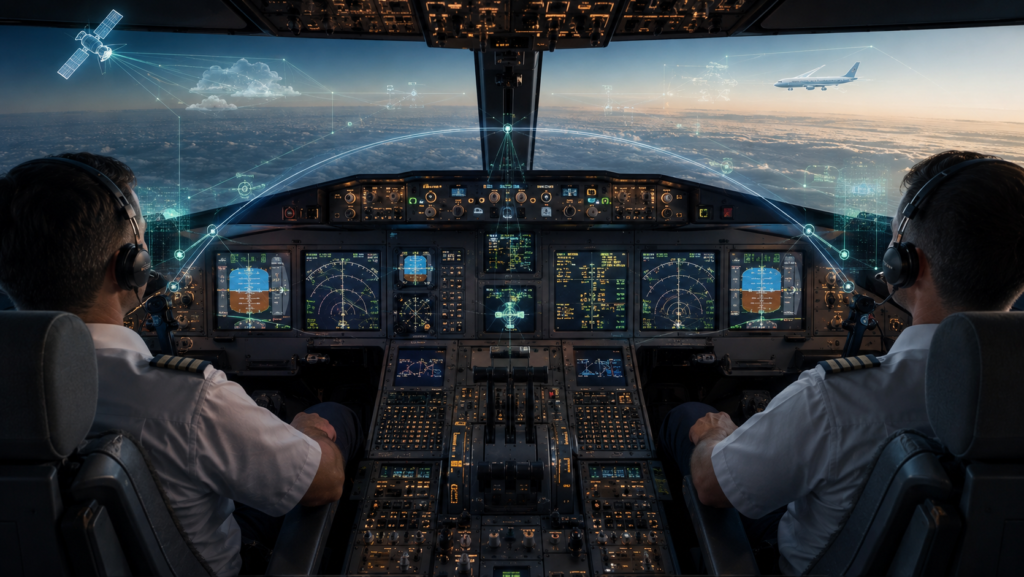
The Problem of Information
The 737 MAX accidents also highlighted another important issue:
Pilots need to understand the systems they are operating.
If an automated function behaves unexpectedly, the crew needs enough information to identify the problem and apply the correct procedure.
This doesn’t mean pilots need to understand every line of software code.
They do, however, need to understand the operational behaviour and limitations of the systems that can affect the aircraft.
That includes questions such as:
- What triggers the system?
- What information does it use?
- What happens when that information is wrong?
- How can the pilot recognize the problem?
- How can the system be stopped or overridden?
- What backup procedures are available?
These questions became central to discussions following the 737 MAX accidents.
Certification and Organizational Responsibility
The 737 MAX accidents also raised important questions about aircraft certification.
A modern aircraft involves enormous numbers of engineers, manufacturers, regulators, airlines, pilots and suppliers.
Certification is therefore not a simple test of whether an aircraft can fly.
It involves demonstrating that the aircraft and its systems meet applicable safety requirements.
The investigations and subsequent reviews led to intense scrutiny of how the aircraft’s design and systems had been assessed and how information was communicated between the manufacturer and regulators.
This reinforced a lesson that had appeared in earlier disasters:
Safety is partly a technical problem and partly an organizational problem.
A perfectly designed system can be undermined by poor communication.
Likewise, strong regulations are less effective if important information is misunderstood or inadequately evaluated.
The Return of System Thinking
The 2010s therefore brought aviation safety back to a lesson that had appeared repeatedly throughout the previous decades.
Accidents usually have chains.
The chain may involve:
Technology
Human decisions
Training
Procedures
Organizational processes
Environmental conditions
The challenge is identifying where the safety barriers can be strengthened.
This is much more useful than simply asking who made the final mistake.
What the 2010s Taught Aviation
Several major lessons emerged from this decade.
Automation must be understandable
Pilots need to understand what automated systems can do and when they can behave differently from expectations.
Sensors matter
Modern aircraft depend heavily on sensor information. Incorrect sensor data can affect automated systems and pilot decisions.
Software requires rigorous safety analysis
A software function that can influence flight behaviour must be treated as a critical safety element.
Training must reflect real system behaviour
Pilots need appropriate preparation for unusual automation and system failures.
Certification must consider interactions
A system cannot always be evaluated effectively by looking at each component independently.
Organizational culture still matters
Technical information needs to reach the people responsible for safety decisions.
🧠 CurioReader Insight: The more sophisticated an aircraft becomes, the more important it is to understand the interaction between its systems rather than evaluating each component in isolation.
Aviation Safety in the Modern Era
By the end of the 2010s, aviation had undergone an extraordinary transformation.
Compare the aircraft of the early 1950s with a modern passenger jet.
The differences are enormous.
Modern aircraft use:
- Advanced digital avionics
- Satellite navigation
- Sophisticated flight-management systems
- Automated flight controls
- Weather radar
- Collision-avoidance systems
- Ground-proximity warning systems
- Flight-data monitoring
- Highly developed maintenance programs
These technologies have prevented countless accidents.
But the 2010s demonstrated that new technology also creates new failure modes.
A mechanical component can fail.
A sensor can provide incorrect information.
Software can respond to incorrect information.
A pilot can misunderstand the resulting behaviour.
An organization can fail to recognize the interaction.
The aircraft can then enter a situation that nobody expected to develop.
This is why aviation safety must continually evolve.
From Crash Investigation to Proactive Safety
One of the biggest changes in aviation safety over the decades has been the movement from reactive investigation toward proactive risk management.
In the early days, the industry often learned primarily after accidents.
Today, aviation organizations can collect enormous quantities of operational information without waiting for a crash.
Modern aircraft generate detailed flight data.
Airlines can analyze:
- Flight parameters
- Engine performance
- Approach profiles
- Hard landings
- Unstable approaches
- Aircraft-system warnings
- Maintenance information
This creates an opportunity to identify trends before they produce an accident.
📊 CurioReader Insight: The ultimate goal of aviation safety is not to become better at investigating crashes. It is to identify dangerous patterns early enough that the crash never happens.
The 2010s Were a Warning About Complexity
The major accidents of the decade demonstrated that modern aviation had entered a new phase.
The industry was no longer primarily dealing with the problems of early jet aircraft.
The challenge had become increasingly about complex systems interacting with humans.
That does not mean modern technology is inherently dangerous.
Quite the opposite.
Modern aviation is exceptionally safe partly because of sophisticated technology.
But technology must be designed around real-world human behaviour.
Pilots must be trained for it.
Regulators must understand it.
Manufacturers must test it.
Airlines must operate it responsibly.
And safety organizations must continuously question whether the assumptions behind it remain valid.
Looking Toward the 2020s
The lessons of the 2010s carried directly into the next decade.
The aviation industry entered the 2020s with increasingly powerful tools for monitoring aircraft and predicting potential problems.
But new challenges were also emerging.
These included:
- Increasing automation
- Artificial intelligence
- Cybersecurity
- New aircraft technologies
- New forms of air mobility
- More complex data systems
- Human interaction with increasingly autonomous systems
The fundamental safety principle remained unchanged.
New technology must be accompanied by new understanding.
Aviation had spent seven decades learning from accidents.
The challenge of the 2020s was to use those lessons proactively—identifying risks before they become another chapter in the history of air crash disasters.
And this leads to the final question of the article:
After more than 75 years of accidents, investigations and technological progress, just how much safer has aviation become—and what lessons continue to shape the future of flight?
The 2020s — A Safer Industry Facing New Risks
By the 2020s, commercial aviation had become dramatically different from the industry of the 1950s.
Aircraft were more reliable, flight crews were extensively trained, navigation systems were highly sophisticated, and international safety standards had developed through decades of experience. The industry also had something earlier generations lacked on the same scale: enormous amounts of operational data that could be analyzed to identify potential risks before they became accidents.
But safer does not mean risk-free.
The challenges facing aviation have continued to evolve. Modern safety programs increasingly focus on proactive risk management, automation, data analysis, cybersecurity, human-machine interaction and emerging technologies.
Aviation Safety Has Improved Dramatically
Looking at individual disasters can create the impression that air travel remains extremely dangerous.
The broader statistics tell a different story.
Commercial aviation has become considerably safer over the long term, particularly when measured against the enormous number of flights and passengers transported.
Modern aviation benefits from multiple layers of protection:
- More reliable aircraft
- Better pilot training
- Improved navigation
- Collision-avoidance systems
- Enhanced weather information
- Ground-proximity warning systems
- Better aircraft maintenance
- Stronger airport procedures
- Flight-data monitoring
- International safety standards
- Detailed accident investigation
These systems did not appear overnight.
Many are the result of lessons accumulated from decades of accidents.
📊 Aviation Safety Insight: Aviation safety is cumulative. Improvements in aircraft design, pilot training, regulation and operational procedures build on knowledge gained from previous incidents and accidents.
From Reacting to Accidents to Predicting Risk
One of the biggest changes in modern aviation safety is the growing emphasis on proactive safety management.
Earlier generations often learned primarily by investigating accidents after they happened.
Modern aviation can increasingly identify warning signs before a major accident occurs.
Airlines and aviation authorities can analyze operational data to identify patterns such as:
- Unstable approaches
- Excessive descent rates
- Runway excursions
- Hard landings
- Aircraft-system anomalies
- Repeated maintenance problems
- Near misses
- Unusual flight paths
This doesn’t mean every abnormal event will lead to an accident.
Instead, the information can help safety professionals identify areas where additional training, procedures or engineering changes may be useful.
This represents a fundamental shift.
Instead of:
Accident → Investigation → Safety improvement
aviation increasingly aims for:
Data → Risk identification → Intervention → Accident prevention
That is one of the most important achievements of modern safety management.
The Role of Technology
Modern aircraft contain sophisticated systems designed to reduce risk.
For example, Terrain Awareness and Warning Systems (TAWS) can alert crews when an aircraft is approaching terrain under dangerous circumstances.
Traffic Collision Avoidance Systems (TCAS) can help aircraft avoid potential mid-air collisions.
Modern navigation systems provide highly accurate positional information.
Weather radar gives crews better information about atmospheric conditions.
Flight-management systems assist crews with navigation and aircraft management.
These systems create layers of protection.
If one layer fails, another may still provide a warning or corrective opportunity.
This approach is sometimes described as defence in depth.
The basic idea is straightforward:
Don’t rely on one system to prevent disaster.
Use multiple independent or complementary protections.
Automation Has Not Eliminated Human Responsibility
Modern aircraft can perform many tasks automatically.
Autopilot systems can control aircraft for large portions of a flight.
Flight-management systems can calculate routes.
Automatic systems can monitor aircraft parameters.
But pilots remain essential.
They supervise the aircraft, interpret information, make decisions and respond to abnormal situations.
This creates a continuing challenge.
Pilots must maintain enough understanding and manual flying ability to respond effectively when automation behaves unexpectedly or becomes unavailable.
The lessons from accidents such as Air France 447 remain relevant.
The question is not whether aircraft should use automation.
They clearly should.
The question is:
How can humans and automation work together safely when the situation falls outside normal expectations?
🤖 Technology Insight: The future of aviation is unlikely to be purely human or purely automated. The safest systems will require effective cooperation between highly capable technology and well-trained human decision-makers.
Artificial Intelligence and the Future of Aviation
Artificial intelligence is increasingly being explored across aviation.
Potential applications include:
- Predictive maintenance
- Weather analysis
- Air-traffic management
- Route optimization
- Operational decision support
- Aircraft-system monitoring
- Airport operations
AI could potentially identify patterns in enormous datasets that humans would struggle to detect manually.
But the introduction of increasingly intelligent systems also raises new safety questions.
What happens when an AI system makes an incorrect prediction?
How does a pilot understand an automated recommendation?
Who is responsible when an automated system makes a poor decision?
How should regulators certify systems whose behaviour may be more complex than traditional software?
These questions are still developing.
The aviation industry cannot simply assume that a more intelligent system is automatically a safer system.
It must demonstrate that the technology behaves predictably, can be monitored effectively and can fail safely.
Cybersecurity Becomes an Aviation Safety Concern
Modern aviation is highly connected.
Aircraft communicate with ground systems.
Airports depend on digital infrastructure.
Airlines use interconnected reservation, scheduling and operational systems.
Air traffic management increasingly depends on sophisticated information technology.
This creates another category of risk:
cybersecurity.
A cybersecurity incident does not necessarily mean that someone can remotely take control of an aircraft.
The more realistic concern is that disruption to critical information systems could affect aviation operations.
Potential targets include:
- Airport systems
- Airline information systems
- Communication networks
- Navigation-related infrastructure
- Operational databases
- Passenger systems
- Air-traffic-management infrastructure
As aviation becomes increasingly digital, cybersecurity becomes part of the wider safety environment.
🔐 CurioReader Safety Insight: Aviation safety used to focus primarily on physical systems. In a highly connected industry, protecting digital systems and information can also be part of protecting passengers.
New Aircraft, New Questions
The aviation industry is also developing new types of aircraft and propulsion technologies.
Electric aircraft, hybrid systems, hydrogen-related concepts and advanced air mobility are being researched and developed.
These technologies may eventually change short-distance transportation and other areas of aviation.
But every new technology creates new safety questions.
For example:
- How should new propulsion systems be tested?
- How should batteries be protected?
- How should emergency procedures change?
- What happens when new aircraft operate alongside conventional aircraft?
- How should pilots be trained?
- How should new systems be certified?
The history of aviation demonstrates why these questions must be answered carefully.
Technological progress is valuable.
But safety needs to develop alongside it.
Why Accident Investigation Still Matters
Despite all these advances, accidents and serious incidents can still occur.
When they do, accident investigation remains essential.
Modern investigators have access to sophisticated evidence, including:
- Flight-data recorders
- Cockpit voice recordings
- Radar data
- Satellite information
- Aircraft maintenance records
- Digital system information
- Weather data
- Communication records
- Wreckage analysis
- Computer simulations
This allows investigators to reconstruct complex sequences with extraordinary detail.
But the purpose remains the same as it was decades ago:
Learn enough to reduce the probability of recurrence.
An investigation isn’t simply a historical explanation.
It can lead to:
- Safety recommendations
- Aircraft modifications
- New training
- New regulations
- Operational changes
- Improved warning systems
The accident therefore becomes part of a larger safety feedback loop.
What More Than 75 Years of Accidents Have Taught Us
Looking across the period from 1950 to the 2020s reveals an extraordinary evolution.
The early jet age taught engineers about structural fatigue and pressurization.
The 1970s highlighted communication, maintenance and airport safety.
The 1980s expanded attention to weather, fire, evacuation and security.
The 1990s demonstrated the importance of automation, situational awareness and human factors.
The 2000s reinforced lessons about security, automation and human-machine interaction.
The 2010s showed how software, sensors, flight-control systems and certification could become central to aviation safety.
The 2020s are increasingly focused on data, automation, cybersecurity and emerging technologies.
The technology has changed.
The fundamental safety principle has not.
Find the risk. Understand the risk. Reduce the risk. Learn from the result.
The Accidents That Changed Aviation
The disasters discussed throughout this article were not all caused by the same type of failure.
That is precisely why they are important.
The Comet accidents changed understanding of structural fatigue.
Turkish Airlines Flight 981 exposed weaknesses in aircraft cargo-door design.
The Tenerife disaster transformed thinking about communication and cockpit teamwork.
British Airtours Flight 28M reinforced the importance of evacuation and cabin-fire safety.
Air India 182 and Pan Am 103 demonstrated the importance of aviation security.
United Airlines Flight 232 showed the extraordinary value of crew coordination during a catastrophic systems failure.
Air France 447 demonstrated the challenges of human interaction with automation.
The Boeing 737 MAX accidents showed how software, sensors, pilot information, certification and organizational decisions could interact.
Each case added another layer to aviation’s collective knowledge.
🧠 CurioReader Insight: The safest aviation system is not one that assumes accidents are impossible. It is one that continuously searches for weaknesses before they combine into a catastrophe.
How Aviation Became Safer
The history of air crash disasters can therefore be viewed from another perspective.
It is also the history of safety improvements.
A structural failure leads to better structural analysis.
A navigation accident leads to better navigation procedures.
A communication failure leads to clearer phraseology.
A runway accident leads to improved runway safety systems.
A fire leads to better cabin materials and evacuation procedures.
A security incident leads to stronger screening.
An automation-related accident leads to improved training and system design.
A software-related accident leads to greater scrutiny of system interactions and certification.
This doesn’t mean every accident immediately produces a perfect solution.
Safety improvement is an ongoing process.
But each lesson can strengthen the system.
The Future of Aviation Safety
The next generation of aviation safety will likely depend increasingly on the ability to identify risks before they become visible as accidents.
Data analysis, predictive maintenance, advanced simulation, artificial intelligence and increasingly sophisticated monitoring systems may provide new opportunities.
At the same time, humans will remain central.
Someone must design the systems.
Someone must certify them.
Someone must monitor them.
Someone must decide how much authority automation should have.
Someone must respond when the unexpected happens.
The future of aviation safety will therefore not be about choosing between humans and technology.
It will be about designing systems in which humans and technology complement each other’s strengths while protecting against each other’s weaknesses.
A Final Perspective
More than seven decades of aviation history reveal something remarkable.
The modern passenger aircraft is the product of thousands of lessons.
Some were learned through research and testing.
Others were learned through incidents.
And some were learned through tragedies that cost hundreds of lives.
The objective of remembering these disasters should not be to make flying appear frightening.
It should be to understand how much the industry has learned.
Every safer aircraft design, every improved cockpit procedure, every emergency checklist, every new training requirement and every safety regulation represents accumulated knowledge.
That is why studying air crashes matters.
It helps us understand not only how aircraft fail, but also how human beings learn from failure.
🛡️ CurioReader Safety Insight: The history of aviation safety is ultimately a history of learning. The goal is not to pretend that complex systems can never fail, but to make each generation better at preventing, detecting and surviving those failures.
Commercial aviation today is the result of more than 75 years of engineering progress and hard-earned experience.
The tragedies of the past cannot be undone.
But the knowledge gained from them can continue to protect people who board aircraft today.
And that may be the most important legacy of every aviation disaster:
The lives lost should never become merely statistics. Their stories should continue to teach the people designing, operating and regulating the aircraft of tomorrow.
Frequently Asked Questions
What was the deadliest air crash in aviation history?
The Tenerife airport disaster of March 27, 1977, involving KLM Flight 4805 and Pan Am Flight 1736, resulted in 583 deaths and remains the deadliest accident involving commercial aircraft.
Why are airplane crashes investigated?
Accident investigations help determine what happened, why it happened, and what can be changed to reduce the likelihood of a similar accident. Findings can lead to improvements in aircraft design, pilot training, maintenance, regulations and operating procedures.
Are airplanes safer today than they were in the 1950s?
Yes. Commercial aviation has become substantially safer over the decades. Improvements in aircraft reliability, navigation, air traffic management, pilot training, aircraft certification, maintenance, weather information and safety management have all contributed to this progress.
What is the most important lesson from major air disasters?
One of the most important lessons is that accidents are often caused by a chain of events rather than a single mistake. Understanding that chain allows investigators and the aviation industry to strengthen multiple safety barriers.
What is Crew Resource Management?
Crew Resource Management, or CRM, is an approach to training that emphasizes communication, teamwork, decision-making and effective use of available resources within the flight crew and wider operational environment.
Can modern technology prevent every airplane crash?
No technology can eliminate every possible risk. Modern systems can reduce many hazards and provide additional layers of protection, but unexpected combinations of technical problems, environmental conditions and human factors can still occur.
Why are past air crashes still studied?
Past accidents provide valuable safety information. Investigators and aviation professionals can identify weaknesses, examine how safety barriers failed, and use those findings to improve future aircraft, procedures and training.
Key Takeaways
- Aviation safety has developed through decades of engineering, investigation and learning.
- Early jet-age disasters helped engineers understand structural fatigue and pressurization.
- The 1970s demonstrated the importance of communication, maintenance and airport safety.
- The 1980s expanded aviation safety to include weather, fire protection, evacuation and security.
- The 1990s highlighted automation, situational awareness and human factors.
- The 2000s demonstrated the continuing importance of security and human-machine interaction.
- The 2010s showed how software, sensors, automation and certification can interact with human decision-making.
- Modern aviation increasingly uses data and proactive safety management to identify risks before accidents occur.
- Accident investigation remains one of the industry’s most important tools for improving safety.
- Technology can reduce risk, but it cannot replace human judgment, training and effective safety culture.
- The safest aviation systems use multiple layers of protection rather than relying on a single component or procedure.
🧠 CurioReader Insight: Every major aviation disaster tells two stories: the story of what went wrong and the story of what the industry changed afterward. The second story is how tragedy can become knowledge that protects future passengers.
Conclusion
More than seven decades of aviation history contain some of humanity’s greatest technological achievements and some of its most painful tragedies.
From the early Comet disasters of the 1950s to the highly computerized aircraft of today, the aviation industry has repeatedly encountered problems that were not fully understood beforehand.
The response has gradually transformed the way aircraft are designed, operated and monitored.
Structural fatigue led to better understanding of aircraft materials and pressurization.
Runway collisions led to improvements in communication and airport procedures.
Fires led to better evacuation systems and cabin safety.
Security threats transformed airport screening and aviation security.
Automation-related accidents encouraged deeper consideration of how pilots interact with increasingly complex aircraft systems.
Software-related accidents demonstrated that digital systems must be treated as fundamental parts of aviation safety.
The result is an industry that is vastly safer than it was during the early decades of commercial jet travel.
But that achievement should never lead to complacency.
✈️ Aviation Safety Background: Modern aviation safety is built around continuous risk management. The objective is not to prove that an accident is impossible, but to identify hazards, reduce their likelihood, strengthen protective barriers and learn from incidents before they become disasters.
There is also an important lesson in the way major accidents are investigated.
The answer is rarely as simple as identifying one person or one component.
A pilot may make an error.
An engineer may overlook a weakness.
A sensor may provide incorrect information.
A component may fail.
Weather may make a situation more difficult.
An organization may misunderstand the significance of a warning.
Several of these factors can interact.
That is why modern safety thinking increasingly focuses on systems rather than isolated failures.
The history of aviation demonstrates the value of this approach.
A disaster can expose a weakness that thousands of successful flights never revealed.
An unusual incident can provide information about a risk that had previously gone unnoticed.
A near miss can provide an opportunity to improve safety before anyone is killed.
This is why the aviation industry must continue to investigate not only crashes, but also serious incidents and emerging risks.
🛡️ CurioReader Safety Insight: The best safety improvement is the one made before the accident. Learning from a near miss or identifying a dangerous trend can prevent the need to learn the same lesson through another tragedy.
The future will bring new challenges.
Artificial intelligence may become increasingly involved in aviation operations.
Automation will continue to evolve.
Aircraft systems will become more interconnected.
New propulsion technologies may change the aircraft themselves.
Cybersecurity will become increasingly important.
And humans will continue to interact with increasingly sophisticated machines.
The lessons of the past therefore remain relevant.
Question assumptions.
Investigate unusual behaviour.
Listen to technical concerns.
Design systems with failure in mind.
Maintain strong human skills alongside automation.
Learn from every incident.
Above all, aviation must never confuse technological progress with the end of risk.
The story of aviation safety from 1950 to today is not simply a history of air crashes.
It is a history of how humans learned from failure and used that knowledge to make flying safer.
The people who lost their lives in these disasters should never be remembered merely as numbers in a list of accidents.
Their stories helped reveal weaknesses that could otherwise have remained hidden.
The most meaningful way to remember them is therefore not through sensationalism, but through continued learning.
Because every safer aircraft, every improved procedure, every better-trained crew and every strengthened safety system represents a lesson carried forward.
The history of aviation shows that progress is not the absence of failure. Progress is the ability to learn from failure—and to make the next generation safer because of what was learned.
Further Reading & Resources
Continue your learning journey with more expert guides and insightful articles from CurioReader. Explore related topics below to deepen your understanding and discover new perspectives.
Related CurioReader Articles
Recommended External Resources