World War I: The Complete History of the Great War, 1914–1918. World War I was not simply a war that began with an assassination and ended with an armistice four years later. It was the result of decades of political rivalry, nationalism, imperial competition, military expansion and diplomatic tension. When violence finally erupted in the summer of 1914, decisions made over a few weeks transformed a crisis in the Balkans into a conflict involving the major powers of Europe and, eventually, countries across the world.
The Great War, as it was commonly called at the time, would destroy empires, redraw national borders, transform warfare and profoundly alter societies. Yet in the summer of 1914, few people could have understood how far the crisis was about to spread.
To understand World War I, therefore, we must begin before the first shots were fired.
Europe Before World War I
By 1914, Europe was the centre of global economic and political power. Britain possessed a vast empire and a powerful navy. France controlled an extensive colonial empire. Germany had become an industrial and military giant after its unification in 1871. Russia stretched across enormous territories in Europe and Asia, while Austria-Hungary ruled a diverse multinational empire in central and southeastern Europe.
The continent was prosperous in many respects, but beneath that prosperity was intense competition.
Nationalism was particularly powerful. Many Europeans increasingly identified themselves through nationality, language and ethnicity, while political movements demanded independence or national unification. In the Balkans, these pressures were especially dangerous because different peoples lived within and across the borders of declining empires.
The Ottoman Empire had been losing territory in southeastern Europe, creating a political vacuum that neighbouring states sought to fill. Serbia, which had gained independence in the nineteenth century, increasingly promoted the idea of bringing South Slavic peoples together. Austria-Hungary, meanwhile, feared that Serbian nationalism could encourage Slavic populations inside its own empire to challenge Habsburg rule.
The region became one of Europe’s most unstable political zones.
At the same time, European powers competed for overseas territories, trade and influence. Germany’s emergence as a major industrial and imperial power challenged the established position of Britain and France. Military spending also increased, and governments increasingly prepared their armies and navies for the possibility of a major European conflict.
None of these factors alone made a general war inevitable. But together they created an international system in which a serious crisis could become extremely difficult to contain.
The Alliance System
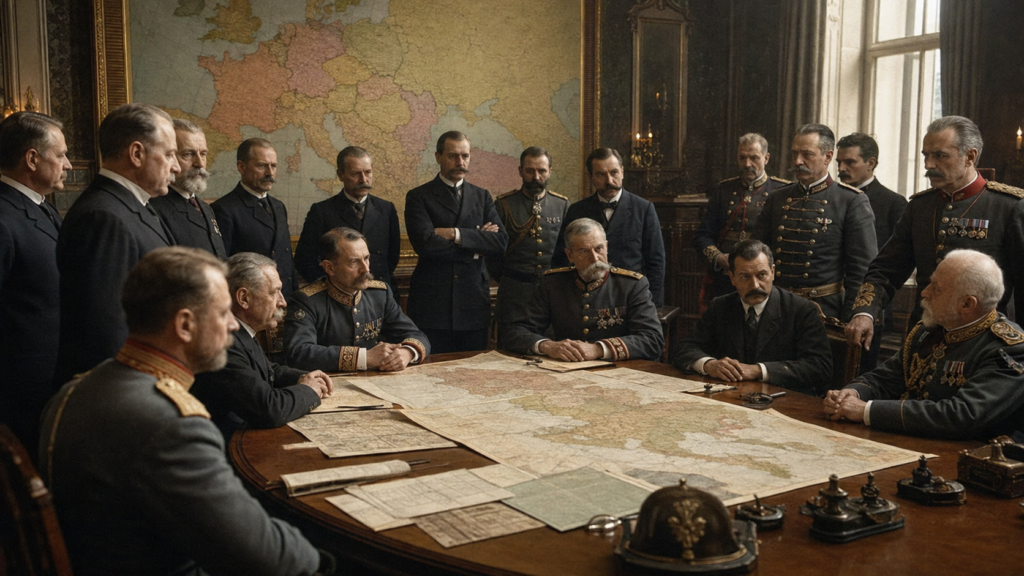
One of the most important features of pre-war Europe was the development of competing diplomatic groupings.
Germany, Austria-Hungary and Italy were associated through the Triple Alliance, while France, Russia and Britain formed the Triple Entente by 1907.
These arrangements were more complicated than two rigid teams waiting for a reason to fight. The agreements varied in their precise obligations, and governments still made decisions according to their own interests. Nevertheless, the existence of these relationships meant that a conflict involving one major power could quickly draw others into the crisis.
Germany was particularly concerned about the possibility of facing France in the west and Russia in the east simultaneously. France, meanwhile, regarded Germany as its principal continental rival, particularly after losing Alsace and Lorraine following the Franco-Prussian War of 1870–71.
Russia had its own interests in the Balkans and regarded itself as a protector of Slavic peoples, including Serbia. Britain was less closely tied to France and Russia through formal military obligations than the popular idea of the “Allied side” sometimes suggests, but British leaders increasingly viewed the balance of power in Europe and the growth of German influence as matters of major concern.
The alliance system therefore did not automatically cause World War I. Instead, it created a network through which a regional crisis could escalate rapidly.
The Balkans: Europe’s Powder Keg
The Balkans were particularly dangerous because several competing national ambitions overlapped there.
Austria-Hungary was a multinational empire containing Germans, Hungarians, Czechs, Slovaks, Croats, Serbs, Slovenes, Romanians, Poles, Ukrainians and others. The empire’s leaders worried that nationalism could weaken the state from within.
Serbia, meanwhile, had emerged as an increasingly influential Balkan state. Its ambitions were closely connected to the broader idea of South Slavic unity.
Austria-Hungary’s annexation of Bosnia and Herzegovina in 1908 intensified these tensions. Bosnia and Herzegovina contained a substantial Slavic population and was viewed by Serbian nationalists as part of a broader South Slavic homeland.
The Balkan Wars of 1912–13 further destabilised the region. Serbia emerged stronger and expanded its territory, increasing Austrian fears of Serbian influence.
By 1914, therefore, the Balkans were not simply a distant regional problem. They had become a point where the interests of Austria-Hungary, Serbia, Russia and other European powers collided.
The Assassination of Archduke Franz Ferdinand
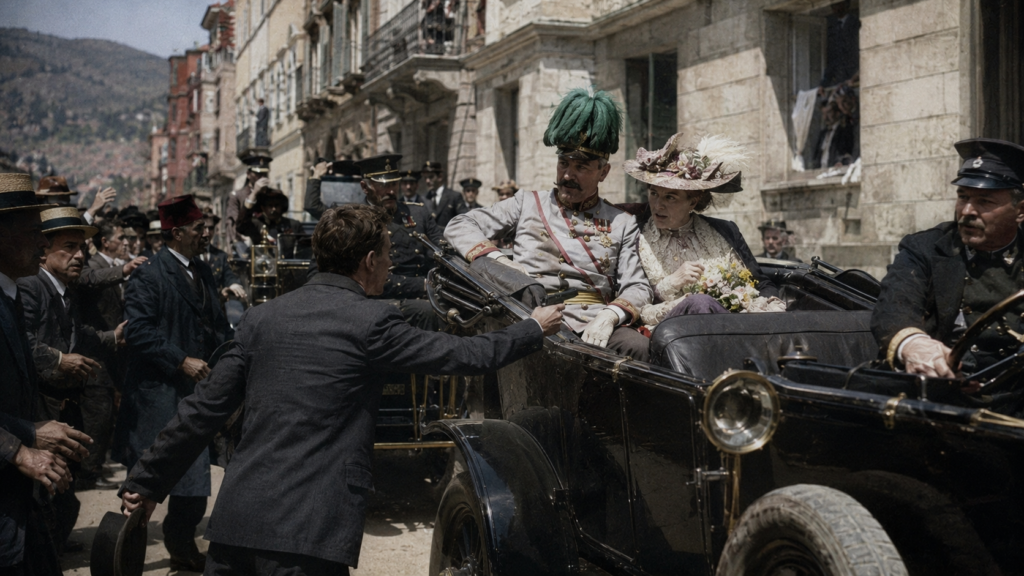
On June 28, 1914, Archduke Franz Ferdinand, heir to the Austro-Hungarian throne, travelled to Sarajevo in Bosnia and Herzegovina with his wife, Sophie.
The visit was politically sensitive. Franz Ferdinand was also inspecting military exercises in the region, which had been annexed by Austria-Hungary several years earlier. Serbian and Bosnian nationalist opposition to Habsburg rule made the trip potentially dangerous.
A group of conspirators prepared to attack the archduke’s motorcade. An initial bomb attempt failed to kill the couple, but later that day the royal vehicle took a wrong turn.
One of the conspirators, Gavrilo Princip, happened to be nearby. He fired at the couple, killing Franz Ferdinand and Sophie. Princip was a young Bosnian Serb nationalist, and the assassination became the immediate trigger for the crisis that followed.
💡 Curiosity Insight: The assassination is often remembered as if it were a carefully executed operation from beginning to end. In reality, the failed first attack and the later accidental encounter between Princip and the archduke’s vehicle played an important role in how the assassination unfolded.
The killings shocked Europe, but they did not make a world war inevitable. The crucial question was how Austria-Hungary and the other great powers would respond.
Austria-Hungary Decides to Confront Serbia
Austria-Hungary considered the assassination an opportunity to confront a problem it had been struggling with for years: Serbian nationalism.
The government in Vienna believed that allowing Serbia to emerge stronger without a decisive response could undermine Austria-Hungary’s position in the Balkans and potentially encourage nationalist movements within the empire.
But there was a major obstacle.
Russia supported Serbia.
A military conflict between Austria-Hungary and Serbia could therefore become a conflict involving Russia. Austrian leaders needed to know whether Germany would support them if Russia intervened.
Germany provided that assurance.
In early July, Kaiser Wilhelm II and the German government gave Austria-Hungary strong backing, commonly described as the “blank cheque.” Germany essentially indicated that Austria-Hungary could rely on German support even if its confrontation with Serbia escalated.
That decision was crucial because it gave Austrian leaders greater confidence in pursuing a hard line.
The July Crisis
The assassination took place on June 28. Almost exactly one month later, Europe was at war.
The period between these events became known as the July Crisis.
Austria-Hungary prepared an extremely demanding ultimatum to Serbia. On July 23, Serbia received the demands and was given only 48 hours to respond. Among other conditions, Austria-Hungary demanded action against anti-Austrian propaganda and wanted to participate directly in investigations connected to the assassination.
The ultimatum was deliberately difficult for Serbia to accept in full.
Serbia accepted most of the demands but rejected or qualified some of the provisions that challenged its sovereignty. Austria-Hungary considered the response insufficient and broke diplomatic relations.
Meanwhile, Russia began moving toward mobilisation in support of Serbia.
The crisis was no longer confined to Austria-Hungary and Serbia.
Germany stood behind Austria-Hungary. Russia supported Serbia. France was linked to Russia, while Britain watched the rapidly deteriorating situation and attempted to assess whether diplomatic intervention could prevent a general European war.
The decisions made during these days mattered enormously because military mobilisation itself was becoming a dangerous political act. Once armies began moving, governments feared that delaying their own mobilisation could leave them strategically vulnerable.
The diplomatic crisis was therefore becoming a military crisis.
The Outbreak of War
On July 28, 1914, Austria-Hungary declared war on Serbia. Austro-Hungarian forces soon began military operations against Serbia. Russia moved toward mobilisation, and the crisis rapidly expanded.
Germany declared war on Russia on August 1.
Two days later, Germany declared war on France.
Germany’s military strategy depended heavily on defeating France quickly before turning its full strength against Russia. This meant that Germany could not simply wait for the diplomatic crisis to settle. Its war plans were based on rapid mobilisation and offensive action.
On August 4, German forces invaded neutral Belgium as part of their advance toward France.
Britain then entered the war against Germany.
A crisis that had begun in Sarajevo had become a continental war.
❓ Did You Know? The speed of the escalation was extraordinary. Austria-Hungary declared war on Serbia on July 28; within just over a week, Germany, Russia, France and Britain were all directly involved in the conflict. The alliance network had transformed a Balkan confrontation into a European war.
Germany’s Opening Strategy and the Schlieffen Plan
Germany faced a difficult strategic problem: France to the west and Russia to the east.
German military planners believed Russia would require more time to mobilise its enormous forces. Germany therefore wanted to defeat France rapidly before concentrating against Russia.
The strategy associated with this approach became known as the Schlieffen Plan, named after former German Chief of the General Staff Alfred von Schlieffen.
Rather than attacking France directly through the heavily fortified Franco-German frontier, German forces would move through neutral Belgium and northern France, attempt to envelop the French armies and capture Paris or force France out of the war quickly.
The plan depended upon speed.
That dependence would become one of the defining characteristics of the opening weeks of the war.
German forces moved through Belgium, encountering resistance that slowed their advance. The British Expeditionary Force also arrived on the continent to support France. German armies pushed deep into northern France, but the expected quick victory did not materialise.
The Battle of the Marne
By early September, German forces had advanced toward Paris.
Then the Allied armies counterattacked.
The First Battle of the Marne, fought from September 6 to 12, 1914, halted the German advance. The battle was one of the decisive moments of the opening campaign because Germany failed to achieve the rapid victory on the Western Front that its strategy required.
The German armies withdrew toward stronger defensive positions.
Instead of ending the war quickly, the opposing armies increasingly began constructing trenches.
What had started as a war of movement was beginning to become something very different.
The Eastern Front
While Germany fought France and Britain in the west, the war was also unfolding across eastern Europe.
Russia mobilised more quickly than Germany had expected and launched offensives into East Prussia and Austria-Hungary.
The Germans responded with a major victory at the Battle of Tannenberg, fought from August 26 to 30, 1914. Russian forces suffered a severe defeat, demonstrating that Germany could still achieve major victories in the east even as its advance in the west was slowing.
The Eastern Front differed significantly from the Western Front. Its enormous distances made continuous trench systems much more difficult to establish on the same scale. Armies could move across hundreds of kilometres, and territorial gains and losses were often much larger.
The war was therefore already developing into two very different conflicts: a heavily fortified struggle in the west and a more mobile, expansive war in the east.
By the end of 1914, however, it was becoming clear that the conflict would not be the short war many had expected.
The opening campaign had failed to deliver a decisive victory. The armies were digging in, new fronts were emerging, and governments were mobilising their economies and societies for a conflict whose end was no longer visible.
The Great War had begun—and its most devastating years were still ahead.
The Birth of Trench Warfare
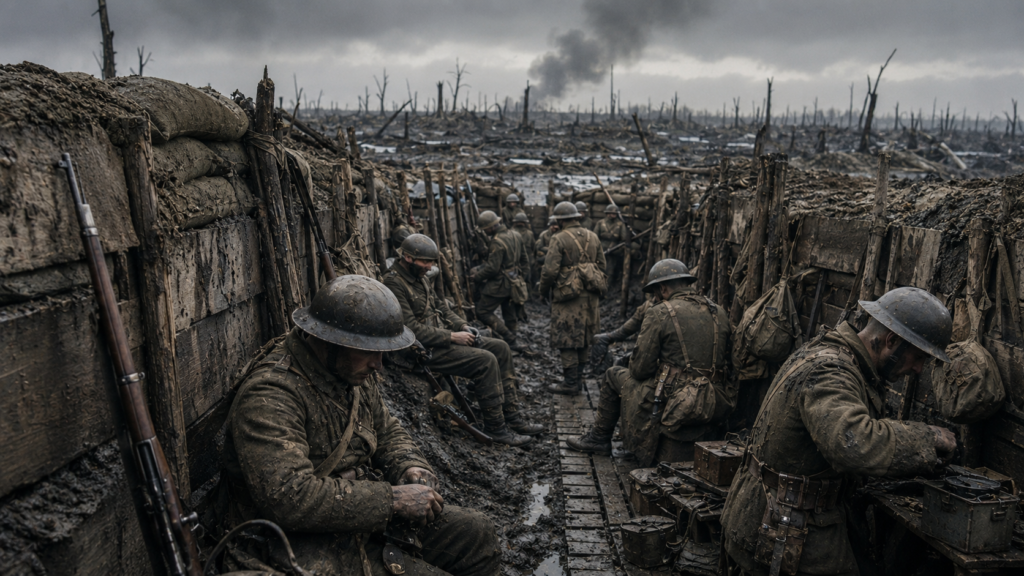
By the end of 1914, the character of the war had changed dramatically. The rapid movements of the opening campaigns had given way to defensive positions stretching across the Western Front. From the North Sea coast through Belgium and northern France toward the Swiss border, opposing armies constructed networks of trenches, dugouts, communication trenches and fortified positions.
The problem was simple but extraordinarily difficult to solve: modern firepower made attacking an entrenched enemy extremely dangerous.
Machine guns could fire hundreds of rounds in a short period, while artillery could bombard positions from a distance. Barbed wire slowed advancing infantry, giving defenders more time to bring weapons to bear. Soldiers attacking across open ground therefore faced a combination of obstacles that made traditional rapid advances increasingly difficult.
The result was a war of endurance.
Soldiers spent long periods in trenches exposed to shellfire, rain, mud, disease and exhaustion. Front-line positions were connected to reserve trenches and supply routes, allowing armies to rotate troops while maintaining their defensive systems.
The trenches were not simply long ditches. They formed complicated military landscapes containing firing positions, shelters, medical posts, command areas, ammunition stores and communication routes.
🔬 Curiosity Insight: The trench system itself was constantly evolving. Engineers and soldiers adapted defensive positions according to experience, creating deeper shelters and stronger fortifications as artillery became increasingly destructive.
The Western Front had become a battlefield where gaining a few kilometres could require enormous resources and thousands of casualties.
Verdun: The Battle That Became a Symbol of Attrition
In February 1916, Germany launched a major offensive against the French fortress region of Verdun.
The battle became one of the longest and most destructive engagements of the war. German planners hoped to place France under enormous pressure by attacking an area of deep national and military significance. France responded by committing large numbers of troops to its defence.
Verdun became a battle of endurance in which artillery dominated the battlefield.
French troops were repeatedly moved into the sector, while German and French forces fought over a landscape increasingly destroyed by bombardment. Fortifications changed hands, villages disappeared under shellfire, and the battle continued for months.
The French eventually held Verdun, but the battle demonstrated the terrible logic of attrition: an army could win strategically while suffering extraordinary losses.
Verdun became deeply embedded in French national memory as a symbol of endurance and sacrifice.
The Battle of the Somme
While Verdun was still raging, the Allies launched another enormous offensive on the Somme River in northern France.
The Battle of the Somme began on July 1, 1916. British and French forces attempted to break through German defensive positions and relieve pressure on the French at Verdun.
The first day became one of the most infamous days in British military history. British forces suffered tens of thousands of casualties, including more than 19,000 killed. The scale of the losses shocked British society and demonstrated how dangerous an assault against prepared defensive positions could be.
The battle continued for months.
The Allies gradually captured territory, but they did not achieve the decisive breakthrough they had hoped for. The Somme demonstrated that numerical superiority and enormous quantities of artillery did not automatically translate into a rapid victory.
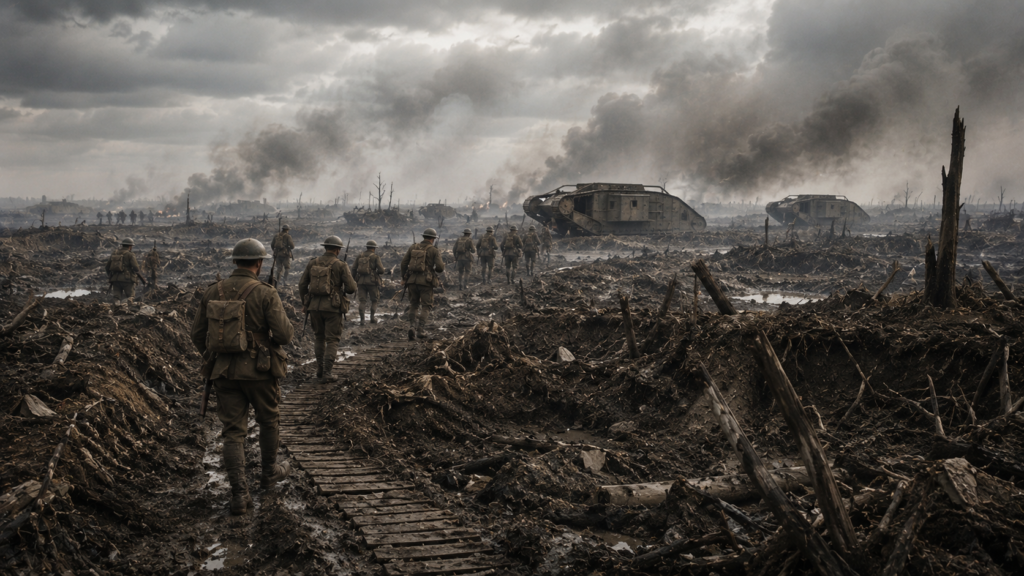
The battle also marked an important moment in the development of armoured warfare. Britain introduced tanks during the Somme campaign in September 1916. Early tanks were unreliable and available in small numbers, but their appearance hinted at how future armies might overcome trench defences.
By the time the Somme offensive ended, the battlefield had become a landscape of mud, shell craters and destroyed infrastructure.
Gallipoli: The War Reaches the Ottoman Empire
The Western Front was not the only place where the Allies attempted to break the strategic deadlock.
The Ottoman Empire had entered the war on the side of Germany and its allies. The Dardanelles Strait provided a potential route toward Constantinople, the Ottoman capital, and the Black Sea. The Allies hoped that forcing the strait could weaken the Ottoman Empire and potentially establish a supply route to Russia.
The campaign initially began as a naval operation.
British and French warships attempted to force their way through the Dardanelles, but Ottoman mines, artillery and coastal defences prevented the fleet from achieving its objective. After the naval failure, the Allies decided that troops would have to seize the peninsula and destroy the defensive positions from land.
On April 25, 1915, Allied troops landed on the Gallipoli Peninsula.
Among them were Australian and New Zealand troops who became known collectively as the ANZACs. British, Indian and French forces also participated in the campaign. The Australian and New Zealand troops landed at what became known as Anzac Cove, where steep terrain and strong Ottoman resistance quickly disrupted the Allied plan.
The campaign soon became a stalemate.
The Allies could establish beachheads but struggled to advance inland. Ottoman forces defended the high ground, while the difficult terrain made movement and supply extremely challenging.
One of the Ottoman commanders who emerged prominently during the fighting was Mustafa Kemal, later known as Mustafa Kemal Atatürk, who would become the founder and first president of modern Turkey.
The Allies launched another major attempt to break the stalemate in August. Battles around Lone Pine, Chunuk Bair and other positions produced fierce fighting but failed to achieve a decisive breakthrough.
Eventually, the Allies withdrew.
The evacuations from Anzac and Suvla in December 1915 were conducted with remarkable success, followed by the evacuation of the remaining British forces from Helles in January 1916.
Gallipoli was a military failure for the Allies, but its historical significance extended far beyond the battlefield. The campaign became central to Australian and New Zealand remembrance and national identity, while the Ottoman victory became an important part of Turkey’s national historical narrative.
The War Spreads Across the Middle East and Africa
World War I was never confined to Europe.
The Ottoman Empire’s involvement opened major fronts in the Middle East. British forces fought Ottoman troops in Mesopotamia, around the Suez Canal and later in Palestine. The campaigns eventually contributed to the collapse of Ottoman control over large parts of the region.
In 1916, the Arab Revolt began against Ottoman rule, with Arab forces receiving support from Britain. The conflict in the Middle East therefore combined the wider European war with local struggles over political authority, independence and imperial control.
Africa also became a battlefield because Britain, France, Germany, Belgium and Portugal possessed extensive colonial territories. German colonies were attacked by Allied forces, while African soldiers and labourers were recruited or compelled to support imperial war efforts.
The global dimensions of the war meant that people from Asia, Africa, the Middle East, Australia, New Zealand, Canada and other parts of the British and French empires became involved in a conflict whose principal political origins lay in Europe.
War at Sea and the U-Boat Campaign
The oceans were another crucial battlefield.
Britain possessed the world’s most powerful navy and attempted to use its naval superiority to restrict Germany’s access to overseas supplies. The British blockade placed growing economic pressure on Germany.
Germany responded with U-boats, or submarines.
Rather than challenging the British fleet directly in a conventional surface battle, German submarines attacked merchant shipping carrying supplies to Britain and its allies.
Submarine warfare created a new strategic problem. Merchant ships were vulnerable because submarines could attack from beneath the surface and disappear before conventional naval forces could respond.
Germany eventually expanded its campaign into unrestricted submarine warfare, targeting shipping travelling to Allied ports.
The sinking of passenger liner Lusitania by a German U-boat in May 1915 became an international controversy, particularly because civilians were among those killed. The incident contributed to growing hostility toward Germany in the United States, although it did not by itself bring America into the war.
The submarine campaign would become even more important in 1917, when Germany resumed unrestricted submarine warfare on a much larger scale.
A New Age of Warfare
World War I introduced or dramatically expanded technologies that changed the battlefield.
Artillery became the dominant killer on many fronts. Heavy guns could bombard enemy positions from kilometres away, sometimes for hours or days.
Machine guns made frontal infantry assaults extremely dangerous.
Poison gas introduced another terrifying dimension. Chlorine, phosgene and mustard gas were among the chemical agents used during the war. Gas did not simply kill; it could cause blindness, respiratory injuries and severe burns, creating a psychological weapon as well as a physical one.
Aircraft also transformed warfare.
At first, aircraft were primarily used for reconnaissance. Pilots observed enemy positions and movements, allowing commanders to gather information that had previously been difficult to obtain.
Aircraft were soon armed, producing aerial combat between fighter pilots. Bombing operations also developed as nations experimented with attacking targets beyond the immediate battlefield.
Tanks represented another attempt to overcome trench warfare. Early models were slow, mechanically unreliable and difficult to operate, but they demonstrated the potential of combining armour, mobility and firepower.
🔬 Science Insight: World War I did not invent every technology associated with modern warfare, but it accelerated the practical development of many of them. Aviation, radio communication, military medicine, engineering and industrial production all became increasingly important because the war demanded technology on an enormous scale.
The Home Front
The war was also fought far from the trenches.
Governments mobilised entire economies to support their armies. Factories shifted toward military production, railways transported troops and supplies, and governments introduced systems to control food, fuel and other essential resources.
Millions of men were drawn into military service, creating labour shortages in civilian industries.
Women increasingly entered occupations that had previously been dominated by men. They worked in factories, transport, administration, agriculture, hospitals and other services. In Britain, for example, the Women’s Army Auxiliary Corps was established in 1917, with women performing administrative, catering, store and other support duties.
These changes did not immediately create complete social equality, but the experience challenged existing assumptions about women’s roles and contributed to broader social changes after the war.
Civilians also experienced shortages and hardship.
The British blockade contributed to severe shortages in Germany, while German submarine warfare threatened Britain’s food and raw-material supplies. Governments introduced propaganda campaigns to maintain morale, encourage recruitment, raise funds and present the enemy in hostile terms.
The distinction between battlefield and civilian society was therefore becoming increasingly blurred.
The War Becomes a Global Struggle
By the middle of the war, World War I had become an enormous international conflict.
The main European fronts remained decisive, but fighting and military commitments extended across the Middle East, Africa, the oceans and colonial territories. Troops from across the British Empire fought alongside Britain, while France drew heavily upon its colonial possessions.
For soldiers, the experience varied enormously depending on where they served. A British infantryman on the Somme experienced a very different war from an Australian soldier at Gallipoli, an Ottoman soldier defending the Dardanelles, a Russian soldier on the Eastern Front or a sailor serving aboard a submarine.
Yet all were participating in the same expanding conflict.
By the end of 1916, neither side had achieved the decisive victory it wanted. Verdun had failed to break France. The Somme had failed to destroy the German armies. Gallipoli had ended in Allied withdrawal.
The war had become a contest of resources, manpower, industrial capacity and political endurance.
And then, in 1917, two developments would fundamentally alter the balance of the conflict: Russia would begin its revolution and move toward leaving the war, while the United States would enter on the Allied side.
The final phase of the Great War was about to begin.
1917: The Year That Changed the War
By the beginning of 1917, World War I had entered its fourth year. The great offensives of 1916 had produced enormous casualties without delivering a decisive victory. France and Britain remained committed to the war, Germany was under increasing economic pressure, and Russia was suffering from military losses, food shortages and political unrest.
Then two developments changed the strategic balance.
Russia began a revolution that would eventually remove it from the war. At almost the same time, the United States entered the conflict on the Allied side.
The war was approaching its decisive phase.
The Russian Revolution
Russia’s participation in the war had placed enormous pressure on the Russian Empire. Military defeats, shortages, inflation and disruption to transportation weakened public confidence in the government.
In March 1917—February according to the Russian calendar then in use—mass protests and strikes in Petrograd led to the collapse of Tsar Nicholas II’s government. The Tsar abdicated, ending centuries of Romanov rule. A Provisional Government took control, but it faced competition from workers’ and soldiers’ councils known as Soviets.
The new government faced a difficult choice. It could withdraw from the war and attempt to stabilise Russia, or continue fighting alongside its Allies.
It chose to continue the war.
This decision proved politically damaging. War exhaustion was widespread, while soldiers increasingly questioned why they should continue fighting for a government that had promised political change.
In November 1917, the Bolsheviks, led by Vladimir Lenin, seized power in Petrograd. One of their central promises was an end to the war.
The new government began negotiations with Germany and the other Central Powers. A temporary armistice was followed by peace negotiations at Brest-Litovsk. Russia formally withdrew from the war through the Treaty of Brest-Litovsk, signed on March 3, 1918.
Russia’s departure had enormous military consequences. Germany could now transfer substantial forces from the Eastern Front to the Western Front.
For Germany, this created an opportunity.
But there was another problem.
America was entering the war.
The United States Enters World War I
The United States had remained officially neutral for most of the conflict, although American economic ties increasingly connected the country with the Allied powers.
Germany’s decision to resume unrestricted submarine warfare in 1917 became a major turning point. German U-boats attacked shipping without the previous restrictions intended to avoid direct confrontation with neutral countries.
The Zimmermann Telegram, in which Germany proposed an alliance with Mexico in the event of war with the United States, further increased American concerns.
On April 2, 1917, President Woodrow Wilson asked Congress to declare war against Germany. Congress approved the declaration, with the Senate voting on April 4 and the House following two days later. The United States later declared war on Austria-Hungary in December.
American involvement did not instantly transform the battlefield. The United States needed time to train, equip and transport a large army to Europe.
But the strategic implications were enormous.
The Allies now had access to America’s industrial capacity, financial resources and growing military manpower. Germany, by contrast, was increasingly struggling with shortages and the effects of years of blockade.
💡 Curiosity Insight: The United States’ entry did not mean millions of American soldiers immediately appeared on the Western Front. Building an effective expeditionary force took time. America’s greatest impact developed gradually during 1917 and 1918.
Germany’s Last Gamble: The Spring Offensive
Russia’s withdrawal gave Germany a temporary strategic advantage.
German commanders transferred troops from the Eastern Front to France and prepared a major offensive before the full strength of the American army could arrive.
Beginning in March 1918, Germany launched a series of offensives on the Western Front. The campaign became known as the Spring Offensive, with the first major attack beginning on March 21.
German troops initially achieved impressive gains.
Using infiltration tactics and specially trained assault units, German forces attempted to bypass strong defensive positions and disrupt Allied command and supply systems. The attacks pushed Allied forces back and created a serious crisis.
For a moment, it appeared possible that Germany might finally break the stalemate.
But the offensive had fundamental weaknesses.
German forces suffered heavy casualties, and advancing armies struggled to maintain supplies over devastated territory. Germany also lacked sufficient reserves to replace losses indefinitely.
Most importantly, the Allies were increasingly able to coordinate their forces.
The German attacks eventually lost momentum.
The opportunity for a decisive German victory disappeared.
The Allied Counterattack and the Hundred Days
In the summer of 1918, the balance shifted decisively.
American troops were arriving in increasingly large numbers, while French and British forces remained capable of sustained operations. Allied commanders increasingly coordinated their offensives instead of launching disconnected attacks.
On August 8, 1918, the Allies launched the Battle of Amiens, beginning the period commonly known as the Hundred Days Offensive.
The Allied armies used artillery, infantry, tanks and aircraft in increasingly coordinated operations.
The German army began retreating.
The psychological effect was particularly significant. German commanders recognised that their forces were becoming exhausted and that the war was increasingly difficult to sustain.
The Hundred Days was not one enormous battle but a series of Allied offensives that steadily pushed German forces back toward the positions they had occupied before their great 1918 advances.
The war of movement that had largely disappeared from the Western Front after 1914 had returned.
This time, however, the Central Powers were on the defensive.
The Collapse of the Central Powers
Germany was not the only Central Power facing collapse.
In September 1918, Allied forces broke through against Bulgaria on the Macedonian Front. Bulgaria requested an armistice.
The Ottoman Empire was also approaching military and political collapse. Allied advances in the Middle East weakened Ottoman control, and the empire eventually signed the Armistice of Mudros on October 30.
Austria-Hungary faced an even deeper crisis.
The empire contained numerous national groups with competing political ambitions. As the military situation deteriorated, nationalist movements increasingly demanded independence.
Austria-Hungary broke apart during the final weeks of the war.
By late October and early November, the Central Powers were collapsing faster than Germany could respond.
Germany itself faced revolution and political unrest.
The German naval mutiny at Kiel in early November helped trigger a broader revolutionary movement. Workers’ and soldiers’ councils appeared in several cities, and Kaiser Wilhelm II abdicated.
Germany’s imperial government was ending at the same time that its military position became untenable.
The Armistice of November 11, 1918
The final German government sought an armistice.
Negotiations took place with the Allied powers, and the terms required Germany to withdraw from occupied territories, surrender military equipment and accept other conditions designed to prevent an immediate resumption of the war.
At 11:00 a.m. on November 11, 1918, the armistice came into effect.
The guns stopped.
After more than four years of industrialised warfare, the fighting on the Western Front ended.
But November 11 was not the same thing as a final peace treaty.
The war had stopped militarily, but the political settlement was still to come.
How Many People Died in World War I?
The human cost of World War I was enormous.
Exact totals vary because governments recorded casualties differently, civilian deaths were often poorly documented, and deaths from disease, starvation and wartime displacement are difficult to classify consistently.
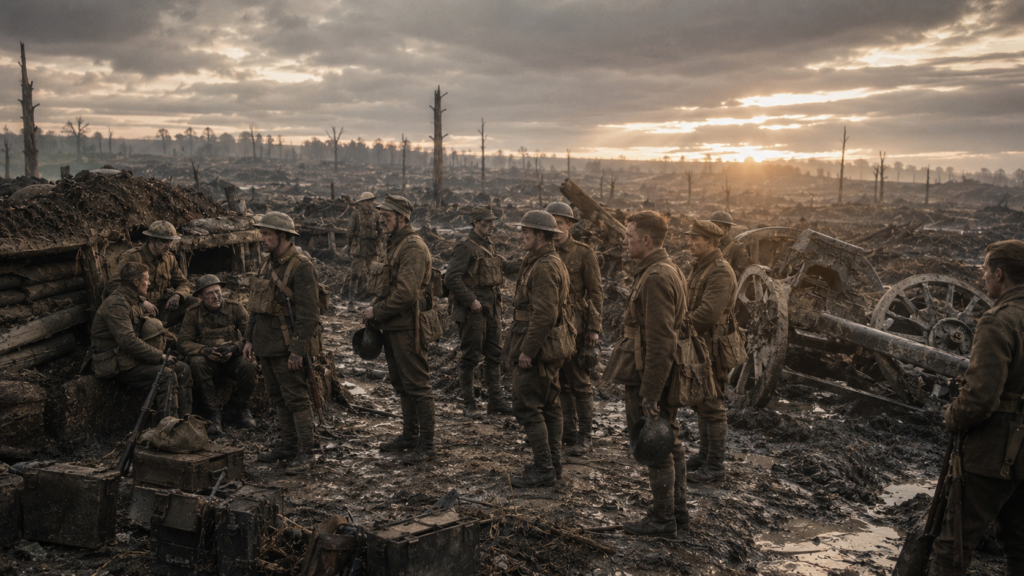
Millions of soldiers were killed, while many millions more were wounded or permanently disabled. Civilian populations also suffered from bombardment, occupation, disease, hunger and wartime shortages.
The scale of the losses transformed entire societies.
Almost every European community was affected by the absence of young men, the return of wounded veterans and the deaths of family members.
The war also produced a generation accustomed to mass death on a scale previously difficult to imagine.
❓ Did You Know? The human cost of the war did not end when the armistice was signed. Many veterans continued to suffer from physical injuries and psychological trauma for decades, while postwar disease and hardship added to the enormous social consequences of the conflict.
The Paris Peace Conference
The victorious powers gathered in Paris in January 1919 to determine the terms of the postwar settlement.
Nearly thirty nations participated, but the negotiations were dominated by the leading Allied powers, particularly Britain, France, the United States and Italy—the group commonly called the Big Four.
President Woodrow Wilson arrived with his vision of a new international order. His Fourteen Points, presented in January 1918, called for principles including open diplomacy, reduced armaments, freer international relations and the creation of an organisation capable of maintaining peace.
France, however, wanted security against future German aggression and demanded a settlement that would weaken Germany.
Britain had its own priorities, including the security of Europe, naval interests and the management of the German Empire’s former colonies.
The final settlement was therefore a compromise between competing visions.
The Treaty of Versailles
The Treaty of Versailles, signed on June 28, 1919, imposed major restrictions on Germany.
Germany lost territory in Europe and all of its overseas colonies. Its armed forces were heavily restricted, and the treaty included provisions concerning German responsibility and reparations. The settlement also established the League of Nations, an international organisation intended to help prevent future wars.
The treaty became deeply controversial.
Many Germans regarded it as humiliating and unjust. Elsewhere, some Allied leaders believed the settlement was necessary to protect Europe from another German attack.
Wilson’s vision also encountered difficulties at home. The United States Senate ultimately failed to ratify the Treaty of Versailles, and the United States never joined the League of Nations.
The peace settlement had therefore ended the war without resolving every political tension that had helped produce it.
The Collapse of Four Empires
One of the most important consequences of World War I was the destruction or transformation of four major imperial systems.
The German Empire became a republic.
The Austro-Hungarian Empire disintegrated, giving rise to Austria, Hungary, Czechoslovakia and the Kingdom of Serbs, Croats and Slovenes, among other political changes.
The Ottoman Empire lost most of its remaining territories, while new borders and mandates reshaped the Middle East.
The Russian Empire disappeared through revolution and civil conflict, eventually giving way to the Soviet Union.
The political map of Europe had been transformed.
New states appeared, old dynasties disappeared, and nationalist movements gained enormous influence.
The Long-Term Consequences of World War I
World War I changed far more than national borders.
The war accelerated social change, expanded government involvement in economic life and transformed relationships between citizens and the state. Women had taken on expanded responsibilities in many societies while millions of men served at the front.
Economic disruption also left many countries heavily indebted.
Nationalism became more powerful in some regions, while revolutionary movements gained strength elsewhere. The Russian Revolution demonstrated that a major European government could collapse under the pressures of war, while political instability spread across several countries after 1918.
The postwar settlement also created unresolved territorial and political disputes.
In central and eastern Europe, newly created states contained populations belonging to different ethnic and national groups. In the Middle East, the collapse of Ottoman rule led to new political arrangements that would have consequences far beyond the immediate postwar period.
The war therefore created a world that was politically different from the one that had entered the conflict in 1914.
Did World War I Cause World War II?
World War I did not make World War II inevitable, but the consequences of the first war helped create conditions in which another major European conflict became possible.
Germany’s defeat, the Treaty of Versailles, economic instability, political extremism, territorial disputes and dissatisfaction with the postwar settlement all became important elements of the interwar environment.
Adolf Hitler and the Nazi movement later exploited German resentment, economic hardship and fears of communism.
The Second World War therefore cannot be reduced to a simple continuation of the first. It had its own causes and decisions. Nevertheless, the unresolved consequences of 1914–1918 formed part of the political background against which the crisis of the 1930s developed.
Why World War I Still Matters
World War I is sometimes overshadowed in popular memory by the even larger conflict that followed it.
Yet many features of the modern world were shaped during and immediately after the Great War.
Modern mass warfare, industrial mobilisation, military aviation, mechanised warfare, submarine warfare and large-scale propaganda all developed rapidly during the conflict.
The political consequences were even greater.
Four major empires disappeared. New countries emerged. Revolutionary politics transformed Russia. The United States became a more important force in international affairs. The Ottoman territories were reorganised, with consequences that continued throughout the twentieth century.
Most importantly, the war demonstrated the destructive potential of modern industrial society when entire economies and populations were mobilised for conflict.
The Great War began with European powers expecting that military strength could secure political objectives. Instead, it produced four years of destruction on a scale that few leaders had anticipated.
Key Takeaways
- World War I grew from a combination of nationalism, militarism, imperial rivalry, political tensions and the European alliance system.
- The assassination of Archduke Franz Ferdinand triggered the July Crisis but was not the sole underlying cause of the war.
- The conflict quickly expanded from a Balkan crisis into a European and global war.
- Trench warfare and industrialised firepower produced unprecedented casualties on the Western Front.
- Major campaigns such as Verdun, the Somme and Gallipoli demonstrated the difficulty of breaking entrenched defensive systems.
- The war increasingly involved civilians, colonial territories, economies and entire national populations.
- The Russian Revolution and American entry transformed the strategic situation in 1917.
- Germany’s Spring Offensive failed to achieve victory in 1918.
- The Allied Hundred Days Offensive helped force Germany into an armistice on November 11, 1918.
- The Treaty of Versailles and other postwar settlements transformed the political map of Europe and the Middle East.
- The consequences of World War I continued to influence international politics for decades.
Frequently Asked Questions
What caused World War I?
World War I resulted from several interconnected factors, including nationalism, militarism, imperial competition, political tensions in the Balkans and the European alliance system. The assassination of Archduke Franz Ferdinand in June 1914 triggered the immediate diplomatic crisis.
Who started World War I?
There is no historically adequate answer that assigns the entire responsibility to one country. Austria-Hungary initiated military action against Serbia after the assassination, while Germany strongly supported Austria-Hungary. Russia, France, Britain and other governments subsequently made decisions that expanded the conflict. Historians continue to debate the relative responsibility of the major powers.
Why did the United States enter World War I?
Germany’s unrestricted submarine warfare was the immediate major reason cited by President Wilson. The Zimmermann Telegram and other developments also contributed to American public and political support for entering the war.
Why did Russia leave World War I?
The Russian Revolution destroyed the old imperial government and brought the Bolsheviks to power. Lenin’s government sought to end Russia’s participation in the war and negotiated with the Central Powers, eventually signing the Treaty of Brest-Litovsk in March 1918.
How did World War I end?
The fighting on the Western Front ended with the armistice that took effect at 11:00 a.m. on November 11, 1918. Formal peace settlements followed, most notably the Treaty of Versailles in 1919.
What was the Treaty of Versailles?
The Treaty of Versailles was the principal peace treaty between Germany and the Allied powers after World War I. It imposed territorial, military and financial conditions on Germany and established the framework for the League of Nations.
Conclusion
World War I began in a Europe already shaped by rivalry and insecurity, but its consequences went far beyond the circumstances that produced it.
The assassination at Sarajevo triggered a crisis. Diplomatic decisions transformed that crisis into war. Industrial technology then turned the conflict into a struggle of extraordinary destructive power.
For four years, soldiers fought across trenches, mountains, deserts and oceans while governments mobilised entire societies behind them. Millions died, empires collapsed and political systems were transformed.
When the guns finally fell silent on November 11, 1918, Europe was no longer the world it had been in 1914.
The Great War had ended, but the consequences of that conflict had only begun.
The new political order created after 1918 carried hopes of lasting peace, yet it also contained unresolved disputes, economic pressures and political resentments. The League of Nations represented an ambitious attempt to prevent another catastrophe, but it could not eliminate the rivalries and instability of the interwar world.
World War I therefore stands as both an ending and a beginning: the end of an old European order and the beginning of a new, more uncertain age.
Sources & References
- U.S. Department of State, Office of the Historian — historical documentation on U.S. entry into World War I and the Paris Peace Conference.
- U.S. Department of State, Office of the Historian — historical documents concerning the Russian Revolution, armistice and Treaty of Brest-Litovsk.
- U.S. Department of State, Office of the Historian — Wilson’s Fourteen Points and American diplomatic aims.
- Imperial War Museums — archival material relating to the German Spring Offensive and the Allied Hundred Days Offensive.
Further Reading & Resources
Continue your learning journey with more expert guides and insightful articles from CurioReader. Explore related topics below to deepen your understanding and discover new perspectives.
Related CurioReader Articles
Recommended External Resources