Introduction
The Battle of Crete, fought from 20 May to 1 June 1941, was one of the most unusual campaigns of the Second World War. Nazi Germany launched Operation Mercury, a massive airborne invasion designed to capture the strategically important Mediterranean island of Crete.
For the first time in the war, Germany attempted to seize a major territory primarily through a large-scale airborne assault. Thousands of German paratroopers and glider-borne troops descended onto Crete while Allied forces defended the island’s airfields, ports and key positions.
The battle became a German victory, but it was far more costly than German planners had expected. German airborne units suffered extremely heavy casualties, while British, Commonwealth, Greek and Cretan forces fought fiercely despite difficult circumstances.
The Battle of Crete therefore became an important turning point in the history of airborne warfare. Germany had demonstrated that airborne forces could be used to capture strategically important territory, but Crete also exposed the enormous risks involved in large-scale parachute operations.
The battle’s consequences extended beyond the military campaign itself. The German occupation brought severe suffering to the Cretan population, while the resistance that developed on the island became an important part of its wartime history.
The Strategic Importance of Crete
Crete occupies a strategically important position in the eastern Mediterranean.
The island lies south of mainland Greece and between Europe, North Africa and the eastern Mediterranean. Its location made it valuable for controlling sea routes and supporting military operations in the region.
After Germany invaded Greece in April 1941, British and Commonwealth forces withdrew toward Crete and other Mediterranean positions.
Crete contained several important airfields, including Maleme, Heraklion, Rethymno and Chania/Souda.
The German military leadership wanted control of these facilities because they could support operations and help strengthen Germany’s position in the eastern Mediterranean.
The island was also important to the British because it provided naval and air bases from which Allied forces could operate.
For Germany, capturing Crete would remove an important Allied position.
For the Allies, holding it could help maintain their presence in the Mediterranean.
The result was a battle in which a relatively small island became the centre of a major military confrontation.
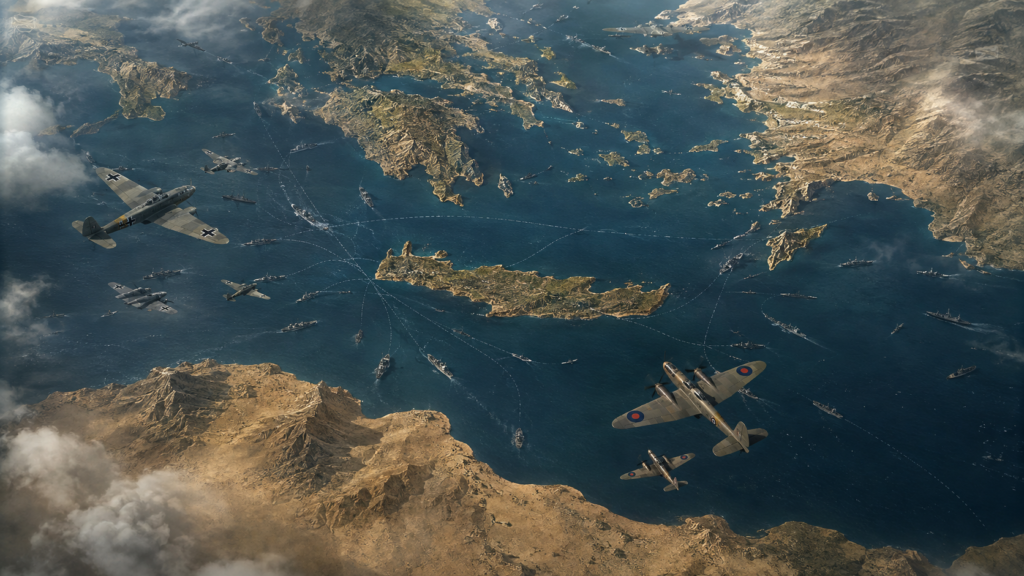
The Forces Preparing for Battle
The German invasion force included elements of the Fallschirmjäger, Germany’s elite airborne troops, along with glider troops, mountain troops and conventional forces that would be transported to the island once suitable landing areas were secured.
The German plan depended heavily on speed.
Paratroopers and glider troops would seize key locations, particularly airfields. Once an airfield was secured, transport aircraft could bring in reinforcements and heavier equipment.
Defending Crete were British and Commonwealth forces, including troops evacuated from mainland Greece.
Greek forces also participated in the defence, while local Cretan civilians became involved in the fighting.
The Allied defenders had an important advantage: they knew an attack was coming.
British intelligence had obtained information about the German plans, giving Allied commanders significant knowledge about the expected airborne assault.
However, knowing that an invasion was coming did not guarantee that the defenders could respond effectively.
The island was large, communications were difficult, and Allied commanders disagreed over how best to deploy their forces.
These problems would become particularly important around the airfield at Maleme.
Operation Mercury: Germany Invades Crete
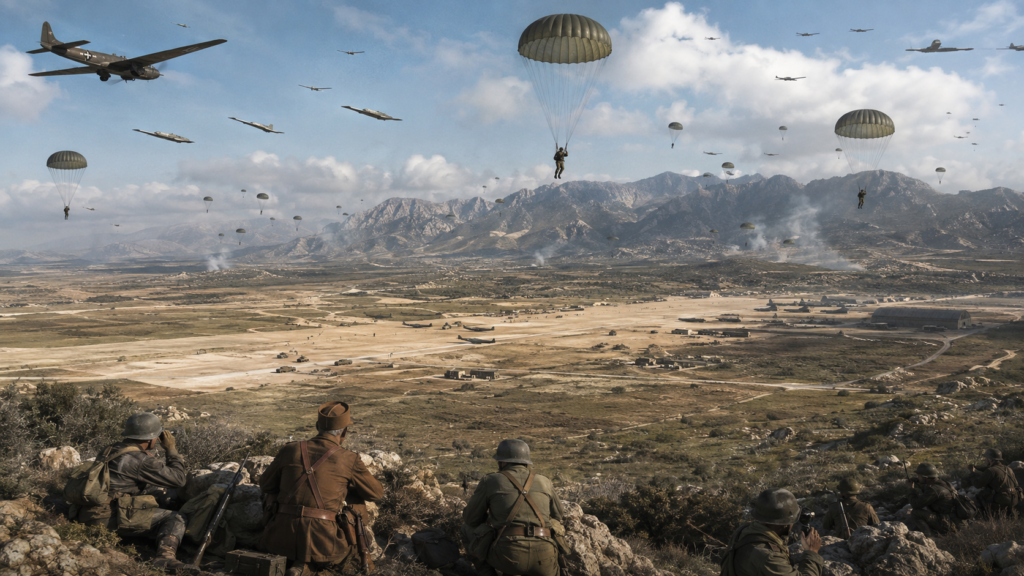
On the morning of 20 May 1941, the German assault began.
Large numbers of German aircraft appeared over Crete.
Paratroopers descended by parachute while gliders carried troops directly toward selected landing areas.
The attack was dramatic but immediately encountered fierce resistance.
German troops landing on the island were often scattered and vulnerable. Many had to fight immediately after landing, sometimes without their heavier weapons and equipment.
Allied and Greek forces fired on the incoming troops, while Cretan civilians also joined the fighting.
The Germans suffered significant casualties during the initial assault.
At several locations, the defenders successfully prevented German forces from achieving their objectives.
However, the battle did not depend on every German landing being successful.
The critical question was whether the Germans could secure one of the island’s airfields.
That question would be answered at Maleme.
The Battle for Maleme
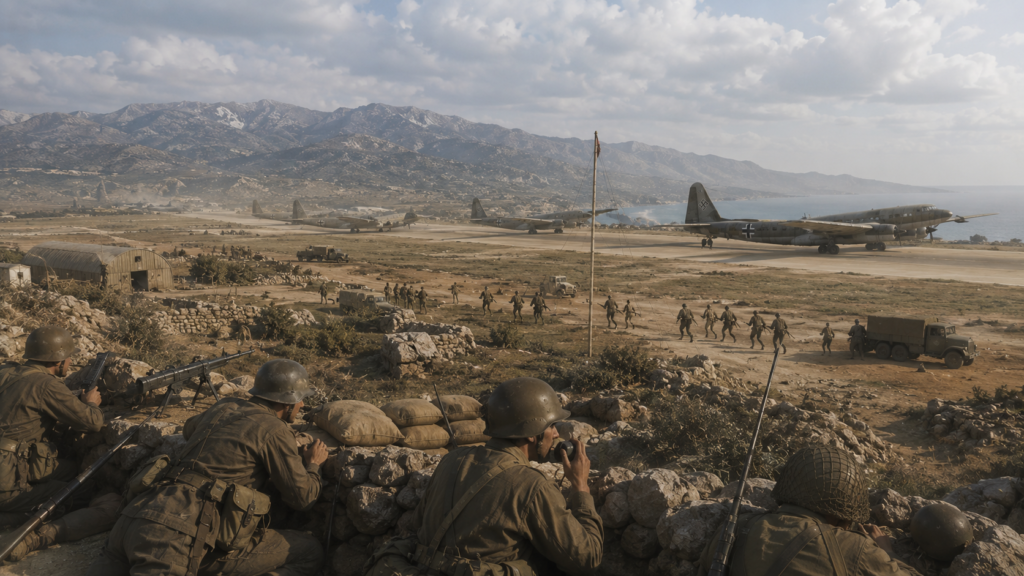
The airfield at Maleme became the decisive point of the campaign.
The Germans initially struggled to capture it.
Allied forces held positions around the airfield, and German troops faced intense resistance.
However, the Allied defence contained weaknesses.
The airfield’s importance was understood, but the defenders did not fully appreciate how quickly the Germans might exploit an opportunity to establish a foothold.
German forces gradually consolidated their position around Maleme.
Once German troops were able to use the airfield, the strategic situation changed dramatically.
Transport aircraft could land and bring in reinforcements.
German mountain troops and additional equipment began arriving.
The defenders now faced an expanding German force rather than isolated groups of paratroopers.
This was the turning point of the battle.
⚔️ CurioReader Insight: The Battle of Crete demonstrated that an airborne invasion did not necessarily need to capture every objective. Securing one strategically important airfield could allow conventional reinforcements to transform a vulnerable airborne force into a much larger ground army.
Fighting Across Crete
While Maleme became decisive, fighting continued across the island.
German forces attacked positions around Chania, Rethymno and Heraklion.
Allied and Greek troops continued resisting the invasion, sometimes holding positions for days despite increasing German pressure.
The mountainous terrain of Crete made movement difficult.
Roads were limited, communications were challenging, and units could become isolated from one another.
For the Germans, this created difficulties of their own.
The invasion plan depended on rapid coordination between airborne forces and reinforcements.
The longer the battle continued, the more important conventional German forces became.
Eventually, Allied commanders concluded that the island could not be held.
British and Commonwealth troops began withdrawing toward the southern coast.
From there, many were evacuated by Royal Navy ships, although German air attacks caused serious losses.
Thousands of Allied troops were eventually captured or left behind.
By early June, organized Allied resistance had largely ended.
The Human Cost of the Battle
The Battle of Crete was extremely costly.
German airborne forces suffered particularly heavy casualties.
The losses were shocking because Germany had expected airborne forces to achieve a rapid victory.
British and Commonwealth forces also suffered thousands of casualties and prisoners, while Greek military personnel were killed or captured.
The civilian population suffered as well.
Cretan civilians participated in the resistance from the earliest stages of the invasion.
Their involvement surprised German forces, who responded with severe reprisals.
Villages were destroyed, civilians were executed, and collective punishments became part of the occupation.
The violence continued beyond the battle itself.
German occupation forces carried out numerous reprisals against Cretan communities during the years that followed.
The island therefore became not only a battlefield but also an important centre of resistance against German occupation.
Why Germany Won
Several factors contributed to the German victory.
The most important was the capture of Maleme airfield.
Once Germany could use the airfield, it could bring in reinforcements and supplies.
The Germans also benefited from air superiority.
The Luftwaffe was able to operate extensively over Crete, making it extremely difficult for Allied forces to move or reinforce positions safely during daylight.
The Allied command structure also suffered from problems.
Although British intelligence had provided substantial warning, the defenders were not always able to convert that information into an effective response.
The German forces, despite their initial losses, were able to concentrate their strength at critical locations.
The battle therefore demonstrated that the outcome of an airborne assault could depend less on the success of every individual landing and more on whether the attackers could seize a key strategic objective.
Why the Victory Came at a Heavy Price
Germany had won the island, but the cost was enormous.
The airborne assault had exposed serious weaknesses.
Paratroopers could be extremely vulnerable immediately after landing.
They could become scattered.
Heavy weapons were difficult to transport during the initial stages.
Communication between separate airborne groups could be difficult.
And once defenders recognized the landing zones, parachuting troops into heavily defended areas could produce catastrophic casualties.
The experience deeply affected German thinking about airborne warfare.
Germany had successfully used airborne troops during earlier campaigns, including operations in Western Europe, but Crete demonstrated the limitations of attempting to capture a large defended territory primarily through airborne forces.
Adolf Hitler became increasingly reluctant to authorize another operation on the same scale.
Large German airborne operations were subsequently used much more cautiously.
How Crete Changed Airborne Warfare
The Battle of Crete became a major case study in the strengths and weaknesses of airborne warfare.
One important lesson was the vulnerability of airborne troops during the initial landing.
Paratroopers arrive with limited equipment and can be widely scattered.
If defenders are prepared and heavily armed, the attackers may suffer severe losses before they can organize.
A second lesson was the importance of airfields.
An airborne force could land successfully but remain vulnerable unless it could receive reinforcements and supplies.
Maleme demonstrated how quickly the situation could change once an airfield was captured.
A third lesson concerned intelligence.
The Allies knew a German airborne invasion was coming, but intelligence alone was not enough.
Defensive plans, communications, leadership and the ability to concentrate forces at the right location were equally important.
The Germans learned lessons too.
Their experience suggested that large airborne assaults against strongly defended objectives could be extremely expensive.
Later Allied airborne operations, particularly during the Normandy invasion in 1944, reflected many lessons from earlier airborne campaigns.
Allied planners used airborne forces alongside large conventional armies rather than expecting paratroopers alone to conquer major territories.
The Cretan Resistance
The end of the formal battle did not mean the end of resistance.
Cretan civilians and resistance groups continued opposing the German occupation.
The island’s mountainous terrain provided hiding places and made guerrilla warfare possible.
Resistance fighters gathered intelligence, disrupted German operations and assisted Allied personnel who remained behind after the evacuation.
British intelligence organizations also supported resistance activities.
The resistance came at a terrible cost.
German occupation forces responded with reprisals against civilians and communities suspected of supporting resistance fighters.
This created a cycle of resistance and punishment that continued throughout the occupation.
The history of Crete during the Second World War is therefore remembered not only for the invasion but also for the determination of the local population to resist occupation.
The Legacy of the Battle of Crete
The Battle of Crete occupies a special place in military history.
It was a German victory, but it demonstrated that airborne warfare had serious limitations.
Germany had shown that paratroopers and glider troops could be used to launch a surprise assault over a large area and capture strategically important objectives.
At the same time, the heavy German losses demonstrated how dangerous such operations could become.
The battle influenced later military planning.
The Allies continued developing airborne warfare and eventually used thousands of paratroopers and glider troops during major operations in Western Europe.
The lessons of Crete were particularly relevant to Operation Overlord, the Allied invasion of Normandy in June 1944.
Airborne troops were used to seize bridges, disrupt German communications, protect invasion flanks and create confusion behind German lines.
Unlike Crete, however, the Normandy airborne operations formed part of a much larger invasion involving massive naval and ground forces.
This illustrates one of Crete’s most important lessons:
Airborne forces could be extremely powerful when integrated with conventional military operations, but relying on them alone against strong opposition was much more dangerous.
Key Takeaways
- The Battle of Crete took place from 20 May to 1 June 1941.
- Germany launched Operation Mercury, one of the largest airborne operations of the Second World War.
- German paratroopers and glider troops attacked several locations across Crete.
- Maleme airfield became the decisive objective.
- Once Germany secured Maleme, reinforcements could be flown onto the island.
- British, Commonwealth and Greek forces resisted strongly but eventually evacuated or surrendered.
- Cretan civilians played an important role in the fighting and later resistance.
- German airborne forces suffered extremely heavy casualties.
- The battle exposed serious weaknesses in large-scale airborne operations.
- Germany became more cautious about conducting major airborne assaults afterward.
- The experience influenced the development and use of airborne forces in later Allied operations.
- The German occupation resulted in severe reprisals against the civilian population.
Frequently Asked Questions
When was the Battle of Crete?
The Battle of Crete began on 20 May 1941 and organized Allied resistance ended by early June. The campaign is generally dated from 20 May to 1 June 1941.
Who won the Battle of Crete?
Germany won the battle and occupied Crete. However, the victory came at a very high cost, particularly for German airborne forces.
What was Operation Mercury?
Operation Mercury was the German military operation to invade and capture Crete in May 1941. It relied heavily on paratroopers, glider troops and subsequent reinforcement by conventional forces.
Why was Maleme airfield so important?
Maleme provided Germany with a functioning airfield through which additional troops, equipment and supplies could be transported. Its capture was a major turning point in the battle.
Why did Germany lose so many paratroopers?
German airborne troops landed in areas defended by Allied and Greek forces. Many were exposed and scattered during the initial assault, while others encountered strong resistance before they could consolidate their positions.
Did Cretan civilians fight the Germans?
Yes. Cretan civilians participated in the defence of the island during the invasion and later became involved in resistance activities against the German occupation.
Did the Battle of Crete affect later airborne warfare?
Yes. The battle demonstrated both the potential and vulnerability of large-scale airborne operations. Its lessons influenced military planning for later airborne operations, including those conducted by the Allies in Normandy.
Conclusion
The Battle of Crete was much more than a German invasion of a Mediterranean island.
It was a major experiment in airborne warfare and one of the most important examples of how rapidly a military operation can change when a single strategic objective falls into enemy hands.
Germany began the campaign with an ambitious plan. Thousands of airborne troops would descend onto Crete, seize important positions and allow the island to be brought under German control.
The initial assault was extremely dangerous.
German paratroopers suffered heavy losses, and Allied and Greek defenders successfully resisted in several areas. Yet the Germans eventually secured Maleme airfield, allowing reinforcements to arrive and changing the balance of the campaign.
The German victory demonstrated the potential of airborne warfare.
At the same time, the enormous German casualties demonstrated its dangers.
Crete showed that airborne forces could be devastating when used against poorly defended or strategically vulnerable objectives, but they could also suffer catastrophic losses when forced to land against prepared defenders.
For the Allies, the battle provided valuable lessons about defensive planning, intelligence, communications and the importance of protecting airfields.
For Germany, it demonstrated that even a successful airborne invasion could come at a price too high to justify repeating the strategy on the same scale.
The battle also left a tragic legacy for the people of Crete.
The island’s civilians participated in the resistance and later endured severe German reprisals. Their resistance became an important part of Cretan identity and the history of the Second World War.
More than eight decades later, the Battle of Crete remains an important case study in military history.
Its greatest lesson is perhaps not that airborne warfare was successful or unsuccessful.
Rather, Crete demonstrated that military technology and tactics are only as effective as the strategy, intelligence, coordination and circumstances in which they are used.
The German airborne invasion changed the course of the battle for Crete—but the enormous cost of victory also changed how Germany viewed airborne warfare for the rest of the war.
Further Reading & Resources
Continue your learning journey with more expert guides and insightful articles from CurioReader. Explore related topics below to deepen your understanding and discover new perspectives.
Related CurioReader Articles
- Interested in experiencing the Battle of Crete through the eyes of a New Zealand soldier?Read The Last Letter Home Chapter 1, CurioReader’s historical fiction series inspired by the real events of World War II.
Recommended External Resources