What Is Climate Change and Why Does It Matter? Earth’s climate has never been completely static. Over millions of years, our planet has experienced ice ages, warmer periods, changing sea levels, and shifting ecosystems. These natural changes have shaped continents, influenced the evolution of life, and affected where humans could settle and build civilizations.
Today, however, scientists have observed that Earth’s climate is changing at a much faster rate than many natural changes seen in the distant past. Rising global temperatures, melting glaciers, changing rainfall patterns, and more frequent extreme weather events have made climate change one of the most widely studied scientific topics in the world.
Climate change affects far more than the weather. It influences agriculture, water supplies, wildlife, public health, economies, and communities across the globe. Understanding how Earth’s climate works helps us better appreciate both the challenges we face and the opportunities to build a more sustainable future.
This guide explains the science behind climate change in clear, accessible language. Rather than focusing on political debates, it explores what climate scientists have learned about Earth’s climate system, the natural and human factors that influence it, and why this knowledge matters to everyone.
🧠 Did You Know? Earth’s average temperature has changed many times throughout its 4.5-billion-year history. Scientists study rocks, ice cores, tree rings, ocean sediments, and satellite observations to understand how the climate has evolved over millions of years.
What Is Climate Change?
Climate change refers to long-term changes in Earth’s average climate, including temperature, rainfall, wind patterns, and other weather conditions that occur over decades, centuries, or even longer periods.
Unlike day-to-day weather, climate describes the long-term patterns that define a region’s typical conditions.
Climate change may involve:
- Rising or falling average temperatures
- Changes in rainfall
- Longer droughts
- More frequent heavy rainfall
- Changes in storm patterns
- Melting glaciers
- Rising sea levels
These changes can occur naturally or be influenced by human activities.
Scientists study climate using observations collected over many decades to identify long-term trends rather than short-term fluctuations.
Climate Has Always Changed
One common misunderstanding is that climate change is entirely new.
In reality, Earth’s climate has changed repeatedly throughout geological history.
Examples include:
- Ice Ages
- Warmer interglacial periods
- Changes caused by volcanic activity
- Variations in Earth’s orbit
- Natural shifts in ocean circulation
These natural processes continue today.
What makes current climate change a major area of scientific research is the speed and scale of observed changes during the modern era and the influence of increasing greenhouse gas concentrations in the atmosphere.
💡 CurioReader Tip: Climate change does not mean every place becomes warmer every day. It refers to long-term shifts in overall climate patterns across regions and the planet as a whole.
Weather vs Climate
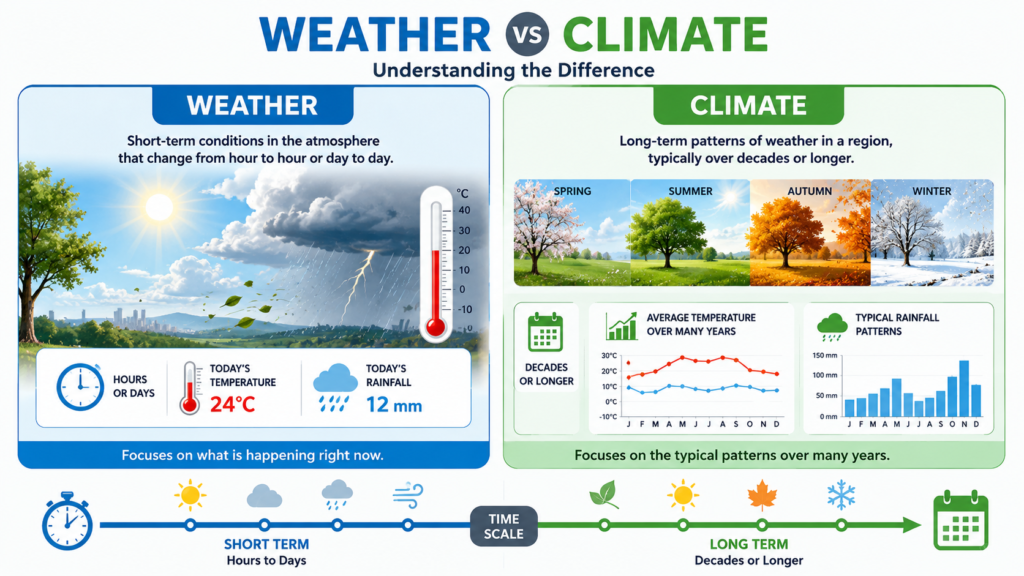
Weather and climate are closely related, but they are not the same.
Understanding the difference is one of the most important foundations of climate science.
| Weather | Climate |
| Short-term conditions | Long-term patterns |
| Hours or days | Decades or longer |
| Daily temperature | Average temperature over many years |
| Today’s rainfall | Typical rainfall patterns |
For example:
A cold winter day does not disprove climate change.
Similarly, one unusually hot day does not prove it.
Scientists examine decades of data before identifying climate trends.
This long-term approach allows researchers to distinguish between normal weather variability and genuine climate change.
Why Long-Term Data Matters
Earth’s weather naturally varies from day to day and year to year.
Some years experience:
- More rainfall
- Less rainfall
- Hotter summers
- Colder winters
- Stronger storms
These short-term variations are expected.
Climate scientists therefore analyse long-term records collected from:
- Weather stations
- Ocean buoys
- Satellites
- Ice cores
- Tree rings
- Coral reefs
- Historical observations
Together, these sources provide a much clearer picture of how Earth’s climate changes over time.
🔬 Science Says: Because climate is measured over long periods, scientists typically use at least 30 years of observations when describing the average climate of a region.
📌 Quick Summary
Weather describes:
- Today’s conditions
- Short-term events
- Local forecasts
Climate describes:
- Long-term averages
- Regional patterns
- Changes occurring over decades or centuries
Understanding Earth’s Climate System
Earth’s climate is controlled by a complex system in which the atmosphere, oceans, land, ice, and living organisms constantly interact.
Rather than operating independently, these systems influence one another in countless ways.
Even small changes in one part of the system can affect others.
The Sun: Earth’s Primary Energy Source
Almost all energy driving Earth’s climate comes from the Sun.
Solar energy warms Earth’s surface, oceans, and atmosphere.
Some of this energy is reflected back into space by:
- Clouds
- Ice
- Snow
- Bright deserts
The remaining energy is absorbed by land and oceans, helping regulate global temperatures.
Maintaining a balance between incoming and outgoing energy is essential for a stable climate.
The Atmosphere
Earth’s atmosphere consists of several gases surrounding the planet.
Major components include:
- Nitrogen
- Oxygen
- Argon
- Carbon dioxide
- Water vapour
Although greenhouse gases make up only a small portion of the atmosphere, they play a crucial role in regulating Earth’s temperature.
Without them, our planet would be far colder and unable to support most forms of life as we know them.
Oceans
The oceans cover more than 70% of Earth’s surface.
They absorb enormous amounts of heat and transport energy around the world through ocean currents.
These currents help regulate regional climates by redistributing warmth between the tropics and higher latitudes.
The oceans also absorb significant amounts of carbon dioxide from the atmosphere, influencing the global carbon cycle.
Ice and Snow
Ice sheets, glaciers, and sea ice reflect large amounts of sunlight back into space.
Because white surfaces reflect more solar energy than darker surfaces, they help cool the planet.
When ice melts, darker land or ocean surfaces absorb more heat, influencing Earth’s energy balance.
Scientists study these processes carefully because they form part of important climate feedback systems.
Living Organisms
Plants, forests, wetlands, and oceans all interact with Earth’s climate.
Plants absorb carbon dioxide during photosynthesis and release oxygen.
Forests also influence rainfall, local temperatures, and biodiversity.
Healthy ecosystems therefore play an important role in regulating Earth’s climate.
🌟 CurioReader Insight: Earth’s climate functions like a giant interconnected system. Changes in the atmosphere, oceans, forests, or ice can influence the entire planet over time.
The Greenhouse Effect
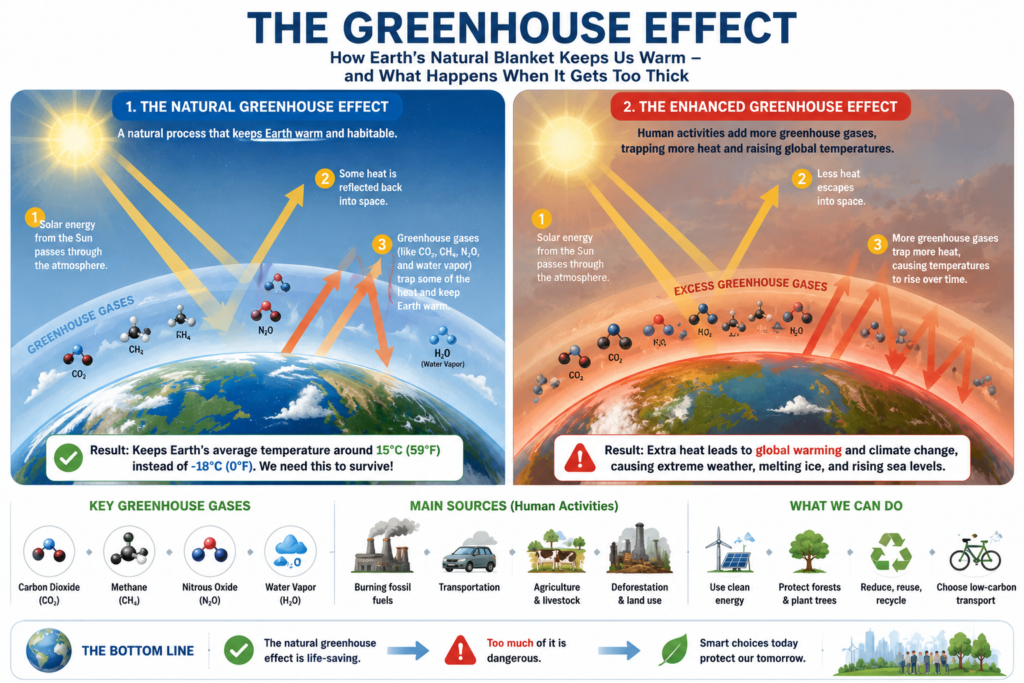
One of the most important concepts in climate science is the greenhouse effect.
Despite its name, it is a completely natural process that makes life on Earth possible.
How It Works
Sunlight passes through Earth’s atmosphere and warms the planet’s surface.
The warmed surface then releases heat back toward space as infrared radiation.
Certain gases in the atmosphere absorb and re-emit part of this heat, slowing the rate at which it escapes into space.
This process helps maintain Earth’s average temperature.
Without the natural greenhouse effect, Earth’s average surface temperature would be approximately –18°C, rather than around 15°C, making the planet far less hospitable for most life.
Greenhouse Gases
The primary greenhouse gases include:
- Water vapour
- Carbon dioxide (CO₂)
- Methane (CH₄)
- Nitrous oxide (N₂O)
- Ozone
Each gas contributes differently to Earth’s energy balance, depending on its concentration and physical properties.
The greenhouse effect itself is essential for life.
The scientific discussion focuses on how increasing concentrations of certain greenhouse gases influence Earth’s climate over long periods.
🧠 Did You Know? Carbon dioxide makes up only a small percentage of Earth’s atmosphere, yet it plays a significant role because of its ability to absorb and re-emit infrared heat.
📌 Quick Summary
The greenhouse effect:
- Is a natural process.
- Keeps Earth warm enough for life.
- Involves greenhouse gases trapping some outgoing heat.
- Has operated throughout Earth’s history.
- Can be influenced by changes in greenhouse gas concentrations.
What Causes Climate Change?
Climate change results from both natural processes and human activities.
Understanding the difference helps explain why scientists carefully study both past and present climate changes.
Natural Causes
Earth’s climate has changed naturally for millions of years due to factors such as:
Variations in Earth’s Orbit
Small changes in Earth’s orbit and tilt alter how sunlight is distributed across the planet over thousands of years.
These changes have contributed to the timing of past ice ages.
Volcanic Eruptions
Large volcanic eruptions release gases and tiny particles into the atmosphere.
These particles can temporarily reduce the amount of sunlight reaching Earth’s surface, leading to short-term cooling.
Solar Activity
The Sun’s energy output changes slightly over time.
Although these variations influence Earth’s climate to some extent, modern climate research indicates they do not fully explain the observed warming trend of recent decades.
Ocean Circulation
Natural patterns such as El Niño and La Niña affect weather and climate around the world.
These events influence rainfall, temperatures, and storm activity over months or years.
Human Activities
Since the Industrial Revolution, human activities have significantly increased the concentration of several greenhouse gases in the atmosphere.
Major sources include:
- Burning coal, oil, and natural gas
- Deforestation
- Agriculture
- Industrial processes
- Transportation
- Cement production
These activities increase the amount of greenhouse gases available to trap heat within Earth’s climate system.
Researchers compare modern observations with historical records, climate models, and multiple independent sources of evidence to better understand these influences.
🔬 Science Says: Climate scientists use evidence from atmospheric measurements, satellites, ice cores, ocean observations, and computer models to study the many factors that influence Earth’s changing climate.
📌 Quick Summary
Climate change is influenced by:
Natural factors
- Changes in Earth’s orbit
- Volcanic activity
- Solar variations
- Ocean circulation
Human factors
- Greenhouse gas emissions
- Deforestation
- Industrial activities
- Transportation
- Agriculture
Understanding how these factors interact is one of the central goals of modern climate science.
The Effects of Climate Change
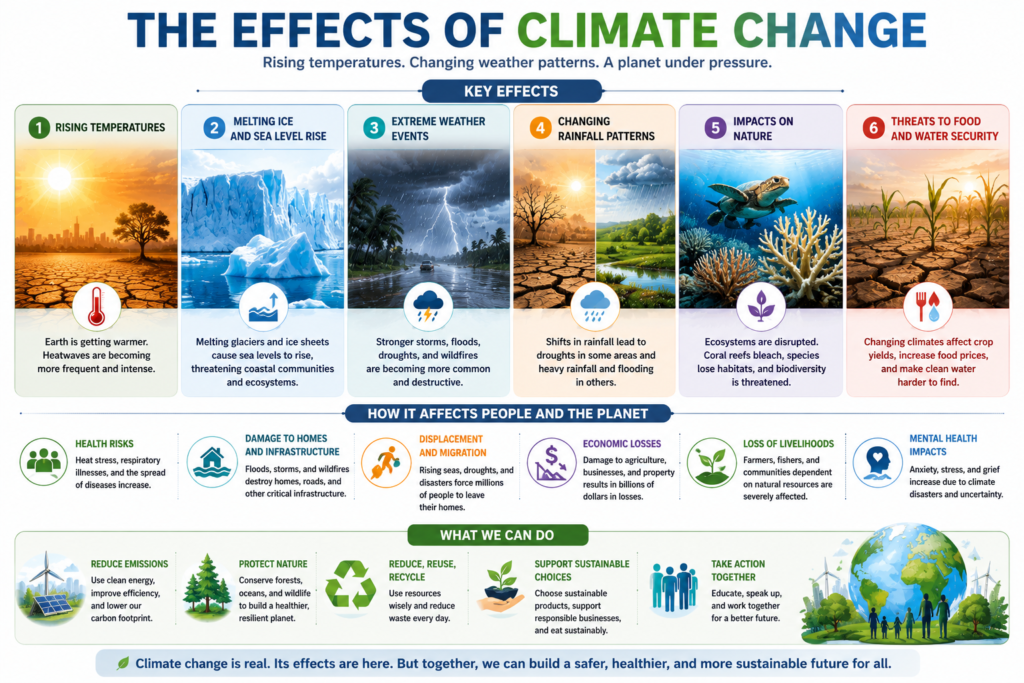
Climate change affects nearly every part of Earth’s natural systems. Rising temperatures influence weather patterns, oceans, ecosystems, agriculture, and human communities. While the impacts vary from one region to another, scientists have observed long-term changes across the globe.
Some areas may experience more frequent heatwaves, while others may face changing rainfall patterns, coastal flooding, or shifts in ecosystems. Understanding these effects helps governments, businesses, and communities prepare for future challenges.
Rising Global Temperatures
One of the clearest indicators of climate change is the long-term increase in Earth’s average surface temperature.
Scientists monitor temperatures using:
- Weather stations
- Ocean measurements
- Weather balloons
- Satellites
- Historical climate records
Although temperatures naturally fluctuate from year to year, long-term observations show a warming trend over recent decades.
Warmer temperatures influence many aspects of Earth’s climate, including rainfall, snow cover, and the length of growing seasons.
More Frequent Heatwaves
As average temperatures increase, many regions experience more frequent and longer-lasting heatwaves.
Heatwaves can affect:
- Public health
- Agriculture
- Water supplies
- Energy demand
- Wildlife
Cities are often particularly vulnerable because buildings and roads absorb and retain heat, creating what scientists call the urban heat island effect.
Melting Glaciers and Polar Ice
Glaciers and ice sheets act as important reservoirs of freshwater and help regulate Earth’s climate.
Over recent decades, many glaciers around the world have lost mass.
Scientists study glaciers because they provide valuable evidence of long-term climate trends.
Melting glaciers can affect:
- River systems
- Freshwater supplies
- Mountain ecosystems
- Sea levels
Changes in Arctic sea ice also influence regional weather patterns and marine ecosystems.
🧠 Did You Know? Ice cores extracted from Antarctica and Greenland contain tiny bubbles of ancient air, allowing scientists to study Earth’s atmosphere and climate from hundreds of thousands of years ago.
Rising Sea Levels
Sea levels change naturally over long periods, but scientists have observed a gradual rise in global average sea level during recent decades.
This occurs mainly because:
- Ocean water expands as it warms.
- Melting glaciers and ice sheets add water to the oceans.
Higher sea levels may increase the risk of coastal flooding during storms and high tides in some regions.
Many of the world’s largest cities are located near coastlines, making coastal planning increasingly important.
📌 Quick Summary
Climate change contributes to:
- Higher average temperatures
- More frequent heatwaves
- Melting glaciers
- Rising sea levels
- Changes to freshwater systems
These changes affect both natural environments and human societies.
Changing Weather Patterns
Weather naturally varies from year to year, but long-term climate change can influence the frequency, intensity, and distribution of certain weather events.
Scientists continue studying how different regions are affected because climate systems are highly complex.
Heavy Rainfall
Warmer air can hold more moisture.
In some regions, this may contribute to heavier rainfall events, increasing the risk of flooding.
However, rainfall patterns vary considerably around the world.
Some areas become wetter, while others experience longer dry periods.
Drought
Changes in rainfall patterns may increase drought risk in certain regions.
Extended droughts can affect:
- Agriculture
- Drinking water
- Hydroelectric power
- Wildlife
- Forest health
Communities often respond through improved water management and conservation strategies.
Storms
Scientists continue researching how climate change influences different types of storms.
Although individual storms cannot be directly attributed to climate change alone, long-term climate conditions may affect storm intensity, rainfall, and coastal impacts in some regions.
Understanding these relationships remains an active area of scientific research.
🔬 Science Says: Climate scientists analyze decades of observations rather than individual weather events when studying how climate change influences extreme weather.
Oceans Under Pressure
The oceans play a vital role in regulating Earth’s climate.
They absorb large amounts of heat and carbon dioxide, helping moderate global temperatures.
However, these changes also affect marine environments.
Ocean Warming
Warmer oceans influence:
- Marine ecosystems
- Fish migration
- Coral reefs
- Weather systems
Some marine species adapt by moving toward cooler waters, while others face increasing environmental stress.
Ocean Acidification
When carbon dioxide dissolves in seawater, it forms weak carbonic acid, gradually lowering the ocean’s pH.
This process is called ocean acidification.
It may affect organisms that build shells or skeletons from calcium carbonate, including:
- Corals
- Oysters
- Some plankton
- Certain shellfish
Healthy oceans remain essential for biodiversity, fisheries, and global food security.
Coral Reefs
Coral reefs support enormous biodiversity despite covering only a small percentage of the ocean floor.
They provide:
- Habitat for marine life
- Coastal protection
- Tourism income
- Fisheries
Warmer ocean temperatures can contribute to coral bleaching, where corals become stressed and lose the algae that help sustain them.
📌 Quick Summary
Climate change affects oceans through:
- Rising temperatures
- Changing ecosystems
- Ocean acidification
- Coral bleaching
- Shifting marine species
Climate Change and Biodiversity
Plants and animals depend on suitable habitats, food supplies, and seasonal patterns.
As climates change, some species adapt, while others struggle to survive.
Habitat Changes
Rising temperatures and changing rainfall may alter forests, wetlands, grasslands, and mountain ecosystems.
Some species move to new areas where conditions are more suitable.
Others may find adaptation more difficult if habitats become fragmented or disappear.
Migration Patterns
Many animals migrate according to seasonal conditions.
Changes in temperature and weather can influence:
- Bird migration
- Fish movement
- Insect populations
- Flowering seasons
Scientists study these changes to better understand ecosystem health.
Protecting Biodiversity
Conservation efforts include:
- National parks
- Habitat restoration
- Sustainable land management
- Wildlife protection
- Scientific monitoring
Healthy ecosystems often become more resilient when biodiversity is protected.
🌟 CurioReader Insight: Climate change is one of several pressures on biodiversity. Habitat destruction, pollution, invasive species, and overexploitation also affect wildlife populations, making conservation a multifaceted challenge.
How Climate Change Affects People
Climate change is not only an environmental issue—it also influences economies, health, infrastructure, and everyday life.
Its impacts vary between countries depending on geography, climate, development, and available resources.
Agriculture
Farmers depend on stable weather patterns.
Changes in rainfall, temperature, and growing seasons may influence crop yields and livestock production.
Agricultural innovation, improved irrigation, and climate-resilient crops help communities adapt.
Water Resources
Reliable freshwater is essential for households, agriculture, and industry.
Changing rainfall patterns may affect water availability in some regions, encouraging better conservation and management.
Human Health
Climate-related changes may influence health in several ways, including:
- Heat-related illnesses
- Air quality
- Water quality
- Spread of certain diseases in some regions
Public health planning helps reduce these risks.
Economic Impacts
Climate-related events can affect:
- Infrastructure
- Insurance costs
- Tourism
- Fisheries
- Agriculture
- Energy systems
Many governments and businesses are investing in strategies to improve resilience and reduce long-term risks.
📌 Quick Summary
Climate change may influence:
- Food production
- Water supplies
- Public health
- Infrastructure
- Local economies
Communities around the world continue developing ways to adapt.
Can Climate Change Be Slowed?
Scientists generally agree that reducing greenhouse gas emissions while improving resilience can help limit future climate change.
Addressing climate change involves action at many levels—from individuals and businesses to governments and international organizations.
Renewable Energy
Many countries are expanding the use of renewable energy sources, including:
- Solar power
- Wind energy
- Hydroelectricity
- Geothermal energy
These technologies generate electricity with lower greenhouse gas emissions than many traditional fossil fuel sources.
Energy Efficiency
Using energy more efficiently reduces both costs and emissions.
Examples include:
- Better building insulation
- Efficient appliances
- LED lighting
- Improved public transport
- Modern industrial technologies
Protecting Forests
Forests absorb carbon dioxide and support biodiversity.
Protecting existing forests while restoring degraded land helps maintain healthy ecosystems and contributes to climate regulation.
Innovation and Research
Scientists and engineers continue developing solutions such as:
- Carbon capture technologies
- Improved batteries
- Sustainable agriculture
- Green building materials
- Cleaner transportation
Innovation plays an important role in addressing environmental challenges.
💡 CurioReader Tip: Climate solutions are most effective when they combine scientific research, technological innovation, responsible policies, and informed individual choices.
What Can Individuals Do?
Although governments and industries play major roles, individuals can also contribute.
Examples include:
- Conserving energy at home
- Using public transport, cycling, or walking when practical
- Reducing food waste
- Recycling appropriately
- Supporting sustainable products
- Planting trees where suitable
- Learning about environmental issues from reliable scientific sources
Small actions become more meaningful when adopted by millions of people.
Common Myths About Climate Change
Myth 1: Climate and Weather Are the Same
Weather describes short-term conditions.
Climate refers to long-term patterns measured over decades.
Myth 2: Climate Has Never Changed Before
Earth’s climate has changed naturally throughout history.
The focus of modern climate science is understanding the current rate of change and the factors influencing it.
Myth 3: One Cold Winter Disproves Climate Change
Individual weather events do not determine long-term climate trends.
Scientists study decades of observations before drawing conclusions.
Myth 4: Individuals Cannot Make Any Difference
Large-scale progress depends on governments, businesses, and communities, but individual actions collectively contribute to broader environmental improvements.
Frequently Asked Questions
What is the difference between climate change and global warming?
Global warming refers specifically to the long-term increase in Earth’s average surface temperature. Climate change is a broader term that includes changes in temperature, rainfall, sea levels, weather patterns, and ecosystems.
Is the greenhouse effect harmful?
No. The natural greenhouse effect is essential because it keeps Earth warm enough to support life. Scientific research focuses on how increasing greenhouse gas concentrations affect Earth’s energy balance over time.
Why do scientists study ice cores?
Ice cores preserve ancient air bubbles and other environmental information, allowing scientists to reconstruct past climates and compare them with modern observations.
Can climate change be solved by one country alone?
No. Climate change is a global issue that requires cooperation among countries, businesses, scientists, and communities while respecting different national circumstances and development needs.
Key Takeaways
Climate change is a long-term shift in Earth’s climate system that influences natural environments and human societies alike.
Remember these key ideas:
- Climate is different from weather.
- Earth’s climate has changed throughout history through both natural processes and human influences.
- The greenhouse effect is a natural process that makes life possible.
- Climate change affects temperatures, oceans, ecosystems, agriculture, and communities.
- Scientific evidence comes from multiple independent sources, including satellites, weather stations, ice cores, and ocean observations.
- Innovation, renewable energy, conservation, and international cooperation all contribute to addressing climate-related challenges.
- Understanding climate science helps people make informed decisions based on evidence.
🌟 CurioReader Insight: Climate change is one of the most extensively studied topics in modern science. By understanding how Earth’s climate system works, we can better appreciate both the complexity of our planet and the importance of informed, evidence-based decision-making.
Conclusion
Climate change is one of the defining scientific and environmental challenges of our time. While Earth’s climate has always changed naturally over millions of years, modern scientific observations show that today’s climate system is experiencing significant changes with wide-ranging effects on ecosystems, economies, and societies. Understanding the science behind these changes helps us move beyond misconceptions and engage with the topic through evidence rather than speculation.
The impacts of climate change are diverse, affecting temperatures, weather patterns, oceans, biodiversity, agriculture, and human communities in different ways across the world. At the same time, advances in renewable energy, scientific research, conservation, and sustainable technologies demonstrate that societies have many tools available to adapt and reduce future risks.
Ultimately, climate change is not only an environmental issue but also a challenge that involves science, economics, technology, public policy, and global cooperation. By learning how Earth’s climate works and supporting informed decision-making, each of us can contribute to building a more resilient and sustainable future for generations to come.
🚀 Think About This: Earth is the only known planet that supports life on this scale. How we understand, protect, and manage its climate today will influence the world inherited by future generations.
Further Reading & Resources
Continue your learning journey with more expert guides and insightful articles from CurioReader. Explore related topics below to deepen your understanding and discover new perspectives.
Related CurioReader Articles
Recommended External Resources