Introduction
Have you ever woken up after an incredibly vivid dream and wondered, “Why did my brain create that?”
Why Do We Dream? The Science Behind Dreams and Sleep. Perhaps you were flying over mountains without wings, talking to someone you haven’t seen in years, or sitting an important exam without knowing any of the answers. Some dreams are joyful, others are frightening, and many are so strange that they seem impossible to explain. Yet almost everyone has experienced them.
For thousands of years, dreams have fascinated humanity. Ancient civilizations believed dreams carried messages from gods, predicted the future, or revealed hidden truths about life. Kings sought advice from dream interpreters before making important decisions, while philosophers debated whether dreams reflected reality or simply the imagination at work. Across different cultures and throughout history, people have searched for meaning in the mysterious stories that unfold while we sleep.
Today, science offers a different perspective. Thanks to advances in neuroscience and sleep research, we now understand much more about what happens inside the brain during sleep than ever before. Researchers have discovered that dreaming is closely connected to memory, emotions, learning, and the complex activity of billions of neurons communicating with one another. Even so, one remarkable fact remains: scientists still cannot fully explain why we dream.
That uncertainty is part of what makes dreams so fascinating. Every night, while our bodies rest, our brains remain surprisingly active. They replay memories, process emotions, strengthen learning, and create vivid experiences that can feel just as real as our waking lives. Some dreams disappear within seconds of waking, while others stay with us for years, raising questions that science is still working to answer.
In this article, we’ll explore what modern research tells us about dreams, what happens inside the brain while we sleep, why dreams can be so strange, why we often forget them, and which popular beliefs are supported by evidence—and which remain myths. By the end, you’ll discover that dreams are far more than random nighttime stories. They may provide valuable insights into one of the most complex and remarkable organs in the human body: the human brain.
So, before you drift off to sleep tonight, remember this:
The moment you close your eyes, your brain is about to begin one of the most extraordinary journeys in nature.
💭 Dream Reflection
Think back to the last dream you can remember.
Ask yourself:
- Was it based on a real memory?
- Did it include people you know?
- Did the events make logical sense?
- How did it make you feel after you woke up?
You don’t need to know the answers yet—but keep those questions in mind as you read. By the end of this article, you may begin to see your dreams in a completely new way.
What Are Dreams?
Close your eyes for a moment and imagine standing on a beach at sunset. The waves are gently rolling onto the shore, the air feels warm, and everything seems perfectly normal. Then, without warning, the beach transforms into a bustling city. A childhood friend appears, your school teacher starts driving a spaceship, and suddenly you’re flying above the clouds.
It sounds impossible.
Yet while you’re dreaming, none of it feels unusual.
This is one of the most remarkable features of dreams. They often combine familiar people, places, memories, and emotions into stories that ignore the normal rules of time, space, and logic. What seems absurd after waking can feel completely believable while we are asleep.
So, what exactly is a dream?
From a scientific perspective, a dream is a series of mental experiences that occur while we sleep. These experiences can include images, sounds, emotions, thoughts, sensations, and sometimes even smells or tastes. Some dreams feel like short conversations, while others unfold like full-length adventure films with detailed characters and dramatic storylines.
Dreams can happen during several stages of sleep, but they are most vivid during Rapid Eye Movement (REM) sleep. During this stage, your eyes move quickly beneath your closed eyelids, your brain becomes highly active, and your body temporarily relaxes most of its muscles. Although you appear deeply asleep, your brain is surprisingly busy—sometimes showing activity levels similar to when you’re awake.
One of the fascinating aspects of dreaming is that no two people dream in exactly the same way. Some people remember several dreams every week, while others rarely remember any. Some dream in full colour, while others describe their dreams as being mostly black and white. Some experience exciting adventures, while others have dreams that simply reflect ordinary moments from everyday life.
Scientists believe dreams are influenced by many different factors, including your memories, emotions, daily experiences, imagination, and even your physical health. A stressful day at work, an inspiring conversation, a film you watched before bed, or a place you visited years ago can all become unexpected pieces of the stories your brain creates while you sleep.
What’s even more remarkable is that your brain is both the author and the audience of these dreams. It creates the people, the dialogue, the scenery, and the emotions, yet while you’re dreaming, you rarely question whether any of it is real. Only after waking do you begin to recognize how extraordinary those experiences truly were.
Although researchers have learned a great deal about dreams over the past century, one important question still remains unanswered:

Why does the brain create these experiences in the first place?
To answer that, we first need to understand what happens inside the brain while we sleep.
🌙 Did You Know?
Most people dream four to six times every night, even though they remember only a small number of those dreams after waking up. In fact, it’s entirely possible to believe you “never dream” when, in reality, you simply don’t remember them.
🤔 Imagine This…
Tonight, while you’re sleeping peacefully, your brain will quietly create several completely new worlds.
Some may last only a few seconds.
Others may feel like hours.
Most will disappear before breakfast.
Yet each one is produced by the same three-pound organ inside your head—a reminder of just how extraordinary the human brain truly is.
✨ CurioReader Insight
Dreams remind us that the brain doesn’t simply switch off during sleep.
In many ways, it begins a different kind of work—organizing memories, processing emotions, strengthening learning, and creating experiences that continue to puzzle scientists even today.
Perhaps the greatest mystery isn’t that we dream.
It’s how our sleeping brain can create an entire world while we remain completely unaware that we’re the one creating it.
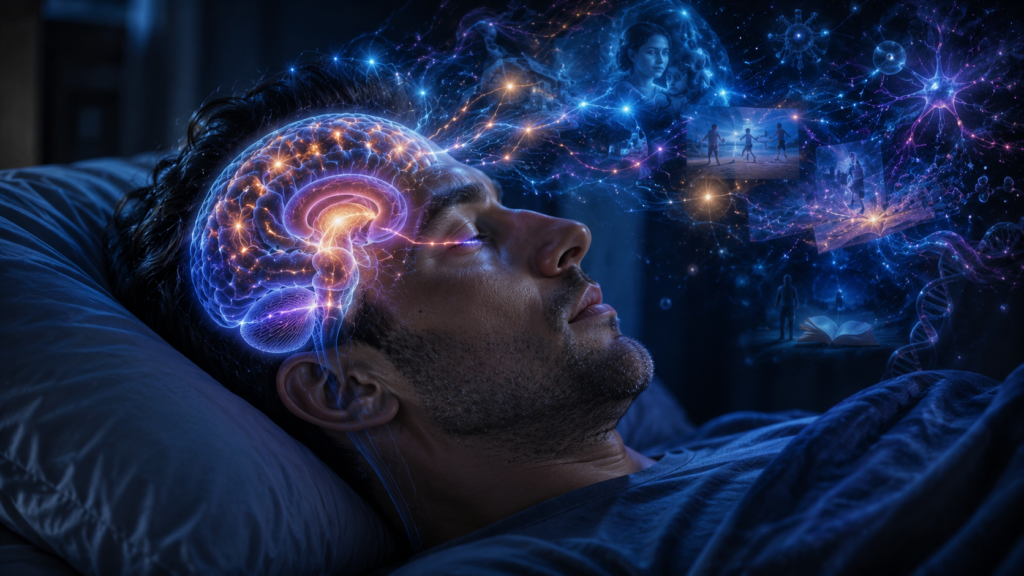
What Happens in Your Brain While You Sleep?
Every night, as you drift into sleep, it may seem as though your body and mind are shutting down for a well-earned rest.
In reality, something very different is happening.
While your muscles relax and your surroundings fade away, your brain begins one of the busiest shifts of the entire day.
Imagine a city after midnight.
The streets are quiet, most buildings are dark, and millions of people are asleep. At first glance, everything appears still. Yet beneath the surface, electricity continues to flow, emergency services remain on duty, hospitals stay open, and workers prepare the city for another day.
Your brain behaves in much the same way.
Although you are unconscious, billions of neurons continue communicating through tiny electrical and chemical signals. They sort through memories, regulate emotions, repair important biological processes, and prepare your mind and body for the day ahead. Sleep is not a period of inactivity—it is a period of essential maintenance.
Scientists divide sleep into two main types:
- Non-Rapid Eye Movement (Non-REM) sleep
- Rapid Eye Movement (REM) sleep
Rather than remaining in one stage all night, your brain moves through these stages in repeating cycles that usually last about 90 minutes. Most adults experience four to six of these cycles during a typical night’s sleep.
Stage One: Falling Asleep
The first stage of sleep is surprisingly light.
This is the moment when you’re no longer fully awake but not yet deeply asleep. Your breathing slows, your muscles begin to relax, and your awareness of the outside world gradually fades.
Have you ever felt as though you were suddenly falling just as you were about to fall asleep?
That unexpected “jump” is called a hypnic jerk, and it is a completely normal experience that many people have. Scientists still debate exactly why it happens, but it is thought to be related to the brain adjusting as it transitions from wakefulness into sleep.
Stage Two: Light Sleep
As you move deeper into sleep, your heart rate slows, your body temperature drops slightly, and your brain begins filtering out most external sounds.
Although you are asleep, your brain isn’t ignoring the outside world completely. Important sounds—such as a smoke alarm, a baby crying, or someone calling your name—can still wake you if necessary.
During this stage, researchers believe the brain is already beginning to organize information gathered throughout the day.
It’s as though your brain has started tidying a busy office after everyone has gone home.
Stage Three: Deep Sleep
This is the stage your body values most for physical recovery.
During deep sleep:
- Muscles repair themselves.
- The immune system becomes more active.
- Growth and repair processes increase.
- Energy stores are replenished.
If someone wakes you during deep sleep, you may feel confused or disoriented for several minutes because your brain is operating at its slowest pace.
Interestingly, vivid dreams are less common during deep sleep than during REM sleep, although they can still occur.
Stage Four: REM Sleep — Where Dreams Come Alive
Around 90 minutes after falling asleep, something extraordinary happens.
Your brain suddenly becomes far more active.
Your eyes begin moving rapidly beneath your closed eyelids.
Your breathing becomes less regular.
Your heart rate changes.
And this is where many of your most vivid dreams begin.
Scientists have discovered something remarkable about REM sleep.
If they measure brain activity using modern imaging technology, parts of the brain can appear almost as active as they are when you’re awake.
In other words…
Your brain is awake.
Your body is asleep.
To prevent you from acting out your dreams, the brain temporarily relaxes most of your voluntary muscles—a natural protective mechanism known as REM atonia. Without it, people might physically respond to their dreams by running, kicking, or reaching for objects while asleep.
It’s one of the brain’s cleverest safety features.
🧠 A Night Inside the Brain
Think of your brain as a giant library.
Throughout the day, thousands of new books arrive.
Some contain important memories.
Some hold emotions.
Others are filled with random conversations, images, sounds, and experiences.
When you finally fall asleep, the librarians begin their work.
They decide:
- Which memories should be kept.
- Which information should be strengthened.
- Which experiences can be forgotten.
- Which emotions still need processing.
Dreams may be one of the ways your brain carries out this enormous task.
Although scientists continue to debate exactly why dreams occur, many agree that sleep is far from “switching off.”
Instead, it is one of the busiest and most important periods of the day for your brain.
🌙 Did You Know?
Although your eyes are closed during Rapid Eye Movement (REM) sleep, they move quickly beneath your eyelids.
Scientists are still investigating why this happens, but one idea is that these movements may be linked to the visual experiences that occur while dreaming.
🤔 Imagine This…
Tonight, while you’re peacefully asleep, your brain will cycle through different stages of sleep several times.
Without you realizing it…
It will strengthen memories.
Repair important systems.
Process emotions.
Create dreams.
And prepare you to wake up ready for a new day.
All before your morning alarm rings.
✨ CurioReader Insight
Sleep is often described as “doing nothing.”
Science tells a completely different story.
While your body rests, your brain becomes an overnight engineer, librarian, repair technician, and storyteller—all working together to protect your health and shape your memories.
Perhaps that’s why sleep isn’t simply the end of today’s story.
It’s where your brain quietly begins writing tomorrow’s.
Why Do We Dream? Science Still Doesn’t Have One Answer
Imagine asking five of the world’s leading dream researchers the same simple question:
“Why do humans dream?”
You might expect everyone to give the same answer.
Surprisingly, they probably wouldn’t.
Unlike questions such as “Why does the heart pump blood?” or “Why do we breathe?”, the purpose of dreaming remains one of neuroscience’s greatest unsolved mysteries. Scientists have gathered decades of research, studied brain activity during sleep, and developed several fascinating theories. Yet no single explanation fully answers why our brains create dreams.
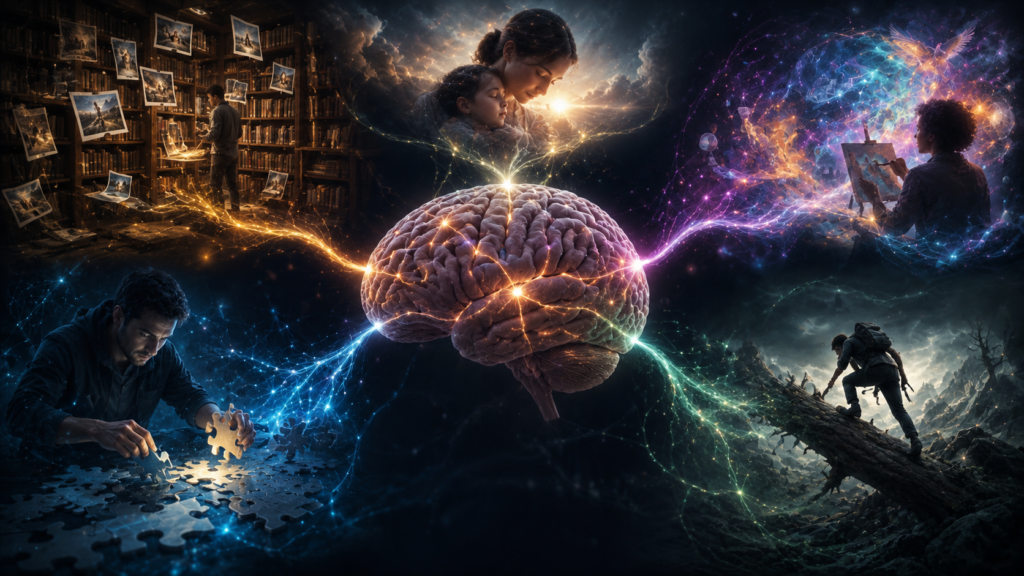
Rather than competing with one another, many researchers believe these theories may each explain part of the puzzle. Dreams may serve several purposes at the same time, helping the brain perform different tasks while we sleep.
Let’s explore the most widely accepted scientific ideas.
1. Dreams Help Organize Memories
Think back to yesterday.
You probably had dozens of conversations, saw hundreds of objects, solved problems, learned new information, and experienced a wide range of emotions.
If your brain tried to store every detail equally, it would quickly become overwhelmed.
Instead, while you sleep, your brain appears to sort through the day’s experiences. Some memories become stronger, others fade away, and important information is connected with knowledge you already have.
Many scientists believe dreams may be part of this organizing process.
Imagine cleaning your bedroom after a busy week.
You don’t keep everything exactly where it landed.
Instead, you sort clothes into drawers, place books back on shelves, throw away rubbish, and organize the room.
Your brain may be doing something remarkably similar with your memories every night.
This could explain why dreams often include familiar people, places, and events—but mixed together in unusual ways. Your brain isn’t replaying your day like a video recording. It’s reorganizing information into a more efficient system.
🧠 CurioReader Insight
Perhaps dreams aren’t random stories at all.
Perhaps they’re your brain quietly deciding:
“What should I remember?”
2. Dreams Help Process Emotions
Have you ever noticed that stressful periods in life often bring unusually vivid dreams?
Perhaps you’ve dreamed about missing an important exam years after leaving school.
Or arriving late for an interview.
Or becoming lost in a place you know well.
Researchers believe dreams may help the brain process emotions that are difficult to deal with during the day.
While you’re asleep, the emotional centers of the brain remain highly active, allowing experiences to be revisited in a safe environment where no real danger exists.
Some psychologists compare dreaming to a form of overnight emotional therapy.
The brain revisits important experiences, explores different emotional responses, and gradually reduces the emotional intensity attached to certain memories.
Although this theory is still being studied, it helps explain why dreams often become more emotional after stressful life events.
🌙 Did You Know?
People experiencing significant life changes—such as moving to a new country, starting a new job, or becoming parents—often report more vivid or emotionally intense dreams.
Scientists believe this may reflect the brain processing new experiences and emotions during sleep.
3. Dreams Help Us Solve Problems
History is filled with remarkable stories of discoveries inspired by dreams.
Scientists, artists, musicians, and inventors have all claimed that important ideas came to them while they were asleep.
Although not every story can be verified, research suggests that the sleeping brain continues making unexpected connections between ideas.
During dreaming, the brain is less restricted by logical thinking.
Instead of following familiar patterns, it freely combines memories, knowledge, and imagination.
Sometimes those unusual combinations produce creative insights that might never appear during waking life.
Have you ever gone to bed unable to solve a problem, only to wake up with a fresh perspective?
That experience may not be a coincidence.
Sleep appears to help the brain reorganize information, allowing new ideas to emerge.
4. Dreams May Prepare Us for Challenges
Another fascinating idea is known as the Threat Simulation Theory.
According to this theory, dreams may act as a kind of mental training ground.
Imagine a flight simulator used by pilots.
Before facing real emergencies, pilots practice difficult situations in a completely safe environment.
Some scientists believe dreams may serve a similar purpose for the human brain.
By simulating dangerous, stressful, or unfamiliar situations, dreams may allow us to rehearse emotional and behavioral responses without facing real-world consequences.
This could explain why many dreams involve:
- Being chased.
- Falling.
- Getting lost.
- Speaking in public.
- Arriving late.
- Facing unexpected danger.
Whether this theory explains all dreams remains uncertain, but it offers an intriguing explanation for why challenging situations appear so frequently in our dreams.
5. Or Are Dreams Simply the Brain’s Night-Time Activity?
Not every scientist believes dreams have a specific purpose.
One influential idea suggests that dreams are simply the brain trying to make sense of its own activity during sleep.
As different brain regions become active, random memories, emotions, and sensations are triggered.
Rather than leaving this activity disconnected, the brain naturally weaves it into a story.
Think of it like watching scattered puzzle pieces gradually forming a picture.
The pieces may appear random at first.
But your brain has an extraordinary ability to create meaning—even when the information itself is incomplete.
According to this view, dreams may not exist for a particular reason.
Instead, they may simply be the fascinating result of a highly active brain doing what it does best:
Creating stories.
🌌 The Beautiful Mystery
So…
Why do we dream?
The honest scientific answer is:
We don’t fully know.
And perhaps that’s what makes dreams so extraordinary.
Every night, billions of human brains create entire worlds, filled with people, emotions, conversations, adventures, and mysteries.
We experience them.
We believe them.
Sometimes we remember them for decades.
Yet scientists are still uncovering exactly why this remarkable ability exists.
Rather than seeing this as a limitation, many researchers see it as an invitation.
Every new discovery brings us a little closer to understanding one of the greatest mysteries of the human mind.
🌙 Did You Know?
Your brain is estimated to contain around 86 billion neurons, constantly communicating through trillions of connections. Even after decades of research, scientists continue to discover new details about how this extraordinary network supports memory, learning, sleep, and dreaming.
✨ CurioReader Insight
Perhaps the greatest lesson dreams teach us isn’t about sleep.
It’s about curiosity.
Even with today’s incredible technology, there are still mysteries inside the human brain waiting to be explored.
Every dream is a reminder that some of the most fascinating journeys don’t begin with opening your eyes.
They begin by closing them.
Why Are Dreams So Strange?
Imagine watching a movie where the main character is your childhood best friend.
Halfway through the story, they suddenly become your mathematics teacher.
The classroom transforms into an airport.
A dog starts talking.
Then, without any explanation, you’re swimming in outer space.
If this happened in a cinema, you’d probably ask for your money back.
But in a dream?
You simply accept it.
One of the most fascinating characteristics of dreams is that they often ignore the rules of logic that govern our waking lives. Time can move backwards, people can change identities without warning, impossible events feel completely normal, and places from different periods of your life can somehow exist together.
So why does the brain create stories that seem so bizarre?
The answer begins with understanding that the dreaming brain does not work in exactly the same way as the waking brain.
During REM sleep, the parts of the brain responsible for emotions, memories, and visual imagination become highly active. At the same time, areas involved in logical reasoning, planning, and critical thinking are generally less active than when we are awake.
This combination creates the perfect environment for unusual stories.
Your brain has access to thousands of memories, emotions, faces, places, and experiences—but without your usual “fact-checking” system working at full strength. As a result, it freely combines pieces of information that would never normally fit together.
Think of it as a giant box of photographs.
Imagine taking hundreds of pictures from different moments in your life:
- Your first day at school.
- Last weekend’s family dinner.
- A holiday you took years ago.
- A film you watched yesterday.
- A conversation you had this morning.
Now imagine throwing all those photographs into the air.
As they fall back to the ground, they land in completely new combinations.
That is similar to what many neuroscientists believe happens during dreaming.
Your brain isn’t trying to create a realistic documentary.
It’s creating a new story using pieces of your existing experiences.

Why Do Familiar People Appear in Unexpected Places?
Have you ever dreamed about speaking with a grandparent inside your current workplace?
Or seeing an old school friend in a city you’ve never visited?
Dreams often mix people and places because memories are not stored like separate folders on a computer.
Instead, memories are connected through vast networks inside the brain.
When one memory becomes active during sleep, it can trigger many related memories.
A familiar face may appear in an unfamiliar place simply because those memories became active at the same time.
Your brain is making connections—not following a script.
Why Does Time Behave So Differently?
In dreams, time rarely behaves the way it does in real life.
A conversation that feels like an hour may last only a few seconds.
You might suddenly become a child again before instantly returning to adulthood.
Entire years may seem to pass inside a dream that actually lasted only minutes.
Scientists believe this happens because dreams don’t necessarily follow a continuous timeline.
Instead, your brain appears to jump between important moments, emotions, and memories, much like flipping through scenes in a movie rather than watching every second in order.
Why Do Dreams Feel So Real?
Perhaps the greatest mystery isn’t why dreams are strange.
It’s why they feel real while they’re happening.
When you’re dreaming, you rarely stop to question whether flying is possible or whether your pet should be driving a car.
The dream simply becomes your reality.
One reason is that the brain regions involved in creating vivid sensory experiences remain highly active during REM sleep. At the same time, regions involved in evaluating whether something is logically possible are generally less active.
As a result, your brain accepts extraordinary situations without raising objections.
Only after waking does your critical thinking return fully, allowing you to recognize just how unusual the dream actually was.
🌙 Did You Know?
Researchers believe that every face you see in a dream is likely based on someone your brain has encountered before, even if you don’t consciously remember seeing them. Your brain is remarkably good at storing faces, including those of people you may have passed briefly in everyday life.
🎬 Imagine This…
Picture your brain as the world’s most creative film director.
It has access to:
- Every memory you’ve kept.
- Every place you’ve visited.
- Every face you’ve seen.
- Every emotion you’ve felt.
- Every story you’ve ever heard.
Now imagine that director has no budget, no laws of physics, and no requirement for the plot to make sense.
That’s one reason dreams can become some of the most imaginative stories you’ll ever experience.
✨ CurioReader Insight
Perhaps dreams seem strange because we judge them by the rules of the waking world.
But dreams were never designed to follow those rules.
They are built from memories instead of maps.
From emotions instead of logic.
From imagination instead of reality.
And perhaps that’s exactly why they continue to fascinate us.
Why Do We Forget Most Dreams?
Have you ever had this experience?
You wake up in the morning with a dream so vivid that it feels as though it actually happened. You remember the people, the places, even the emotions.
Then you brush your teeth.
Make a cup of coffee.
Check your phone.
And suddenly…
It’s gone.
You know you had an incredible dream, but all that’s left is a vague feeling that something interesting happened during the night.
Where did it go?
Did your brain erase it?
Or was it never fully stored in the first place?
The answer lies in one of the brain’s most remarkable abilities: memory formation.
Your Brain Doesn’t Save Everything
Every second of every day, your brain receives an enormous amount of information.
The sound of birds outside.
The colour of the sky.
The conversation you had at lunch.
The hundreds of objects your eyes noticed without you realizing it.
If your brain stored every detail permanently, it would quickly become overwhelmed.
Instead, it constantly decides what is worth remembering and what can safely be forgotten.
The same process appears to happen during dreaming.
Not every dream becomes a lasting memory.
In fact, most disappear before they are ever fully stored.
Dreams Are Like Writing on Water
Imagine trying to write your name on the surface of a calm lake.
For a brief moment, you can see the movement.
Then the water becomes smooth again.
Dream memories often behave in a similar way.
They exist for only a short time before fading away unless something helps transfer them into long-term memory.
This is one reason many dreams vanish within just a few minutes of waking.
The Brain Is in a Different Mode
Scientists have discovered that during REM sleep, the brain operates differently from when we are fully awake.
Certain chemicals involved in forming long-term memories are present at lower levels during this stage of sleep. As a result, even though dreams may feel incredibly vivid, they are often not stored in the same way as waking experiences.
It’s a little like watching an amazing movie without pressing the “Save” button afterward.
The experience feels real while it’s happening, but much of it fades before it can become a permanent memory.
Why Do Some Dreams Stay With Us?
Of course, not every dream disappears.
Some remain unforgettable.
Perhaps you’ve remembered a dream for years because it was:
- Emotionally powerful.
- Surprisingly realistic.
- Deeply frightening.
- Exceptionally joyful.
- Connected to an important life event.
Emotion plays an important role in memory.
Dreams that trigger strong feelings are generally more likely to remain in our minds after waking.
Timing also matters.
If you wake up naturally during or immediately after a dream—particularly during REM sleep—you are much more likely to remember it than if you continue sleeping through several more sleep cycles.
That’s why an alarm clock sometimes interrupts a dream you can recall clearly, while on other mornings you wake with no memory of dreaming at all.
Can You Improve Dream Recall?
Interestingly, many people can become better at remembering their dreams.
Researchers and sleep specialists often suggest simple habits such as:
- Keeping a notebook beside your bed.
- Writing down your dream as soon as you wake up.
- Avoiding distractions like checking your phone immediately.
- Taking a few quiet moments to replay the dream in your mind before getting out of bed.
These habits don’t necessarily cause more dreaming.
Instead, they help capture dream memories before they fade.
🌙 Did You Know?
Some researchers estimate that we may forget around 90–95% of our dreams shortly after waking. Although the exact percentage varies between studies, most dreams disappear surprisingly quickly unless they are remembered or recorded soon after waking.
📖 Imagine This…
Imagine your dreams are messages written in sand along a beach.
As long as you look at them, they remain clear.
But each passing wave gently washes part of the message away.
Within minutes…
Only a few words remain.
A little later…
Even those have disappeared.
Dream memories often fade in much the same way.
✨ CurioReader Insight
Forgetting dreams isn’t necessarily a flaw in the brain.
It may simply reflect the brain’s remarkable ability to prioritize what is most important.
After all, every day we create thousands of new memories.
Perhaps remembering every dream would leave less room for remembering the moments that shape our waking lives.
And yet…
Every now and then…
A single dream refuses to disappear.
Perhaps because, for reasons science is still trying to understand, our brain quietly decided:
“This one is worth keeping.”
Why Do We Have Nightmares?
Almost everyone has experienced it.
You’re running through a dark forest, but something is chasing you.
You try to scream, but no sound comes out.
You wake suddenly, your heart is racing, your breathing is fast, and for a few seconds you’re not even sure whether the danger was real.
Then you realize…
It was only a dream.
But why would our brains create experiences that feel so frightening?
At first, nightmares seem like a mistake. If sleep is supposed to help us recover, why would the brain interrupt it with fear, anxiety, or panic?
The answer isn’t completely understood, but scientists believe nightmares are often connected to the same processes that make ordinary dreams possible—memory, emotion, and the brain’s effort to process important experiences.
When Emotions Continue After We Fall Asleep
Our emotions don’t simply switch off when we close our eyes.
If you’ve had a stressful day, argued with someone you care about, worried about an upcoming exam, or faced an important life decision, those feelings don’t disappear just because you’re asleep.
Instead, your brain may continue working through them.
During REM sleep, the emotional centers of the brain—particularly areas involved in processing fear, stress, and emotional memories—remain highly active. Many researchers believe this is one reason dreams often reflect the emotions we experienced during the day, even if the dream itself tells a completely different story.
For example, someone feeling pressure at work may dream about missing an important train.
A student worried about exams may dream about arriving at school without studying.
The details change.
The emotions often stay the same.
Why Are Certain Nightmares So Common?
Across different countries and cultures, researchers have found that many people report remarkably similar nightmares.
Some of the most common include:
- Falling from a great height.
- Being chased by an unknown person or animal.
- Losing your way in a familiar place.
- Arriving late for an important event.
- Being unprepared for an examination.
- Losing your voice when trying to speak.
- Discovering your teeth have fallen out.
Although these dreams can feel very personal, scientists believe they often reflect universal human emotions such as uncertainty, vulnerability, responsibility, or fear of failure rather than predicting future events.
Can Stress Increase Nightmares?
Yes.
Research has shown that periods of increased stress, anxiety, major life changes, illness, or lack of sleep are often associated with more frequent or more vivid nightmares.
This doesn’t mean stress always causes nightmares, but it does suggest that emotional well-being and sleep quality are closely connected.
Traumatic experiences can also influence dreaming. Some people who have experienced severe trauma may develop recurring nightmares related to those events. In these cases, healthcare professionals can provide appropriate support and treatment.
When Should You Be Concerned?
For most people, occasional nightmares are completely normal.
They are simply one part of the rich variety of experiences that can occur during sleep.
However, if nightmares become very frequent, regularly disturb your sleep, cause significant distress, or interfere with your daily life, it may be helpful to speak with a healthcare professional. Persistent nightmares can sometimes be linked to sleep disorders, certain medications, mental health conditions, or other medical factors that deserve proper assessment.
Seeking advice is not a sign that something is “wrong” with you—it’s simply another way of looking after your health.
🌙 Did You Know?
Children often experience nightmares more frequently than adults. Researchers believe this may be because young brains are still developing, processing new experiences rapidly, and learning to regulate emotions. Most children gradually experience fewer nightmares as they grow older.
🎭 Imagine This…
Think of your brain as a film director.
During the day, it collects emotions instead of movie scenes.
At night, it sometimes turns those emotions into dramatic stories.
The monster chasing you…
The endless staircase…
The impossible exam…
They may all be different ways of expressing the same underlying feeling.
The characters change.
The emotions remain surprisingly familiar.
✨ CurioReader Insight
Nightmares remind us that dreams are not simply entertainment created by the sleeping brain.
They are closely connected to our emotions, our memories, and our experiences.
Although they can feel frightening, they also reveal something remarkable:
Even while we sleep, the human brain continues trying to understand the world around us—and the emotions within us.
Perhaps nightmares are not evidence that the brain has failed.
Perhaps they are evidence that it is still working.
What Is Lucid Dreaming? When You Realize You’re Dreaming
Imagine standing on the edge of a cliff in the middle of a dream.
The wind is blowing, the sky stretches endlessly above you, and everything feels completely real. Then, without warning, a thought crosses your mind:
“Wait… I’m dreaming.”
In that single moment, something extraordinary happens.
The fear disappears.
Instead of wondering what will happen next, you realize you already know the answer—because this world exists entirely inside your own mind.
You take a deep breath…
Step off the cliff…
And instead of falling, you begin to fly.
It sounds like the plot of a science fiction film, yet millions of people around the world have experienced something remarkably similar. This phenomenon is known as lucid dreaming—a dream in which the dreamer becomes aware that they are dreaming while the dream is still happening.
For many people, this awareness lasts only a few seconds before they wake up or return to a normal dream. For others, it can last much longer, allowing them to observe the dream with surprising clarity and, in some cases, influence what happens next.
What Makes Lucid Dreaming Different?
In an ordinary dream, we usually accept everything as real.
A talking cat?
Perfectly normal.
Driving a car across the ocean?
No problem.
Meeting someone who passed away years ago?
It feels completely natural.
Our brains rarely question these impossible events while we’re asleep.
Lucid dreaming is different.
At some point during the dream, a part of your awareness seems to “wake up.”
You suddenly recognize that the strange events around you are not happening in the real world.
It’s as though your conscious mind quietly steps into the dream and whispers:
“You’re asleep… but the dream is still continuing.”
This moment of realization can feel incredibly vivid. Many people describe lucid dreams as being more colourful, more detailed, and more memorable than ordinary dreams.
Can You Control a Lucid Dream?
This is where fact and fiction often become confused.
Many people believe that becoming aware you’re dreaming automatically gives you complete control over everything that happens.
Scientific research suggests the reality is more complex.
Some lucid dreamers report being able to make small changes, such as deciding where to walk, choosing to fly, or speaking with dream characters. Others say they can influence the dream only slightly, while many simply observe the experience without controlling it at all.
In other words, awareness and control are not exactly the same thing.
Think of it like becoming aware you’re inside a virtual reality game.
Realizing you’re in the game doesn’t necessarily mean you can instantly change every part of the world around you.
What Does Science Say?
For many years, lucid dreaming was dismissed as little more than an interesting story.
Then, in the late twentieth century, sleep researchers began gathering convincing evidence that lucid dreaming is a genuine phenomenon.
In specially designed sleep laboratories, scientists observed volunteers who had trained themselves to become aware during dreams. Because the body is largely unable to move during REM sleep, researchers asked participants to communicate using a unique method—moving their eyes in a pre-agreed pattern after becoming lucid.
Remarkably, the eye movements recorded during sleep matched the signals the participants had agreed to make.
This provided strong evidence that people could become consciously aware during a dream while remaining asleep.
Today, lucid dreaming continues to be studied by neuroscientists, psychologists, and sleep researchers around the world. Although many questions remain unanswered, the scientific evidence clearly shows that lucid dreaming is a real experience for some people.
🌙 Did You Know?
Research suggests that many people experience at least one lucid dream during their lifetime, even if they never intentionally try to have one. For some, it happens only once. For others, it occurs several times a year—or even more frequently.
🌌 Imagine This…
Imagine watching a movie.
Halfway through the film, you suddenly realize you’re not just watching it.
You’re standing inside it.
You know the story isn’t real.
You know the characters are part of your imagination.
Yet the sights, sounds, and emotions still feel completely genuine.
That extraordinary experience is perhaps the closest comparison to lucid dreaming.
✨ CurioReader Insight
Lucid dreaming reminds us that consciousness is not as simple as being either awake or asleep.
Sometimes the boundaries blur.
For a brief moment, the dreaming brain and the conscious mind appear to meet in the same place, creating one of the most fascinating experiences the human brain can produce.
Perhaps that’s why lucid dreaming continues to captivate both scientists and dreamers alike.
It offers a rare glimpse into a mind that is asleep…
yet somehow knows it is dreaming.
Can Dreams Predict the Future? Science, Belief, and the Mystery of Premonitions
Imagine waking from a dream that feels unusually vivid.
A few days later…
Something happens that reminds you of it.
For a moment, you’re left wondering:
“Did I dream the future?”
Stories like this have fascinated humanity for thousands of years.
Ancient kings consulted dream interpreters before making important decisions. Religious texts from many cultures describe dreams carrying symbolic messages. Even today, people around the world share stories of dreams that seemed to predict future events, warn of danger, or reveal something they could not have known while awake.
It’s a compelling idea.
But what does science say?
The honest answer is both simple and fascinating.
There is currently no reliable scientific evidence that dreams can predict future events.
Yet that doesn’t mean the experiences people report should simply be dismissed. Instead, psychologists and neuroscientists have explored several reasons why dreams can sometimes feel remarkably accurate.
The Brain Is an Excellent Pattern Finder
One of the brain’s greatest strengths is its ability to recognize patterns.
Every day, without us realizing it, our brains collect enormous amounts of information:
- People’s behaviour.
- Facial expressions.
- Conversations.
- News.
- Weather.
- Personal experiences.
- Small details we barely notice consciously.
While we sleep, our brains continue processing much of this information.
Sometimes a dream combines these observations in ways that later seem surprisingly accurate.
For example, imagine you’ve unconsciously noticed that a close friend seems stressed or unusually quiet.
That night, you dream they are facing a difficult situation.
A week later, they tell you they have been struggling.
It may feel as though the dream predicted the future.
In reality, your brain may simply have noticed subtle clues before your conscious mind did.
The Coincidence We Never Forget
Think about how many dreams you have in a lifetime.
If you dream four or five times most nights, you could experience tens of thousands of dreams over several decades.
Most are forgotten.
Many never resemble real life at all.
But occasionally…
One dream seems to match something that later happens.
That single coincidence becomes unforgettable.
Psychologists call this confirmation bias—our natural tendency to remember events that support a belief while forgetting the many examples that do not.
This doesn’t mean people are imagining their experiences.
It simply reflects how human memory naturally works.
Dreams Can Prepare Us Emotionally—Not Predict Events
Some researchers believe dreams may help us prepare for possible situations rather than predict them.
Imagine dreaming about giving an important presentation.
The next day, you actually give one.
It might seem as though the dream predicted the event.
More likely, your brain was rehearsing something it already knew was approaching.
Similarly, dreams about exams, job interviews, travel, or family events often occur because those experiences occupy our thoughts before we fall asleep.
The dream reflects our expectations—not necessarily the future itself.
Why Do Some Dreams Feel So Meaningful?
Not every dream is simply random.
Dreams often contain powerful emotions.
They may reflect hopes, fears, memories, or unresolved questions in ways that feel deeply personal.
Because of this emotional intensity, some dreams stay with us for years.
Even if they don’t predict future events, they can still help us understand ourselves better.
A dream may reveal:
- A hidden worry you’ve been ignoring.
- An important decision weighing on your mind.
- A goal you genuinely care about.
- An emotion you’ve struggled to express while awake.
In this sense, dreams may not tell us about tomorrow.
They may tell us something about today.
🌍 Dreams Across Cultures
Throughout history, different cultures have understood dreams in many different ways.
Some have viewed them as spiritual experiences.
Others have interpreted them as symbolic messages or reflections of the subconscious mind.
These beliefs remain important to many people and form a rich part of human history and culture.
Science approaches the question differently.
Rather than asking “What does this dream mean?”, researchers ask:
“How does the brain create this experience?”
These two perspectives are different, but both demonstrate humanity’s long-standing fascination with dreams.
🌙 Did You Know?
The oldest known written records discussing dreams are more than 4,000 years old. Civilizations in ancient Mesopotamia and Egypt recorded dreams on clay tablets and papyrus, showing that humans have been trying to understand dreams for thousands of years.
🌌 Imagine This…
Imagine your brain as an incredibly powerful weather forecaster.
It constantly collects information.
Looks for patterns.
Makes predictions.
Sometimes…
It gets remarkably close.
But predicting tomorrow’s weather isn’t the same as controlling tomorrow.
Perhaps dreams work in a similar way.
They may reflect possibilities, emotions, and expectations—not necessarily future events.
✨ CurioReader Insight
Whether dreams predict the future remains one of humanity’s oldest questions.
Science has not found convincing evidence that they do.
Yet perhaps their greatest value lies somewhere else.
Rather than revealing what will happen…
Dreams may help us understand what we hope, fear, remember, or imagine.
And perhaps those discoveries are just as meaningful.
What Science Still Doesn’t Know About Dreams
After decades of research, thousands of scientific studies, and incredible advances in brain imaging technology, you might expect scientists to have completely solved the mystery of dreams.
Surprisingly…
They haven’t.
In fact, the more researchers learn about the sleeping brain, the more fascinating questions continue to emerge.
We know that dreams are closely connected to sleep.
We know that REM sleep plays an important role in many vivid dreams.
We know that dreams are influenced by memories, emotions, learning, and the remarkable activity of billions of neurons.
But one fundamental question remains unanswered:
Why does the brain create dreams at all?
Despite many well-supported theories, no single explanation has been able to account for every type of dream or every dreamer’s experience.
Perhaps that’s because dreaming isn’t driven by just one purpose.
It may be one of the brain’s most complex activities, helping us process memories, regulate emotions, strengthen learning, encourage creativity, and prepare for future challenges—all at the same time.
Or perhaps there is something important we still haven’t discovered.
The Human Brain: Our Greatest Unsolved Puzzle
For centuries, humanity has explored the oceans, mapped distant continents, and even walked on the Moon.
Today, powerful telescopes allow us to study galaxies billions of light-years away.
Yet one of the greatest mysteries in the universe remains much closer to home.
It sits quietly inside our own heads.
The human brain contains approximately 86 billion neurons, connected through trillions of tiny communication pathways.
It enables us to think, imagine, love, remember, create music, solve mathematical problems, recognize faces, and dream.
Even with today’s extraordinary technology, scientists continue to uncover new discoveries about how this remarkable organ works.
In many ways, we know more about distant planets than we know about the full complexity of our own minds.
Could Future Technology Reveal More?
The future of dream research is incredibly exciting.
Advances in neuroscience, artificial intelligence, and brain imaging are allowing researchers to study sleep with greater detail than ever before.
Scientists are beginning to understand how different parts of the brain communicate during dreaming, how memories are strengthened during sleep, and how emotional experiences may be processed overnight.
Researchers are also exploring whether dream research could one day improve treatments for sleep disorders, post-traumatic stress disorder (PTSD), anxiety, depression, and certain neurological conditions.
Each new discovery brings us closer to understanding one of the most mysterious experiences in human life.
But every answer also seems to create new questions.
And that is how science moves forward.
Perhaps the Mystery Is Part of the Magic
Imagine a world where scientists could explain every single dream with complete certainty.
Every flying dream.
Every nightmare.
Every strange conversation.
Every impossible adventure.
Would dreams still feel quite as magical?
Part of what has fascinated humanity for thousands of years is that dreams remain beautifully unpredictable.
They sit somewhere between science and imagination, between biology and personal experience.
Each night, every one of us becomes the main character in a story written by a brain that is both familiar and mysterious.
Perhaps the unanswered questions are not signs that science has failed.
Perhaps they are invitations to keep asking better questions.
🌙 Did You Know?
Sleep scientists estimate that a person who lives to the age of 80 may spend around 26 years asleep.
Of those years, approximately six years could be spent dreaming.
That’s six years exploring worlds created entirely by your own mind.
🌌 Imagine This…
Tonight…
As millions of people around the world fall asleep…
Millions of different dream worlds will begin.
Some will be peaceful.
Some will be frightening.
Some will be wonderfully strange.
Some will inspire new ideas.
Most will never be remembered.
Yet every single one will be created by the most complex object known in the universe:
The human brain.
✨ CurioReader Insight
Dreams remind us of something wonderfully human.
Not every mystery needs to be solved immediately.
Some mysteries exist to inspire curiosity.
Every unanswered question encourages another scientist to begin a new experiment.
Another student to open a book.
Another reader to wonder:
“What if?”
Perhaps that’s the greatest gift dreams offer us.
Not certainty.
But curiosity.
And curiosity has always been the beginning of discovery.
🌠 A Final Thought Before We Wake Up…
Every night, without buying a ticket or packing a suitcase, we travel to places that have never existed.
We meet people who are no longer here.
We solve impossible problems.
We experience fear, joy, surprise, sadness, and wonder.
Then, with the sound of an alarm clock or the first rays of morning sunlight…
The journey quietly comes to an end.
Or does it?
Perhaps the real journey begins after we wake up.
Because every dream leaves behind something more valuable than the dream itself.
A question.
A memory.
A feeling.
A spark of curiosity.
And sometimes…
One simple thought that has inspired explorers, philosophers, artists, and scientists for thousands of years:
“What is my brain really doing while I sleep?”
📌 Key Takeaways
If you remember only a few things from this article, let them be these:
- 🌙 Dreams are a natural part of sleep and are experienced by almost everyone.
- 🧠 Most vivid dreams occur during Rapid Eye Movement (REM) sleep, when the brain is highly active.
- 📚 Scientists believe dreams may help process memories, emotions, learning, and creativity, although no single theory explains every dream.
- 🎭 Dreams often seem strange because the brain combines memories, emotions, and imagination while areas responsible for logical thinking are less active.
- 💭 Most dreams are forgotten within minutes because they are not always stored as long-term memories.
- 😨 Nightmares are usually a normal part of dreaming and are often linked to stress, emotions, or significant life experiences.
- ✨ Lucid dreaming is a real phenomenon in which a person becomes aware they are dreaming while remaining asleep.
- 🔮 There is currently no reliable scientific evidence that dreams can predict the future, although they can reflect our emotions, memories, and expectations.
- 🔬 Dreams remain one of the greatest mysteries in neuroscience, and researchers continue to study them.
- ❤️ Perhaps the greatest value of dreams is not that they answer our questions—but that they inspire us to keep asking them.
📖 Frequently Asked Questions (FAQ)
1. Does everyone dream every night?
Yes. Most healthy adults dream several times during a typical night’s sleep, especially during REM sleep. However, many people don’t remember their dreams because dream memories often fade quickly after waking.
2. Why do some dreams feel so real?
During REM sleep, parts of the brain responsible for emotions and visual experiences are highly active, while areas involved in logical reasoning are generally less active. This combination can make dreams feel vivid and convincing, even when they contain impossible events.
3. Why do we forget our dreams so quickly?
Dreams are not always stored as long-term memories. Brain chemistry during sleep differs from wakefulness, and unless you wake during or shortly after a dream, much of it may fade within minutes.
4. Are nightmares normal?
Yes. Most people experience nightmares from time to time. Stress, anxiety, illness, significant life changes, and emotional experiences can all contribute to them. If nightmares become frequent or severely disrupt your sleep or daily life, it is a good idea to speak with a healthcare professional.
5. Can people control their dreams?
Some people experience lucid dreams, where they become aware that they are dreaming. While some lucid dreamers report influencing parts of the dream, awareness does not necessarily mean complete control.
6. Can dreams predict the future?
Many cultures have traditions and stories about prophetic dreams. However, current scientific evidence does not support the idea that dreams can reliably predict future events. Researchers believe dreams are more closely linked to memory, emotion, learning, and the brain’s natural pattern-recognition processes.
7. Do animals dream?
Research suggests that many mammals and some birds experience sleep stages similar to humans, including REM sleep. While scientists cannot know exactly what animals dream about, observations indicate that many species likely experience dream-like brain activity.
8. Will scientists ever fully understand dreams?
Possibly—but no one knows when. Sleep and dream research continue to advance through neuroscience, psychology, and brain imaging. Each discovery answers some questions while raising new ones, making dreams one of the most exciting areas of modern science.
🌙 Conclusion
Every night, we willingly do something extraordinary.
We close our eyes, disconnect from the outside world, and place ourselves in the care of an organ that never truly sleeps.
While we rest, our brains continue working in remarkable ways—organizing memories, processing emotions, strengthening learning, and creating experiences that can be joyful, confusing, frightening, or deeply meaningful.
Although science has uncovered many fascinating insights into dreaming, one truth remains clear:
Dreams are still one of the greatest mysteries of the human mind.
Perhaps that is exactly why they continue to inspire researchers, writers, artists, philosophers, and curious minds around the world.
Each dream reminds us that the brain is far more than a machine for thinking. It is also a storyteller, an artist, a problem solver, and an explorer capable of creating entire worlds while we sleep.
Whether your dreams are unforgettable adventures, puzzling mysteries, or fleeting moments that disappear with the morning light, they reveal something remarkable about the incredible complexity of the human brain.
The next time you wake from a vivid dream, resist the temptation to dismiss it as “just a dream.”
Instead, pause for a moment and appreciate what happened.
For a few minutes, your brain created a world that felt completely real.
And even today, with all of humanity’s scientific knowledge and technological achievements…
We’re still learning how it does it.
Perhaps that is the most beautiful lesson dreams have to offer.
The more we discover about the human mind, the more we realize there is still left to explore.
And that is exactly where curiosity begins.
Further Reading & Resources
Continue your learning journey with more expert guides and insightful articles from CurioReader. Explore related topics below to deepen your understanding and discover new perspectives.
Related CurioReader Articles
Recommended External Resources