Introduction
The Roman Empire: Rise Expansion and Fall. Few civilizations have left a legacy as profound as the Roman Empire. From its beginnings as a small settlement on the Italian Peninsula, Rome developed into one of the largest and most influential empires of the ancient world.
At its height, Roman territory stretched across much of Europe, North Africa, and the Middle East. Millions of people lived within its borders, connected by roads, trade networks, military routes, administrative systems, and Roman law.
Rome’s story was not simply one of conquest. Its success depended on a combination of military organization, political adaptation, engineering, economic activity, citizenship, and the ability to govern people from many different cultures.
The empire eventually declined in the western Mediterranean world, but its influence survived. Roman law, architecture, engineering, language, government, military organization, and cultural traditions continue to influence societies today.
Understanding Rome therefore requires looking at both sides of its history: how a small state became an enormous empire and why maintaining that empire eventually became increasingly difficult.
The Origins of Rome
According to Roman legend, Rome was founded in 753 BCE by the twin brothers Romulus and Remus. The famous story says that the twins were abandoned as infants and raised by a she-wolf before eventually becoming involved in the foundation of the city.
The story is part of Roman mythology rather than established historical fact.
Archaeological evidence indicates that communities were developing around the hills of Rome long before the traditional founding date. Over time, these settlements grew together and became an important urban center in central Italy.
Rome was initially governed as a kingdom.
According to traditional Roman history, the monarchy ended in 509 BCE, when Rome became a republic.
The Roman Republic introduced a political system involving elected officials, assemblies, and the Senate. Although political power was initially concentrated among wealthy elites, Rome’s political institutions developed over centuries.
The Republic would eventually become the foundation from which Rome built its enormous empire.
The Rise of the Roman Republic
During the Republican period, Rome expanded gradually across the Italian Peninsula.
Military success played an important role, but Rome’s expansion was not based solely on conquest.
The Romans developed alliances with communities they encountered and created different relationships with conquered peoples.
Rome also developed a highly organized military system.
Roman soldiers trained regularly, followed strict discipline, and operated within organized units. Roads and military camps allowed Roman armies to move efficiently across conquered territories.
As Rome gained control over Italy, it eventually came into conflict with other major Mediterranean powers.
One of the most important struggles was the series of Punic Wars against Carthage.
The wars lasted from 264 to 146 BCE.
The most famous Carthaginian commander was Hannibal, who famously crossed the Alps with an army that included elephants and inflicted several major defeats on Roman forces.
Rome ultimately survived and defeated Carthage.
By the end of the Punic Wars, Rome had become the dominant power in the western Mediterranean.
Its expansion then continued into Greece, Spain, North Africa, and parts of the eastern Mediterranean.
From Republic to Empire
Rome’s growing wealth and territory also created political problems.
Competition among powerful generals and political leaders became increasingly intense.
One of the most famous figures was Julius Caesar.
Caesar was a successful military commander who gained enormous political influence after his conquest of Gaul.
His growing power alarmed political opponents.
In 49 BCE, Caesar crossed the Rubicon River with his army, beginning a civil war.
He eventually defeated his rivals and became the dominant political figure in Rome.
Caesar was appointed dictator, but his concentration of power created fears that the Republic was being replaced by personal rule.
On 15 March 44 BCE, known as the Ides of March, Caesar was assassinated by a group of senators.
His death did not restore the Republic.
Instead, another period of civil war followed.
Caesar’s adopted heir, Octavian, eventually defeated his major rivals.
In 27 BCE, Octavian received the title Augustus, traditionally marking the beginning of the Roman Empire.
Augustus and the Early Empire
Augustus became the first Roman emperor, although he carefully maintained the appearance that traditional Republican institutions still existed.
He reorganized the administration, strengthened the military and established a more stable political system.
His reign helped bring an end to the prolonged civil wars that had weakened the Republic.
The early imperial period became associated with relative stability and prosperity.
Later historians often use the term Pax Romana, meaning “Roman Peace”, for the extended period of relative stability that followed the establishment of imperial rule.
This stability encouraged trade, urban development and economic activity across large parts of the empire.
However, Roman peace did not mean that the empire was completely peaceful.
Rome continued to fight wars along its frontiers, expand in some regions and suppress rebellions in others.
Expansion Across Three Continents
Over the following centuries, Roman territory expanded across enormous areas.
At different points, Roman-controlled lands included:
- Italy
- Spain
- Gaul
- Britain
- Greece
- Egypt
- North Africa
- Anatolia
- Syria
- Parts of the Balkans
- Parts of the Middle East
The Mediterranean became central to Roman power.
Because Rome controlled much of its coastline, the sea became an enormous transportation network for armies, merchants, food, and other goods.
Romans referred to the Mediterranean as Mare Nostrum, meaning “Our Sea.”
Roman expansion was supported by military infrastructure.
Roads connected important cities and military bases. Fortifications protected strategic borders. Ports allowed goods and troops to move around the Mediterranean.
The empire’s size was therefore supported not only by armies but by an extensive infrastructure system.
Life in the Roman Empire
Life in the Roman Empire varied enormously according to location, wealth, occupation, gender, and social status.
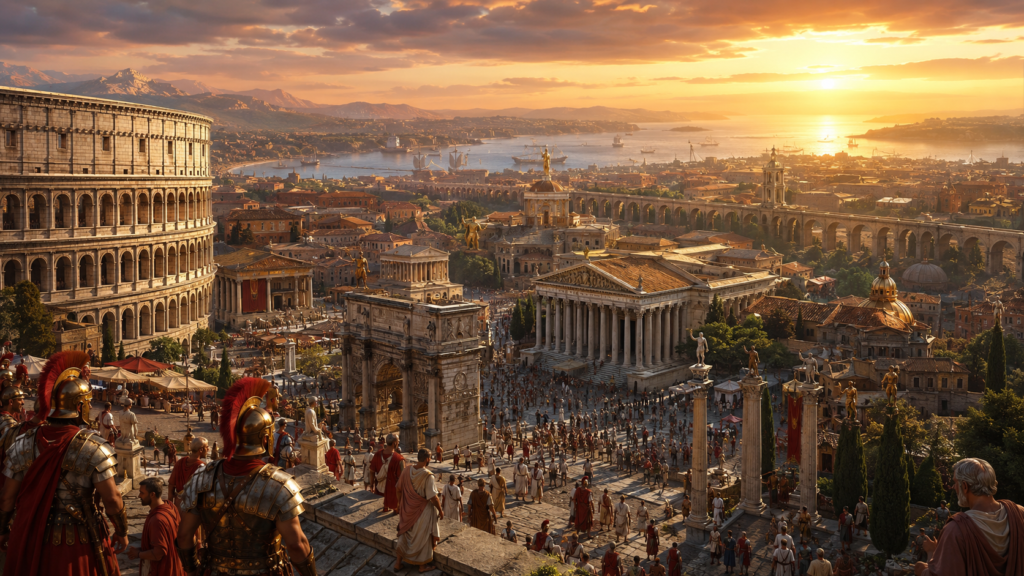
Large cities such as Rome contained enormous populations and impressive public buildings.
Roman cities commonly included:
- Markets
- Temples
- Public baths
- Forums
- Theatres
- Amphitheatres
- Libraries
- Government buildings
Many poorer Romans lived in apartment buildings known as insulae.
Wealthier families could live in large houses or villas decorated with mosaics, gardens, sculptures, and painted walls.
Public baths were especially important parts of Roman urban life.
They were places for bathing, exercise, social interaction, and business.
Food and goods also travelled considerable distances.
Grain from regions such as Egypt and North Africa helped supply Rome’s enormous population, while merchants transported products including olive oil, wine, metals, spices, textiles, and luxury goods throughout the empire.
Roman Society and Citizenship
Roman society was highly hierarchical.
At the top were powerful political and wealthy families.
Below them were various groups of citizens, freed people, enslaved people, soldiers, merchants, farmers, artisans, and others.
Slavery was deeply integrated into the Roman economy and society.
Enslaved people performed many different kinds of work, including domestic service, agriculture, construction, mining, and skilled occupations.
At the same time, Roman citizenship became an important instrument of imperial integration.
Over centuries, citizenship was extended to increasing numbers of people living within Roman territories.
In 212 CE, Emperor Caracalla issued the Constitutio Antoniniana, which extended Roman citizenship to most free inhabitants of the empire.
This demonstrated how Roman identity could expand beyond the city of Rome itself.
Roman Engineering and Innovation
Perhaps Rome’s most visible legacy is its engineering.
Roman engineers developed extensive infrastructure designed to support cities, trade and military operations.
Roads
Roman roads connected distant parts of the empire.
They were used by soldiers, government officials, merchants and travellers.
Some roads were constructed with multiple layers of stone and carefully engineered drainage.
Aqueducts
Growing cities required reliable water supplies.
Roman aqueducts transported water from distant sources into urban areas.
The water supported public baths, fountains, households, industries and other activities.
Concrete and Architecture
Romans made extensive use of concrete, allowing them to construct large and complex buildings.
The Colosseum became one of the most famous examples of Roman monumental architecture.
The Pantheon, particularly its enormous concrete dome, demonstrates the engineering capabilities of Roman builders.
Bridges, harbours, sewers, roads, walls and public buildings all contributed to the functioning of Roman society.
🔬 CurioReader Insight: Roman engineering was not simply about creating impressive monuments. Much of it served practical purposes—moving water, transporting armies, supporting cities and connecting distant regions.
Government and Roman Law
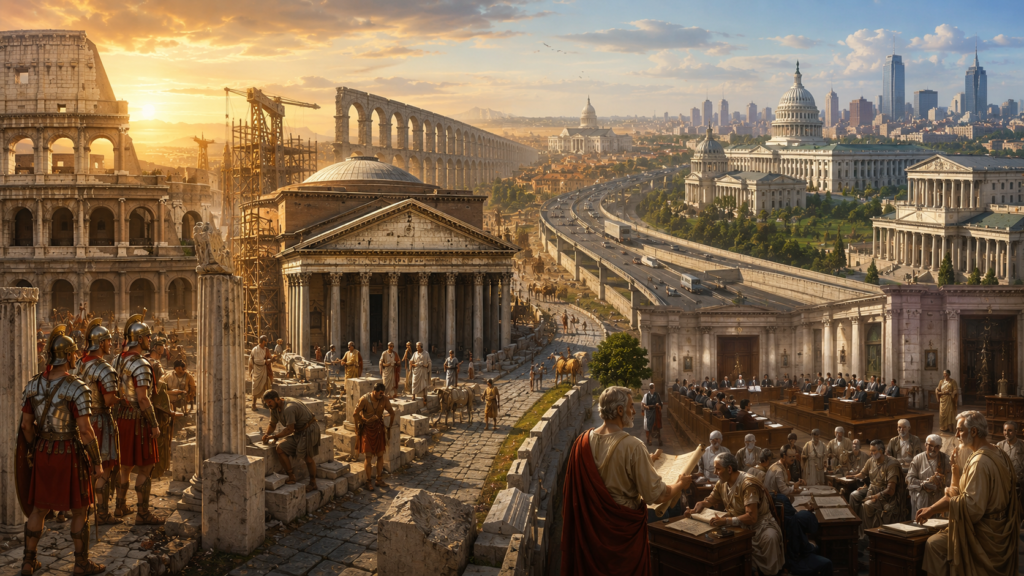
The Romans developed sophisticated administrative and legal systems for governing a large and diverse population.
The Roman Senate remained an important institution, although its role changed significantly under imperial rule.
Governors administered provinces, taxes supported the state, and Roman officials helped enforce imperial authority.
Roman law became one of Rome’s most enduring contributions.
Roman legal thinkers developed principles concerning contracts, property, citizenship, family relationships, inheritance, and legal procedures.
Although modern legal systems are not simply copies of Roman law, many legal traditions were influenced by Roman concepts.
The Roman approach to written laws and legal reasoning became particularly influential in later European legal development.
Christianity and the Changing Empire
Religion was an important part of Roman life.
Romans worshipped many gods and often incorporated religious traditions from peoples they conquered.
Over time, however, Christianity transformed the religious landscape of the empire.
Christianity began in the eastern Mediterranean during the 1st century CE and gradually spread through Roman territory.
Early Christians sometimes faced persecution from Roman authorities.
A major turning point came under Emperor Constantine the Great.
In the early 4th century, Constantine supported Christianity and helped establish a new relationship between Christianity and imperial power.
Later in the 4th century, Christianity became increasingly dominant within the empire.
These religious changes had enormous consequences for Roman society and European history.
The Division of the Roman Empire
As the empire became larger and more difficult to administer, emperors increasingly relied on regional governments.
The emperor Diocletian, who came to power in 284 CE, introduced major reforms and established a system known as the Tetrarchy, involving multiple rulers.
Later emperors continued to divide administrative responsibilities.
Eventually, the empire developed into eastern and western spheres of government.
In 330 CE, Constantine established Constantinople, an important imperial capital in the eastern Mediterranean.
The eastern part of the Roman Empire was wealthier and more urbanized in many areas and eventually survived long after the western empire collapsed.
Why Did the Western Roman Empire Fall?
The fall of the Western Roman Empire was not caused by one event.
It was a gradual process involving several interconnected problems.
Political instability
The empire experienced frequent struggles over imperial power.
Emperors could be overthrown by rival political factions or military commanders.
Economic difficulties
Maintaining a huge empire required enormous resources.
Tax pressures, economic instability and other financial challenges placed increasing strain on the state.
Military pressures
Roman territory faced growing pressure along its frontiers.
Various Germanic peoples and other groups entered or settled within Roman territories, sometimes as allies and sometimes as enemies.
Internal division
The enormous size of the empire made administration increasingly complicated.
The western provinces also faced different economic and military conditions from the wealthier eastern regions.
Political and military transformation
The Roman army itself changed over time.
Rome increasingly relied on soldiers and commanders from outside Italy, including groups that had entered the empire through treaties or settlement.
These developments were not necessarily signs of immediate collapse, but they demonstrate how Roman institutions were changing.
The Fall of the Western Empire
The traditional date for the fall of the Western Roman Empire is 476 CE.
In that year, the Germanic military leader Odoacer deposed the young Western emperor Romulus Augustulus.
This event is often used by historians as the symbolic end of the Western Roman Empire.
However, Roman institutions did not suddenly disappear.
Roman laws, traditions, Christianity, cities, languages and political structures continued.
Most importantly, the Eastern Roman Empire survived.
Its capital, Constantinople, remained a major center of political and economic power for centuries.
The Eastern Roman Empire eventually came to be known as the Byzantine Empire, although its inhabitants continued to regard themselves as Romans.
Rome’s Lasting Legacy
The Roman Empire disappeared as a unified western political power, but its influence remained enormous.
Roman roads and urban layouts influenced later settlements.
Roman architecture inspired later governments, universities, museums, churches, and monuments.
Latin became the foundation for languages including:
- Spanish
- French
- Italian
- Portuguese
- Romanian
Latin also remained an important language of scholarship, religion, and administration for centuries.
Roman law influenced legal traditions across Europe and beyond.
Roman political concepts influenced later thinkers who studied republican government, citizenship, political institutions, and the relationship between law and authority.
What Rome Can Teach Us
The history of Rome offers more than stories of emperors and battles.
Its rise demonstrates how military organization, infrastructure, political flexibility, economic networks, and administrative systems can help a relatively small state expand dramatically.
Its decline demonstrates the difficulties involved in maintaining a huge and diverse political system.
An empire can become powerful enough to control enormous territory, but controlling that territory requires constant resources.
Rome had to maintain armies, roads, fortifications, government institutions and food supplies across thousands of kilometres.
When political instability and external pressures increased, those systems became harder to sustain.
🧠 CurioReader Insight: Rome did not simply “fall” in a single moment. Its western political system changed gradually as economic, military, political, and social pressures accumulated over generations.
Key Takeaways
- Rome developed from an ancient settlement into a powerful Mediterranean state.
- The Roman Republic began traditionally in 509 BCE.
- Rome expanded through military conquest, alliances and political integration.
- Julius Caesar’s rise contributed to the collapse of the Republican political system.
- Augustus became the first Roman emperor in 27 BCE.
- The empire eventually controlled territories across Europe, North Africa and the Middle East.
- Roman roads, aqueducts, concrete construction and architecture demonstrated remarkable engineering abilities.
- Roman law became an important influence on later legal traditions.
- Christianity transformed Roman religious and political life.
- The Western Roman Empire gradually weakened through multiple political, economic and military pressures.
- The traditional date for the fall of the Western Empire is 476 CE.
- The Eastern Roman Empire survived for almost another thousand years.
- Roman language, law, architecture, engineering and political ideas continue to influence the modern world.
Frequently Asked Questions
When was the Roman Empire founded?
The Roman Empire is traditionally considered to have begun in 27 BCE, when Octavian received the title Augustus and established himself as Rome’s first emperor.
Was Julius Caesar the first Roman emperor?
No. Julius Caesar was a powerful Roman general and political leader, but he was never officially the first emperor. Augustus, Caesar’s adopted heir, is traditionally regarded as Rome’s first emperor.
How large was the Roman Empire?
At its greatest extent, the Roman Empire controlled a vast territory surrounding much of the Mediterranean and extending across parts of Europe, North Africa, and the Middle East.
Why was Rome so successful?
Rome’s success resulted from several factors, including military organization, political institutions, alliances, infrastructure, economic networks, citizenship policies, and effective administration.
Why did the Roman Empire fall?
The Western Roman Empire declined because of a combination of political instability, economic difficulties, military pressures, administrative challenges and other long-term changes. Historians generally reject the idea that one single cause explains the collapse.
When did the Western Roman Empire fall?
476 CE is the traditional date. In that year, Odoacer deposed Romulus Augustulus, the last emperor of the Western Roman Empire.
Did the Roman Empire completely disappear in 476 CE?
No. The eastern Roman state continued from Constantinople for centuries. Modern historians commonly call this later state the Byzantine Empire.
What was Rome’s greatest legacy?
There is no single answer. Roman law, engineering, architecture, language, government, urban planning, Christianity’s development within the empire, and cultural traditions all had enormous long-term influence.
Conclusion
The Roman Empire’s story is one of extraordinary expansion, achievement, transformation, and decline.
Rome began as a small community in central Italy and eventually became the dominant power across much of the Mediterranean world. Its armies conquered enormous territories, while its roads, aqueducts, cities, laws, and administrative systems helped connect and govern them.
The Romans were also remarkably adaptable.
They incorporated different peoples into their political system, extended citizenship, adopted cultural influences from conquered societies, and built a diverse empire around the Mediterranean.
Yet the same size that made Rome powerful also created enormous challenges.
Maintaining armies and infrastructure across such a vast territory required resources and stable political leadership. Over time, political conflicts, economic difficulties, military pressures and administrative challenges placed increasing strain on the western empire.
The traditional fall of the Western Roman Empire in 476 CE was therefore not the sudden disappearance of Roman civilization.
Roman institutions and cultural traditions continued in many forms.
The Eastern Roman Empire survived for centuries. Latin developed into several modern languages. Roman law influenced later legal systems. Roman architectural principles inspired generations of builders. Roads, cities and engineering techniques left physical traces that remain visible today.
Perhaps the most important lesson of Rome is that civilizations are rarely defined simply by their rise or fall.
Rome’s political empire eventually disappeared, but its ideas, infrastructure, language, law and culture continued to influence the world long afterward.
More than 1,500 years after the traditional fall of the Western Empire, the Roman legacy remains visible in modern cities, courts, languages, architecture, political thought and historical scholarship.
That extraordinary survival of influence is what makes the story of Rome one of the most important chapters in human history.
Further Reading & Resources
Continue your learning journey with more expert guides and insightful articles from CurioReader. Explore related topics below to deepen your understanding and discover new perspectives.
Related CurioReader Articles
- Ancient China’s Greatest Inventions That Changed the World.
- Ancient Egypt: Life Along the Nile.
- Ancient Greece: The Birthplace of Democracy.
Recommended External Resources