Introduction
Prehistoric Sri Lanka: Before Recorded History. Long before kings ruled from Anuradhapura, before Buddhism arrived from India, and even before written records existed, Sri Lanka was already home to thriving human communities. For tens of thousands of years, early hunter-gatherers adapted to the island’s forests, rivers, mountains, and coastal plains, developing unique survival techniques and cultures that laid the foundations for later civilizations.
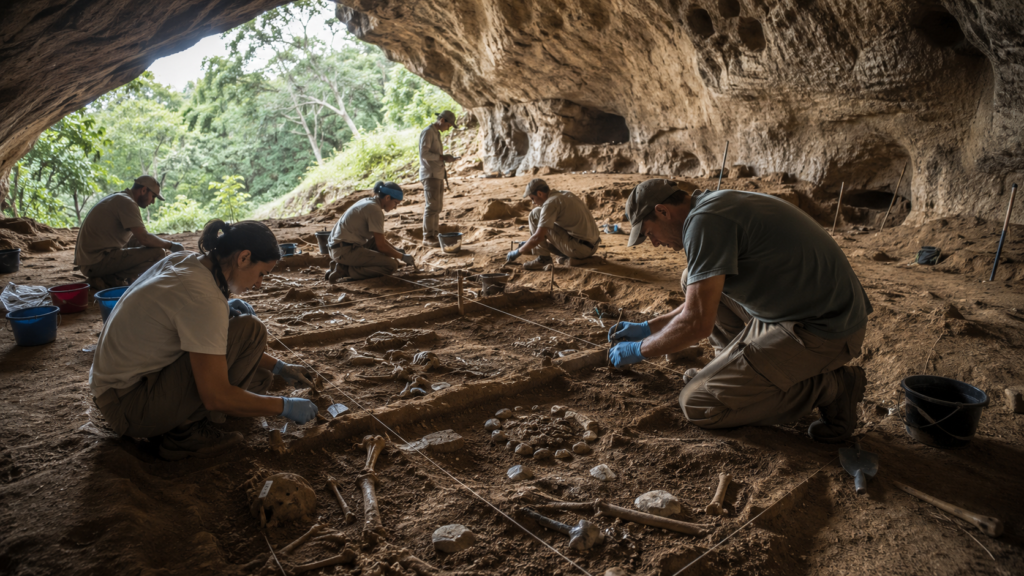
Unlike many ancient societies whose earliest history survives through written documents, Sri Lanka’s prehistoric past has been reconstructed through archaeology. Excavations in caves, rock shelters, ancient campsites, and burial grounds have revealed stone tools, human skeletons, animal bones, pottery, beads, and even traces of the foods consumed by the island’s first inhabitants.
Among the most remarkable discoveries is the prehistoric population commonly known as the Balangoda culture, named after archaeological finds near Balangoda in Sri Lanka’s central highlands. These early people lived thousands of years before recorded history yet displayed impressive adaptability, hunting skills, craftsmanship, and social organization.
Modern archaeological research continues to reshape our understanding of prehistoric Sri Lanka. New discoveries suggest that humans reached the island remarkably early, successfully adapting to one of the world’s oldest tropical rainforest environments. This challenges earlier assumptions that advanced prehistoric cultures developed only in open grasslands or river valleys.
This article explores Sri Lanka before recorded history, examining the island’s geological formation, the arrival of its earliest humans, major archaeological sites, Stone Age technology, and the remarkable achievements of the people who called Sri Lanka home thousands of years before written civilization began.
Timeline of Prehistoric Sri Lanka
| Period | Approximate Date |
| Formation of Sri Lanka as an island | Millions of years ago |
| Earliest human presence | Around 48,000–45,000 years ago |
| Balangoda culture flourishes | c. 38,000–12,000 years ago |
| Microlithic Stone Age communities | c. 38,000–4,000 years ago |
| Early pottery and village life emerge | c. 4,500–3,000 years ago |
| Beginning of Protohistoric Sri Lanka | c. 1000–500 BCE |
Sri Lanka Before Humans
To understand prehistoric Sri Lanka, it is essential to look even further back—long before humans arrived.
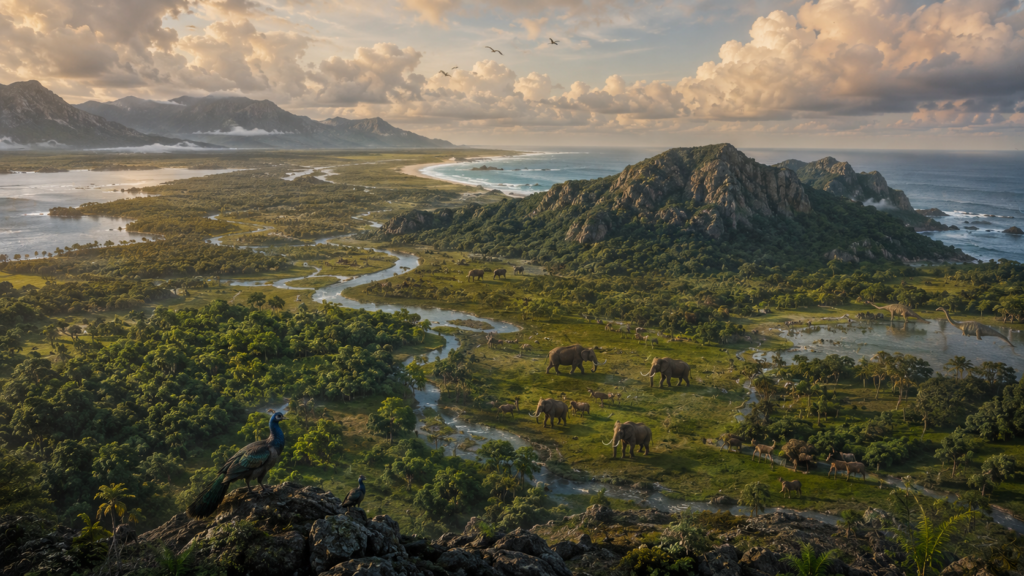
The island’s geological history stretches back hundreds of millions of years. Sri Lanka forms part of the ancient continental crust known as the Indian Plate, one of Earth’s oldest geological formations. During prehistoric times, changing sea levels repeatedly connected and separated Sri Lanka from the Indian subcontinent.
During the Ice Ages, global sea levels fell dramatically because vast quantities of water were locked in continental glaciers. As a result, the shallow waters of today’s Palk Strait became dry land, creating a natural land bridge between southern India and Sri Lanka.
This land connection allowed animals and eventually humans to migrate into the island without requiring boats.
As the Ice Age ended around 12,000 years ago, melting glaciers caused sea levels to rise. The land bridge gradually disappeared beneath the sea, permanently transforming Sri Lanka into an island. Although separated by water, the narrow distance between Sri Lanka and India continued to allow cultural exchanges throughout later history.
The island itself offered an extraordinary variety of environments within a relatively small area:
- Dense tropical rainforests
- Dry-zone forests
- Grasslands
- Wetlands
- Rivers
- Mountain ranges
- Coastal lagoons
- Rich marine ecosystems
This ecological diversity became one of prehistoric Sri Lanka’s greatest strengths. Different regions supported different plant and animal life, giving early humans numerous opportunities to hunt, gather, and adapt.
The Arrival of the First Humans
Exactly when humans first reached Sri Lanka remains one of archaeology’s most fascinating questions.
Earlier researchers believed humans arrived around 30,000 years ago. However, recent archaeological evidence has pushed this date significantly further back.
Excavations at several cave sites have uncovered human remains, charcoal, animal bones, and stone tools dating to approximately 48,000–45,000 years ago. These discoveries suggest that modern humans settled in Sri Lanka surprisingly early in the Late Pleistocene period.
The first inhabitants were Homo sapiens—anatomically modern humans similar to people living today.
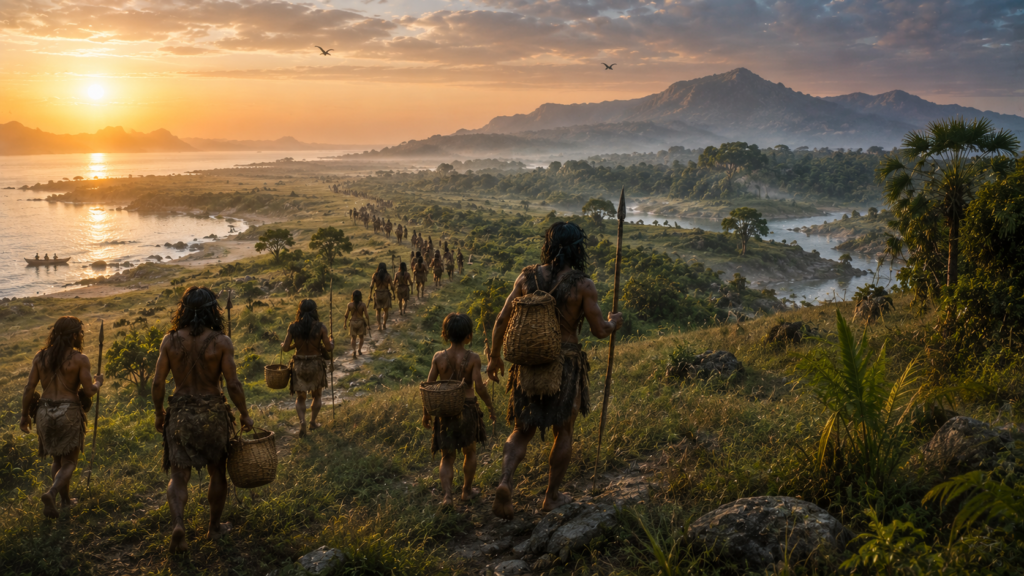
They likely migrated south through the Indian subcontinent before crossing the land bridge into Sri Lanka during periods of low sea levels.
Unlike later agricultural societies, these early settlers lived as hunter-gatherers.
Their survival depended on:
- Hunting wild animals
- Fishing
- Collecting shellfish
- Gathering fruits
- Harvesting nuts
- Digging edible roots
- Collecting honey
Rather than building permanent cities, they moved seasonally according to food availability, rainfall, and animal migrations.
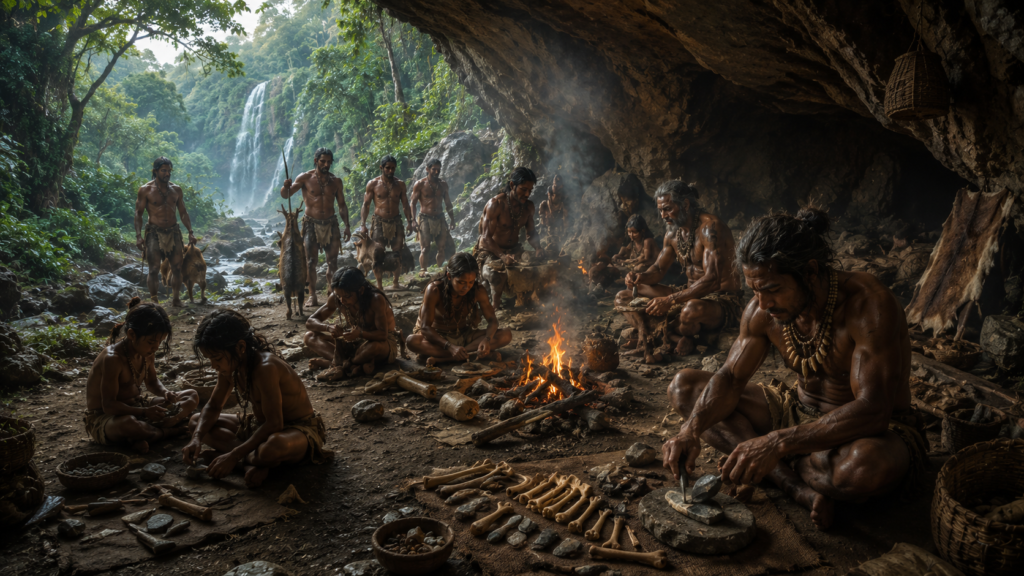
Natural caves offered ideal shelters.
These caves protected families from heavy tropical rain, dangerous animals, and intense sunlight while remaining close to water sources and hunting grounds.
Many of these same caves have preserved archaeological evidence remarkably well, allowing scientists to reconstruct prehistoric life with increasing accuracy.
The Balangoda Culture
One of the defining chapters of Sri Lanka’s prehistoric past is the Balangoda culture, often referred to informally as the “Balangoda people.” The term does not refer to a single tribe or ethnic group but to a prehistoric cultural tradition identified through archaeological discoveries in and around the Balangoda region.
The name originated after important excavations uncovered distinctive human skeletal remains, stone tools, and other artifacts.
Members of the Balangoda culture were physically robust. Archaeological evidence indicates that many adults were relatively tall for prehistoric populations, with strong bones and muscular builds that reflected demanding physical lifestyles.
Their daily activities required considerable endurance. Hunting, climbing steep terrain, gathering food, and traveling across forests would have demanded exceptional fitness.
Unlike the stereotype of primitive cave dwellers, the Balangoda people possessed sophisticated knowledge of their environment.
They understood:
- Seasonal weather patterns
- Animal behavior
- Edible and poisonous plants
- Forest navigation
- Water sources
- Stone tool production
This accumulated knowledge was likely passed orally from one generation to the next.
Research also indicates that they adapted successfully to tropical rainforests—a remarkable achievement.
For many years, archaeologists believed prehistoric humans preferred open grasslands because hunting was easier there. Sri Lanka’s evidence challenged this assumption.
The Balangoda culture demonstrated that humans could thrive in dense tropical forests by developing specialized hunting strategies and exploiting a wide range of forest resources.
Their success represents one of humanity’s earliest known examples of long-term rainforest adaptation.
Important Archaeological Sites
Sri Lanka contains hundreds of prehistoric sites, but a handful have transformed our understanding of early human history.
Fa Hien Cave
Located near Bulathsinhala in western Sri Lanka, Fa Hien Cave is among the most important prehistoric archaeological sites in South Asia.
Excavations have uncovered:
- Human skeletons
- Stone tools
- Animal bones
- Charcoal
- Food remains
- Bone implements
Radiocarbon dating suggests human occupation extending back approximately 48,000 years.
Perhaps most importantly, Fa Hien Cave provides evidence that prehistoric humans successfully lived inside dense tropical rainforest environments for tens of thousands of years.
Researchers discovered remains of monkeys, squirrels, birds, reptiles, and other rainforest animals, indicating highly specialized hunting techniques rather than simple opportunistic gathering.
These discoveries significantly influenced international research into early human adaptation.
Batadomba Lena
Another internationally significant site is Batadomba Lena, located near Kuruwita.
This cave has yielded some of the oldest evidence of microlithic stone technology in South Asia.
Excavations uncovered:
- Tiny stone blades
- Human burials
- Bone tools
- Food remains
- Shell ornaments
The site’s remarkable preservation has allowed researchers to study prehistoric diets, hunting methods, and technological innovation in exceptional detail.
Beli Lena
Situated in the hill country, Beli Lena has provided further evidence of continuous prehistoric occupation.
Among the discoveries were:
- Human remains
- Animal bones
- Stone implements
- Charcoal deposits
The evidence indicates that prehistoric communities repeatedly returned to the cave over thousands of years, suggesting seasonal settlement patterns rather than permanent occupation.
Alu Lena and Other Cave Sites
Numerous additional cave sites—including Alu Lena, Bellanbandi Palassa, and Kitulgala Beli Lena—have expanded our understanding of prehistoric Sri Lanka.
Although each site offers unique evidence, together they reveal consistent patterns of human adaptation across different ecological zones.
Instead of isolated discoveries, archaeologists now recognize a widespread network of prehistoric communities living throughout much of the island.
Stone Age Technology
The earliest inhabitants of Sri Lanka relied on stone technology for survival.
Their tools were carefully shaped from locally available rocks such as quartz and chert. Over thousands of years, tool-making techniques became increasingly refined.
One of the most distinctive developments was the production of microliths—small, sharp stone blades that could be attached to wooden shafts or bone handles. These lightweight tools were versatile and effective for hunting, cutting, scraping, and processing plant materials.
The widespread use of microlithic technology demonstrates that prehistoric Sri Lankans were not merely surviving but innovating. Rather than relying on large, crude hand axes alone, they developed compact, specialized tools suited to the dense forests they inhabited.
Archaeologists have also uncovered evidence of bone tools, suggesting that early people skillfully used every available resource from hunted animals. Bone points and awls may have been used for piercing hides, crafting clothing or baskets, and preparing food.
These technological advances highlight a community capable of planning, experimentation, and adapting to changing environmental conditions—qualities that would continue to shape Sri Lanka’s human history for millennia.
Daily Life in Prehistoric Sri Lanka
Although no written records exist from prehistoric Sri Lanka, archaeological discoveries allow researchers to reconstruct many aspects of everyday life. The island’s earliest inhabitants lived in small, mobile communities whose survival depended on a close understanding of nature.
Most groups likely consisted of extended families who traveled together, sharing responsibilities such as hunting, gathering food, caring for children, and making tools. Cooperation was essential. A successful hunt or a season rich in edible plants benefited the entire community rather than a single individual.
Caves and rock shelters served as temporary homes during different times of the year. Evidence of repeated occupation at sites such as Fa Hien Cave, Batadomba Lena, and Beli Lena suggests that these locations were visited over many generations. The caves offered protection from heavy rain, tropical heat, and wild animals while remaining close to reliable water sources.
Inside these shelters, families probably gathered around controlled fires. Fire provided warmth, light, protection from predators, and a way to cook food, making many plants and meats easier to digest. Charcoal remains discovered at several archaeological sites confirm the regular use of fire throughout prehistoric Sri Lanka.
Life was physically demanding. Every day involved searching for food, maintaining tools, caring for children, and responding to seasonal changes. Yet archaeological evidence also suggests that these communities were highly adaptable, successfully occupying diverse environments ranging from tropical rainforests to dry-zone forests.
Hunting and Gathering
The economy of prehistoric Sri Lanka was based on hunting and gathering rather than agriculture. Early communities depended on a wide variety of natural resources instead of relying on a single food source.
Animal remains recovered from archaeological sites show that prehistoric hunters captured many species, including:
- Deer
- Wild boar
- Monkeys
- Giant squirrels
- Porcupines
- Monitor lizards
- Birds
- Freshwater fish
One of the most surprising discoveries is the large number of monkey and squirrel bones found in rainforest cave sites. Hunting agile tree-dwelling animals would have required exceptional skill, suggesting that prehistoric Sri Lankans developed sophisticated hunting techniques adapted to dense forests.
Researchers believe hunters may have used sharpened wooden spears tipped with stone or bone points. Traps, snares, and coordinated group hunting were also likely employed, although direct evidence for these methods is difficult to preserve over thousands of years.
Gathering was equally important. Women, children, and older members of the community probably collected fruits, berries, edible leaves, mushrooms, nuts, seeds, roots, and medicinal plants. Honey gathered from wild bees likely provided an important source of energy and nutrition.
Along rivers and coastal areas, fishing and shellfish collection supplemented the diet. Shell remains found at several sites indicate that aquatic resources formed an important part of prehistoric life, especially during seasons when hunting was less successful.
This flexible approach to obtaining food helped prehistoric communities survive environmental changes and seasonal shortages.
Diet and Nutrition
Archaeological evidence suggests that prehistoric Sri Lankans enjoyed a surprisingly varied diet.
Unlike later farming societies that depended heavily on cultivated crops, hunter-gatherers obtained nutrition from many different sources. This diversity reduced the risk of famine and provided a balanced intake of protein, fats, vitamins, and minerals.
Their diet likely included:
- Wild game
- Fish
- Freshwater crabs
- Shellfish
- Fruits
- Nuts
- Seeds
- Tubers
- Honey
- Wild vegetables
Animal bones recovered from cave sites often show cut marks made by stone tools, indicating that meat was carefully butchered before cooking. Burned bones also suggest that roasting over open fires was a common cooking method.
Seasonal variation played an important role in food availability. During rainy seasons, certain plants flourished, while dry periods may have encouraged greater reliance on hunting or fishing. This seasonal knowledge would have been passed down through generations, allowing communities to make efficient use of available resources.
Clothing and Personal Adornment
Organic materials such as animal skins, bark fibers, and woven plant materials rarely survive in tropical climates, making prehistoric clothing difficult to study directly. However, archaeologists have uncovered indirect evidence that early Sri Lankans paid attention not only to survival but also to personal appearance.
Beads made from shells, animal teeth, and bone have been discovered at several archaeological sites. These ornaments may have been worn as necklaces, bracelets, or decorative accessories.
Personal adornments could have served several purposes:
- Displaying social identity
- Marking adulthood
- Indicating family or group membership
- Symbolizing achievements
- Decorative expression
The presence of carefully crafted ornaments demonstrates creativity and suggests that symbolic thinking developed alongside practical survival skills.
Social Organization
Although prehistoric societies left no written records describing their social structure, archaeologists can make informed interpretations based on evidence from settlements and burials.
Most researchers believe communities were relatively small, perhaps consisting of twenty to fifty individuals. Such group sizes would have balanced the need for cooperation with the availability of local food resources.
Leadership may have been informal, based on experience, hunting ability, or knowledge rather than inherited authority. Decisions affecting the community were likely shared among respected adults.
Children probably learned practical skills through observation rather than formal teaching. Hunting techniques, tool making, plant identification, and navigation would have been passed from older generations to younger members over many years.
This transfer of knowledge played a crucial role in the survival of prehistoric communities and laid the foundation for increasingly complex societies in later periods.
Burial Practices and Spiritual Beliefs
One of archaeology’s most valuable sources of information about prehistoric societies comes from burial sites.
Human burials discovered at locations such as Batadomba Lena indicate that prehistoric Sri Lankans treated the dead with care rather than abandoning bodies in the wilderness. This suggests emotional bonds within communities and possibly beliefs about death or an afterlife.
Some burials contain grave goods, including ornaments or tools, although the exact meanings remain uncertain. These objects may have held symbolic significance or reflected the social status of the deceased.
While no direct evidence reveals the religious beliefs of prehistoric Sri Lanka, many archaeologists believe early communities possessed a spiritual understanding of nature. Forests, rivers, mountains, and animals may have held symbolic or sacred importance.
Such beliefs would later evolve into more organized religious traditions, but their earliest roots may stretch back into prehistory.
Early Art and Symbolic Expression
Evidence for prehistoric art in Sri Lanka is limited compared with regions such as Europe or Australia. Nevertheless, discoveries of beads, ornaments, and carefully crafted tools demonstrate that prehistoric people possessed both artistic ability and symbolic thought.
The production of decorative objects requires planning, patience, and an appreciation for beauty beyond immediate survival needs. These qualities indicate increasingly sophisticated cognitive development.
Some researchers also believe that certain rock surfaces may have been used for symbolic markings, although interpretations remain debated. Because organic materials such as wood and bark decay rapidly in tropical climates, many forms of prehistoric artistic expression have likely been lost forever.
Even so, the surviving evidence demonstrates that Sri Lanka’s earliest inhabitants were capable of creativity and abstract thinking.
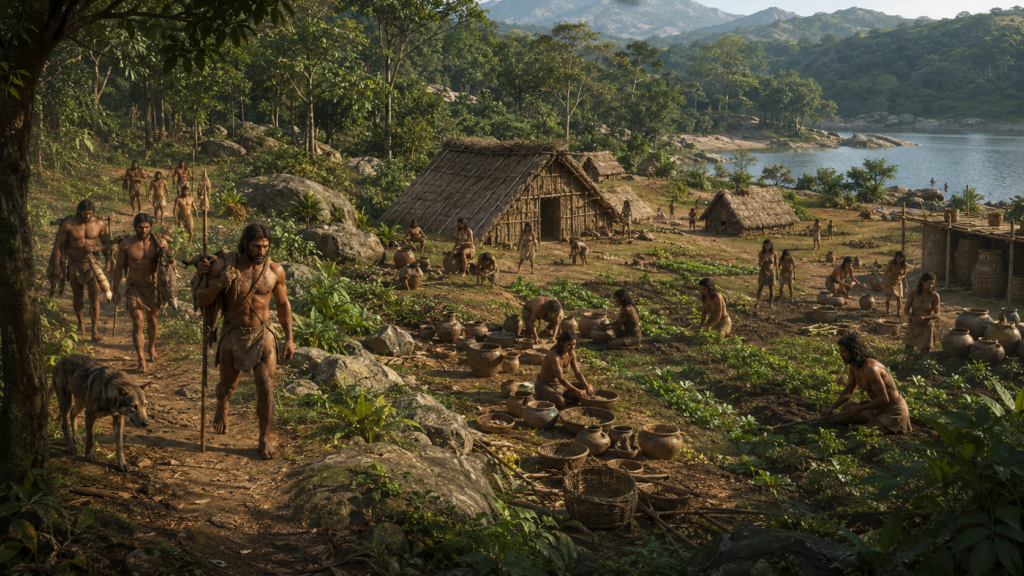
From Hunter-Gatherers to Early Farming
One of the most significant changes in human history occurred when communities gradually shifted from hunting and gathering toward food production.
In Sri Lanka, this transition was gradual rather than sudden. Around 4,500 to 3,000 years ago, archaeological evidence begins to show important cultural changes.
These include:
- Early pottery
- More permanent settlements
- Domestication of some plants
- Improved food storage
- Greater regional trade
Pottery represented a major technological breakthrough. Clay vessels allowed people to cook food more efficiently, store water, and preserve surplus supplies.
Although hunting and gathering continued for many centuries, increasing reliance on cultivation encouraged communities to remain in one place for longer periods.
This gradual transformation eventually led to the emergence of protohistoric societies that would later develop into the organized kingdoms described in Sri Lanka’s recorded history.
The Legacy of Prehistoric Sri Lanka
Prehistoric Sri Lanka represents far more than a distant chapter of the island’s past. It marks the beginning of a continuous human story that extends back nearly 50,000 years.
The earliest inhabitants demonstrated remarkable adaptability. They successfully occupied dense tropical rainforests, developed specialized hunting techniques, produced sophisticated stone and bone tools, and established communities capable of surviving changing climates and environments.
Their achievements challenge outdated assumptions that prehistoric societies were simple or primitive. Instead, archaeological research reveals intelligent, resourceful people whose knowledge of nature allowed them to thrive for thousands of years.
Many aspects of later Sri Lankan civilization—including deep familiarity with the island’s landscapes, careful management of natural resources, and strong community cooperation—may have roots in these early prehistoric traditions.
As archaeological methods continue to improve, new discoveries will undoubtedly expand our understanding of Sri Lanka’s distant past. Each excavation adds another piece to the puzzle, helping historians reconstruct the lives of the island’s earliest inhabitants with greater accuracy.
The story of prehistoric Sri Lanka reminds us that history did not begin with written records. Long before kings, kingdoms, and chronicles, generations of ordinary people shaped the island through resilience, innovation, and adaptation.
Key Takeaways
- Human beings reached Sri Lanka at least 45,000–48,000 years ago, making it one of South Asia’s earliest continuously inhabited regions.
- Early settlers crossed a land bridge connecting Sri Lanka with southern India during periods of lower sea levels.
- The Balangoda culture represents one of the island’s most important prehistoric populations.
- Archaeological sites such as Fa Hien Cave, Batadomba Lena, and Beli Lena have transformed our understanding of early human life.
- Prehistoric Sri Lankans developed sophisticated microlithic stone tools and adapted successfully to tropical rainforest environments.
- Their economy relied on hunting, fishing, gathering, and the sustainable use of natural resources.
- Around 4,500–3,000 years ago, pottery and more permanent settlements began to appear, marking the transition toward the protohistoric period.
Frequently Asked Questions
How old is the earliest evidence of humans in Sri Lanka?
Current archaeological evidence indicates that anatomically modern humans lived in Sri Lanka approximately 45,000–48,000 years ago, although future discoveries may extend this timeline further.
Who were the Balangoda people?
The Balangoda people were prehistoric hunter-gatherers identified through archaeological discoveries in Sri Lanka. They are known for their robust physical build, advanced stone tool technology, and successful adaptation to tropical rainforests.
Did prehistoric Sri Lankans practice farming?
The earliest inhabitants were hunter-gatherers. Farming developed gradually several thousand years later as communities began producing pottery, cultivating plants, and establishing more permanent settlements.
Why are caves important to Sri Lankan archaeology?
Caves preserved human skeletons, stone tools, charcoal, animal bones, ornaments, and other artifacts that help archaeologists reconstruct prehistoric life over tens of thousands of years.
When does prehistoric Sri Lankan history end?
The prehistoric period gradually transitions into the protohistoric era between 1000 and 500 BCE, when agriculture, iron technology, and increasingly organized settlements emerged before the beginning of recorded history.
Conclusion
The prehistoric history of Sri Lanka reveals an island inhabited by resilient and innovative communities long before the emergence of kingdoms or written chronicles. Through archaeological discoveries, researchers have uncovered evidence of early human migration, advanced stone technology, rainforest adaptation, and the gradual evolution of increasingly complex societies.
These prehistoric communities laid the foundations for the civilizations that would later flourish across the island. Their story demonstrates that Sri Lanka’s history begins not with kings or monuments but with thousands of years of human ingenuity, cooperation, and adaptation to one of the world’s most diverse natural environments.
In the next article of this series, we will explore Prince Vijaya and the Origins of the Sinhalese Kingdom, examining the famous legend recorded in the Mahavamsa, the archaeological evidence surrounding early settlements, and the continuing debate between tradition and history.
Continue Exploring the Series: This article is part of The Complete History of Sri Lanka series. Visit the The Complete History of Sri Lanka. to explore the complete chronological timeline, discover related historical periods, and continue your journey through The Pearl of the Indian Ocean: From Ancient Lanka to Ceylon and Modern Sri Lanka.