Introduction
Did Ancient Civilizations Believe in Life Beyond Earth? For as long as humans have looked at the stars, they have asked one profound question: Are we alone in the universe?
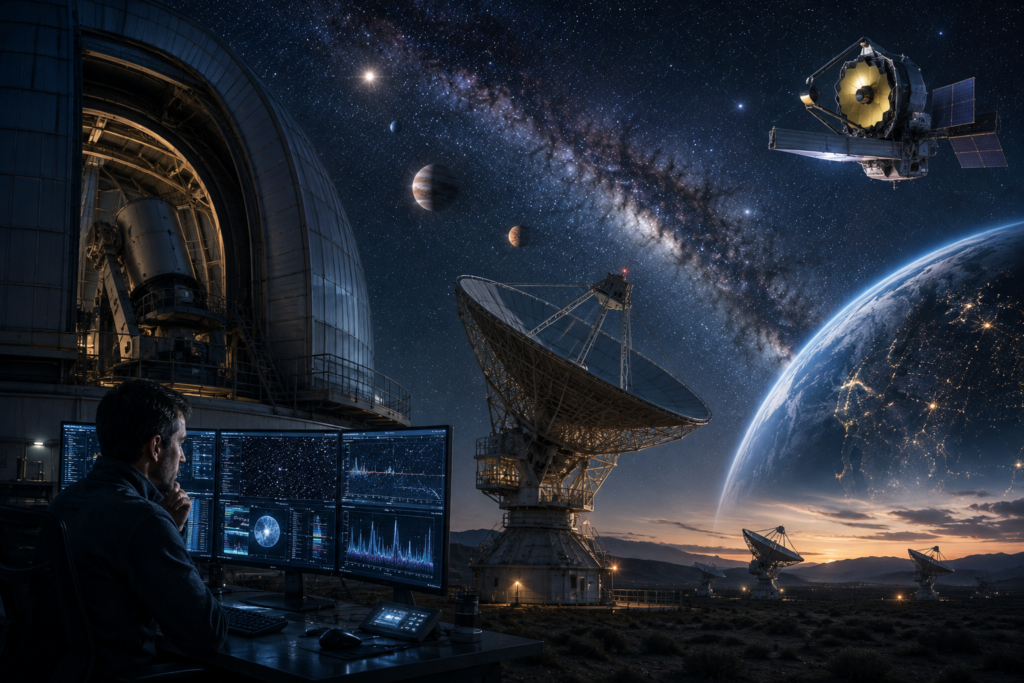
Today, scientists investigate this question using powerful space telescopes, robotic spacecraft, radio observatories and increasingly sophisticated computer systems. Astronomers have discovered thousands of planets orbiting stars beyond our Sun, while planetary scientists search Mars and other worlds for evidence that life may once have existed beyond Earth.
But the question itself is much older than modern science.
Long before telescopes and spacecraft existed, ancient civilizations carefully observed the heavens. They tracked the movements of the Sun, Moon and planets, recorded unusual celestial events and developed complex calendars. The sky influenced agriculture, navigation, religion, political authority and ideas about humanity’s place in the universe.
Some ancient cultures imagined gods or supernatural beings living in heavenly realms. Others developed philosophical ideas about the possibility of multiple worlds. Some religious traditions described enormous cosmic systems extending far beyond the human world.
However, an important distinction must be made.
There is no reliable historical evidence that ancient civilizations possessed scientific knowledge of extraterrestrial life or knew that intelligent beings lived on other planets.
Ancient descriptions of gods, spirits, celestial beings and heavenly realms should generally be understood within their own religious and cultural contexts rather than interpreted as accounts of alien visitors.
Nevertheless, ancient thinkers sometimes asked surprisingly modern questions.
Could there be other worlds?
Is Earth unique?
Could life exist elsewhere?
And how large might the universe actually be?
The answers were speculative, but the questions reveal something fundamental about humanity: curiosity about life beyond Earth is not a modern obsession. It is part of a much older attempt to understand our place in the cosmos.
Looking to the Sky
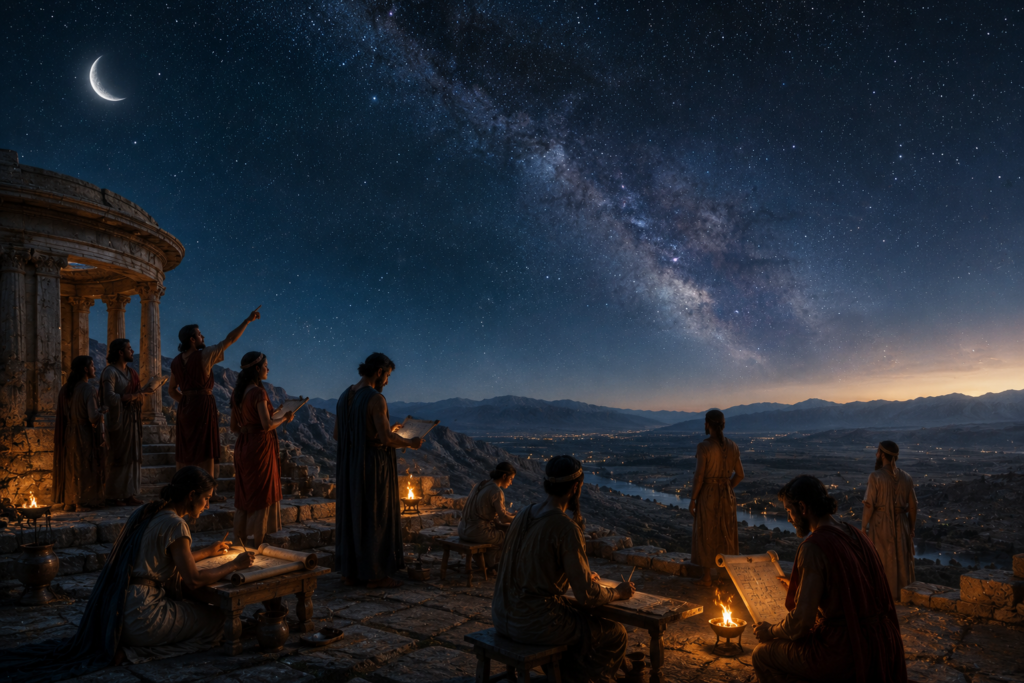
Before modern astronomy, the night sky was one of humanity’s most reliable natural clocks.
The Sun marked the passage of days and seasons. The Moon provided a repeating cycle that could be used to organize calendars. Stars helped travellers navigate, while the changing position of celestial objects could provide clues about agricultural seasons.
Because the heavens were so important, many ancient societies considered them sacred.
The movements of celestial bodies were often connected to religious beliefs, political authority or predictions about earthly events.
This does not mean ancient people thought of the stars as other solar systems containing planets and life.
Their understanding of the cosmos was fundamentally different from modern astronomy.
For many societies, the heavens were part of a sacred order populated by gods or supernatural forces.
Yet careful observation of the sky gradually created knowledge that later contributed to astronomy.
This is an important part of the story.
Ancient people were not simply looking at the stars and imagining stories. Many also made systematic observations and recorded what they saw.
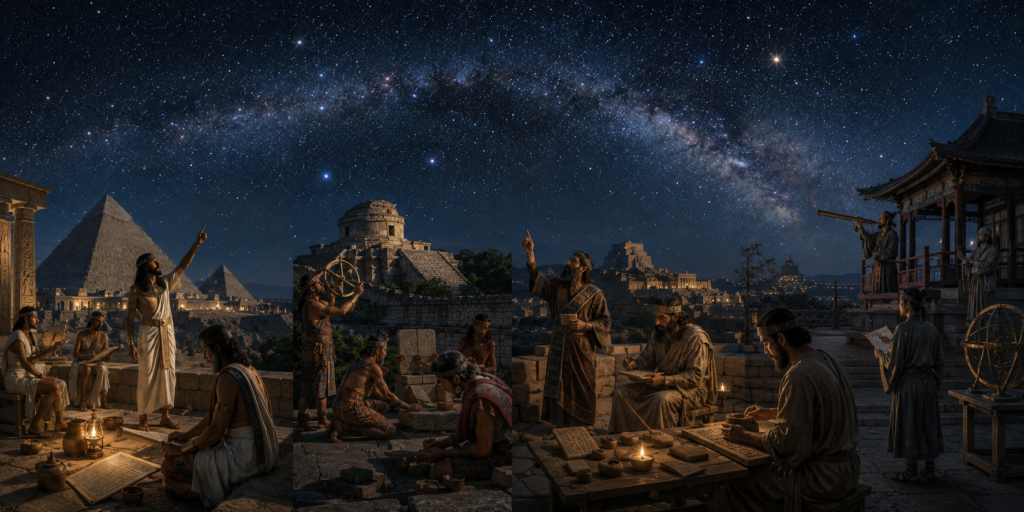
Ancient Mesopotamia: The Earliest Astronomical Records
Some of the world’s earliest detailed astronomical records came from Mesopotamia, particularly the Babylonian civilization.
Babylonian astronomers carefully observed the movements of the Moon, Sun and planets. They recorded eclipses and other celestial phenomena and developed sophisticated mathematical methods for predicting astronomical events.
Their observations were often connected to astrology and religious interpretations.
The appearance of a particular celestial event could be considered an omen for a king or kingdom.
This was very different from modern scientific astronomy, but the observational records themselves were valuable.
Babylonian astronomers recognized that celestial movements followed patterns that could be recorded and predicted.
There is no convincing evidence that they believed in extraterrestrial civilizations in the modern sense.
Their importance to the history of the question lies elsewhere.
They demonstrated that human beings could systematically study the heavens rather than simply viewing them as mysterious lights.
🔭 CurioReader Insight: The ancient search for meaning in the sky gradually developed into increasingly systematic observation. Modern astronomy grew from a much longer human tradition of recording and explaining celestial phenomena.
Ancient Egypt: A Divine Heaven
Ancient Egyptian civilization developed a rich understanding of the sky.
The heavens were closely connected with Egyptian religion.
The goddess Nut was associated with the sky, while Ra was associated with the Sun and played a central role in Egyptian religious traditions.
Stars and celestial regions were also connected with ideas about the afterlife.
Egyptian monuments demonstrate that the movement of celestial objects was important to their culture. Some buildings were deliberately aligned with astronomical directions or celestial phenomena.
The pyramids in particular have inspired many modern claims about mysterious astronomical knowledge.
However, there is no credible evidence that the Egyptians understood the universe in terms of planets orbiting distant stars or believed that extraterrestrial civilizations were visiting Earth.
Their celestial beliefs were primarily religious.
The stars formed part of a sacred universe in which gods, humans and the afterlife were connected.
This distinction matters because modern readers sometimes interpret ancient references to heavenly beings through a modern science-fiction framework.
A description of a god descending from the sky does not automatically describe a spacecraft.
Understanding the original cultural context is essential.
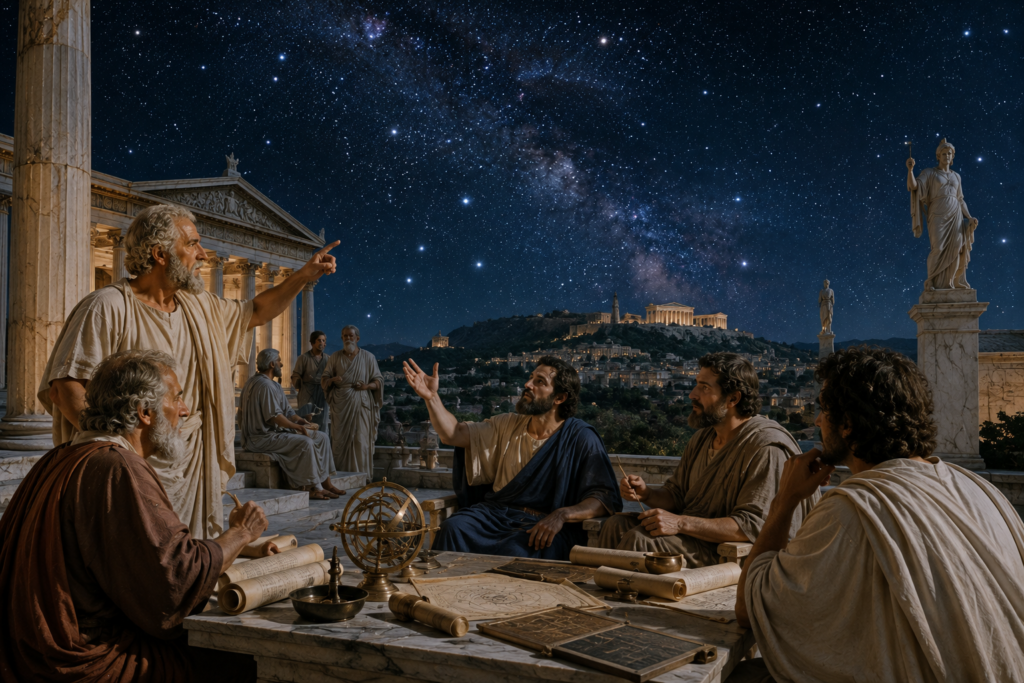
Ancient Greece: The Birth of Cosmic Philosophy
Ancient Greek thinkers took the question of the universe in a different direction.
Greek philosophers increasingly attempted to explain nature through reasoning and philosophical argument rather than relying exclusively on mythology.
Among the most interesting ideas came from philosophers associated with atomism.
Democritus proposed that matter was composed of extremely small particles called atoms and considered the universe to contain an enormous number of them.
Later, Epicurus developed ideas about an immense universe containing numerous worlds.
The Roman writer Lucretius, influenced by Epicurean philosophy, also described a universe in which other worlds could exist.
These ideas are particularly interesting because they opened the possibility that Earth might not be unique.
If the universe was enormous and contained countless worlds, why should life exist only here?
This was not evidence-based astronomy in the modern sense.
Greek philosophers did not possess telescopes capable of detecting planets around distant stars.
Their arguments were philosophical.
Nevertheless, they represent some of the earliest known intellectual discussions resembling the modern question of whether Earth is the only inhabited world.
Aristotle’s Different View
Not all Greek thinkers accepted the idea of multiple inhabited worlds.
Aristotle, one of the most influential philosophers of the ancient world, developed a very different cosmological model.
He argued for a finite cosmos organized around Earth, with celestial bodies moving in orderly patterns.
Aristotle’s influence became enormous.
His philosophical and scientific ideas shaped European and Middle Eastern scholarship for centuries.
The disagreement between thinkers such as Epicurus and Aristotle is historically important because it demonstrates that ancient philosophy did not have a single view of the universe.
Some thinkers imagined many worlds.
Others argued for a single ordered cosmos.
This debate resembles a modern scientific discussion in one important respect: people were willing to ask whether Earth occupied a unique position in reality.
The methods were different, but the philosophical question was surprisingly familiar.
Ancient India: Vast Cosmic Cycles
Ancient Indian traditions contain some of the most expansive cosmological ideas in human history.
Various Hindu philosophical and religious texts describe enormous cycles of creation and destruction extending across vast periods of time.
Some traditions describe multiple realms of existence and extraordinarily large cosmic scales.
These ideas should not be treated as ancient scientific descriptions of galaxies and extraterrestrial planets.
They belong primarily to religious and philosophical traditions.
Nevertheless, they demonstrate that ancient Indian thinkers were willing to imagine a reality much larger than the human world.
The concept of countless worlds or realms appears in several Indian philosophical and religious traditions, although their meanings are not equivalent to the modern scientific concept of extraterrestrial planets.
The important historical point is that humanity has repeatedly imagined realities extending far beyond the visible human environment.
Ancient China: Observing an Ordered Cosmos
Ancient Chinese astronomers developed sophisticated traditions of celestial observation.
They recorded solar and lunar eclipses, comets, novae and other unusual astronomical events.
Chinese scholars regarded the heavens as an organized system whose patterns could provide information about the natural and political world.
Celestial events could have political significance, particularly in relation to the emperor.
Chinese astronomical records became valuable historical evidence because they documented events that can sometimes be compared with modern astronomical calculations.
However, there is no strong evidence that ancient Chinese astronomy involved a scientific theory of extraterrestrial civilizations.
As with Egypt and Mesopotamia, celestial beliefs were closely connected to the culture’s understanding of nature, religion and political order.
The Chinese contribution is particularly important because it demonstrates how systematic astronomical observation developed independently in different parts of the world.
The Maya and the Observation of the Heavens
The Maya civilization of Mesoamerica also developed sophisticated astronomical knowledge.
Maya astronomers carefully tracked celestial cycles and incorporated astronomical observations into complex calendars.
The movements of the Sun, Moon and planets were important to Maya religious and political traditions.
The Maya’s astronomical achievements have sometimes been exaggerated in modern popular culture.
There is no credible evidence that Maya civilization had knowledge of extraterrestrial visitors or technology originating beyond Earth.
Their achievements are impressive precisely because they were human accomplishments.
Through long-term observation, mathematical reasoning and cultural knowledge, Maya astronomers developed sophisticated systems for understanding celestial cycles.
Their example reinforces an important lesson:
Ancient civilizations did not need outside assistance to develop remarkable astronomical knowledge.
Gods, Spirits, and Extraterrestrials Are Not the Same Thing
One of the biggest problems in discussions about ancient civilizations and extraterrestrial life is the tendency to treat every supernatural story as evidence of aliens.
Ancient cultures frequently described beings who lived in the sky or interacted with humans.
But the concept of a god is not equivalent to the concept of an extraterrestrial biological organism.
A god in a religious tradition may represent nature, morality, creation, death, fertility, war or other abstract concepts.
An extraterrestrial life-form, by contrast, is a scientific hypothesis concerning organisms that evolved somewhere beyond Earth.
These are fundamentally different ideas.
Ancient myths should therefore be studied according to their cultural meaning.
A story about a deity travelling through the heavens does not become a description of a spacecraft simply because modern readers can reinterpret it that way.
This distinction is particularly important when discussing ancient monuments.
The Ancient Astronaut Theory
In modern popular culture, some writers and television programs have argued that extraterrestrial visitors came to Earth in the distant past and influenced ancient civilizations.
This idea is commonly associated with the Ancient Astronaut Theory.
Supporters have sometimes claimed that structures such as the Egyptian pyramids, Stonehenge or the Nazca Lines could not have been created by ancient humans without outside assistance.
Mainstream archaeology does not accept these claims.
There is extensive evidence showing that ancient societies possessed the organizational skills, tools, engineering knowledge and labour forces required to construct their monumental works.
The pyramids of Egypt, for example, were products of a highly organized civilization capable of quarrying stone, transporting materials, feeding workers and coordinating large construction projects.
Likewise, archaeological evidence demonstrates that ancient communities created Stonehenge over generations using human labour and technological knowledge available to them.
The absence of modern machinery does not mean ancient people lacked engineering ability.
🏛️ History Insight: One of the dangers of the ancient-astronaut idea is that it can unintentionally diminish the achievements of ancient people by assuming that impressive accomplishments must have come from an outside civilization.
The fascination with ancient astronauts is understandable.
Ancient monuments are genuinely remarkable.
But mystery is not evidence.
When archaeological evidence provides a human explanation, there is no scientific reason to replace it with an extraterrestrial one without additional evidence.
How Ancient Ideas Shaped Modern Thinking
The ancient debate about the nature of the cosmos did not directly create modern astronomy.
Modern science developed through many centuries of observation, mathematics, experimentation and technological advancement.
However, ancient philosophy contributed to an intellectual tradition in which people were willing to ask fundamental questions about reality.
The invention and improvement of the telescope transformed astronomy.
Instead of relying only on naked-eye observation, scientists could examine distant objects in far greater detail.
The work of Nicolaus Copernicus, Galileo Galilei, Johannes Kepler and Isaac Newton gradually transformed humanity’s understanding of the universe.
Earth was no longer considered the centre of a simple cosmic system.
The planets were understood to orbit the Sun.
The same physical laws could be applied to objects on Earth and in the heavens.
Eventually, astronomers discovered that the Sun itself was one star among enormous numbers of stars.
The possibility of other worlds therefore changed from a philosophical speculation into a scientific question.
What Modern Science Has Discovered
Modern astronomy has revealed that planets are extremely common.
Astronomers have confirmed thousands of exoplanets, planets orbiting stars beyond our Sun.
Some are gas giants.
Others are rocky worlds.
Some orbit extremely close to their stars, while others travel at much greater distances.
Scientists are particularly interested in planets located within the habitable zone of their stars.
This is the region where temperatures may potentially allow liquid water to exist on a planet’s surface under suitable atmospheric conditions.
But being in the habitable zone does not mean that a planet contains life.
A planet’s atmosphere, chemistry, geology, radiation environment and history all matter.
Earth is currently the only world known to support life.
That fact remains extremely important.
Despite decades of searching, scientists have not confirmed extraterrestrial life.
Searching for Life Beyond Earth
Modern researchers are approaching the question using several methods.
Mars
Mars is one of the most extensively studied places beyond Earth.
Robotic missions have discovered evidence that liquid water existed on the Martian surface billions of years ago.
Scientists are investigating whether ancient Mars ever developed environments capable of supporting microbial life.
Europa and Enceladus
Moons such as Europa, orbiting Jupiter, and Enceladus, orbiting Saturn, are also scientifically important.
Both are believed to contain subsurface oceans beneath their icy surfaces.
These environments could potentially provide conditions suitable for life, although no life has yet been confirmed there.
Exoplanets
Astronomers can analyze some exoplanet atmospheres using powerful space telescopes.
Scientists are interested in atmospheric chemicals that might eventually provide clues about biological activity.
However, identifying a genuine biosignature is extremely difficult.
A chemical associated with life may sometimes be produced by non-biological processes.
Scientists therefore look for multiple lines of evidence rather than relying on one unusual observation.
Intelligent Life
The search is not limited to microbial organisms.
Projects such as SETI search for possible technological signals from intelligent civilizations.
These searches look for unusual signals that could potentially indicate technology.
So far, no confirmed extraterrestrial technological signal has been established.
Why Haven’t We Found Aliens?
The absence of confirmed evidence raises another fascinating question.
If life is possible elsewhere, why have we not discovered it?
This problem is often associated with the Fermi paradox.
There are many possible explanations.
Perhaps intelligent life is extremely rare.
Perhaps microbial life is common but technological civilizations are uncommon.
Perhaps civilizations do not survive long enough to communicate across interstellar distances.
Perhaps the distances between stars are simply too enormous.
Or perhaps humanity has not yet searched enough of the universe.
The important point is that scientists do not currently know the answer.
The absence of evidence is not proof that extraterrestrial life does not exist.
But it is equally important not to treat the possibility of alien life as established fact.
Ancient Questions, Modern Methods
This is where the ancient and modern stories connect.
An ancient Greek philosopher could ask:
Are there other worlds?
A modern astronomer can ask the same basic question, but now has telescopes capable of detecting planets orbiting distant stars.
An ancient observer could wonder whether the heavens contained other realms.
A modern space mission can travel to another world and analyze its rocks and atmosphere.
The question has remained surprisingly stable while the tools have transformed.
This is one of the most interesting aspects of the history of science.
Human curiosity often survives for centuries before technology becomes capable of testing the questions.
Key Takeaways
The search for extraterrestrial life continues using observation, experimentation and evidence.
Humans have wondered about the nature of the universe for thousands of years.
Ancient civilizations carefully observed the Sun, Moon, stars and planets.
Most ancient beliefs about heavenly beings were religious or philosophical rather than scientific theories about aliens.
Mesopotamian and Babylonian astronomers created detailed astronomical records.
Ancient Egyptian culture connected the heavens closely with religion and the afterlife.
Greek philosophers including Democritus and Epicurus considered the possibility of multiple worlds.
Aristotle supported a very different cosmological model.
Ancient Indian traditions imagined vast cosmic systems and multiple realms.
Chinese and Maya civilizations developed sophisticated astronomical traditions.
There is no credible historical evidence that ancient civilizations possessed knowledge of extraterrestrial life.
The Ancient Astronaut Theory is not supported by mainstream archaeological evidence.
Modern astronomy has confirmed thousands of planets beyond our Solar System.
Scientists are searching Mars, icy moons and exoplanets for evidence of life.
Earth remains the only world where life has been confirmed.
Key Takeaways
- Humans have wondered about the nature of the universe for thousands of years.
- Ancient civilizations carefully observed the Sun, Moon, stars and planets.
- Most ancient beliefs about heavenly beings were religious or philosophical rather than scientific theories about aliens.
- Mesopotamian and Babylonian astronomers created detailed astronomical records.
- Ancient Egyptian culture connected the heavens closely with religion and the afterlife.
- Greek philosophers including Democritus and Epicurus considered the possibility of multiple worlds.
- Aristotle supported a very different cosmological model.
- Ancient Indian traditions imagined vast cosmic systems and multiple realms.
- Chinese and Maya civilizations developed sophisticated astronomical traditions.
- There is no credible historical evidence that ancient civilizations possessed knowledge of extraterrestrial life.
- The Ancient Astronaut Theory is not supported by mainstream archaeological evidence.
- Modern astronomy has confirmed thousands of planets beyond our Solar System.
- Scientists are searching Mars, icy moons and exoplanets for evidence of life.
- Earth remains the only world where life has been confirmed.
- The search for extraterrestrial life continues using observation, experimentation and evidence.
Frequently Asked Questions
Did ancient civilizations believe in aliens?
Not in the modern scientific sense. Ancient civilizations commonly believed in gods, spirits, celestial beings and supernatural realms, but these concepts should not automatically be interpreted as extraterrestrial life.
Which ancient civilization first suggested that other worlds might exist?
Ancient Greek philosophers were among the earliest known thinkers to seriously discuss the possibility of multiple worlds. Philosophers associated with atomism and later Epicureanism argued that the universe could contain many worlds.
Did Epicurus believe that life existed on other worlds?
Epicurean philosophy allowed for the possibility of many worlds, and Epicurean thinkers discussed the possibility that other worlds could exist. These were philosophical arguments rather than conclusions based on astronomical observations.
Did the Egyptians believe aliens built the pyramids?
There is no credible historical evidence for this. Archaeological discoveries provide extensive evidence that the ancient Egyptians designed and constructed the pyramids using human labour, organization and engineering knowledge.
Did ancient people know that planets existed?
Ancient astronomers could identify several planets visible to the naked eye, including Mercury, Venus, Mars, Jupiter and Saturn. However, they did not understand these objects in the same way modern astronomy understands planets orbiting stars.
Is there evidence of extraterrestrial life today?
No extraterrestrial life has been scientifically confirmed. Scientists have discovered potentially interesting environments and thousands of exoplanets, but no confirmed life beyond Earth has yet been found.
Could there be life on Mars?
Scientists consider ancient Mars a promising place to investigate because evidence shows that liquid water existed there billions of years ago. However, no Martian life has been confirmed.
Could life exist under the ice of Europa?
Europa is considered an important target because evidence suggests it has a subsurface ocean beneath its icy crust. Scientists are investigating whether such environments could provide conditions suitable for life, but no life has been detected there.
What is the Ancient Astronaut Theory?
The Ancient Astronaut Theory proposes that extraterrestrial beings visited Earth in the distant past and influenced human civilizations. It remains a popular cultural idea but is not supported by mainstream archaeological evidence.
Why do people connect ancient monuments with aliens?
Ancient monuments can appear extraordinary when viewed without understanding the technology and organization available to their builders. Modern popular culture has sometimes interpreted this mystery as evidence of extraterrestrial involvement, although archaeological evidence generally provides human explanations.
Conclusion
The question of whether life exists beyond Earth is not new.
Long before humanity developed rockets, radio telescopes or space probes, people looked upward and wondered about the nature of the heavens.
Ancient civilizations created gods and celestial beings, developed elaborate cosmologies and carefully recorded the movements of objects in the sky.
Some philosophical traditions went even further.
Ancient Greek thinkers such as Democritus and Epicurus considered the possibility that the universe might contain multiple worlds. Ancient Indian traditions imagined vast cosmic systems extending far beyond the human world. Babylonian, Chinese, Egyptian and Maya astronomers developed sophisticated methods for observing and recording the heavens.
But these achievements should be understood within their historical contexts.
There is no reliable evidence that ancient civilizations discovered extraterrestrial life, communicated with alien civilizations or received advanced technology from beings beyond Earth.
The pyramids, temples, astronomical calendars and other monumental achievements of ancient cultures are remarkable examples of human ingenuity.
The modern search for extraterrestrial life is fundamentally different.
Scientists now have tools capable of detecting planets around distant stars, examining the chemistry of planetary atmospheres, exploring Mars and investigating potentially habitable environments beneath the icy surfaces of distant moons.
For the first time in human history, the question of whether life exists elsewhere can be investigated using direct scientific evidence.
Yet the answer remains unknown.
Earth is currently the only world known to contain life.
We have discovered no confirmed extraterrestrial organism, civilization or technological signal.
That uncertainty is not a failure of science.
It is an invitation to keep investigating.
Perhaps life exists only on Earth.
Perhaps simple microbial life is widespread but intelligent civilizations are rare.
Perhaps the universe contains countless living worlds that we have not yet learned how to detect.
We simply do not know.
And that uncertainty connects modern science with one of humanity’s oldest intellectual traditions.
Thousands of years ago, people looked at the night sky and wondered whether their world was unique.
Today, scientists are asking essentially the same question—but with telescopes, spacecraft, laboratory experiments and evidence that ancient observers could never have imagined.
The tools have changed.
The question has not.
Are we alone in the universe?
For now, the most scientifically honest answer remains:
We don’t know—but we are finally capable of searching for the answer.
Further Reading & Resources
Continue your learning journey with more expert guides and insightful articles from CurioReader. Explore related topics below to deepen your understanding and discover new perspectives.
Related CurioReader Articles
Recommended External Resources