Introduction
The Complete Guide to the Universe: For thousands of years, humans have looked up at the night sky and wondered what lies beyond the stars. Ancient civilizations created myths to explain the heavens, while early astronomers carefully mapped the movements of celestial bodies. Today, powerful telescopes, robotic spacecraft, and advanced scientific theories have transformed those early questions into one of humanity’s greatest scientific journeys.
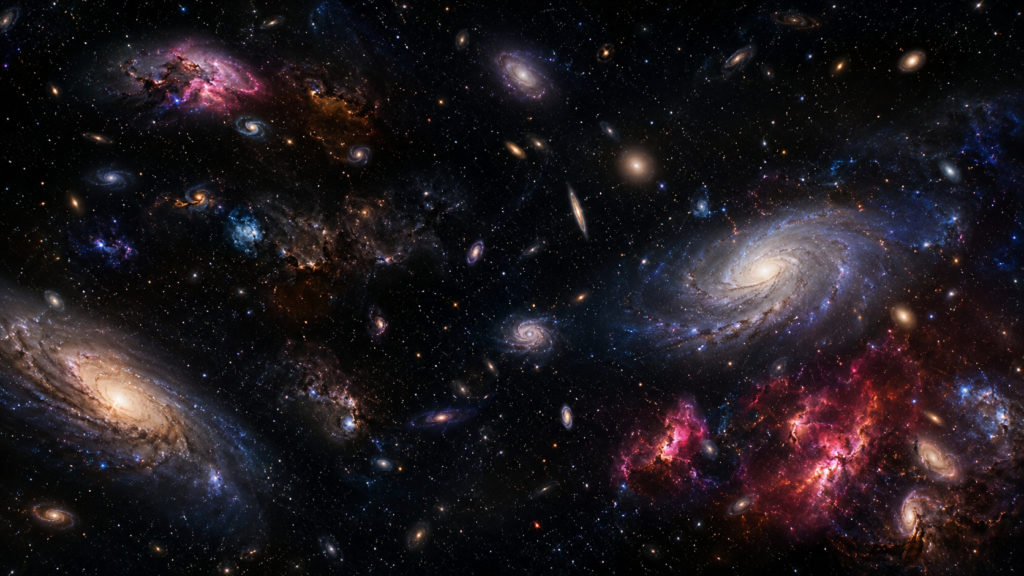
The universe is everything that exists. It includes every galaxy, every star, every planet, every atom, every beam of light, and even the invisible forms of matter and energy that scientists are still trying to understand. It also includes the very fabric of space and time, which forms the stage on which all cosmic events unfold.
Despite centuries of discoveries, we have explored only a tiny fraction of the cosmos. The observable universe alone contains hundreds of billions of galaxies, each with billions or even trillions of stars. Beyond that lies an even greater mystery—regions of the universe so distant that their light has not yet reached Earth.
Modern astronomy has revealed an astonishing reality. The Earth is not the center of the universe. Our planet orbits an ordinary star called the Sun, which is just one of hundreds of billions of stars in the Milky Way Galaxy. The Milky Way itself is only one galaxy among countless others scattered across the vastness of space.
Understanding the universe is about much more than satisfying curiosity. It helps us answer some of humanity’s biggest questions:
- How did everything begin?
- What is the universe made of?
- How do galaxies, stars, and planets form?
- Are we alone in the cosmos?
- What will happen to the universe in the distant future?
This comprehensive guide explores what scientists currently know about the universe while also highlighting the mysteries that remain unsolved. In this first part, we’ll examine the basic nature of the universe, its immense scale, its age, its structure, and the fundamental components that make up everything we observe.
What Is the Universe?
The universe is the totality of everything that exists. It includes:
- Space
- Time
- Matter
- Energy
- Galaxies
- Stars
- Planets
- Moons
- Asteroids
- Comets
- Black holes
- Nebulae
- Radiation
- Every known law of physics
Simply put, if something exists anywhere in reality, it is part of the universe.
One common misconception is that the universe is simply “outer space.” In reality, space is only one part of it. The universe also includes time itself, meaning the history and future of everything are woven into the same cosmic framework.
Scientists often describe the universe as a combination of space-time, a concept introduced by Albert Einstein. Instead of treating space and time as separate entities, Einstein showed that they are interconnected, forming a four-dimensional structure that can bend and curve under the influence of gravity.
This idea explains why massive objects such as stars and galaxies influence the motion of nearby objects. Rather than pulling them through empty space with an invisible force, they curve the space-time around them, causing planets and stars to follow those curved paths.
How Old Is the Universe?
One of the most remarkable achievements of modern science has been determining the age of the universe.
Current evidence indicates that the universe is approximately 13.8 billion years old.
Scientists did not arrive at this number through guesswork. Instead, they combined several independent observations, including:
- The expansion of the universe
- The cosmic microwave background radiation
- The ages of the oldest known stars
- Computer models based on the laws of physics
Together, these observations point to a universe that began around 13.8 billion years ago in an event known as the Big Bang.
It is important to understand that the Big Bang was not an explosion occurring at one point in space. Instead, it marked the rapid expansion of space itself. Every region of today’s universe emerged from an extremely hot and incredibly dense early state.
For comparison, consider Earth’s timeline:
| Event | Approximate Age |
|---|---|
| Universe forms | 13.8 billion years ago |
| Milky Way begins forming | About 13.6 billion years ago |
| Sun forms | About 4.6 billion years ago |
| Earth forms | About 4.54 billion years ago |
| First simple life on Earth | About 3.8 billion years ago |
| Modern humans appear | Around 300,000 years ago |
This comparison shows just how recent humanity is on the cosmic timeline. If the entire history of the universe were compressed into a single calendar year, modern humans would appear only in the final minutes of December 31.
How Big Is the Universe?
The true size of the universe remains one of science’s greatest unanswered questions.
Scientists distinguish between two important concepts:
The Observable Universe
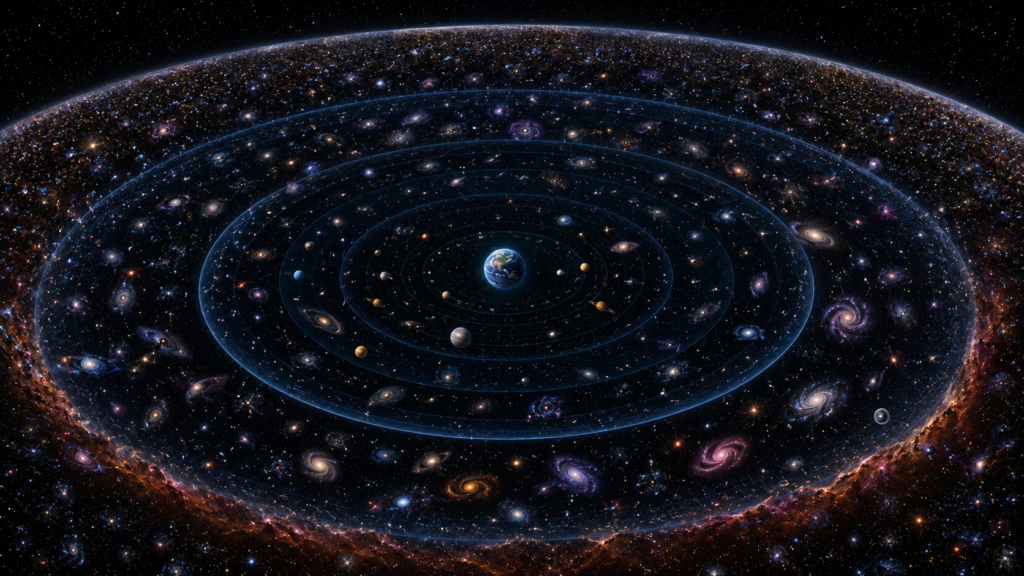
The observable universe is the portion of the universe whose light has had enough time to reach Earth since the Big Bang.
Because light travels at a finite speed—about 300,000 kilometers (186,000 miles) per second—we cannot instantly see distant objects. Looking farther into space is also looking farther back in time.
Today, the observable universe is estimated to be about 93 billion light-years in diameter.
At first glance, this may seem confusing. If the universe is 13.8 billion years old, why isn’t it only 27.6 billion light-years across?
The answer lies in the expansion of space. While light has been traveling toward us for billions of years, the space between galaxies has continued to stretch. As a result, the galaxies that emitted that ancient light are now much farther away than they were when the light first began its journey.
The Entire Universe
The observable universe is almost certainly not the whole universe.
Beyond the limits of what we can currently observe may lie regions extending far beyond our cosmic horizon. Because light from those areas has not yet had enough time to reach us, they remain invisible.
Scientists have proposed several possibilities:
- The universe is infinitely large.
- The universe is extremely large but finite.
- Space may curve back on itself in ways that are difficult to detect.
- There could be regions forever beyond our observational reach.
At present, there is no definitive answer, making the true size of the universe one of cosmology’s biggest mysteries.
Measuring Cosmic Distances
Distances within our Solar System are often measured in millions or billions of kilometers. However, those units become impractical when discussing galaxies.
Astronomers instead use the light-year.
A light-year is the distance that light travels in one year, not a measure of time.
One light-year equals approximately:
- 9.46 trillion kilometers
- 5.88 trillion miles
To appreciate these distances:
| Object | Distance from Earth |
|---|---|
| Moon | 1.3 light-seconds |
| Sun | 8.3 light-minutes |
| Neptune | About 4 light-hours |
| Proxima Centauri | 4.24 light-years |
| Center of the Milky Way | About 26,000 light-years |
| Andromeda Galaxy | About 2.5 million light-years |
This means that when we observe the Andromeda Galaxy, we are seeing it as it existed approximately 2.5 million years ago.
Astronomy is therefore a form of time travel through observation. Every telescope acts as a window into the past.
The Large-Scale Structure of the Universe
Although the universe may appear chaotic when viewed through images of stars and galaxies, it follows an astonishing level of organization on the largest scales.
Galaxies
Galaxies are immense collections of stars, planets, gas, dust, dark matter, and black holes held together by gravity.
They vary dramatically in size.
Small dwarf galaxies may contain only a few billion stars, while giant galaxies can contain several trillion.
Our home galaxy, the Milky Way, contains an estimated 100–400 billion stars.
Galaxy Groups and Clusters
Galaxies are rarely isolated.
Instead, gravity pulls them into groups and clusters.
The Milky Way belongs to a small collection known as the Local Group, which includes more than 80 galaxies, among them the nearby Andromeda Galaxy and the Triangulum Galaxy.
On even larger scales, galaxy clusters can contain hundreds or thousands of galaxies bound together by gravity.
Superclusters
Galaxy clusters themselves are connected into enormous structures called superclusters.
These span hundreds of millions of light-years and represent some of the largest known formations in the observable universe.
However, even superclusters are not the final level of cosmic organization.
The Cosmic Web
When astronomers map millions of galaxies, they discover something extraordinary.
Galaxies are not evenly distributed through space.
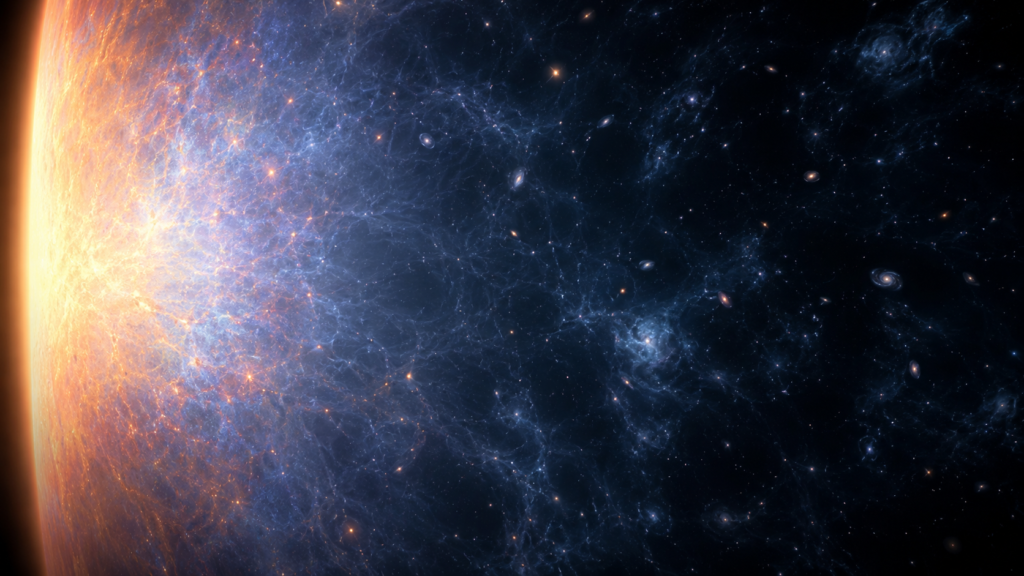
Instead, they form an enormous network known as the cosmic web.
This structure resembles a three-dimensional web of interconnected filaments.
These filaments consist of galaxies and dark matter stretching across hundreds of millions of light-years.
Between them lie enormous empty regions known as cosmic voids, where relatively few galaxies exist.
The cosmic web is considered the largest known structure in the observable universe and provides important clues about how matter evolved after the Big Bang.
What Is the Universe Made Of?
One of the greatest surprises in modern astronomy is that everything humans can directly observe makes up only a tiny fraction of the universe.
Scientists estimate that the universe consists of three main components.
Ordinary Matter
Ordinary matter includes everything we can directly detect:
- People
- Animals
- Planets
- Stars
- Gas
- Dust
- Water
- Trees
- Buildings
It is composed of atoms, which themselves consist of protons, neutrons, and electrons.
Surprisingly, ordinary matter accounts for only about 5% of the universe.
Everything humanity has ever observed directly falls within this small percentage.
Dark Matter
Around 27% of the universe appears to consist of dark matter.
Dark matter does not emit, reflect, or absorb light, making it invisible to telescopes.
Scientists cannot observe it directly, but they know it exists because of its gravitational effects. For example, galaxies rotate much faster than they should if they contained only visible matter. The additional gravitational pull provided by dark matter helps explain these observations.
Although researchers have proposed several possible particles that could make up dark matter, its true nature remains one of the biggest mysteries in physics.
Dark Energy
The largest component of the universe is dark energy, making up roughly 68% of the total.
Dark energy is even more mysterious than dark matter.
Rather than pulling objects together through gravity, it appears to drive the accelerated expansion of the universe. Observations of distant supernovae in the late 1990s revealed that galaxies are not merely moving apart—they are doing so at an increasing rate.
Scientists do not yet know what dark energy is. It may be a property of space itself or the result of entirely new physics that has yet to be discovered.
Together, dark matter and dark energy dominate the cosmos, meaning that about 95% of the universe is still largely unknown.
How Did the Universe Begin?
The story of the universe begins with one of the most significant scientific discoveries ever made—the Big Bang Theory. Despite its name, the Big Bang was not a giant explosion in empty space. Instead, it marks the moment when space and time themselves began expanding from an extremely hot, dense state around 13.8 billion years ago.
Before this event, the conditions of the universe are still unknown. Current scientific theories cannot fully explain what, if anything, existed “before” the Big Bang because time itself, as we understand it, is believed to have begun with the universe.
The Big Bang Theory is supported by multiple independent lines of evidence, making it the most widely accepted explanation for the origin and evolution of the universe. These include:
- The expansion of the universe.
- The cosmic microwave background radiation.
- The abundance of light elements such as hydrogen and helium.
- The large-scale distribution of galaxies across space.
Rather than describing the creation of matter from nothing, the Big Bang explains how the universe evolved from its earliest measurable moments into the vast cosmos we observe today.
The First Moments After the Big Bang
The earliest stages of the universe unfolded incredibly quickly. Within fractions of a second, temperatures exceeded trillions of degrees, and matter existed in forms unlike anything seen today.
Scientists divide these early moments into several stages.
The Planck Era
During the first unimaginably tiny fraction of a second (less than 10⁻⁴³ seconds), all four fundamental forces of nature may have been unified:
- Gravity
- Electromagnetism
- Strong nuclear force
- Weak nuclear force
Our current understanding of physics breaks down at this stage, making it one of cosmology’s greatest mysteries.
Cosmic Inflation
Almost immediately after the Big Bang, the universe experienced a period of extraordinarily rapid expansion known as cosmic inflation.
During inflation, the universe expanded from subatomic size to something vastly larger in an incredibly short time.
This rapid growth explains several puzzling observations, including why the universe appears remarkably uniform in every direction despite its enormous size.
Formation of Fundamental Particles
As the universe expanded, it also cooled.
Within seconds:
- Quarks combined to form protons and neutrons.
- Matter began to dominate over antimatter.
- The first atomic nuclei formed.
However, the universe remained far too hot for atoms to exist.
The First Atoms
Approximately 380,000 years after the Big Bang, temperatures dropped enough for electrons to combine with atomic nuclei.
This event produced the first atoms, primarily:
- Hydrogen
- Helium
- Tiny amounts of lithium
Once atoms formed, light was finally able to travel freely through space.
This ancient light still exists today as the Cosmic Microwave Background (CMB).
The Cosmic Microwave Background
One of the strongest pieces of evidence supporting the Big Bang Theory is the Cosmic Microwave Background, often called the afterglow of the Big Bang.
Discovered accidentally in 1965 by radio astronomers Arno Penzias and Robert Wilson, the CMB fills every direction of space.
It represents light emitted approximately 380,000 years after the Big Bang.
Although this radiation originally consisted of visible light, billions of years of cosmic expansion stretched its wavelength into the microwave region of the electromagnetic spectrum.
Today, sensitive satellites such as COBE, WMAP, and the Planck Space Observatory have mapped tiny temperature variations across the CMB.
These slight differences reveal where matter was slightly denser in the early universe—regions that later evolved into galaxies and galaxy clusters.
The Birth of the First Stars
Following the formation of atoms, the universe entered a period often called the Cosmic Dark Ages.
During this era:
- No stars had formed.
- Space was filled mainly with hydrogen and helium gas.
- The universe was dark because no objects emitted visible light.
Over millions of years, gravity gradually pulled clouds of gas together.
As these clouds became denser, pressure and temperature increased until nuclear fusion ignited.
The first stars were born.
These earliest stars differed significantly from those we see today.
They were:
- Extremely massive
- Exceptionally bright
- Very short-lived
- Composed almost entirely of hydrogen and helium
Inside their cores, nuclear fusion created heavier elements such as carbon, oxygen, silicon, and iron.
When these massive stars exploded as supernovae, they scattered these newly formed elements throughout space.
Without these early stars, planets like Earth—and life itself—could never have existed.
How Galaxies Formed
Stars rarely exist in complete isolation.
Gravity gradually gathered enormous numbers of stars into galaxies.
Scientists believe galaxies formed through a combination of processes:
- Small clouds of matter merged together.
- Dark matter created gravitational “frameworks.”
- Gas collected within these invisible structures.
- Stars formed inside giant clouds of gas.
- Smaller galaxies merged into larger ones over billions of years.
Today, galaxies continue evolving through collisions and mergers.
The Milky Way itself has absorbed many smaller galaxies throughout its history and is expected to merge with the Andromeda Galaxy approximately 4–5 billion years from now.
Although such a collision sounds catastrophic, individual stars are so widely separated that direct stellar collisions will be extremely rare.
Instead, both galaxies will slowly reshape into a much larger galaxy over millions of years.
Types of Galaxies
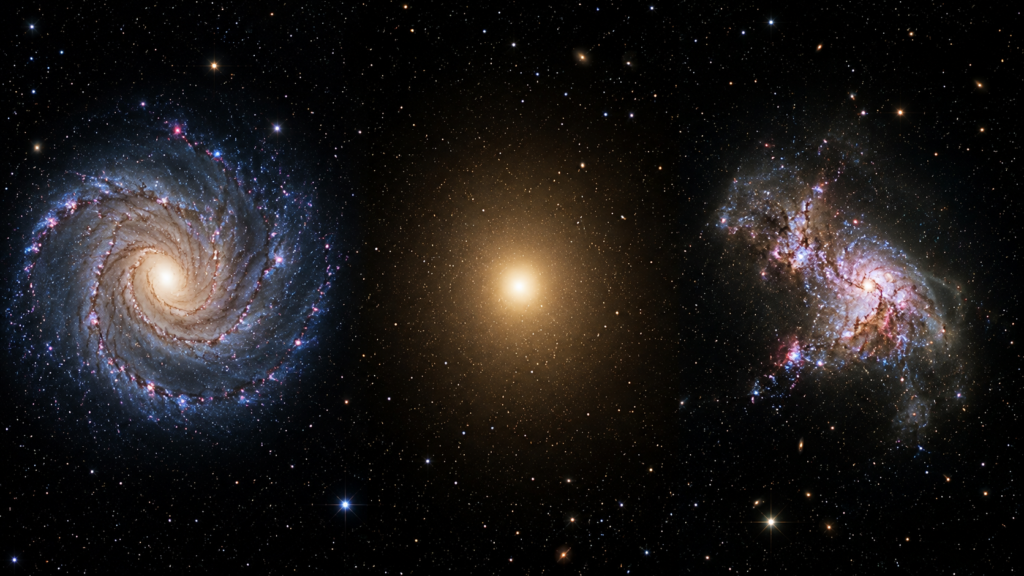
Astronomers classify galaxies according to their shapes.
Spiral Galaxies
Spiral galaxies have:
- Rotating disks
- Curved spiral arms
- Active star formation
Examples include:
- Milky Way
- Andromeda
These are among the most visually striking galaxies in the universe.
Elliptical Galaxies
Elliptical galaxies appear:
- Rounded
- Oval-shaped
- Smooth
- Largely lacking spiral arms
They contain mostly older stars and have relatively little gas available for forming new stars.
Some of the largest galaxies known are giant ellipticals.
Irregular Galaxies
Irregular galaxies have no obvious structure.
Many have been distorted through gravitational interactions or collisions with neighboring galaxies.
They often contain vigorous regions of star formation.
How Stars Produce Light
Every star shines because of nuclear fusion occurring deep within its core.
Fusion combines hydrogen atoms into helium.
This process releases enormous amounts of energy.
That energy travels outward through the star before being emitted as:
- Visible light
- Infrared radiation
- Ultraviolet radiation
- X-rays
- Other forms of electromagnetic radiation
Our Sun converts approximately 600 million tons of hydrogen into helium every second.
Despite this enormous consumption, it contains enough hydrogen to continue shining for roughly another 5 billion years.
The Life Cycle of Stars
Like living organisms, stars experience life cycles.
Their evolution depends largely on their mass.
Birth
Stars begin as cold clouds of gas called nebulae.
Gravity compresses these clouds until fusion begins.
Main Sequence
Most stars spend the majority of their lives converting hydrogen into helium.
Our Sun is currently in this stable phase.
Giant Stage
Eventually hydrogen in the core becomes depleted.
The star expands dramatically.
Depending on its mass, it may become:
- Red Giant
- Red Supergiant
Death
The final stage depends on the star’s size.
Smaller stars become:
- White dwarfs
Larger stars explode as:
- Supernovae
Their remnants may become:
- Neutron stars
- Black holes
The heavy elements produced during stellar deaths eventually become part of future generations of stars and planets.
Every atom of oxygen you breathe, every calcium atom in your bones, and every iron atom in your blood was forged inside ancient stars.
The Formation of Planetary Systems
Stars often form together with surrounding disks of gas and dust.
These rotating disks eventually produce planets.
The process generally follows several stages:
- Dust particles collide.
- They stick together.
- Larger rocks form.
- Gravity pulls these objects together.
- Planet-sized bodies gradually emerge.
This process explains why planets orbit their stars in roughly the same plane.
Our own Solar System formed approximately 4.6 billion years ago through this mechanism.
Scientists have now discovered thousands of exoplanets—planets orbiting stars beyond our Solar System—showing that planetary systems are common throughout the Milky Way.
The Expanding Universe
For centuries, many scientists believed the universe was static.
That changed dramatically in the 1920s.
Astronomer Edwin Hubble discovered that distant galaxies are moving away from us.
Even more surprising, the farther away a galaxy is, the faster it appears to recede.
This relationship is now known as Hubble’s Law.
An everyday analogy helps explain this phenomenon.
Imagine dots drawn on the surface of an inflating balloon.
As the balloon expands:
- Every dot moves farther from every other dot.
- No single dot is the center of the expansion.
- The farther apart two dots are, the faster they separate.
The universe behaves similarly.
Galaxies are not simply flying through empty space.
Instead, space itself is expanding, carrying galaxies farther apart over time.
Dark Matter: The Universe’s Invisible Framework
As discussed in Part 1, ordinary matter accounts for only about 5% of the universe.
One of the reasons scientists infer the existence of dark matter is that galaxies rotate too quickly.
If only visible matter were present, galaxies should fly apart.
Instead, an unseen form of matter provides the additional gravity needed to hold them together.
Dark matter also influences:
- Galaxy formation
- Galaxy clusters
- The cosmic web
- Gravitational lensing, where massive objects bend light from distant galaxies
Although scientists have not directly detected dark matter particles, evidence for its gravitational effects is overwhelming.
Dark Energy and Accelerating Expansion
One of the most surprising discoveries in modern astronomy came in 1998.
Astronomers studying distant exploding stars called Type Ia supernovae found that the expansion of the universe is speeding up, not slowing down.
Something appears to be pushing galaxies apart faster and faster.
Scientists call this mysterious phenomenon dark energy.
Dark energy makes up roughly 68% of the universe, yet its true nature remains unknown.
Some theories suggest it is:
- A property of empty space.
- A new type of energy field.
- Evidence that our understanding of gravity is incomplete.
Whatever its origin, dark energy is expected to shape the universe’s future for billions—or even trillions—of years.
Black Holes: The Universe’s Most Mysterious Objects
Few cosmic objects capture the imagination like black holes. Once considered purely theoretical, black holes are now known to exist throughout the universe, from the remnants of massive stars to the gigantic monsters lurking at the centers of galaxies.
A black hole is a region of space where gravity is so intense that nothing—not even light—can escape once it crosses a boundary known as the event horizon.
Contrary to popular belief, black holes are not giant cosmic vacuum cleaners that suck everything around them into oblivion. Objects must come very close before a black hole’s gravity becomes overwhelming. If our Sun were magically replaced with a black hole of the same mass, Earth’s orbit would remain almost unchanged—although our planet would quickly become cold and lifeless without sunlight.
How Black Holes Form
Most stellar black holes form when very massive stars reach the end of their lives.
The process typically follows these stages:
- A massive star exhausts its nuclear fuel.
- Its core collapses under its own gravity.
- The outer layers explode in a spectacular supernova.
- If the remaining core is massive enough, it collapses into a black hole.
Astronomers also know of supermassive black holes, which contain millions or even billions of times the mass of the Sun. Nearly every large galaxy, including the Milky Way, appears to host one at its center.
The Milky Way’s central black hole, known as Sagittarius A*, has a mass of about 4 million Suns.
Can We See a Black Hole?
Because black holes emit no light, they cannot be observed directly.
Instead, scientists detect them by observing their effects on nearby matter:
- Stars orbiting invisible objects
- Hot gas spiraling into black holes
- Powerful X-ray emissions
- Gravitational waves produced by merging black holes
- The shadow of the event horizon, first photographed in 2019
These observations have transformed black holes from mathematical predictions into well-established astronomical objects.
Neutron Stars: Cosmic Cities with the Mass of the Sun
Not every massive star becomes a black hole.
If the collapsing core is slightly less massive, it forms a neutron star instead.
Neutron stars are among the densest known objects in the universe.
A typical neutron star:
- Measures only about 20 kilometers (12 miles) across.
- Contains more mass than the Sun.
- Has gravity billions of times stronger than Earth’s.
Just one teaspoon of neutron star material would weigh billions of tons on Earth.
Some neutron stars rotate hundreds of times every second, emitting beams of radio waves like cosmic lighthouses. These rapidly spinning objects are known as pulsars.
Others possess incredibly strong magnetic fields and are called magnetars, capable of producing the most powerful magnetic fields ever observed.
Quasars: The Brightest Beacons in the Universe
Some galaxies contain extraordinarily active central black holes.
As gas and dust fall toward these black holes, friction heats the material to incredible temperatures.
The result is a quasar—one of the brightest objects in the universe.
A single quasar can outshine an entire galaxy containing hundreds of billions of stars.
Because many quasars are extremely distant, astronomers use them to study the early universe, observing light that has traveled for more than 12 billion years before reaching Earth.
Nebulae: Stellar Nurseries and Cosmic Graveyards
Nebulae are enormous clouds of gas and dust drifting through space.
Far from being empty, they play a crucial role in the life cycle of stars.
Star-Forming Nebulae
Some nebulae collapse under gravity to create entirely new generations of stars.
Examples include:
- The Orion Nebula
- The Eagle Nebula
- The Carina Nebula
These regions are often called stellar nurseries.
Planetary Nebulae
Despite their name, planetary nebulae have nothing to do with planets.
They form when Sun-like stars shed their outer layers near the end of their lives, creating beautiful glowing shells of gas.
Supernova Remnants
When massive stars explode, they leave behind expanding clouds of gas enriched with heavy elements.
These remnants help seed future generations of stars and planets.
Gravity: The Architect of the Universe
Gravity is the force that shapes nearly every large-scale structure in the universe.
It governs:
- Planetary orbits
- Star formation
- Galaxy formation
- Galaxy clusters
- Black holes
- The cosmic web
Albert Einstein’s General Theory of Relativity revolutionized our understanding of gravity by describing it as the curvature of space-time rather than simply a force acting at a distance.
This theory has passed every major observational test, from the bending of starlight during solar eclipses to the detection of gravitational waves in recent years.
The Search for Life Beyond Earth
One of humanity’s oldest questions remains unanswered:
Are we alone in the universe?
Given the enormous number of stars and planets, many scientists believe it is statistically unlikely that Earth hosts the only life in the cosmos.
Exoplanets
Since the 1990s, astronomers have discovered more than 5,000 confirmed exoplanets, with many more awaiting confirmation.
These planets vary dramatically:
- Rocky worlds
- Gas giants
- Ocean planets
- Lava worlds
- Ice giants
- Potentially Earth-like planets
Some orbit within their stars’ habitable zones, where temperatures may allow liquid water to exist.
What Makes a Planet Habitable?
Although life elsewhere may differ greatly from life on Earth, scientists generally look for conditions that include:
- Liquid water
- Stable temperatures
- A suitable atmosphere
- Energy sources
- Essential chemical elements
Future telescopes may soon analyze the atmospheres of distant planets for gases that could indicate biological activity.
The Fermi Paradox
Despite the vast number of stars, we have found no confirmed evidence of extraterrestrial civilizations.
This puzzle is known as the Fermi Paradox.
Possible explanations include:
- Intelligent life is extremely rare.
- Civilizations destroy themselves before spreading through space.
- Advanced civilizations deliberately avoid contact.
- We simply have not searched long enough.
The search continues through projects studying radio signals, planetary atmospheres, and future interstellar missions.
The Future of the Universe
The universe has been expanding for billions of years.
But what will happen over unimaginably long timescales?
Scientists have proposed several possibilities.
Heat Death
The leading theory suggests the universe will continue expanding forever.
Over trillions upon trillions of years:
- Stars gradually burn out.
- Galaxies become isolated.
- Black holes slowly evaporate.
- The universe approaches maximum entropy.
Eventually, the cosmos may become cold, dark, and nearly empty.
Big Crunch
If gravity were strong enough to overcome expansion, the universe could eventually reverse course and collapse back into an extremely dense state.
Current observations suggest this outcome is unlikely.
Big Rip
If dark energy continues strengthening over time, expansion could accelerate until:
- Galaxies separate.
- Solar systems break apart.
- Planets drift away.
- Atoms themselves are torn apart.
This dramatic scenario remains speculative.
Vacuum Decay
Some physicists have proposed an even stranger possibility.
If our universe exists in a temporary state, a quantum event could trigger a transition to a lower-energy state.
Such an event would fundamentally alter the laws of physics throughout the universe.
Fortunately, there is currently no evidence that this process is imminent.
How We Study the Universe
Modern astronomy combines observations from Earth and space using increasingly sophisticated technology.
Ground-Based Telescopes
Large observatories located on mountains and in deserts minimize atmospheric interference.
They study:
- Visible light
- Radio waves
- Infrared radiation
Some of the world’s largest telescopes feature mirrors more than 30 meters across.
Space Telescopes
Placing telescopes above Earth’s atmosphere provides clearer observations.
Among the most influential are:
- Hubble Space Telescope, which transformed our understanding of galaxies, nebulae, and the age of the universe.
- James Webb Space Telescope, capable of observing some of the earliest galaxies formed after the Big Bang and studying the atmospheres of distant exoplanets.
These observatories have opened entirely new windows into the cosmos.
Space Probes
Robotic spacecraft have revolutionized planetary science.
Notable missions include:
- Voyager 1 and Voyager 2
- Cassini
- New Horizons
- Juno
- Parker Solar Probe
These missions continue to provide valuable data about planets, moons, asteroids, comets, and the Sun.
Gravitational Wave Observatories
In 2015, scientists made history by directly detecting gravitational waves—tiny ripples in space-time caused by violent cosmic events such as merging black holes.
This achievement confirmed another major prediction of Einstein’s General Theory of Relativity and opened an entirely new branch of astronomy.
Today, astronomers can study the universe not only through light but also through these subtle distortions of space-time.
The Biggest Unanswered Questions
Although astronomy has advanced tremendously, many fundamental mysteries remain.
Scientists continue searching for answers to questions such as:
- What caused the Big Bang?
- What is dark matter?
- What is dark energy?
- What lies beyond the observable universe?
- Is space infinite?
- Are there multiple universes?
- How common is intelligent life?
- What happens inside a black hole?
- Can gravity be unified with quantum mechanics?
Each discovery often leads to new questions, reminding us that science is an ongoing journey rather than a finished story.
Key Takeaways
- The universe is approximately 13.8 billion years old.
- The observable universe spans about 93 billion light-years in diameter.
- Ordinary matter makes up only about 5% of the universe.
- Dark matter accounts for roughly 27%, while dark energy makes up about 68%.
- Galaxies are organized into clusters, superclusters, and the vast cosmic web.
- Stars create the heavy elements necessary for planets and life.
- Black holes, neutron stars, and quasars are among the most extreme objects in existence.
- Thousands of exoplanets have been discovered, increasing the possibility that habitable worlds are common.
- The universe continues expanding, and its ultimate fate remains uncertain.
- Modern telescopes, spacecraft, and gravitational-wave detectors continue to transform our understanding of the cosmos.
Frequently Asked Questions
What is the universe?
The universe includes everything that exists: space, time, matter, energy, galaxies, stars, planets, and the physical laws governing them.
How old is the universe?
Current scientific evidence indicates that the universe is approximately 13.8 billion years old.
How large is the universe?
The observable universe is estimated to be about 93 billion light-years across. The total universe may be much larger and could even be infinite.
What is the universe mostly made of?
About 95% of the universe consists of dark matter and dark energy, both of which remain poorly understood.
Are black holes dangerous to Earth?
No. The nearest known black holes are far from Earth, and there is no evidence that they pose any threat to our Solar System.
Are we alone in the universe?
Scientists have not found confirmed evidence of extraterrestrial life. However, the discovery of thousands of exoplanets suggests that potentially habitable worlds may be common.
Conclusion
The universe is the grandest natural system humanity has ever explored. From the birth of space and time in the Big Bang to the formation of galaxies, stars, planets, and the elements that make up our own bodies, every discovery reveals a cosmos of extraordinary scale and complexity. Yet the more we learn, the more we realize how much remains unknown. Dark matter, dark energy, black holes, and the possibility of life beyond Earth continue to challenge our understanding and inspire new generations of scientists.
Advances in technology—from powerful space telescopes to gravitational-wave observatories—are allowing us to look farther into space and further back in time than ever before. Each mission, observation, and breakthrough brings us closer to answering some of humanity’s oldest questions while uncovering new mysteries that await exploration.
Whether you are a student, an enthusiast, or simply curious about the night sky, the universe offers an endless source of wonder. As our knowledge grows, one thing becomes increasingly clear: our small planet is part of an unimaginably vast and interconnected cosmos, and the journey to understand it has only just begun.
Further Reading & Resources
Continue your learning journey with more expert guides and insightful articles from CurioReader. Explore related topics below to deepen your understanding and discover new perspectives.
Related CurioReader Articles
Recommended External Resources