Introduction
Prince Vijaya and the Origins of the Sinhalese Kingdom. Long before the name Prince Vijaya appeared in Sri Lanka’s ancient chronicles, the island already had a long human history.
Sri Lanka’s story did not begin with the arrival of a prince from northern India. Archaeological discoveries show that humans had lived on the island for tens of thousands of years, adapting to its forests, grasslands, rivers, mountains, and coastal environments. Over time, these communities developed increasingly complex ways of living, hunting, farming, trading, and interacting with the wider South Asian world.
Understanding this earlier history is essential when examining the traditional story of Vijaya. The account preserved in later Sri Lankan chronicles presents Vijaya’s arrival as a major turning point in the island’s political and cultural history. However, archaeology provides a much broader picture. It shows that Sri Lanka already contained established human communities and developing societies long before the period traditionally associated with Vijaya.
The story of Prince Vijaya therefore belongs to a much larger historical landscape.
The First Humans in Sri Lanka
Sri Lanka has one of the longest records of human habitation in South Asia. Archaeological evidence from caves and other prehistoric sites indicates that modern humans were living on the island at least tens of thousands of years ago.
Among the most important discoveries have been made in the island’s interior caves, particularly Fa-Hien Lena in the Western Province. Archaeological research at the site has produced evidence of human occupation dating back roughly 48,000 years. Other prehistoric sites have revealed stone tools, animal remains, beads, and other objects that provide clues about the lives of early inhabitants.
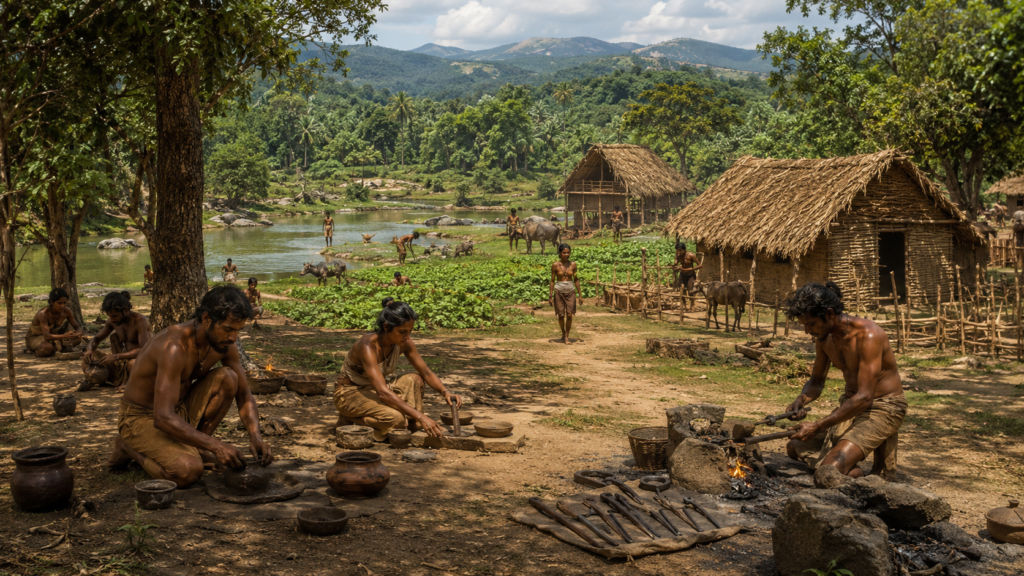
These communities are often associated with what archaeologists call the Balangoda culture, named after the region where important discoveries were made. They were hunter-gatherers who exploited the resources of Sri Lanka’s forests and surrounding environments.
Their lives were very different from those of the kings and kingdoms that would emerge much later. There were no large cities, monumental stupas, or centralized states. Instead, people lived in smaller communities and relied heavily on hunting, gathering, fishing, and the seasonal availability of natural resources.
Yet these early inhabitants were highly adaptable.
They learned to exploit different ecological zones, from tropical forests to coastal environments, and developed technologies suited to their surroundings. Their survival over many thousands of years demonstrates that Sri Lanka was not an isolated or empty island waiting for civilization to arrive. Human societies had already been developing there for an immense period of time.
From Prehistory to Early Settlements
Over thousands of years, life on the island gradually changed.
Human communities became increasingly settled, and new technologies and economic practices appeared. The transition toward agriculture and more permanent settlements was not a single event that happened at one particular moment. Instead, it was a long process influenced by environmental changes, technological development, population movements, and connections with neighboring regions.
By the first millennium BCE, archaeological evidence indicates that Sri Lanka had societies considerably more complex than the small hunter-gatherer communities of earlier periods.
Iron technology became increasingly important. Agriculture expanded, domesticated animals were used, and settlements became more established. Burial practices also provide evidence of social organization and cultural traditions.
One particularly important development was the emergence of megalithic burial traditions. Archaeological sites containing burial chambers, pottery, iron objects, beads, and other artifacts demonstrate connections between Sri Lanka and broader cultural developments in South India.
These connections are important because Sri Lanka has never developed entirely separately from the Indian subcontinent. The narrow maritime distance between the island and southern India made movement between the two regions possible for thousands of years.
People, technologies, languages, religious ideas, goods, and cultural practices could cross the sea in both directions.
Sri Lanka and the Indian Ocean
Sri Lanka’s geography has played a major role in its history.
Located just south of the Indian subcontinent, the island occupies a strategic position in the Indian Ocean. Its location eventually made it an important meeting point between South Asia and the wider maritime world.
But these connections began long before the great trading ports of later centuries.
The waters between Sri Lanka and southern India were not an absolute barrier. Small-scale maritime movement would have been possible for ancient communities, allowing people to travel between coastal regions and the island.
Archaeological discoveries suggest that early Sri Lankan societies participated in cultural networks extending beyond individual settlements. Similarities in pottery traditions, burial practices, metalworking, and other archaeological evidence point to interaction with communities elsewhere in South Asia.
This does not mean that Sri Lanka was simply an extension of another civilization. The island developed its own distinctive cultural traditions while remaining connected to neighboring regions.
That combination—local development alongside external connections—would become one of the defining characteristics of Sri Lankan history.
The Emergence of Early Political Communities
By the early centuries of the first millennium BCE, Sri Lanka was entering a period in which more organized settlements and political communities were developing.
Later chronicles describe a number of groups and rulers associated with the island’s early history. However, the historical reliability of individual figures and events varies considerably.
This is where the distinction between chronicle tradition and archaeological evidence becomes important.
The principal written sources for early Sri Lankan history were compiled centuries after many of the events they describe. The most famous is the Mahavamsa, a Pali chronicle traditionally attributed to the monk Mahanama and generally dated to around the fifth or sixth century CE.
The Mahavamsa presents a continuous historical and religious narrative stretching back to the earliest rulers of the island. It became enormously influential in preserving Sri Lanka’s historical traditions.
But it was not written as a modern history book.
The chronicle combined historical traditions, religious narratives, genealogy, political memory, and Buddhist perspectives. Consequently, historians compare its accounts with archaeology, inscriptions, linguistics, and other evidence rather than accepting every episode literally.
This distinction becomes particularly important when we reach the story of Prince Vijaya.
A Society Before Vijaya
When the traditional Vijaya story begins, Sri Lanka was therefore not an uninhabited wilderness.
The island had already experienced thousands of years of human settlement. Communities had developed their own technologies, economic practices, cultural traditions, and connections with neighboring regions.
The exact political structure of these early communities remains difficult to reconstruct. Archaeology cannot always tell us the names of individual rulers or precisely identify the languages spoken by particular groups. Nor can it confirm every detail contained in later chronicles.
Nevertheless, the evidence shows that the island was undergoing significant social and technological development during the first millennium BCE.
This provides an important context for understanding Vijaya.
The traditional narrative does not necessarily represent the moment when civilization first arrived in Sri Lanka. Instead, it represents a later cultural tradition about the origins of a ruling lineage and the beginnings of a political order that would eventually lead toward the great kingdoms of ancient Sri Lanka.
Why the Vijaya Story Became Important
The story of Prince Vijaya became particularly important because later Sri Lankan chroniclers used it to explain the origins of the island’s ruling traditions and the ancestry of the Sinhala people.
According to the Mahavamsa, Vijaya was descended from a royal lineage in northern India and arrived in Sri Lanka with a group of followers. His arrival is traditionally placed in the same broad period as the lifetime of the Buddha.
The story then introduces figures such as Kuveni, describes encounters with the island’s inhabitants, and eventually connects Vijaya’s rule with the establishment of a new political order.
Whether Vijaya himself can be identified as a historically verifiable individual remains debated. There is no contemporary inscription from the period that independently confirms the complete narrative presented in the Mahavamsa.
What can be studied, however, is the historical context surrounding the tradition.
Sri Lanka was already developing complex communities. South Asian connections were well established. New technologies and settlement patterns were emerging. Political organization was becoming increasingly important.
Against this background, traditions about migration, kingship, ancestry, and the foundation of kingdoms could develop and later be preserved by chroniclers.
The Vijaya story should therefore be approached neither as something that can simply be dismissed as a myth nor as a completely verified historical account.
It is better understood as an important historical tradition whose claims must be examined alongside independent evidence.
That distinction will remain important throughout this article.
The Setting for a New Era
By the time we approach the period traditionally associated with Vijaya, Sri Lanka was already on the threshold of major political and cultural developments.
Permanent settlements were becoming more important. Agriculture was expanding. Iron technology was established. Communities were interacting with neighboring parts of South Asia. And the foundations of larger political centers were beginning to emerge.
The centuries that followed would witness the development of increasingly organized kingdoms and, eventually, the rise of Anuradhapura, one of the most important ancient capitals in South Asia.
But before exploring that transformation, we first need to examine the story that later generations placed at its beginning.
Who was Prince Vijaya?
Why did the Mahavamsa give his arrival such importance?
And what does the traditional account actually tell us about the origins of Sri Lanka’s early kingdom?
To answer those questions, we now turn to the Vijaya tradition itself.
Who Was Prince Vijaya?
The story of Prince Vijaya occupies a special place in Sri Lanka’s traditional historical narrative. According to the Mahavamsa, Vijaya was a prince from northern India whose arrival in Sri Lanka marked the beginning of an important royal lineage.
The account is preserved most prominently in the Mahavamsa, a Pali chronicle compiled centuries after the period in which Vijaya is traditionally said to have lived. The chronicle presents his story as part of a much larger narrative connecting the island’s rulers with Buddhism and the historical development of Sri Lanka.
According to the traditional chronology, Vijaya arrived in Sri Lanka around 543 BCE, a date associated with the traditional dating of the Buddha’s death. Modern historians, however, generally treat this date cautiously because the chronology of early Sri Lankan history is not independently established with precision.
The story begins not in Sri Lanka, but in a kingdom in northern India.
The Legend of the Lion Prince
The Mahavamsa traces Vijaya’s ancestry through a remarkable genealogy.
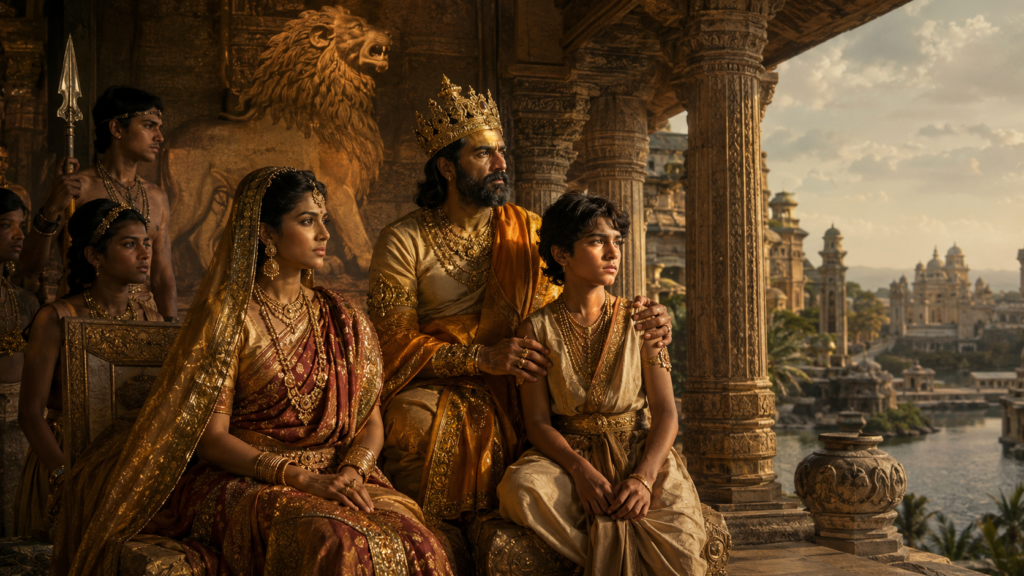
According to the chronicle, Vijaya was the son of Sinhabahu and Suppadevi. Sinhabahu himself was said to be the son of a princess and a lion.
The story tells of a princess who was abducted by a lion and taken to his cave. She later had two children, Sinhabahu and his sister Sinhasiivali. When Sinhabahu grew older, he escaped from the cave with his mother and sister.
Eventually, he returned and killed the lion who had been his father.
Sinhabahu then established a kingdom called Sinhapura and became its ruler.
Vijaya was born into this royal family.
This part of the narrative is clearly legendary in character. The lion ancestry is especially significant because later traditions connected it with the origin of the name Sinhala and with the symbolic identity of the Sinhala people.
The story is therefore more than a simple genealogy. It functions as an origin narrative explaining how a royal lineage was believed to have begun.
Vijaya’s Behaviour as a Young Prince
According to the Mahavamsa, Vijaya did not initially behave like an ideal prince.
The chronicle describes him as the leader of a group of young men who caused trouble in the kingdom. Their behavior became so disruptive that the people complained to Vijaya’s father, King Sinhabahu.
The king eventually decided that his son and his followers should be expelled.
Vijaya was therefore stripped of his position and sent away from the kingdom together with a large group of companions.
The traditional account says that approximately 700 followers accompanied him.
This number should not necessarily be interpreted as an exact historical population figure. Ancient chronicles frequently use rounded or symbolic numbers, and there is no contemporary evidence that independently confirms the size of Vijaya’s group.
Nevertheless, the narrative establishes an important theme: Vijaya’s journey to Sri Lanka was presented as a migration of a group, rather than the arrival of a single individual.
The Journey Across the Sea
Vijaya and his followers were placed aboard ships and sent away from their homeland.
Their destination eventually became Sri Lanka.
The journey is significant because it reflects something that was entirely possible within the geography of the ancient Indian Ocean. Sri Lanka was separated from the Indian subcontinent by relatively short stretches of sea, and maritime movement between the two regions occurred long before the period of European exploration.
However, the specific voyage described in the Mahavamsa cannot be independently reconstructed.
We do not have contemporary records identifying Vijaya’s ships, route, departure point, or landing location.
What the story does provide is a traditional explanation for how a group associated with an Indian royal lineage reached the island.
The sea journey therefore serves as a bridge between two parts of the narrative: Vijaya’s life in northern India and the beginning of his political story in Sri Lanka.
The Arrival at Tambapanni
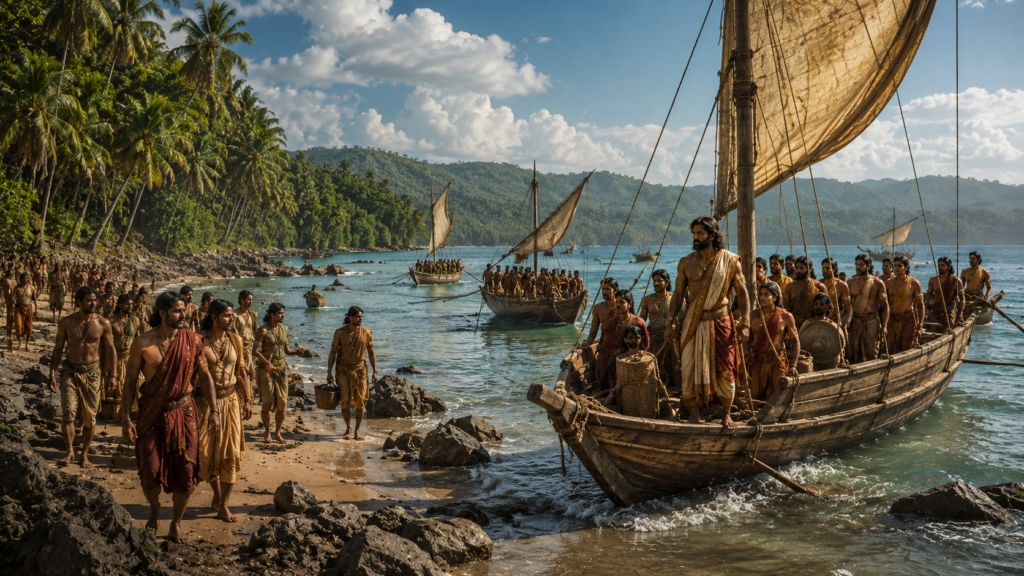
According to the Mahavamsa, Vijaya and his followers eventually reached the coast of Sri Lanka.
The place where they landed was called Tambapanni.
The chronicle explains that when Vijaya and his companions touched the ground, their hands became reddish or copper-coloured from the soil. This was said to be the origin of the name Tambapanni, commonly interpreted as referring to copper-coloured or reddish hands.
The name became associated with the region in northwestern Sri Lanka.
Later historical sources also preserve the name in different forms, and ancient geographical traditions used related terminology when referring to Sri Lanka.
The landing at Tambapanni is one of the central moments of the Vijaya story.
From the perspective of the Mahavamsa, it marks the beginning of Vijaya’s presence on the island.
From a modern historical perspective, however, the precise location and circumstances of a sixth-century BCE landing cannot be established solely from the chronicle.
The Island Vijaya Encountered
The Sri Lanka described in the Vijaya story was not portrayed as empty.
The Mahavamsa mentions groups already living on the island, most notably the Yakshas and Nagas in its broader account of early Sri Lankan history.
These groups occupy an important place in traditional literature, but their exact historical identity is difficult to determine.
The term “Yaksha,” for example, has religious and literary meanings in South Asian traditions and appears in various contexts beyond Sri Lankan history. It should therefore not automatically be treated as the name of a clearly identifiable ethnic group in the modern sense.
Similarly, references to the Nagas may reflect historical communities, cultural traditions, religious concepts, or a combination of these.
Archaeology provides evidence of communities living in Sri Lanka during this period, but it cannot simply assign every archaeological population to one of the groups named in later chronicles.
This is another example of why the Vijaya narrative must be read alongside independent evidence.
Vijaya and the Local Inhabitants
The most dramatic part of the traditional story begins when Vijaya encounters the inhabitants already living on the island.
The Mahavamsa introduces Kuveni, a woman associated with the Yakshas.
According to the chronicle, Kuveni encountered Vijaya and his followers and became deeply involved in the events that followed.
Her role is unusual and important because she is not simply a minor character in the narrative. She becomes a central figure in Vijaya’s establishment of power in Sri Lanka.
The story presents Kuveni as someone who possessed knowledge of the local environment and political circumstances.
Through her, Vijaya gained access to information about the island and its inhabitants.
The narrative subsequently becomes a story of alliance, betrayal, political ambition, and the establishment of a new ruling order.
This will become particularly important in the next part of the series.
Vijaya’s Search for a Kingdom
Vijaya’s objective was not simply to survive on the island.
According to the chronicle, he sought to establish himself as ruler.
This reflects one of the central themes of the traditional narrative: the transformation of an exiled prince into the founder of a new royal lineage.
The story therefore fits a familiar pattern found in many ancient origin traditions. A displaced leader arrives in a new land, encounters an existing population, forms alliances, defeats or absorbs rivals, and eventually establishes a political center.
Whether the events occurred exactly as described cannot be established with the available evidence.
But the story’s structure reveals how later Sri Lankan society understood its own political origins.
The Mahavamsa was not merely recording names and dates. It was constructing a narrative explaining how kingship, ancestry, territory, and Buddhist civilization became connected.
The Traditional Date of 543 BCE
The year 543 BCE is frequently given as the traditional date for Vijaya’s arrival in Sri Lanka.
It is an important date in traditional Sri Lankan chronology, but modern readers should understand its limitations.
The Mahavamsa was compiled centuries after the events it describes. Its chronology was constructed through a sequence of reigns, religious events, and historical traditions.
Modern scholarship uses archaeological evidence, inscriptions, comparative chronology, and other sources to evaluate early dates.
As a result, the traditional date should not be presented as an independently verified historical fact.
A more accurate formulation is:
According to traditional Sri Lankan chronology, Prince Vijaya arrived in Sri Lanka around 543 BCE.
This wording preserves the historical tradition while making clear that the date belongs to the traditional chronology.
That distinction is particularly important when writing about ancient history, where later literary traditions can preserve genuine memories while also containing legendary or symbolic elements.
The Importance of the Vijaya Migration Story
Regardless of how literally individual events should be understood, the Vijaya narrative became enormously influential.
It provided later generations with an explanation for the origins of the Sinhala royal tradition and connected Sri Lanka’s early rulers to a wider South Asian world.
The story also established several themes that would recur throughout Sri Lankan history:
- Migration across the sea
- Connections with the Indian subcontinent
- The establishment of kingship
- Interaction between different communities
- Political alliances and conflict
- The importance of ancestry and legitimacy
These themes make the Vijaya story more significant than a simple tale about one prince.
It became part of the historical memory through which Sri Lanka understood its early political development.
History, Tradition, and Evidence
At this point, it is useful to establish a principle that will guide the rest of this article.
There are three different things that should not be confused:
- The traditional narrative preserved in chronicles such as the Mahavamsa.
- Archaeological and inscriptional evidence from ancient Sri Lanka.
- Modern historical interpretations that compare the available evidence.
The first tells us what later Sri Lankan chroniclers believed or wanted to preserve.
The second provides physical evidence from the past.
The third attempts to determine what can reasonably be concluded when the different forms of evidence are considered together.
There is no surviving contemporary inscription that independently confirms the entire story of Prince Vijaya, his genealogy, his voyage, or his conquest of Sri Lanka.
At the same time, this does not mean that every element of the story must be dismissed as meaningless fiction. Ancient traditions can preserve memories of migration, political change, cultural contact, and early state formation even when the details have been shaped by centuries of storytelling.
The challenge for historians is to separate what can be independently supported from what belongs primarily to tradition.
Toward the Story of Kuveni
The arrival of Vijaya is only the beginning of the traditional account.
The next stage introduces one of the most fascinating figures in Sri Lankan history: Kuveni.
Her relationship with Vijaya becomes central to the story of how the newcomers established themselves on the island.
The narrative also raises difficult questions about how later chroniclers understood the people who lived in Sri Lanka before the emergence of the island’s major kingdoms.
Who were the Yakshas described in the chronicles?
Was Kuveni a historical individual?
What does the story reveal about relations between newcomers and established communities?
And how did Vijaya ultimately establish his authority?
To explore these questions, we must turn to the next chapter of the story: Vijaya, Kuveni, and the people he encountered in Sri Lanka.
Vijaya, Kuveni, and the People of Early Sri Lanka
The arrival of Prince Vijaya in Sri Lanka, as described in the Mahavamsa, begins a dramatic chapter involving local communities, political alliances, marriage, betrayal, and the establishment of royal authority.
At the center of this story is Kuveni, a woman identified in the chronicle with the Yakshas. Her role is crucial to the traditional account because she helps Vijaya and his followers establish themselves on the island.
Yet Kuveni’s story also raises important historical questions. Who were the people described as Yakshas? Was Kuveni a historical individual? And does the story preserve memories of encounters between migrating groups and communities already living in Sri Lanka?
The evidence cannot provide definitive answers to all of these questions. However, examining the traditional account alongside archaeology and later historical interpretation allows us to understand both the story itself and why it became so important.
The Yakshas in the Traditional Account
The Mahavamsa describes the island as being inhabited by groups known as Yakshas and Nagas.
These names appear frequently in ancient South Asian literature and cannot automatically be interpreted as straightforward ethnic labels in the modern sense.
Yakshas, in particular, appear in Indian and Buddhist traditions as supernatural or semi-divine beings associated with nature, particular places, and local communities. In some historical narratives, however, the term may also have been used when describing human groups or communities whose identity was understood through the religious and cultural concepts of the time.
This makes the historical interpretation complicated.
The Mahavamsa was written centuries after the period traditionally associated with Vijaya. Its authors were working within a Buddhist literary tradition and were not using modern archaeological or anthropological categories.
Consequently, historians cannot simply say that the Yakshas were a clearly defined ethnic group with a known modern descendant population.
What can be said with greater confidence is that Sri Lanka already had established communities before the emergence of the large historical kingdoms. Archaeological evidence demonstrates settlement, agriculture, metallurgy, burial traditions, and regional connections during the first millennium BCE.
The literary references to Yakshas and Nagas may therefore preserve aspects of how later generations remembered those early communities, even though their exact historical identities remain uncertain.
The Encounter with Kuveni
According to the Mahavamsa, Vijaya and his followers encountered Kuveni soon after arriving in Sri Lanka.
She is portrayed as a woman associated with the Yakshas and becomes one of the most important characters in the entire Vijaya narrative.
The chronicle describes her as possessing knowledge of the local environment and the people living on the island.
For Vijaya, this knowledge was extremely valuable.
His group had arrived in an unfamiliar land. They needed food, shelter, information, and a way to establish themselves. Kuveni’s connection to the local population gave Vijaya access to resources and information that his followers did not possess.
The traditional narrative therefore presents her as a bridge between the newcomers and the existing inhabitants.
But the relationship soon becomes much more complicated.
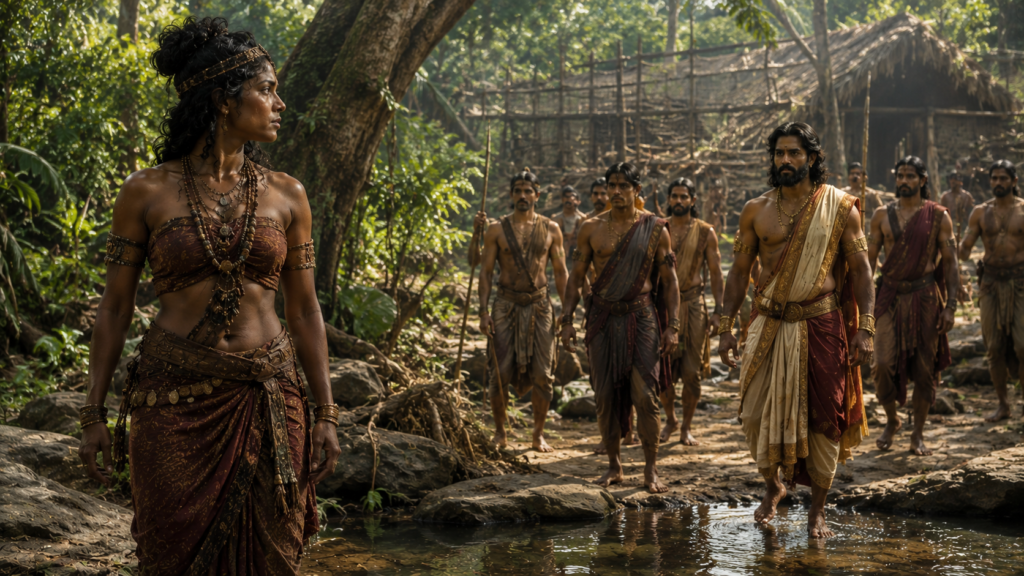
Kuveni and Vijaya
The Mahavamsa describes Kuveni becoming associated with Vijaya and assisting him in overcoming opposition from other Yakshas.
In the traditional story, Vijaya and his followers use the information provided by Kuveni to defeat their rivals and strengthen their position.
Kuveni consequently becomes an important participant in the establishment of Vijaya’s authority.
This part of the story has often been interpreted symbolically as representing the interaction between an incoming political group and an existing population.
However, it is important not to turn that interpretation into an established historical fact.
We do not possess independent contemporary evidence proving that a woman named Kuveni lived during this period or that the events occurred exactly as described.
What we do have is a later narrative that places a local woman at the center of the transition between an existing society and a new ruling lineage.
That feature makes Kuveni particularly interesting from a historical and cultural perspective.
The Political Importance of Kuveni
Kuveni’s role is not simply romantic.
She is presented as someone with political and strategic importance.
She knows the island. She understands the people around her. She helps Vijaya identify and overcome his opponents.
In other words, the traditional story does not portray Vijaya as succeeding entirely through his own power.
His success depends partly on cooperation with someone who already understands the local political environment.
This is significant because it complicates the idea of a simple foreign conquest.
The story describes relationships between newcomers and existing inhabitants, rather than presenting the establishment of Vijaya’s authority as an isolated event.
At the same time, the narrative ultimately gives political legitimacy to Vijaya and his descendants rather than to Kuveni or the community she represents.
This becomes particularly important later in the story.
The Arrival of Vijaya’s Followers
The traditional account describes Vijaya as arriving with approximately 700 followers.
Whether this number is historically accurate is impossible to establish.
Ancient chronicles often use specific numbers that may have symbolic or literary significance, and no independent record confirms the size of Vijaya’s migration.
Nevertheless, the idea of a group migration is historically plausible in a broader sense.
Maritime movement between southern India and Sri Lanka was possible, and archaeological evidence demonstrates interaction between the two regions long before the emergence of later kingdoms.
A movement of people from the Indian subcontinent to Sri Lanka would therefore not have been geographically extraordinary.
What remains uncertain is whether there was a single migration led by an individual called Vijaya that occurred in precisely the manner described by the Mahavamsa.
This distinction allows us to acknowledge the historical plausibility of migration without treating the complete traditional narrative as proven.
Vijaya’s Conflict with the Yakshas
According to the chronicle, Vijaya’s followers eventually confront the Yakshas.
With Kuveni’s assistance, Vijaya is able to defeat those who oppose his authority.
The story presents this as an important step toward establishing his kingdom.
From a traditional perspective, this represents the transfer of political power.
From a modern historical perspective, the episode is more difficult to interpret.
There is no archaeological layer that can be confidently identified as “the defeat of the Yakshas,” nor is there a contemporary inscription describing such a conflict.
Archaeology can reveal settlements, weapons, buildings, burial practices, agricultural systems, and other aspects of ancient life, but it cannot automatically connect those discoveries to specific characters in a later chronicle.
The conflict should therefore be presented as part of the traditional Vijaya narrative rather than as an independently verified military event.
The Story of the Yaksha Stronghold
The Mahavamsa describes Vijaya’s followers confronting the Yakshas and eventually defeating them.
Some of the episodes take place around settlements and strongholds associated with the Yakshas.
These accounts contain dramatic elements that resemble other ancient foundation narratives, in which a new ruler defeats supernatural or semi-historical inhabitants before establishing a legitimate kingdom.
Such stories can serve an important political purpose.
They explain why a particular ruler and his descendants have the right to govern a territory. By presenting the founder as overcoming earlier forces, the narrative establishes a symbolic beginning for a new political order.
This does not necessarily mean that the chroniclers deliberately invented every element.
Historical memories may have been transmitted orally for generations before being incorporated into written chronicles. During that process, events can acquire symbolic, religious, and literary features.
The Vijaya story may therefore contain several layers of memory.
Kuveni and the Birth of Vijaya’s Children
According to the traditional account, Kuveni and Vijaya had children together.
The Mahavamsa identifies them as a son and daughter.
Their children are important because they represent the descendants of the relationship between Vijaya and a local woman associated with the island’s earlier inhabitants.
Yet their fate also reveals one of the most troubling aspects of the story.
Vijaya eventually abandons Kuveni.
The reason is connected with his desire to establish a formal royal marriage and secure his political position.
The story therefore shifts from cooperation to betrayal.
Kuveni, who had helped Vijaya establish himself, ultimately loses her place beside him.
Vijaya’s Marriage to a Pandyan Princess
The Mahavamsa states that Vijaya wanted a royal bride and sent messengers to the Pandyan kingdom in southern India.
A Pandyan princess was eventually sent to Sri Lanka, accompanied by other women and attendants.
Vijaya married her and established a formal royal household.
This part of the narrative is particularly interesting because it reinforces the historical connection between Sri Lanka and southern India.
The Pandyas were a major ancient Tamil dynasty based in southern India. Their territories were geographically close to Sri Lanka, and contacts between the two regions continued throughout antiquity.
The marriage described in the Mahavamsa may therefore reflect a broader tradition of political and cultural connections across the Palk Strait.
However, once again, the specific marriage cannot be independently confirmed from contemporary evidence.
The Abandonment of Kuveni
Kuveni’s fate is one of the most memorable and tragic parts of the traditional story.
After Vijaya’s marriage to the Pandyan princess, Kuveni is rejected.
She leaves the royal settlement and returns toward her own people.
According to the Mahavamsa, she eventually meets a violent death at the hands of the Yakshas.
The story then becomes a powerful contrast between the two women.
The Pandyan princess represents formal royal legitimacy and the establishment of a recognized dynasty.
Kuveni represents the earlier inhabitants of the island and the local alliance that helped Vijaya gain power.
The narrative ultimately favors the royal lineage descended from Vijaya’s political marriage rather than Kuveni’s children.
This has led later writers and historians to interpret Kuveni’s story in many different ways.
Some view it as a symbolic account of the displacement of earlier communities. Others focus on its literary and religious dimensions. Still others caution against projecting modern ideas of ethnicity or colonialism onto an ancient chronicle.
There is no single interpretation that can be treated as proven.
What Does Kuveni Represent?
Kuveni is one of the most debated figures in traditional Sri Lankan history because she occupies a position between history, legend, and cultural memory.
From a literary perspective, she is a tragic figure whose loyalty is ultimately betrayed.
From a political perspective, she helps establish a new royal order but is excluded from its final legitimacy.
From a cultural perspective, she can be interpreted as representing the island’s pre-existing communities.
But none of these interpretations can be confirmed as the original intention of the ancient chroniclers.
The safest historical approach is to recognize Kuveni as an important figure within the traditional narrative while clearly acknowledging that independent evidence for her existence has not been found.
Her story nevertheless provides valuable insight into how later generations imagined the encounter between newcomers and established communities.
The Sinhala Origin Tradition
The Vijaya story eventually becomes connected with the traditional explanation for the origin of the Sinhala people.
The Mahavamsa traces Vijaya’s ancestry through Sinhabahu, whose name is associated with the word for lion.
The lion motif became deeply connected with Sinhala identity.
According to the traditional genealogy, Vijaya was therefore not simply a foreign prince who happened to arrive in Sri Lanka. He was presented as the ancestor of a royal line that would become associated with the Sinhala people and the island’s Buddhist civilization.
Modern historians, however, do not treat this genealogy as a simple biological record.
The formation of ethnic and linguistic identities is generally understood as a long historical process involving migration, intermarriage, political organization, language development, and cultural change.
The Sinhala identity that emerged over the centuries cannot be reduced to the actions of one individual.
The Vijaya tradition is better understood as an important origin narrative within that longer process.
Connections Across the Palk Strait
One of the most historically plausible elements of the broader Vijaya story is the continuing connection between Sri Lanka and the Indian subcontinent.
The island’s proximity to southern India meant that movement between the two regions was possible.
Archaeological evidence shows similarities and contacts between communities on both sides of the Palk Strait during ancient periods. Trade, migration, marriage, religious exchange, and political interaction continued throughout Sri Lankan history.
The Pandyan marriage described in the chronicle fits within this wider geographical reality.
However, it would be incorrect to conclude that archaeological similarities prove the Vijaya story itself.
They demonstrate regional interaction, not the existence of a specific prince or a particular migration described centuries later.
This distinction is essential for understanding early Sri Lankan history.
What Archaeology Can Tell Us
Archaeology provides a different perspective from the Mahavamsa.
Excavations have revealed evidence of settlements, pottery, iron production, agriculture, burial practices, and long-distance exchange during the first millennium BCE.
These discoveries demonstrate that Sri Lanka was experiencing significant social and technological development during the period traditionally associated with Vijaya.
They also show that the island had connections with neighboring regions.
But archaeology does not currently provide a simple inscription saying that “Vijaya arrived here” or identifying Kuveni and the Yakshas by name.
This is not unusual.
Most ancient societies left incomplete archaeological records, and many individuals known from later texts have no surviving contemporary inscription.
Historical reconstruction therefore requires comparing different forms of evidence rather than expecting one discovery to prove or disprove an entire narrative.
Tradition Versus Historical Certainty
The story of Vijaya and Kuveni illustrates a broader problem in ancient history.
A tradition can be culturally important without every detail being historically verifiable.
The Mahavamsa preserves a narrative that later generations considered fundamental to Sri Lanka’s history. It tells a story of migration, local communities, kingship, marriage, conflict, and ancestry.
At the same time, the archaeological record demonstrates that Sri Lanka’s human history began thousands of years before the traditional arrival of Vijaya.
Therefore, the most responsible interpretation is not to choose blindly between “myth” and “fact.”
Instead, we can recognize several layers:
- Archaeology demonstrates long-term human settlement and developing societies.
- Historical linguistics helps investigate changing languages and cultural connections.
- Inscriptions provide evidence for rulers, institutions, religious practices, and social organization from later periods.
- Ancient chronicles preserve traditions about early rulers and events.
- Modern historical research compares all of these sources to determine what can reasonably be established.
The Vijaya story belongs primarily to the fourth category, while parts of its broader historical setting can be examined through the others.
A Turning Point in the Traditional Narrative
Despite the uncertainties surrounding individual details, the Vijaya story marks a major transition in the traditional history of Sri Lanka.
Vijaya has established himself as a ruler.
A connection with the Pandyan kingdom has been created through marriage.
The narrative has explained the origins of a royal lineage.
And the story has begun to connect the island’s political development with wider South Asian networks.
Yet the kingdom described in the Vijaya tradition is still not the great centralized state that would later emerge at Anuradhapura.
The next stage of Sri Lanka’s history involves the development of increasingly organized political institutions, expanding settlements, irrigation, religious establishments, and eventually a powerful capital.
That transformation is associated particularly with Pandukabhaya, a figure who occupies an important position between the traditional founders and the emergence of Anuradhapura as a major center.
Before reaching that period, however, the consequences of Vijaya’s rule must be considered.
How was his authority established?
What happened to the communities already living on the island?
And how did the early political tradition eventually lead toward the kingdom of Anuradhapura?
Those questions take us into the next chapter of Sri Lanka’s ancient history.
From Vijaya to the First Great Kingdoms
The traditional story of Prince Vijaya does not end with his arrival in Sri Lanka. His reign forms the beginning of a much longer narrative about the development of political authority, settlement, and kingship on the island.
According to the Mahavamsa, Vijaya established himself as ruler at Tambapanni but died without a son who could succeed him. The succession that followed eventually led to the rise of Pandukabhaya, whose reign is traditionally associated with the establishment of Anuradhapura as a major political center.
This transition is important because it takes Sri Lankan history from the world of origin traditions into a period for which archaeological and inscriptional evidence becomes increasingly valuable.
It is also a reminder that kingdoms do not appear overnight. The emergence of Anuradhapura was the result of a much longer process of settlement, agricultural development, political consolidation, and cultural change.
The Succession After Vijaya
According to the traditional chronology, Vijaya ruled for many years after establishing himself at Tambapanni.
Because he had no son to inherit the throne, the Mahavamsa describes a succession involving relatives and rulers connected to his original homeland.
The chronicle states that Vijaya’s successor was his brother’s son, Panduvasudeva, who was brought from India and became ruler of Sri Lanka.
This episode continues the pattern of political connections between the island and the Indian subcontinent found throughout the Vijaya narrative.
Panduvasudeva is traditionally said to have married Bhaddakaccana, a princess associated with a royal family from northern India. The chronicle gives considerable attention to her arrival and the people who accompanied her.
Again, the precise historical details cannot be independently verified.
However, the tradition reinforces a broader point: ancient Sri Lanka was connected to South Asia through migration, marriage, and political relationships.
The island’s history cannot be understood in isolation from the wider Indian Ocean and South Asian world.
Pandukabhaya and a New Political Order
The most important figure in the transition toward the Anuradhapura period is Pandukabhaya.
According to the Mahavamsa, Pandukabhaya was the son of Panduvasudeva and Unmada Chitra.
His birth was surrounded by political conflict.
The chronicle describes a prophecy that Pandukabhaya would eventually become king, causing concern among members of his family who feared that he might challenge their power.
The story that follows contains elements of political intrigue, exile, warfare, alliances, and survival.
Pandukabhaya eventually gathered supporters and fought against his rivals.
After years of conflict, he defeated his opponents and became ruler.
Whether the events occurred exactly as described cannot be established from contemporary evidence. Nevertheless, Pandukabhaya occupies an important place in Sri Lanka’s traditional historical chronology because his reign is associated with a major stage in the development of organized political authority.
The Establishment of Anuradhapura
The Mahavamsa traditionally credits Pandukabhaya with establishing Anuradhapura as a major royal center.
Anuradhapura would eventually become the capital of one of the longest-lasting kingdoms in South Asian history.
The city developed into a vast urban and religious complex containing palaces, monasteries, stupas, reservoirs, roads, gardens, and other infrastructure.
Its importance did not emerge entirely during Pandukabhaya’s reign. Archaeological evidence indicates that the area had already been inhabited before it became the center of a powerful kingdom.
This distinction is important.
Rather than imagining Pandukabhaya suddenly creating a city where nothing previously existed, it is more accurate to understand his traditional role as part of a broader process in which an existing settlement developed into an increasingly important political center.
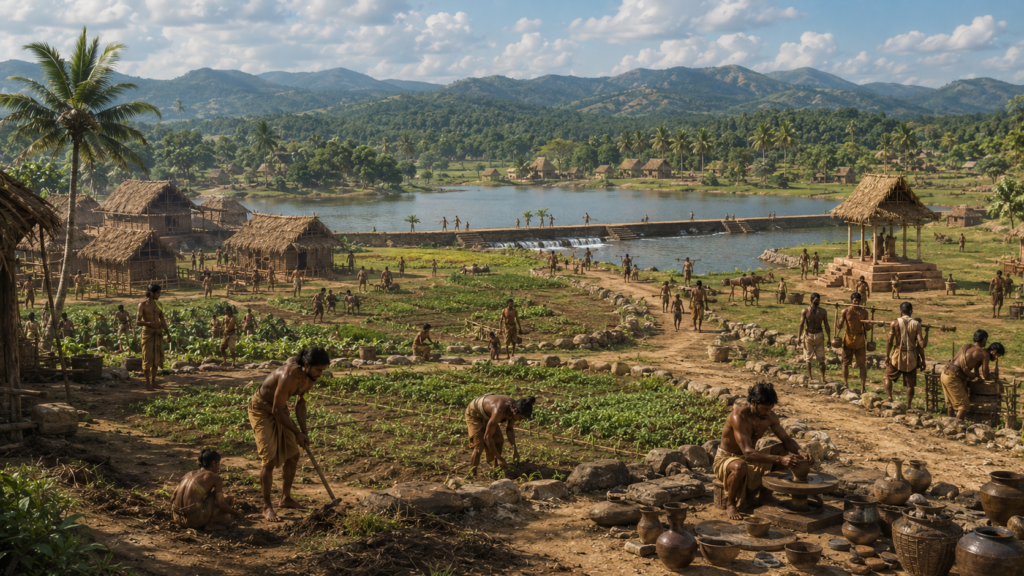
Anuradhapura Before the Great Monuments
The Anuradhapura most visitors recognize today—with enormous stupas, monasteries, ancient reservoirs, and monumental ruins—developed over many centuries.
The earliest settlement was much more modest.
Archaeological excavations have revealed evidence of occupation and increasing urban development at the site during the early first millennium BCE.
The settlement benefited from its location in the dry zone of Sri Lanka.
The surrounding landscape could support agriculture, but water management was essential.
Over time, Sri Lankan communities developed increasingly sophisticated methods for collecting, storing, and distributing water.
These developments would become one of the defining achievements of ancient Sri Lankan civilization.
The Growth of Agriculture
The development of agriculture was fundamental to the rise of larger political communities.
A settled agricultural population could produce food surpluses, support specialized workers, and sustain political and religious institutions.
Sri Lanka’s dry zone presented both opportunities and challenges.
Seasonal rainfall could provide substantial quantities of water, but long dry periods required careful management.
The construction and expansion of reservoirs, channels, and irrigation networks allowed communities to make more reliable use of available water.
The great irrigation systems associated with later Anuradhapura and Polonnaruwa did not appear fully developed from the beginning.
They evolved gradually through generations of experimentation and investment.
This is another reason why the rise of Anuradhapura should be understood as a long historical process rather than the work of a single founder.
Political Consolidation
As settlements expanded and agriculture became more productive, political authority could become increasingly centralized.
A ruler who controlled agricultural land, water infrastructure, labor, and trade could exercise influence over a larger territory.
The traditional narrative presents Pandukabhaya as an important consolidator of this political order.
The Mahavamsa describes him as organizing settlements, appointing officials, establishing facilities, and creating structures of government.
Some of these details may reflect the political institutions of the period in which the chronicle was written rather than a precise description of conditions centuries earlier.
Nevertheless, they provide insight into how later Sri Lankan society imagined the foundations of organized kingship.
The Importance of Water Management
Ancient Sri Lanka’s irrigation achievements deserve particular attention because they became central to the island’s civilization.
The dry zone receives seasonal rainfall rather than evenly distributed rainfall throughout the year.
Communities therefore needed ways to capture water during wet periods and make it available during dry periods.
Small tanks and reservoirs gradually became part of an increasingly interconnected landscape.
Later rulers expanded these systems dramatically.
The result was an agricultural environment capable of supporting large populations and urban centers.
The relationship between water, agriculture, political power, and settlement would remain fundamental throughout the history of the island’s ancient kingdoms.
This achievement also demonstrates why Sri Lanka’s ancient civilization should not be viewed only through its religious monuments.
Its survival depended on sophisticated practical knowledge.
The Arrival of Buddhism
Another major transformation came with the introduction of Buddhism.
According to the traditional chronicles, Buddhism was introduced to Sri Lanka during the reign of King Devanampiya Tissa, traditionally dated to the third century BCE.
The story is closely connected with Emperor Ashoka of the Mauryan Empire and Mahinda Thera, who is traditionally described as Ashoka’s son.
Mahinda is said to have arrived in Sri Lanka and met Devanampiya Tissa at Mihintale.
The king subsequently accepted Buddhism, and the religion gained royal patronage.
This event became one of the defining moments in Sri Lankan historical tradition.
However, as with the Vijaya narrative, the traditional account should be distinguished from what can be independently established.
The Mahavamsa was compiled centuries after the events, while inscriptions and archaeological evidence provide additional information about the spread of Buddhism.
By the later centuries BCE, Buddhist institutions had clearly become deeply established in Sri Lankan society.
Devanampiya Tissa and the Wider Indian Connection
Devanampiya Tissa is traditionally presented as a close ally of Ashoka.
The two rulers are said to have exchanged gifts, and the relationship helped establish links between Sri Lanka and the Mauryan world.
The traditional story of Mahinda’s arrival at Mihintale places Sri Lanka firmly within the wider Buddhist network developing across South Asia during the third century BCE.
The establishment of Buddhist monasteries and sacred sites transformed the cultural landscape.
Religious institutions became important centers of learning, art, agriculture, landholding, and social organization.
The introduction of Buddhism therefore had consequences far beyond religious practice.
It contributed to the development of a distinctive civilization centered on the relationship between kingship, religion, agriculture, and monumental architecture.
Anuradhapura Becomes a Major Center
Over the centuries, Anuradhapura grew into the political and religious heart of ancient Sri Lanka.
Successive rulers expanded the city and constructed increasingly impressive monuments.
Among the most famous later developments were the Ruwanwelisaya, Abhayagiri, and Jetavanaramaya complexes.
The city eventually became one of the great urban centers of the ancient world.
Its monasteries attracted monks and pilgrims, while its reservoirs and irrigation systems supported a large population.
Anuradhapura also became a center of international religious and commercial connections.
Buddhist traditions linked the island with other parts of South and Southeast Asia, while maritime trade connected Sri Lanka with the wider Indian Ocean.
The transformation from an early settlement into a major capital illustrates the enormous changes that occurred during the centuries following the traditional Vijaya narrative.
The Vijaya Tradition and the Rise of the Sinhala Kingdom
The traditional story ultimately connects Vijaya’s arrival with the emergence of the Sinhala royal lineage.
But the development of the Sinhala kingdom was not the result of one event.
It was a long process involving:
- Migration and population movement
- Interaction between different communities
- Development of agriculture
- Expansion of settlements
- Growth of political authority
- Adoption and expansion of Buddhism
- Development of irrigation
- Increasing connections with India and the Indian Ocean
The identity and political institutions that later became associated with the Sinhala kingdom developed over generations.
This is why modern historians are cautious about describing Vijaya as the literal “founder of Sri Lanka.”
He is better understood as a central figure in the traditional origin story of Sri Lankan kingship and Sinhala identity.
What Can We Actually Establish?
At the end of the Vijaya narrative, it is useful to separate several levels of certainty.
Strong archaeological evidence
There is substantial evidence for:
- Very early human habitation
- Established communities before the traditional Vijaya date
- Agriculture and settlement during the first millennium BCE
- Iron technology
- Regional connections with South India
- The development of Anuradhapura as a major settlement
- The expansion of Buddhism during later centuries BCE
- Sophisticated irrigation systems
Traditional historical accounts
The Mahavamsa and related chronicles preserve traditions concerning:
- Vijaya
- Panduvasudeva
- Pandukabhaya
- Devanampiya Tissa
- Mahinda
- Ashoka
- Early royal genealogies
These accounts are historically valuable but must be compared with independent evidence.
Areas of uncertainty
There is no contemporary evidence that independently confirms every detail of:
- Vijaya’s genealogy
- His exact arrival date
- The voyage described in the chronicle
- Kuveni’s historical identity
- The number of Vijaya’s followers
- The complete sequence of early rulers as presented by later chronicles
Recognizing these uncertainties does not diminish Sri Lanka’s history.
Instead, it allows us to understand it more accurately.
From Origin Story to Historical Kingdom
The centuries following the traditional arrival of Vijaya saw the gradual emergence of the political and cultural foundations of ancient Sri Lanka.
By the time Buddhism became firmly established and Anuradhapura emerged as a major center, the island had developed a complex society capable of supporting large-scale agriculture, monumental architecture, religious institutions, and centralized political authority.
The story had moved far beyond the arrival of a single prince.
Sri Lanka was becoming a kingdom.
And in the centuries that followed, that kingdom would produce some of the island’s most famous rulers, monumental achievements, and defining conflicts.
Among them was King Dutugemunu, whose struggle with the South Indian ruler Elara would become one of the most famous episodes in the traditional history of Sri Lanka.
That story leads directly into the rise of the Anuradhapura Kingdom—the subject of the next major chapter in this series.
History, Tradition, and the Legacy of Prince Vijaya
The story of Prince Vijaya occupies an unusual position in Sri Lankan history.
For centuries, it has been treated as the traditional beginning of the island’s recorded royal history and as an important origin story associated with the Sinhala people. Yet the events described in the chronicles took place many centuries before those chronicles were written down.
This creates an important historical challenge.
How much of the Vijaya story can be established as fact? Which parts belong to tradition and legend? And what does the archaeological record tell us about Sri Lanka during the period in which Vijaya is traditionally said to have arrived?
The answers are not simple. But examining the evidence carefully allows us to appreciate the story without confusing traditional history with independently proven fact.
What Is the Mahavamsa?
The most important written source for the Vijaya narrative is the Mahavamsa, a Pali chronicle of Sri Lankan history.
The text was compiled in approximately the fifth or sixth century CE, many centuries after the traditional date of Vijaya’s arrival.
The Mahavamsa was written primarily within a Buddhist monastic tradition. Its purpose was not simply to record political events in the way a modern historian might.
It connected the history of Sri Lanka with the history of Buddhism, the Buddha’s visits to the island according to tradition, the succession of kings, and the development of the Buddhist religious establishment.
The Vijaya narrative therefore needs to be understood within this wider purpose.
The chronicle presents Vijaya as an ancestor of Sri Lanka’s royal lineage and places his arrival within a sacred and political chronology.
Later sections of the Mahavamsa continue this narrative through successive rulers and eventually reach the emergence of the great Anuradhapura civilization.
The Dipavamsa and Earlier Traditions
The Mahavamsa was not the only Buddhist chronicle to preserve early traditions about Sri Lanka.
The Dipavamsa, generally considered older than the Mahavamsa, also contains traditions concerning the island’s early rulers and Buddhist history.
The existence of multiple chronicle traditions is useful because it demonstrates that stories about the island’s early history circulated before the Mahavamsa reached its final form.
However, these texts still do not provide contemporary eyewitness accounts of Vijaya.
They were compiled considerably later than the period they describe.
For historians, this means the chronicles are valuable sources of historical memory, but they must be evaluated critically.
Can We Prove That Prince Vijaya Existed?
There is currently no contemporary inscription that conclusively identifies a ruler named Prince Vijaya and confirms the complete narrative presented in the Mahavamsa.
This is one of the most important points readers should understand.
The absence of such evidence does not prove that Vijaya never existed.
Ancient societies frequently left incomplete records, and many people who genuinely lived in antiquity are known only through later sources.
However, without independent contemporary evidence, historians cannot confidently verify every detail of the traditional account.
The responsible conclusion is therefore that Vijaya is a central figure in Sri Lankan historical tradition, but the complete story of his life and arrival cannot be independently verified.
This is a more accurate position than either declaring the entire story proven or dismissing it entirely.
What About the Date 543 BCE?
Traditional Sri Lankan chronology places Vijaya’s arrival around 543 BCE.
This date has become deeply embedded in popular accounts of Sri Lankan history.
It is important, however, to distinguish between a traditional chronological date and a date established through independent evidence.
The chronology of the earliest centuries of Sri Lankan history remains difficult to reconstruct with the same precision possible for later periods, when inscriptions and other archaeological evidence become more abundant.
Therefore, when discussing Vijaya’s arrival, it is preferable to write:
According to traditional Sri Lankan chronology, Vijaya arrived in Sri Lanka around 543 BCE.
This formulation respects the historical tradition without presenting the date as an archaeological certainty.
What Does Archaeology Tell Us?
Archaeology provides an entirely different perspective on the period.
Excavations across Sri Lanka have revealed evidence of established communities, agriculture, ironworking, pottery production, burial practices, and long-distance interaction during the first millennium BCE.
Sites associated with early settlement, including areas around Anuradhapura, demonstrate that significant communities existed before and during the period traditionally associated with Vijaya.
This is important because it changes how the story should be understood.
The archaeological record does not support the idea that Sri Lanka was an empty island awaiting the arrival of civilization.
Instead, it shows a landscape already occupied by communities undergoing substantial social and technological development.
The traditional Vijaya story therefore needs to be placed within this existing historical environment.
Could the Vijaya Story Preserve a Memory of Migration?
This is one of the more interesting questions surrounding the tradition.
The movement of people between India and Sri Lanka was geographically possible and occurred at different points throughout ancient history.
Sri Lanka’s proximity to southern India meant that the Palk Strait was a zone of interaction rather than an absolute barrier.
Archaeological similarities between Sri Lanka and parts of southern India demonstrate connections between communities on both sides.
These connections could have involved:
- Trade
- Migration
- Marriage
- Technology
- Religious ideas
- Cultural practices
- Political relationships
It is therefore historically reasonable to recognize that migration from the Indian subcontinent contributed to Sri Lanka’s population history.
What cannot be demonstrated is that one particular migration occurred exactly as described in the Mahavamsa, led by a prince named Vijaya with the precise genealogy, companions, and sequence of events described in the chronicle.
The distinction is important.
The broader historical process may be plausible even when the specific narrative cannot be verified.
The Problem of Ethnic Origins
The Vijaya story is sometimes presented as a simple explanation for the origin of the Sinhala people.
Such an interpretation is too simplistic for modern historical understanding.
Ethnic identities do not usually appear fully formed from a single migration or from one founding individual.
The development of the Sinhala language, culture, and political identity occurred over many centuries.
It involved interaction between communities, migration, marriage, political consolidation, religious transformation, and cultural exchange.
The Sinhala identity that developed in ancient Sri Lanka was therefore the product of a long historical process.
The Vijaya narrative is best understood as an important traditional explanation of ancestry and political legitimacy, rather than as a complete biological or demographic explanation for the origins of an entire population.
Who Were the Yakshas and Nagas?
The traditional chronicles refer to groups such as the Yakshas and Nagas.
Their identities remain a subject of historical discussion.
These names appear in religious and literary traditions across South Asia and do not necessarily correspond directly to modern ethnic categories.
There may have been historical communities behind some of these traditions, but the available evidence does not allow historians to reconstruct their identities with certainty.
Archaeology has revealed communities living in Sri Lanka during the relevant periods, but material remains cannot simply be assigned to a named group from a later literary text.
Therefore, claims that directly equate the ancient Yakshas or Nagas with a particular modern ethnic group should be treated cautiously.
Kuveni’s Historical Significance
Kuveni is another figure whose historical status remains uncertain.
There is no contemporary inscription independently confirming her existence.
Yet her role in the traditional narrative is significant.
She is portrayed as a woman connected with the island’s existing inhabitants who helps Vijaya establish himself before eventually being rejected.
Her story introduces themes of:
- Local communities
- Migration
- Political power
- Marriage
- Loyalty
- Betrayal
- Cultural identity
For modern readers, Kuveni’s story can also raise questions about how historical traditions remember women and communities that ultimately lost political power.
However, interpretations of Kuveni as a literal symbol of a particular ethnic group or political event remain interpretations rather than established facts.
Her greatest historical importance may lie in what the tradition tells us about the way later Sri Lankan society remembered its own beginnings.
Why Did the Vijaya Story Survive?
The story survived because it became connected to the political and religious history of the island.
Later rulers and Buddhist institutions had strong reasons to preserve narratives linking Sri Lanka’s kingship with an ancient lineage.
The chronicles created a continuous historical framework.
Vijaya stood near the beginning.
Pandukabhaya represented the development of organized political authority.
Devanampiya Tissa became associated with the establishment of Buddhism under royal patronage.
Dutugemunu became one of the most celebrated kings of the Anuradhapura tradition.
Through these figures, the chronicles created a connected story stretching from legendary beginnings to historical kingdoms.
The significance of Vijaya therefore increased over time because he occupied the symbolic starting point of this royal narrative.
Vijaya and the Idea of Kingship
The Vijaya story also reveals how ancient and medieval societies could understand political legitimacy.
A ruler needed more than military power.
Ancestry, marriage, lineage, religious associations, and connections with established traditions could all strengthen a king’s claim to authority.
The Mahavamsa presents Vijaya as someone who moves from exile to kingship.
His eventual connection with a Pandyan princess also provides a royal marriage that strengthens the legitimacy of his position.
In this sense, the story is partly about the creation of legitimate kingship.
It explains not only who ruled, but why a particular royal line could be considered entitled to rule.
From Vijaya to Anuradhapura
The most important historical development after the Vijaya tradition was the gradual emergence of the Anuradhapura Kingdom.
Anuradhapura did not simply appear because of Vijaya.
The archaeological record shows that the settlement had a history of its own, and its growth took place over generations.
Agriculture expanded.
Irrigation systems developed.
Settlements became larger and more organized.
Political authority became increasingly centralized.
Trade and cultural connections expanded.
Buddhism became deeply established.
Over time, these developments transformed Anuradhapura into one of the most important centers of ancient South Asia.
The transition from Vijaya’s traditional kingdom to the mature Anuradhapura civilization therefore represents a shift from an origin narrative toward a much richer body of archaeological and historical evidence.
What We Can Reasonably Conclude
After examining the traditional story and the available evidence, several conclusions can be made with reasonable confidence.
1. Sri Lanka was inhabited long before Vijaya
Archaeological evidence demonstrates human settlement on the island for tens of thousands of years.
2. Early Sri Lankan communities were developing before the traditional Vijaya date
By the first millennium BCE, agriculture, ironworking, settlement, burial practices, and regional connections were becoming increasingly important.
3. Sri Lanka had strong connections with the Indian subcontinent
Geography and archaeological evidence demonstrate interaction between Sri Lanka and neighboring regions.
4. Vijaya belongs primarily to the traditional historical narrative
The Mahavamsa and related traditions make him a central figure in the origin story of Sri Lankan kingship.
5. The complete Vijaya story cannot be independently verified
There is no contemporary evidence confirming all of the events, individuals, dates, and numbers described in the later chronicles.
6. The development of Sri Lankan civilization was gradual
The emergence of kingdoms resulted from generations of demographic, agricultural, technological, political, and cultural development.
7. The Vijaya tradition remains historically important
Even where individual details cannot be verified, the story has had an enormous influence on how Sri Lanka understood its past.
Why the Story Still Matters
The story of Prince Vijaya continues to matter because history is not only about events that can be reconstructed with absolute certainty.
It is also about memory.
The Vijaya tradition has influenced literature, political thought, religious identity, education, art, and popular understanding of Sri Lankan history for centuries.
At the same time, modern archaeology has expanded the story by showing that Sri Lanka’s past began much earlier and was considerably more complex than a single founding narrative suggests.
This does not make the Vijaya story irrelevant.
Instead, it gives us an opportunity to understand it in a more sophisticated way.
Vijaya can be studied as a figure of historical tradition, while the archaeological record can be used to reconstruct the societies that existed around the same period.
Together, these sources provide a richer picture of Sri Lanka’s early history.
From Traditional Beginnings to a Great Civilization
The story that began with an exiled prince eventually leads toward something much larger.
Over the following centuries, Sri Lanka developed powerful kingdoms, sophisticated irrigation systems, monumental Buddhist architecture, organized urban centers, international trade networks, and a distinctive cultural tradition.
Among these achievements, none was more important than the rise of Anuradhapura.
The ancient city would become the center of Sri Lanka’s political and religious life for centuries.
Its kings would fight wars, build enormous reservoirs and stupas, expand agriculture, establish monasteries, and maintain connections with kingdoms across South Asia.
The story of Vijaya therefore represents not the end of Sri Lanka’s beginnings, but the opening chapter of a much longer historical journey.
From the traditional arrival of Vijaya, the story moves toward the rulers and institutions that transformed the island into one of the great civilizations of the ancient Indian Ocean.
And at the center of that transformation stands Anuradhapura.
Conclusion
Prince Vijaya remains one of the most recognizable figures in the traditional history of Sri Lanka.
According to the Mahavamsa, his arrival around 543 BCE marked the beginning of a royal lineage that would eventually lead to the great kingdoms of the island. His story includes migration, local communities, Kuveni, political conflict, marriage, and the establishment of kingship.
Yet archaeology tells us that Sri Lanka’s history began long before Vijaya.
The island had already been inhabited for tens of thousands of years, and by the first millennium BCE its communities were developing agriculture, iron technology, permanent settlements, and connections with the wider South Asian world.
The most responsible way to understand Vijaya is therefore to recognize the difference between traditional history and independently verifiable evidence.
His story remains an essential part of Sri Lanka’s cultural and historical heritage, while the archaeological record reminds us that the island’s civilization was shaped by many communities and by processes that unfolded over thousands of years.
The next chapter of this journey moves from the world of legendary origins into one of ancient Sri Lanka’s most remarkable periods.
The Anuradhapura Kingdom would rise, flourish, and eventually become the foundation of a civilization whose influence can still be seen across Sri Lanka today.
Continue Exploring the Series
This article is part of The Complete History of Sri Lanka series.
Explore the complete chronological journey from prehistoric Sri Lanka through the ancient kingdoms, colonial Ceylon, independence, and modern Sri Lanka on the page The Complete History of Sri Lanka.