Introduction
Ancient China’s Greatest Inventions. Ancient China was one of the world’s great centres of innovation. For centuries, Chinese inventors, craftspeople, scholars and engineers developed technologies that transformed everyday life, warfare, communication, transportation and trade.
Some of these inventions were created gradually over many generations rather than by a single inventor. Others emerged from practical needs within a rapidly developing civilization. Whatever their origins, many eventually travelled beyond China through trade, cultural exchange and contact between civilizations.
Among the most influential were papermaking, printing, gunpowder and the compass, often called the Four Great Inventions of ancient China. Their influence extended far beyond East Asia and helped shape major changes in world history.
But China’s technological achievements went much further. Chinese innovators also developed advanced forms of porcelain, silk production, cast iron, crossbows, wheelbarrows, seismological instruments, mechanical clocks, canals and agricultural technologies.
These inventions demonstrate that technological progress is rarely about one spectacular breakthrough. It is often the result of people solving practical problems over generations.
The story of ancient Chinese invention is therefore also a story about how knowledge develops, spreads and changes civilizations.
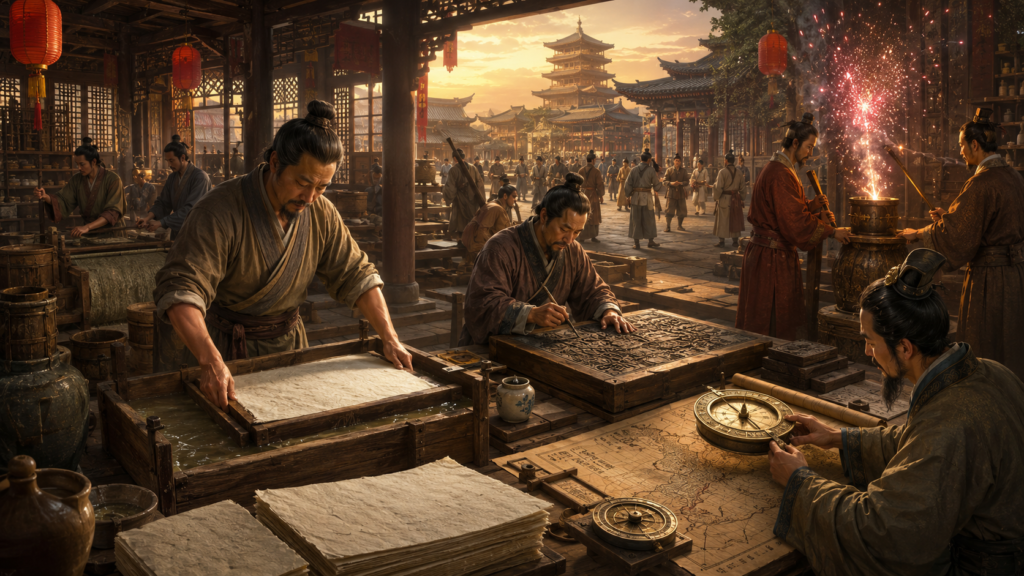
Papermaking: A Revolution in Communication
One of China’s most important inventions was paper.
Before paper became widespread, people recorded information on materials such as bamboo strips, wooden tablets and silk. Bamboo was durable but heavy, while silk was much more expensive.
Paper offered a lighter and more practical alternative.
Traditional Chinese accounts associate an important improvement in papermaking with Cai Lun, an official of the Eastern Han dynasty, around 105 CE. Earlier forms of paper existed, but Cai Lun is credited with improving and standardizing the manufacturing process.
The process involved materials such as plant fibres, bark and old cloth. These materials were broken down, mixed with water and formed into thin sheets before being pressed and dried.
The result was a lightweight writing material that could be produced relatively efficiently.
Paper transformed administration and education.
Governments could maintain records more conveniently. Scholars could write and preserve texts. Religious works could be copied and distributed.
Over time, papermaking techniques spread beyond China.
Paper eventually became an essential part of intellectual and administrative life across much of the world.
Its significance was enormous because communication depends on the ability to record, preserve and distribute information.
Woodblock Printing: Making Knowledge Easier to Reproduce
Paper created a practical writing surface, but another invention transformed how written information could be reproduced.
Chinese craftsmen developed woodblock printing, in which an entire page of text or images was carved into a wooden block. Ink was applied to the raised surface, and the block was pressed onto paper.
The technique was being used in China by at least the 7th century CE.
One of the most famous surviving examples is the Diamond Sutra, printed in 868 CE. It is widely recognized as the world’s oldest known dated complete printed book.
Woodblock printing had several advantages.
Once a block had been carved, many copies could be produced without rewriting the entire text by hand.
This made the reproduction of religious texts, literature, calendars and educational materials much easier.
Printing therefore helped knowledge travel more efficiently.
Movable Type
Chinese inventors later developed movable type.
During the 11th century, Bi Sheng developed a system using individual characters that could be arranged and reused.
Movable type was technically impressive, although the enormous number of characters used in written Chinese made it more complicated than alphabetic printing systems.
Centuries later, printing technologies developed in Europe and elsewhere would transform society.
Chinese printing was an important earlier chapter in this much larger history of mass communication.
Gunpowder: From Experiment to Revolutionary Technology
Few inventions changed warfare as dramatically as gunpowder.
Gunpowder was developed in China during the Tang dynasty, probably by alchemists searching for substances with medicinal or other extraordinary properties.
The mixture generally involved saltpetre, sulfur and charcoal.
Early experiments eventually led to the discovery that the mixture could burn rapidly and produce explosive effects.
At first, gunpowder was not immediately used in the modern form of firearms.
Chinese inventors developed applications such as fireworks, incendiary weapons and explosive devices.
Over time, increasingly sophisticated gunpowder weapons appeared.
These included early forms of rockets, bombs and eventually firearms.
Gunpowder technology gradually spread beyond China.
Its impact on military history was profound.
Weapons based on gunpowder eventually transformed fortifications, armies and naval warfare.
The development of firearms helped change the balance between different types of military forces and contributed to major transformations in warfare across Eurasia.
It is important to remember that gunpowder did not instantly revolutionize the world.
Its influence developed over centuries as engineers and military organizations learned how to use it more effectively.
The Compass: Finding Direction
Another Chinese invention with enormous global consequences was the magnetic compass.
Early Chinese compasses were based on the magnetic properties of naturally occurring lodestone.
Some early devices were used for directional or divinatory purposes rather than navigation.
Over time, however, Chinese sailors began using magnetic compasses for maritime navigation.
This was particularly important because ships could travel more confidently when visual landmarks were unavailable.
A compass could provide directional information even when skies were cloudy or visibility was poor.
As the technology spread beyond China, it became increasingly important to long-distance navigation.
Eventually, improved navigation technologies contributed to the expansion of maritime trade and exploration.
The compass did not cause global exploration by itself, but it became one of the technologies that made increasingly ambitious voyages possible.
Silk: A Technology That Built an International Trade Network
Silk is not always described as an invention in the same way as paper or gunpowder, but Chinese silk production technology was one of the country’s most important technological achievements.
Chinese communities developed sophisticated methods for raising silkworms and producing silk from their cocoons.
For centuries, the techniques were closely protected.
Silk became a valuable luxury material and an important export.
Trade routes connecting China with Central Asia, the Middle East and eventually Europe became associated with what is now called the Silk Road.
Silk was valued not only for its beauty but also for its unusual combination of lightness, strength and softness.
The production of silk required specialized knowledge at many stages, from cultivating mulberry trees to managing silkworms and processing silk fibres.
The technology therefore represented a sophisticated agricultural and manufacturing system.
Porcelain: China’s Famous Ceramic Innovation
China also became famous for producing porcelain, a refined ceramic material that eventually became highly prized around the world.
Chinese ceramic production developed over many centuries.
By the Tang and Song dynasties, Chinese craftsmen had developed increasingly sophisticated techniques for producing high-quality ceramics and porcelain.
Porcelain could be thin, durable and visually elegant.
Chinese porcelain became a major export product.
Foreign rulers and wealthy consumers prized Chinese ceramics, and the material became associated with luxury.
European demand eventually became so strong that attempts were made to reproduce Chinese porcelain manufacturing techniques.
The word “china” became associated with porcelain in English because of China’s historic connection with the material.
This is a striking example of how a technological achievement can influence not only trade but also language and culture.

Cast Iron and Advanced Metalworking
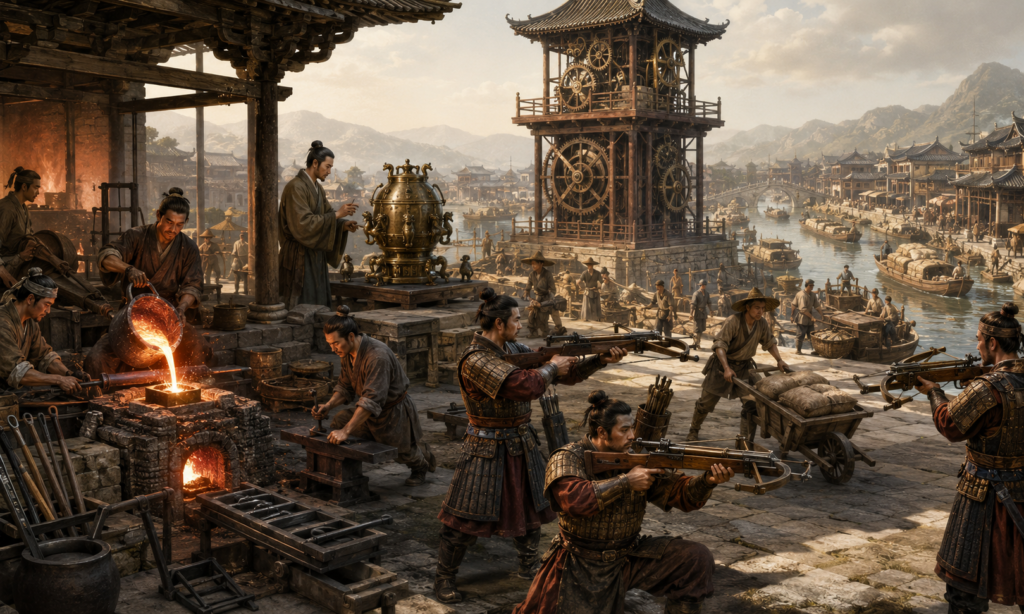
Ancient Chinese metalworkers developed sophisticated techniques for producing and processing iron.
China was among the earliest civilizations to develop cast iron production on a large scale.
Chinese ironworkers used furnaces capable of reaching temperatures high enough to melt iron.
Cast iron could then be poured into moulds to create tools and other objects.
This had significant economic and agricultural consequences.
Metal tools could be produced in standardized forms, helping farmers and craftsmen increase productivity.
Iron technology was also important for weapons and infrastructure.
Chinese metallurgists developed increasingly sophisticated techniques for controlling the properties of iron and steel.
These achievements demonstrate that ancient Chinese technology was not limited to writing and communication.
It extended deeply into industrial production.
The Crossbow
The crossbow was another important Chinese military innovation.
Although the exact origins are debated, crossbows were being used in China by the late first millennium BCE.
Unlike a traditional bow, a crossbow could store energy mechanically before the weapon was fired.
This made it possible for a soldier to aim without continuously holding the bowstring under tension.
Crossbows could therefore provide military advantages in certain circumstances.
Chinese armies used them extensively, and crossbow technology continued to develop over centuries.
Large-scale military organization allowed China to deploy substantial numbers of such weapons.
The crossbow illustrates an important principle of technological history: an invention becomes more powerful when combined with effective organization, training and production.
The Wheelbarrow
The wheelbarrow is another practical invention associated with ancient China.
Early Chinese wheelbarrows differed from modern designs, but they used the same basic principle: placing a wheel beneath a load to make transportation easier.
This simple mechanical arrangement could significantly reduce the effort required to move materials.
Wheelbarrows could be used in agriculture, construction and military logistics.
Moving heavy loads over short distances became easier and more efficient.
It is an excellent example of how seemingly simple engineering solutions can have significant practical value.
Not every world-changing invention needs to be technologically complex.
Sometimes the greatest innovation is simply finding a better way to perform an everyday task.
The Seismograph: Detecting Earthquakes
Ancient China also produced remarkable scientific instruments.
Around 132 CE, the Chinese scientist and inventor Zhang Heng developed an instrument designed to detect distant earthquakes.
The device is often described as an early seismograph, although it worked differently from modern seismic instruments.
According to historical accounts, the instrument could indicate the direction from which an earthquake had originated.
This was particularly valuable in a country where earthquakes could cause enormous destruction.
The invention demonstrated that ancient Chinese scientists were interested not only in observing visible celestial phenomena but also in measuring natural events that could not be easily detected by human senses.
Modern seismology is vastly more sophisticated, but Zhang Heng’s instrument represents an important milestone in the long history of earthquake detection.
Mechanical Clocks and Timekeeping
Chinese engineers also made significant contributions to mechanical timekeeping.
During the Song dynasty, the scientist and engineer Su Song constructed an elaborate astronomical clock tower in the 11th century.
The machine incorporated mechanical systems, astronomical instruments and a sophisticated escapement mechanism.
It was far more than a simple clock.
The structure demonstrated an impressive understanding of gears, mechanical power transmission and automated movement.
Su Song’s work reflected the wider scientific culture of Song China, a period associated with major developments in engineering, astronomy and technology.
Precise timekeeping had practical importance for government, astronomy and daily life.
Canals and Hydraulic Engineering
China’s technological achievements also included enormous infrastructure projects.
The Grand Canal became one of the world’s greatest artificial waterways.
Its origins stretch back to earlier periods, but successive Chinese governments expanded and connected sections over centuries.
The canal system helped transport grain, goods and people across enormous distances.
This was particularly important because China’s major agricultural regions were not always located near the political centres of power.
Water transport could move large quantities of goods more efficiently than overland transportation.
The Grand Canal therefore supported administration, agriculture, trade and military logistics.
It is a powerful reminder that infrastructure can be as transformative as individual inventions.
Agricultural Innovations
Chinese farmers and engineers developed numerous agricultural technologies that improved productivity.
These included improved ploughs, irrigation systems, water-lifting devices and techniques for managing crops.
The development of chain pumps, for example, helped move water for irrigation.
Chinese agriculture also benefited from intensive cultivation methods and experimentation with different crops.
Agricultural innovation mattered enormously because large civilizations depend on reliable food production.
Higher agricultural productivity could support larger populations, cities, armies and specialized occupations.
In this sense, farming technology helped create the economic foundation upon which many other inventions could flourish.
Why Did Ancient China Produce So Many Inventions?
China’s technological achievements were not the result of a single cause.
Several factors contributed.
Large Population
A large population created enormous demand for agricultural tools, transportation, construction and administration.
Government Organization
Imperial governments could mobilize large numbers of workers and resources for major projects.
Skilled Craftspeople
Specialized artisans developed expertise that could be passed between generations.
Trade
Trade connected different regions and allowed technologies and materials to circulate.
Intellectual Traditions
Chinese scholars and inventors developed strong traditions of observation, mathematics, engineering and practical problem-solving.
Competition and Warfare
Military competition encouraged innovation in weapons, transportation and logistics.
These factors interacted with one another.
An invention developed for one purpose could later be adapted for another.
How Chinese Inventions Spread Around the World
Technology rarely remains confined to the place where it was created.
Chinese inventions spread through trade, migration, warfare, diplomacy and cultural exchange.
Paper and papermaking techniques eventually travelled westward.
Gunpowder technology spread across Eurasia.
The magnetic compass became increasingly important to sailors outside China.
Chinese porcelain became a major international trade commodity.
Printing techniques influenced the development of information technologies in other societies.
The spread of these technologies demonstrates how civilizations are connected.
Human progress is rarely produced by one civilization working in complete isolation.
Ideas move.
They are copied, adapted, improved and sometimes combined with inventions from entirely different cultures.
The Global Impact of China’s Four Great Inventions
The four inventions traditionally called the Four Great Inventions of Ancient China are:
- Papermaking
- Printing
- Gunpowder
- The Compass
Their combined influence is difficult to overstate.
Paper supported large-scale record keeping and education.
Printing made written information easier to reproduce.
Gunpowder transformed warfare.
The compass improved navigation.
Together, they influenced communication, military power, commerce, exploration and the spread of knowledge.
Their significance is not that they single-handedly created the modern world.
Instead, they became important building blocks in technological systems that developed over many centuries.
Key Takeaways
- Ancient China was one of history’s major centres of technological innovation.
- Papermaking transformed the recording and distribution of information.
- Woodblock printing allowed texts to be reproduced more efficiently.
- Movable type was developed in China centuries before modern printing systems.
- Gunpowder began as an alchemical discovery before becoming an important military technology.
- The magnetic compass improved navigation and eventually supported long-distance maritime travel.
- Silk production became the foundation of an important international trade network.
- Chinese craftsmen developed sophisticated porcelain production.
- Cast iron and advanced metalworking supported agriculture, manufacturing and warfare.
- The crossbow became an important military technology.
- The wheelbarrow provided a simple but highly effective transportation solution.
- Zhang Heng developed an early earthquake-detection instrument.
- Chinese engineers developed sophisticated mechanical clocks.
- Hydraulic engineering and the Grand Canal supported trade, agriculture and government.
- China’s inventions spread across Asia and eventually influenced societies around the world.
Frequently Asked Questions
What are China’s Four Great Inventions?
The Four Great Inventions traditionally associated with ancient China are papermaking, printing, gunpowder and the compass.
Who invented paper?
Paper developed gradually, but Cai Lun, an official of the Eastern Han dynasty, is traditionally credited with improving and standardizing papermaking around 105 CE. Earlier forms of paper existed before his time.
Did China invent printing?
Chinese craftsmen developed woodblock printing centuries before printing became widespread in Europe. China also developed movable type, with Bi Sheng credited with creating an early movable-type system during the 11th century.
Did China invent gunpowder?
Gunpowder was developed in China, probably during the Tang dynasty. Early Chinese experiments eventually led to fireworks, explosives, incendiary weapons and later firearms.
Why was the compass important?
The magnetic compass provided a reliable method of determining direction and eventually became an important tool for maritime navigation.
What other inventions came from ancient China?
Ancient Chinese technological achievements included porcelain, cast iron, crossbows, wheelbarrows, earthquake-detection instruments, mechanical clocks, hydraulic systems and numerous agricultural technologies.
Why did China develop so many inventions?
A combination of factors contributed, including China’s large population, agricultural needs, government organization, skilled craftspeople, trade networks, intellectual traditions and military competition.
Did Chinese inventions influence the rest of the world?
Yes. Technologies such as papermaking, printing, gunpowder and the compass eventually spread beyond China and became important technologies in other parts of Asia, the Middle East and Europe.
Conclusion
Ancient China’s history of invention demonstrates how technology can reshape civilization.
From paper and printing to gunpowder and the compass, Chinese innovations influenced communication, education, warfare, navigation and international trade.
But the story goes far beyond the Four Great Inventions.
Chinese engineers developed sophisticated canals and irrigation systems. Metalworkers mastered large-scale cast iron production. Craftspeople developed extraordinary porcelain and silk technologies. Scientists such as Zhang Heng created instruments for studying natural phenomena, while engineers such as Su Song developed remarkable mechanical devices.
These achievements were made possible by a civilization with enormous economic, agricultural and administrative complexity.
Perhaps the most important lesson is that innovation does not happen in isolation.
An invention may begin as a solution to a local problem and eventually transform societies thousands of kilometres away. Paper created in China eventually became essential to global education and administration. Gunpowder changed warfare across continents. The compass helped sailors navigate unfamiliar waters. Printing accelerated the spread of knowledge.
The people who created these technologies could not have predicted their eventual global influence.
That is one of the fascinating characteristics of technological history.
An invention’s importance is often determined not only by what it does when it is created, but by how later generations adapt, improve and spread it.
Ancient China’s greatest inventions are therefore more than historical curiosities.
They are reminders that human progress is built through accumulated knowledge, practical experimentation and the willingness to find better ways of solving problems.
Many centuries later, their influence can still be seen in the way people communicate, travel, manufacture goods, study science and organize societies.
The story of ancient Chinese invention is ultimately a story about human creativity—and how an idea developed in one civilization can eventually change the world.
Further Reading & Resources
Continue your learning journey with more expert guides and insightful articles from CurioReader. Explore related topics below to deepen your understanding and discover new perspectives.
Related CurioReader Articles
- Ancient Egypt: Life Along the Nile.
- Ancient Greece: The Birthplace of Democracy.
- The Roman Empire: Rise, Expansion, and Fall.
Recommended External Resources