Introduction
Ancient Egypt: Life Along the Nile. Few civilizations were shaped by a river as completely as Ancient Egypt was shaped by the Nile.
For more than 3,000 years, Egyptian civilization developed along a narrow strip of fertile land surrounded by the vast deserts of North Africa. The Nile provided water, supported agriculture, enabled transportation and connected communities. Without the river, the civilization of ancient Egypt could never have developed in the same way.
The Nile was far more than a source of water. It influenced Egyptian farming, trade, religion, settlement, government and even the way Egyptians understood life and death.
Every year, the river’s waters traditionally rose and flooded nearby agricultural land. When the waters retreated, they left behind fertile sediment that helped farmers grow crops. This dependable agricultural cycle supported food production and allowed a large population to live in an otherwise dry environment.
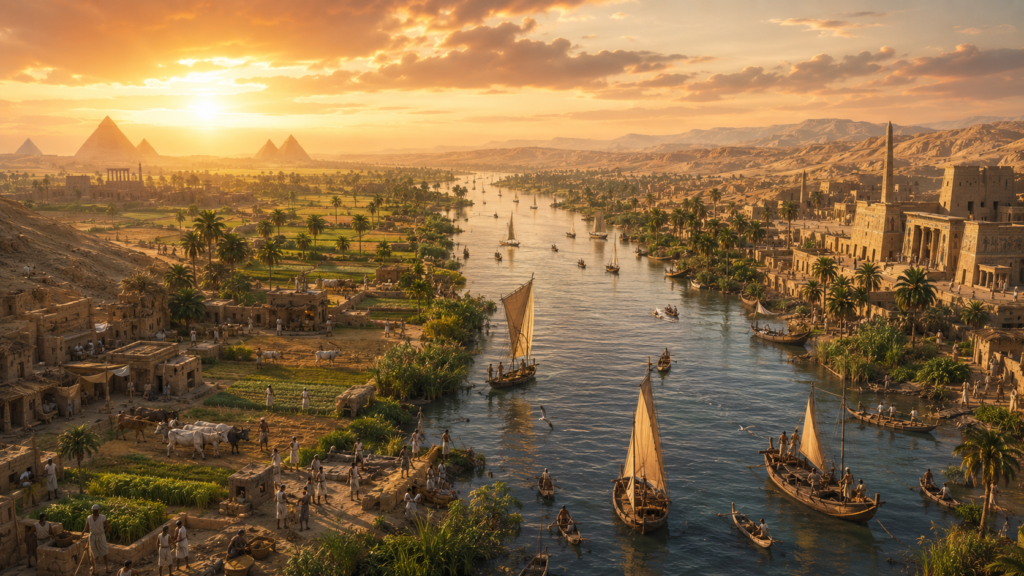
Along the river, villages grew into towns and cities. Farmers cultivated wheat and barley, fishermen worked the waterways, craftsmen produced tools and pottery, merchants transported goods, and government officials collected taxes and organized irrigation.
The Nile also connected Upper and Lower Egypt and provided an efficient transportation route through the kingdom.
Understanding Ancient Egypt therefore begins with understanding its river.
The story of Egyptian civilization is, in many ways, the story of life along the Nile.
The Nile and the Egyptian Landscape
Ancient Egypt occupied a remarkable geographical environment.
The Nile flows northward through northeastern Africa before reaching the Mediterranean Sea. Much of the surrounding region is extremely dry, with deserts extending on both sides of the river.
This created a striking contrast.
Near the Nile was a relatively narrow region of fertile land.
Beyond it were vast areas of desert.
Ancient Egyptians recognized this contrast and even used different concepts to describe their environment. The fertile agricultural land was associated with the “Black Land”, while the surrounding desert was known as the “Red Land.”
The distinction was practical as well as symbolic.
The fertile land supported crops, settlements and communities.
The desert provided natural resources, grazing areas and routes to distant locations, but it was much more difficult to farm.
The Nile therefore acted as the central lifeline of Egyptian society.
Communities were concentrated close to the river and its fertile floodplain.
The Annual Flood
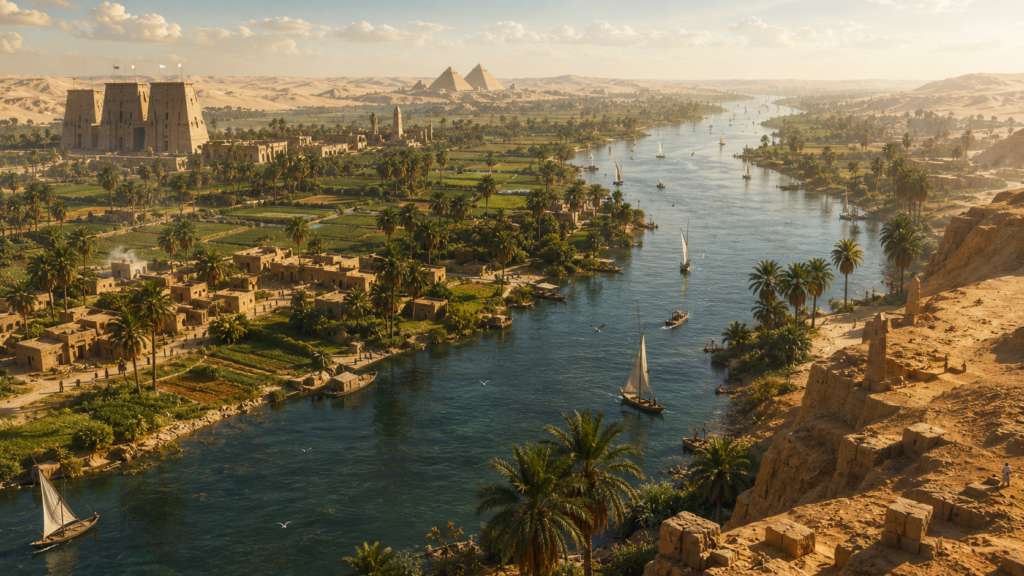
One of the most important natural events in ancient Egyptian life was the annual flooding of the Nile.
The river’s water levels rose during the summer and spread across parts of the surrounding floodplain.
When the waters eventually withdrew, they left behind fertile sediment.
This natural process helped renew agricultural land.
For farmers, the flood was closely connected to the agricultural calendar.
The Egyptians developed systems for organizing farming activities around the river’s changing conditions.
The flood was not always identical each year.
A particularly high flood could damage settlements and infrastructure, while a flood that was too low could reduce agricultural production.
Managing the relationship between water and farmland therefore became an important responsibility of the state.
Egyptian society developed increasingly sophisticated methods for measuring and controlling water.
Farming Along the Nile
Agriculture was the foundation of ancient Egyptian civilization.
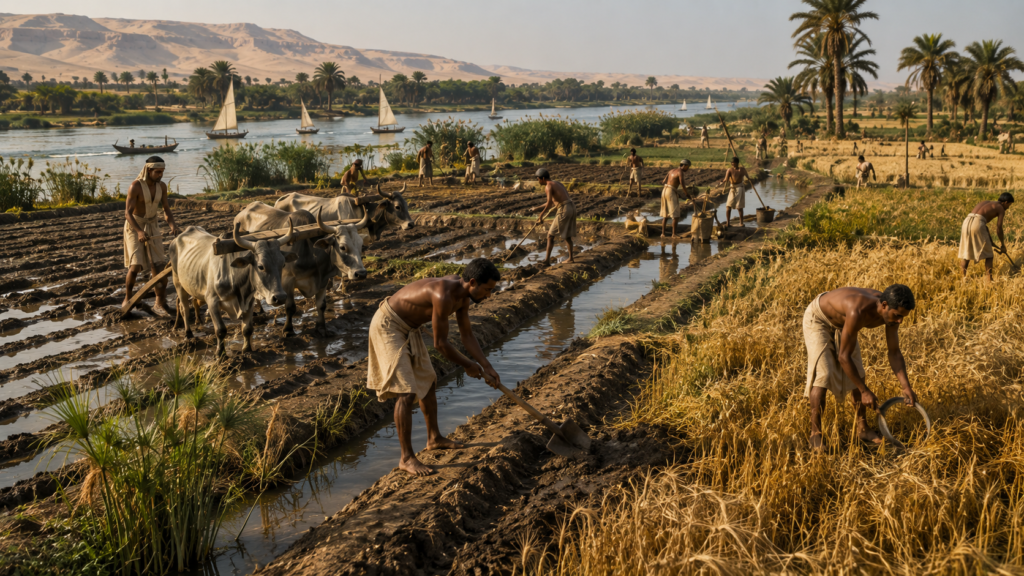
Farmers grew crops such as wheat, barley, flax and various fruits and vegetables.
Wheat and barley were particularly important because they could be used to produce bread and beer, two major parts of the Egyptian diet.
Flax was valuable because it could be processed into linen.
Farmers also raised animals including cattle, sheep, goats, pigs and donkeys.
The Nile provided more than irrigation.
It supported fishing and provided reeds and other plants that could be used for food, construction and crafts.
Agriculture produced the surplus food necessary to support people who were not directly involved in farming.
This allowed Egyptian society to develop specialized occupations.
Priests, scribes, soldiers, craftsmen, builders, administrators and merchants could all contribute to society because farmers produced enough food to support a broader population.
🌾 CurioReader Insight: A civilization cannot build monumental temples, maintain armies or develop specialized professions without a reliable food supply. In Ancient Egypt, the Nile helped create the agricultural surplus that made this complex society possible.
Villages and Cities
Most ordinary Egyptians lived in communities close to the Nile and agricultural land.
Homes were commonly constructed from mud bricks, a practical building material made from mud and dried in the sun.
Houses varied according to wealth.
A modest family home might contain only a few rooms, while wealthier households could have larger spaces, courtyards and storage areas.
Cities were more complex.
They contained temples, administrative buildings, workshops, markets and residences.
Important urban centres developed along the Nile and in the Nile Delta.
The river connected these communities.
Boats could carry people and goods between settlements much more efficiently than transporting heavy loads across desert terrain.
The Nile therefore functioned as one of Egypt’s greatest transportation networks.
Boats and Transportation
The ancient Egyptians became skilled boat builders.
Boats were constructed from materials including papyrus and wood.
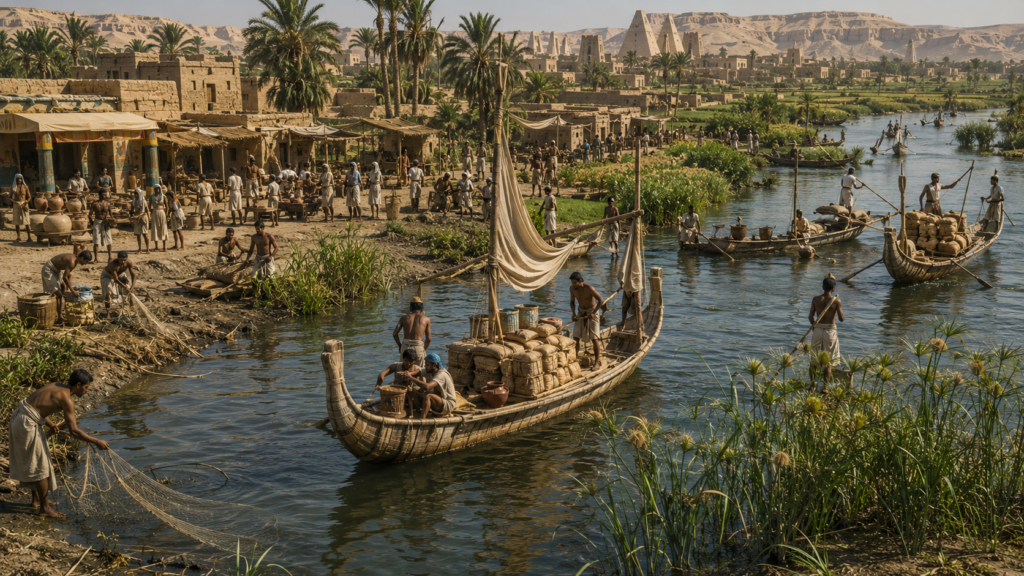
Small boats could be used for fishing and local transportation, while larger vessels transported people, agricultural products, stone and other materials.
The direction of the Nile’s current made northward travel relatively convenient, while prevailing winds often helped sailing southward.
This combination created an efficient natural transportation system.
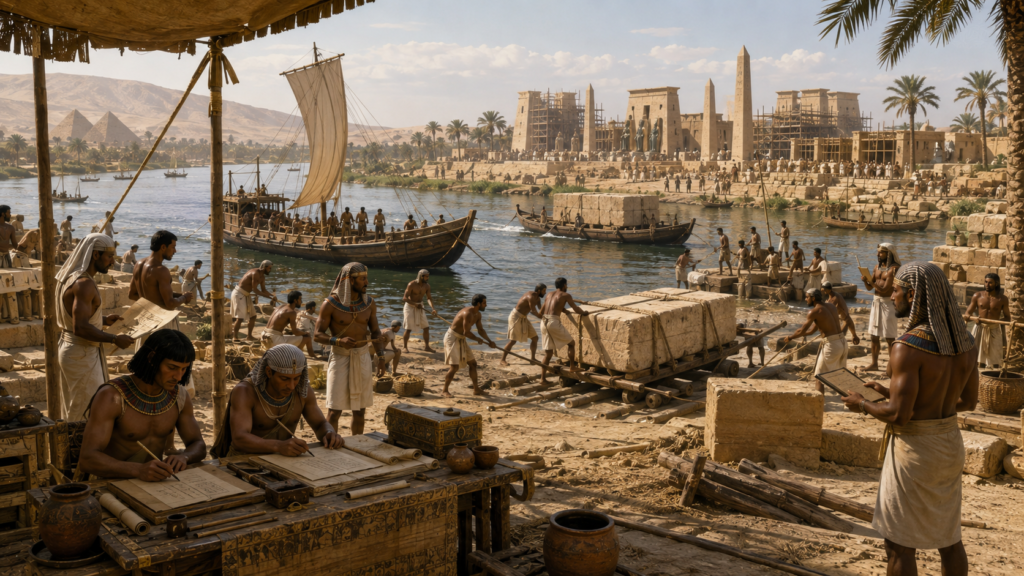
Heavy materials used in monumental construction could be transported by water.
Stone from distant quarries could be moved toward major building sites.
Grain and other agricultural products could also travel between regions.
The Nile therefore connected the economic and political life of Egypt.
Trade and the Nile
The river played a major role in Egyptian trade.
Egypt produced agricultural goods but also needed materials that were not readily available along the Nile Valley.
These included certain types of timber, metals, precious stones and other resources.
Egyptian traders and expeditions travelled beyond the Nile Valley to obtain valuable materials.
Trade routes connected Egypt with regions in the eastern Mediterranean, Nubia and the wider ancient Near East.
The Nile provided an essential transportation route within Egypt, while ports and waterways connected the civilization to longer-distance trade networks.
Merchants and government expeditions could transport large quantities of goods by boat.
This was considerably more efficient than moving heavy cargo over land.
Writing and the Rise of the Scribes
The complexity of Egyptian society created a need for record keeping.
This helped make writing and scribal culture extremely important.
Egyptian scribes recorded taxes, agricultural production, religious texts, legal matters, government activities and commercial transactions.
One of the most recognizable forms of Egyptian writing was hieroglyphic writing.
Hieroglyphs used symbols representing objects, sounds and concepts.
For everyday administrative purposes, Egyptians also developed more practical scripts, including hieratic and later demotic.
Writing materials included papyrus, a plant that grew abundantly in parts of the Nile environment.
Papyrus could be processed into sheets used for writing.
This made it possible to preserve and transport written information more conveniently than relying only on stone monuments.
Scribes therefore became important members of Egyptian administration.
Literacy was not widespread among the entire population, and specialized scribal training was an important path into government and administrative work.
Religion and the Nile
The Nile was deeply connected to Egyptian religion.
The annual flood appeared to renew the land and support life.
This encouraged religious interpretations of the natural world.
Egyptian religion included many gods associated with different aspects of nature, society and existence.
The god Hapi was particularly associated with the Nile’s inundation.
Other major deities included Osiris, Isis, Horus, Ra and Anubis.
Egyptian religious beliefs were complex and changed over thousands of years.
The Nile’s life-giving role nevertheless fitted naturally into Egyptian ideas about fertility, death, renewal and rebirth.
The river was part of an environment in which life seemed to emerge repeatedly from the cycle of water, agriculture and harvest.
The Pharaoh and the River
The Egyptian state was highly centralized, with the pharaoh occupying a central political and religious position.
The pharaoh was expected to maintain order and uphold ma’at, a concept involving balance, justice and cosmic order.
Managing Egypt’s agricultural resources was one aspect of maintaining that order.
The state organized taxation, labour and infrastructure.
Government officials monitored agricultural production and collected part of the harvest as taxes.
The ability to manage resources along the Nile contributed to the strength of the Egyptian state.
Large building projects required enormous quantities of food, materials and labour.
The river made it possible to transport many of those resources.
Irrigation and Water Management
The Egyptians did not simply depend passively on the Nile.
They developed methods for managing water and expanding agricultural productivity.
Canals, basins and other systems could help distribute floodwater across farmland.
A technology known as the shaduf, a counterweighted device for lifting water, was used in later periods to move water from lower to higher levels.
Water management allowed farmers to make better use of the river.
The state had a strong interest in maintaining irrigation systems because agricultural production affected taxation, food supplies and political stability.
This demonstrates an important characteristic of Egyptian civilization:
The Nile provided the natural foundation, but humans had to organize themselves to make the most of it.
Everyday Food
Life along the Nile shaped the Egyptian diet.
Bread and beer were staple foods.
Wheat and barley were cultivated extensively, while vegetables such as onions, garlic, lettuce and legumes could supplement meals.
Fish was an important source of protein for many people living near the river.
Dates, figs, grapes and other fruits were also available.
Wealthier Egyptians had access to a greater variety of foods, including meat and luxury products.
The Nile environment therefore influenced not only agriculture but also what people ate every day.
Clothing and Everyday Life
Most Egyptians wore clothing made from linen, which was produced from flax.
Linen was well suited to Egypt’s hot climate.
Men commonly wore simple kilts or wrapped garments, while women’s clothing could include long dresses.
Styles varied according to period, wealth and social position.
Personal cleanliness was valued, and cosmetics such as eye pigments were widely used.
People also wore jewellery made from materials ranging from simple beads to gold and precious stones.
Daily life was strongly influenced by social class.
Farmers worked the land.
Craftspeople produced pottery, tools, furniture and other goods.
Scribes worked in administration.
Priests served religious institutions.
Soldiers protected the kingdom.
Members of the royal family and elite households lived very different lives from ordinary labourers.
Women in Ancient Egyptian Society
Women in Ancient Egypt had a legal and economic position that could differ significantly from women in some other ancient societies.
They could own property, inherit wealth and enter into certain legal agreements.
Women could also work in various occupations.
The extent of their opportunities depended on social position and historical period.
Some women became influential religious figures, while a small number eventually ruled Egypt as pharaohs.
The most famous include Hatshepsut, who ruled during the 15th century BCE and became one of Egypt’s most successful female monarchs.
Her reign was associated with major building projects and long-distance trade expeditions.
The existence of powerful women did not mean Egyptian society was fully equal by modern standards.
Nevertheless, women’s legal rights are an important part of understanding everyday Egyptian society.
The Nile and Monumental Construction
The great monuments of Egypt are often associated with the desert landscape, but the Nile played an essential role in their construction.
The pyramids, temples and other monumental structures required enormous quantities of stone and other materials.
Much of that material could be transported using the Nile and associated waterways.
Workers could move stone by boat and then transport it over shorter distances to construction sites.
The river therefore provided a transportation system supporting projects that would have been enormously more difficult without water access.
The pyramids were not simply isolated architectural achievements.
They were products of an organized society capable of feeding workers, obtaining materials, managing labour and coordinating transportation.
The Nile helped make that organization possible.
Death and the Afterlife
Egyptian civilization is famous for its elaborate beliefs about death and the afterlife.
Egyptians believed that death was not simply an end but a transition into another form of existence.
This encouraged complex burial practices.
The process of mummification was developed to preserve bodies for the afterlife.
Tombs could contain food, objects, jewellery and other items believed to be useful to the deceased.
The Nile also influenced the geography of burial.
Many important settlements and agricultural areas were located on the eastern side of the river, while burial grounds were often associated with the western side.
The relationship was not absolute, but the pattern reflected broader Egyptian ideas about the rising and setting Sun and the cycle of life and death.
The Nile Delta
Northern Egypt presented a different environment from the narrow Nile Valley.
Near the Mediterranean, the Nile divided into several branches and created a broad region known as the Nile Delta.
The Delta contained fertile agricultural land and wetlands.
It became one of the most productive regions of ancient Egypt.
The area was also important for trade because of its connection to the Mediterranean.
Cities and settlements developed throughout the Delta, creating another major centre of Egyptian population and economic activity.
The contrast between the narrow river valley and broad Delta helped create the geographical divisions within ancient Egypt.
Upper and Lower Egypt
Ancient Egypt was traditionally divided into Upper Egypt and Lower Egypt.
The names can be confusing because Upper Egypt was located in the south while Lower Egypt was in the north.
The distinction reflected the direction of the Nile’s flow.
Upper Egypt occupied the higher southern part of the river valley.
Lower Egypt included the northern Delta.
The unification of these regions became a foundational event in Egyptian history.
The king traditionally associated with this unification is often identified as Narmer, although the exact historical process was probably more complex than the traditional narrative suggests.
Political unification allowed Egypt to develop as a powerful territorial state connected by the Nile.
Challenges of Life Along the Nile
Although the Nile provided enormous benefits, life along the river was not always easy.
Floods could be unpredictable.
Crops could fail.
Droughts could create food shortages.
Diseases and injuries were common, while agricultural labour was physically demanding.
Farmers also depended heavily on environmental conditions.
A poor flood could affect the entire economy.
This meant that Egyptians developed systems of storage and administration to manage resources.
Grain could be collected and stored during productive years and distributed when necessary.
The ability to manage agricultural surpluses was an important source of political power.
Why the Nile Made Civilization Possible
The Nile’s importance extended far beyond agriculture.
It provided:
Water for people and animals.
Fertile soil for farming.
Transportation between communities.
Fish and other food resources.
Papyrus and other useful plants.
A route for trade and communication.
A foundation for centralized government.
A setting for religious traditions.
Few natural features have influenced a civilization so extensively.
Egypt’s achievements in architecture, mathematics, writing, administration and art were supported by the economic stability created by the river.
The Lasting Legacy of Ancient Egypt
Ancient Egyptian civilization lasted for thousands of years and left a remarkable legacy.
Its monuments remain among the world’s most recognizable archaeological sites.
Its writing system continues to fascinate researchers.
Its mathematics, medicine, architecture and engineering demonstrate sophisticated knowledge.
Its religious traditions influenced the cultures that came after it.
Yet perhaps the greatest lesson of Ancient Egypt is geographical.
Civilizations do not develop independently of their environments.
Egyptian society adapted itself to the rhythm of the Nile.
Farmers depended on its waters.
Merchants travelled along it.
Government officials measured and managed its resources.
Religious traditions connected its cycles with ideas about life and renewal.
Engineers used it to transport materials.
Communities grew beside it.
The Nile was not merely part of Egyptian civilization.
It was one of the conditions that made Egyptian civilization possible.
Key Takeaways
- The Nile was the foundation of Ancient Egyptian civilization.
- The river provided water, fertile agricultural land, food and transportation.
- Annual flooding helped renew farmland with fertile sediment.
- Agriculture supported Egypt’s population and allowed specialized professions to develop.
- Boats transported people, food, stone and other materials along the river.
- The Nile supported domestic and international trade.
- Papyrus, an important writing material, grew in the Nile environment.
- Egyptian religion was closely connected with natural cycles and the Nile.
- Government officials managed agricultural production, taxation and water resources.
- The river helped support the construction of monumental buildings and pyramids.
- Upper and Lower Egypt were connected through the Nile.
- The Nile Delta became one of Egypt’s most productive and important regions.
- Floods, droughts and crop failures could also create serious challenges.
- Ancient Egypt’s achievements were closely connected to its environment.
Frequently Asked Questions
Why was the Nile so important to Ancient Egypt?
The Nile provided water, fertile land, food, transportation and opportunities for trade. Its annual flooding helped renew agricultural soil and supported the large population needed for a complex civilization.
How did the Nile help Egyptian farmers?
When the river flooded, it deposited fertile sediment across parts of the floodplain. After the water receded, farmers could cultivate the enriched soil.
What crops did Ancient Egyptians grow?
Important crops included wheat, barley and flax, along with various fruits, vegetables and legumes.
Did Egyptians use the Nile for transportation?
Yes. Boats were an important means of transporting people and goods. The river allowed heavy materials such as stone and grain to be moved more efficiently than by land.
What was the Black Land?
The “Black Land” was the fertile agricultural region near the Nile, named for the dark, fertile soil associated with the river’s flooding.
What was the Red Land?
The “Red Land” referred to the surrounding desert regions, which contrasted with the fertile Nile Valley.
How did the Nile influence Egyptian religion?
The river’s life-giving cycle influenced Egyptian ideas about fertility, renewal and the natural order. The annual inundation was associated with the god Hapi, among other religious traditions.
Did the Nile help build the pyramids?
Yes. The river and its waterways provided an important transportation route for moving stone and other materials used in monumental construction.
Why were Upper and Lower Egypt named that way?
Upper Egypt was in the south, where the land was geographically higher, while Lower Egypt was in the north, including the Nile Delta.
What happened when the Nile flood was too low?
A low flood could reduce the amount of fertile land and water available for agriculture, potentially causing lower harvests and food shortages.
Conclusion
Ancient Egypt’s extraordinary civilization grew beside one of the world’s great rivers.
The Nile provided the resources that allowed communities to survive in a largely desert environment. Its waters supported agriculture, while its floodplain provided fertile soil. Its channels became transportation routes, connecting villages, cities and regions across the kingdom.
The river also influenced Egyptian culture.
It shaped religious ideas about fertility and renewal, supported the development of government administration and helped make large-scale construction possible.
Farmers relied on it for their crops.
Fishermen relied on it for food.
Merchants relied on it for transportation.
Government officials relied on it for taxation and resource management.
Builders relied on it to transport heavy materials.
The Nile was woven into almost every aspect of Egyptian life.
But the relationship was not entirely effortless.
The river could flood unpredictably, and inadequate flooding could threaten harvests. Egyptian society therefore had to develop systems for managing resources, organizing agriculture and preparing for difficult years.
This relationship between people and environment is one of the most important lessons of Egyptian history.
The pyramids and temples may be the most visible symbols of Ancient Egypt, but they were made possible by a much more fundamental achievement: the ability of a society to organize itself around the resources provided by its environment.
The Nile created the conditions.
Human beings transformed those conditions into a civilization.
For thousands of years, Egyptians built their homes, farms, cities, temples and institutions along its banks.
Even today, the remains of that civilization continue to attract people from around the world.
The monuments remind us of the power of ancient engineering and organization.
The written records reveal a complex society.
The archaeological evidence shows how ordinary people lived, worked and adapted to their environment.
And the river itself remains the key to understanding why this civilization emerged where it did.
Ancient Egypt was not simply a civilization beside the Nile. It was a civilization shaped by the Nile.
Further Reading & Resources
Continue your learning journey with more expert guides and insightful articles from CurioReader. Explore related topics below to deepen your understanding and discover new perspectives.
Related CurioReader Articles
- Ancient China’s Greatest Inventions That Changed the World.
- The Roman Empire: Rise, Expansion, and Fall.
- Ancient Greece: The Birthplace of Democracy.
Recommended External Resources