The Space Shuttle Disasters: How Challenger and Columbia Were Lost and What They Taught Us. The Space Shuttle was one of the most ambitious engineering projects of the twentieth century. Designed to make human spaceflight more reusable and routine, the Shuttle became a symbol of technological achievement. Over its three-decade program, NASA’s orbiters carried astronauts into space, launched satellites, conducted scientific research, and helped build and service major space infrastructure.
But twice, the Shuttle program experienced catastrophic accidents that changed the history of human spaceflight.
On January 28, 1986, Space Shuttle Challenger broke apart just 73 seconds after launch, killing all seven crew members. The subsequent Presidential Commission found that the immediate technical cause was the failure of a pressure seal in a joint of the right Solid Rocket Motor. The failure was associated with a design that was highly sensitive to several factors, including temperature. The investigation also identified serious problems in the decision-making process surrounding the launch.
Seventeen years later, on February 1, 2003, Space Shuttle Columbia was lost during atmospheric re-entry, again killing all seven astronauts. Investigators determined that insulating foam had struck the orbiter’s left wing during launch, damaging its thermal protection system. During re-entry, superheated gases entered through the damaged area, eventually leading to the destruction of the spacecraft.
The two accidents were technically different.
🚀 Science & Engineering Background: Challenger’s loss involved a failed Solid Rocket Motor joint seal, while Columbia’s loss began with damage to the wing’s thermal protection system. In both cases, however, the investigations went beyond identifying a single failed component and examined the wider engineering and organizational circumstances that allowed the risks to develop.
That is what makes these disasters particularly important to study.
They were not simply stories about machines breaking.
They were stories about engineering decisions, warnings, communication, risk, organizational culture, human judgment, and the limits of complex technology.
The Challenger investigation found that NASA and its contractor had not adequately responded to earlier evidence concerning the O-ring problem and that the launch decision process was seriously flawed. The Columbia investigation similarly examined not only the foam strike but also the organizational and safety factors surrounding the accident.
This article will examine what happened to Challenger and Columbia, how seemingly manageable technical problems developed into catastrophic failures, what investigators discovered afterward, and how NASA changed its approach to Shuttle safety.
Most importantly, these events offer lessons that extend far beyond space exploration.
They demonstrate that in complex systems, technical problems, human decisions, communication failures, and organizational culture can interact in ways that no single component or individual can explain.
Understanding these disasters is therefore not simply about remembering two tragic moments in space history.
It is about understanding how complex systems fail—and how organizations can learn to prevent the next failure.
The Space Shuttle Era
Before examining the two disasters, it is important to understand what the Space Shuttle was designed to accomplish and why the system was considered such a remarkable achievement.
The Shuttle was not simply a rocket. It was a reusable transportation system designed to carry people and cargo into low Earth orbit and return the crewed spacecraft to Earth. NASA’s first Shuttle mission, STS-1, launched on April 12, 1981, with Columbia. The program eventually flew 135 missions over 30 years, ending with the landing of Atlantis on July 21, 2011.
A Different Kind of Spacecraft
Earlier human spaceflight systems generally used spacecraft that were launched on expendable rockets and then returned to Earth in capsules.
The Space Shuttle introduced a very different concept.
It was designed to:
- Launch vertically like a rocket
- Carry astronauts and payloads into orbit
- Operate in space
- Return through Earth’s atmosphere
- Land on a runway like an unpowered aircraft
- Reuse major components for future missions
NASA describes the Shuttle as the world’s first reusable spacecraft. Its reusable orbiter combined the functions of a spacecraft and a high-speed glider.
This approach was intended to make space transportation more practical and reusable.
The Shuttle also became an important platform for scientific research, satellite deployment and servicing, and eventually construction of the International Space Station.
🚀 Science & Engineering Background: The Shuttle was essentially a combination of several different types of vehicle. During launch it functioned like a powerful rocket system; in orbit the orbiter operated as a spacecraft; and during its return to Earth it behaved like a glider, landing without conventional jet propulsion.
How the Space Shuttle Was Built
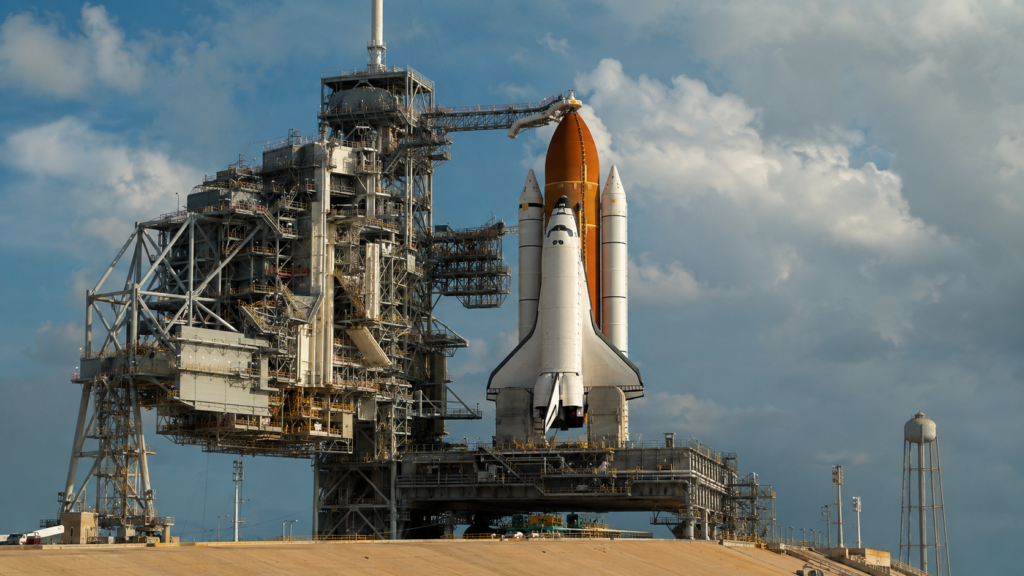
The Shuttle system consisted of three major elements:
The Orbiter
This was the winged spacecraft where the astronauts lived and worked. It contained the crew cabin, flight systems, payload bay, and three Space Shuttle Main Engines.
The External Tank
The large central tank supplied liquid hydrogen and liquid oxygen to the orbiter’s three main engines. It also provided the structural connection between the orbiter and the two solid rocket boosters.
The Two Solid Rocket Boosters
The boosters provided most of the thrust during the first approximately two minutes of flight. After that stage, they separated from the Shuttle and were recovered from the Atlantic Ocean for refurbishment and reuse.
Together, these components formed an extraordinarily complex launch vehicle.
The Launch
At liftoff, the Shuttle’s three main engines and two Solid Rocket Boosters operated together.
The main engines received their propellants from the External Tank, while the solid rocket boosters supplied enormous additional thrust.
The boosters operated for approximately two minutes before separating.
The orbiter and external tank continued upward, with the main engines providing thrust for the remainder of the powered ascent. Eventually, the external tank was jettisoned and was not reused.
This meant that thousands of components had to function together correctly during an extremely demanding sequence.
A small problem in one part of the system could potentially have consequences elsewhere.
That complexity is important when considering the later disasters.
The Orbiter Was More Than a Spacecraft
The orbiter looked somewhat like an aircraft, but its mission was very different.
Its wings and aerodynamic shape allowed it to return to Earth as a high-speed glider.
Unlike an ordinary commercial aircraft, however, the Shuttle had no conventional engines available to power its landing approach.
Once the orbiter entered its final descent, the astronauts had essentially one opportunity to guide the vehicle toward a safe runway landing.
The orbiter also had to survive the extreme heating generated during atmospheric re-entry.
This required a specialized Thermal Protection System, including thousands of heat-resistant tiles and other protective materials.
That protection would later become central to the Columbia disaster.
A Program Built Around Reuse
The concept of reuse was one of the defining characteristics of the Shuttle program.
The orbiters could fly multiple missions.
The Solid Rocket Boosters were recovered and refurbished.
The External Tank was the major component that was not reused.
NASA designed the system to support repeated missions rather than treating every launch as a completely new spacecraft.
Over time, the Shuttle fleet became an important part of American space exploration.
📚 CurioReader History Insight: The Shuttle program was not simply a transportation project. It became an infrastructure for human spaceflight, supporting scientific research, satellite operations, astronomy missions, and eventually construction and servicing of the International Space Station.
Challenger and Columbia Were Part of a Larger Fleet
The Shuttle program eventually operated five orbiters that flew into space:
- Columbia
- Challenger
- Discovery
- Atlantis
- Endeavour
Enterprise was also an important early Shuttle vehicle, but it was used for atmospheric and ground testing rather than orbital missions.
Each orbiter accumulated its own history.
Columbia became the first Shuttle to fly into space in 1981.
Challenger began flying Shuttle missions in 1983 and completed several successful flights before its final mission in 1986.
The fleet demonstrated that reusable human spaceflight could become a continuing operational activity.
And this success created an important psychological and organizational challenge.
When Success Can Become a Risk
By the middle of the 1980s, Shuttle launches were no longer unprecedented events.
The program had accumulated numerous successful missions.
That history of success was valuable—but it could also influence how people perceived risk.
A complex system can operate successfully many times while still containing vulnerabilities.
Previous successful missions demonstrate that a system has worked under previous conditions.
They do not prove that every future combination of circumstances will be safe.
This distinction becomes extremely important when examining Challenger.
Before its final flight, NASA and its contractors had already accumulated experience with the Shuttle’s systems, including components that would later become central to the investigation.
The question was therefore not simply whether the Shuttle was technologically advanced.
It was whether people understood which risks remained unacceptable even after repeated successful missions.
🧠 CurioReader Insight: Repeated success can provide confidence, but confidence should never become a substitute for continuously questioning whether a complex system remains safe under changing conditions.
The Shuttle program had achieved extraordinary technological milestones.
But beneath the spectacular launches was a complicated network of engineering decisions, contractors, procedures, safety assessments, and human judgments.
That network would be tested catastrophically on January 28, 1986, when Challenger prepared for mission STS-51L.
The first great Shuttle disaster was about to expose a problem that had been developing inside the system long before the final countdown.
Challenger — January 28, 1986
By January 1986, Space Shuttle launches had become a regular part of NASA’s operations. The Shuttle was no longer an experimental vehicle making its first flight. It had already completed numerous successful missions.
But the launch of Challenger mission STS-51L would become one of the most consequential events in the history of spaceflight.
Seven people were aboard: Commander Francis R. Scobee, Pilot Michael J. Smith, Mission Specialists Ellison S. Onizuka, Judith A. Resnik and Ronald E. McNair, and Payload Specialists Gregory Jarvis and Christa McAuliffe. McAuliffe, a teacher selected for NASA’s Teacher in Space program, had attracted enormous public attention to the mission.
A Launch Delayed by Weather and Technical Problems
The original launch attempt was scheduled for January 27, 1986.
That attempt was cancelled after a series of problems, including concerns about crosswinds and other launch-related conditions. The launch was rescheduled for the following day.
But January 28 brought exceptionally cold conditions to Florida.
The temperature at launch was approximately 36°F (2°C) at ground level—about 15°F colder than any previous Shuttle launch. Overnight temperatures had fallen much lower, and ice had accumulated around the launch complex.
The unusual conditions created concerns among engineers and launch personnel.
Ice inspections were conducted, and the countdown was delayed while teams assessed conditions around the launch pad.
However, the most serious concern was not simply the ice.
It involved a component deep inside the Shuttle’s Solid Rocket Boosters.
The O-Ring Problem
The Solid Rocket Boosters were constructed from several segments that had to be joined together.
The joints needed to prevent extremely hot combustion gases from escaping.
To provide that seal, engineers used O-rings—flexible rings designed to seal the joint.
Under normal circumstances, the O-rings were expected to respond to pressure and move into position quickly enough to prevent combustion gases from escaping.
But temperature mattered.
Rubber-like materials become less flexible as temperatures fall.
The investigation later found that the O-ring design was unacceptably sensitive to several factors, including temperature, physical dimensions, materials, processing, reuse and dynamic loading.
The problem was therefore not simply that the O-ring was “bad.”
It was that the overall joint design did not provide an adequate margin of safety under certain conditions.
🚀 Science & Engineering Background: An O-ring works by forming a seal between surfaces. In the Challenger case, the investigation found that low temperatures reduced the O-ring’s ability to respond quickly enough to changes occurring during ignition and motor operation. This increased the possibility of hot combustion gases escaping through the joint.
Engineers Had Seen Warning Signs Before Challenger
One of the most important lessons from Challenger is that the O-ring problem did not suddenly appear on the morning of January 28.
Previous Shuttle missions had produced evidence of O-ring erosion and gas blow-by.
Engineers had already observed concerning behaviour in the Solid Rocket Motor joints.
Cold temperatures made the concern more serious.
The Rogers Commission later examined the history of these problems and found that the risks associated with the O-rings had not been adequately addressed.
This transformed the Challenger disaster from a simple story of unexpected mechanical failure into something much more complicated.
There was a known technical concern.
There was incomplete understanding of how serious that concern was.
And there was a decision-making process that ultimately allowed the launch to proceed.
The Night Before the Launch
The temperature forecast became a major issue during discussions between NASA and Morton Thiokol, the contractor responsible for the Solid Rocket Motors.
Engineers at Thiokol were concerned about the effect of low temperatures on the O-rings.
The company initially recommended not launching unless the temperature of the O-rings reached at least 53°F (approximately 12°C). The recommendation was based on the available engineering data and previous experience.
The discussion then became contentious.
According to the Rogers Commission investigation, Thiokol management eventually reversed the initial recommendation and supported the launch, despite continuing concerns from engineers. The Commission concluded that the launch decision-makers did not have all of the relevant information about the O-ring history and the contractor’s original recommendation.
This is one of the most important aspects of the Challenger story.
The disaster cannot be understood simply as:
“The temperature was too cold.”
The deeper question is:
Why was a launch permitted when experienced engineers had raised concerns about the effect of the cold on a critical component?
That question would become central to the investigation.
The Morning of January 28
As the morning progressed, the launch team continued evaluating the conditions.
Ice had accumulated around the launch structure, creating additional concerns.
The crew was already strapped into the spacecraft while engineers and managers continued dealing with the unusual conditions. The countdown eventually resumed.
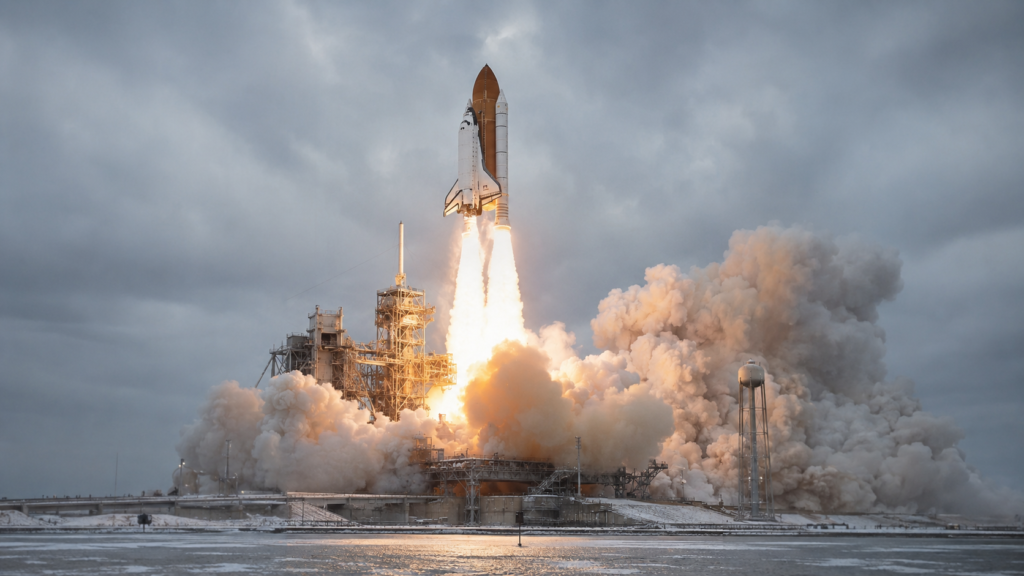
At 11:38:00 a.m. Eastern Standard Time, Challenger lifted off from Launch Complex 39B at Kennedy Space Center.
Initially, everything appeared normal.
The Shuttle climbed into the sky.
The engines were operating.
The vehicle followed its planned trajectory.
Millions of people watching the launch had no reason to believe that anything catastrophic was about to happen.
But evidence from cameras later showed something unusual.
The First Signs of Failure
During the early moments of flight, a brief dark plume and abnormal flame appeared near the aft field joint of the right Solid Rocket Motor.
This was the area containing the O-ring seals.
The leak was initially small.
But combustion gases escaping from the joint could cause severe damage.
The vehicle continued climbing.
For several seconds, the Shuttle appeared to remain under control.
Then the situation rapidly deteriorated.
The escaping hot gases damaged surrounding structures and ultimately affected the External Tank.
At approximately 73 seconds after liftoff, the External Tank ruptured, releasing and igniting its propellants. The resulting forces subjected the Shuttle to extreme aerodynamic and structural loads, and the vehicle broke apart.
All seven crew members were lost.
What Actually Caused Challenger to Fail?
It is tempting to describe the disaster in one sentence:
The O-ring failed because it was cold.
That is an oversimplification.
The Presidential Commission concluded that the immediate technical cause was the failure of the pressure seal in the aft field joint of the right Solid Rocket Motor.
But the Commission also found that the joint design was unacceptably sensitive to multiple factors, including:
- Temperature
- Joint dimensions
- Material characteristics
- Reusability
- Manufacturing and processing
- Dynamic loading during flight
The cold weather was therefore a crucial contributing condition, but it existed within a larger engineering problem.
The temperature at launch was only part of the story.
Why Was the Cold So Important?
The O-rings needed to respond quickly during the initial pressure increase when the Solid Rocket Motor ignited.
At lower temperatures, the material became less flexible.
The Rogers Commission’s investigation found evidence that reduced temperature increased the O-ring response time. Testing also demonstrated significant changes in the material’s behaviour as temperature decreased.
The launch conditions were particularly concerning because the Solid Rocket Booster hardware had become extremely cold.
The investigation estimated that the temperature at the coldest point of the right aft field joint was around 28°F, with an uncertainty of several degrees.
This was far outside the conditions of many earlier Shuttle flights.
The critical lesson was that a component that had performed acceptably under previous conditions could behave differently when the environment changed.
The Role of Decision-Making
The technical failure explains how the accident began.
But it doesn’t fully explain why the Shuttle was launched under those conditions.
The Rogers Commission found serious flaws in the decision-making process.
According to the Commission, decision-makers were not aware of the complete recent history of O-ring problems, the initial recommendation from Thiokol against launching at temperatures below 53°F, or the continuing opposition from engineers after management changed its recommendation.
The Commission also criticized communication within NASA.
It found evidence that potentially serious problems were sometimes contained within management channels rather than communicated effectively to higher levels of the organization.
This transformed the meaning of Challenger.
It was no longer simply an engineering story.
It became a story about how technical information moves through an organization—and what happens when warnings do not receive the attention they deserve.
🧠 CurioReader Insight: In complex engineering systems, a disaster may begin with a physical failure, but the conditions that allow that failure to become catastrophic can develop through many earlier decisions.
The Ice on the Launch Pad
The severe cold also created another visible problem: ice.
Large quantities of ice had accumulated around the launch complex.
Teams conducted inspections and worked to assess whether the ice presented a hazard. The Rogers Commission later concluded that the ice itself was not the cause of the Challenger accident, although it considered the launch conditions highly questionable and criticized the inadequate freeze-protection arrangements.
This distinction is important.
It is easy to look at photographs of the heavily iced launch pad and conclude that the ice caused the accident.
It did not.
The critical technical failure involved the Solid Rocket Motor joint.
But the extreme cold was directly relevant to the O-ring problem.
So the launch environment mattered—but not in the simplest way.
The Investigation
The loss of Challenger led to an extensive investigation.
President Ronald Reagan established the Presidential Commission on the Space Shuttle Challenger Accident, commonly known as the Rogers Commission.
The investigation examined:
- Engineering evidence
- Recovered hardware
- Launch photographs and video
- Telemetry
- Previous Shuttle missions
- O-ring performance
- Temperature effects
- NASA decision-making
- Contractor relationships
- Communication
- Safety procedures
The investigation ultimately concluded that the accident had both a technical cause and contributing organizational causes.
The technical cause was the failure of the Solid Rocket Motor joint seal.
But the investigation also identified failures in decision-making and communication that allowed a known area of concern to remain unresolved.
Challenger Changed the Shuttle Program
The disaster resulted in a major reassessment of the Space Shuttle system.
NASA redesigned the Solid Rocket Booster joints and made significant changes to the Shuttle program’s safety and management processes.
The program did not simply return to flight as though nothing had happened.
The accident demonstrated that successful previous missions were not enough to establish that every aspect of the system was safe.
A component could show warning signs repeatedly without causing immediate catastrophe.
That did not make the warning less important.
In fact, Challenger demonstrated the opposite.
A warning that does not produce an accident is still a warning.
🛡️ CurioReader Safety Insight: One of the most important lessons from Challenger is that organizations should not wait for a failure before taking recurring warning signs seriously.
The Shuttle program eventually returned to flight, but the memory of Challenger remained deeply embedded in NASA’s approach to risk.
Seventeen years later, another Shuttle would expose a different vulnerability.
This time, the problem would not begin with an O-ring.
It would begin with a piece of insulating foam striking the spacecraft during launch.
That spacecraft was Columbia.
Columbia — February 1, 2003
Seventeen years after Challenger, the Space Shuttle program faced another catastrophe.
This time, the spacecraft did not break apart shortly after launch. Columbia completed its launch, spent 16 days in orbit conducting scientific research, and began its scheduled return to Earth. The danger had been created during the first minutes of the mission, but its consequences would not become fatal until re-entry.
The mission was STS-107, and Columbia carried seven astronauts: Commander Rick Husband, Pilot William McCool, Mission Specialists Michael Anderson, Kalpana Chawla, David Brown and Laurel Clark, and Payload Specialist Ilan Ramon. The crew conducted a wide range of scientific experiments during the mission.
The Launch of Columbia
Columbia launched from Kennedy Space Center on January 16, 2003.
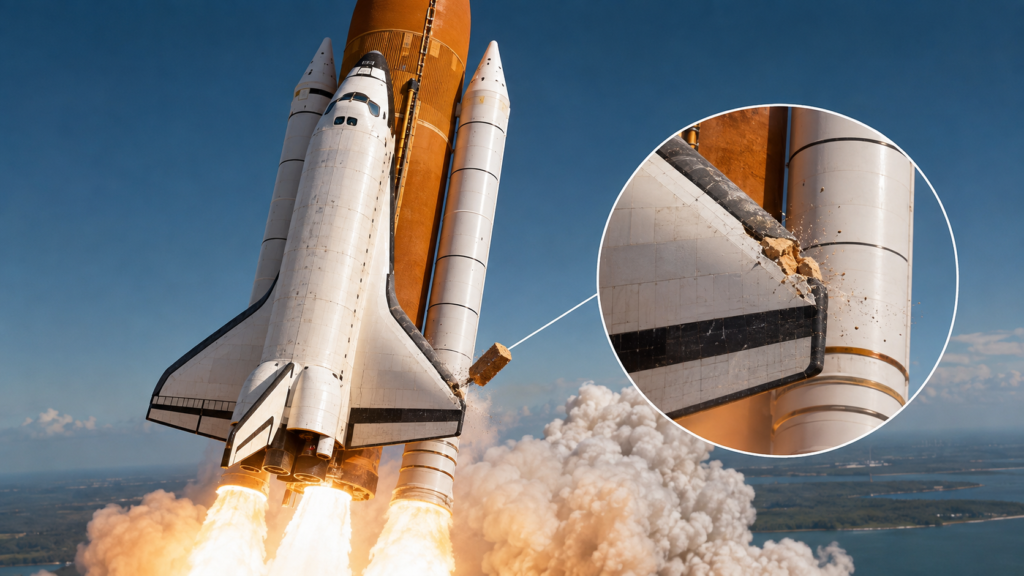
During ascent, approximately 81.7 seconds after liftoff, a large piece of insulating foam separated from the External Tank and struck the leading edge of Columbia’s left wing. The Columbia Accident Investigation Board later identified this event as the physical cause that initiated the accident.
At the time, however, the event did not appear to have caused an immediate crisis.
The Shuttle continued climbing.
The spacecraft reached orbit.
The crew carried out its planned scientific activities.
From the perspective of the mission, everything appeared to be proceeding normally.
But the foam strike had created damage to the Shuttle’s Thermal Protection System.
That damage would remain hidden for most of the mission.
Why Did a Piece of Foam Matter?
To understand the Columbia disaster, it is necessary to understand what protected the Shuttle during re-entry.
When a spacecraft returns to Earth from orbit, it encounters the atmosphere at extremely high speed. The air surrounding the spacecraft becomes intensely heated.
The Shuttle therefore required a Thermal Protection System, including heat-resistant materials along the orbiter’s most exposed surfaces.
The leading edges of the wings were protected by Reinforced Carbon-Carbon (RCC) panels.
These components had to withstand extraordinarily high temperatures during atmospheric entry.
🚀 Science & Engineering Background: The Shuttle’s thermal protection system was not simply designed to keep the spacecraft comfortable. It protected the vehicle’s structure from the extreme heating produced as the orbiter passed through the atmosphere at orbital-entry speeds.
The foam that struck Columbia was part of the insulation on the External Tank.
The purpose of the insulation was to reduce the formation of ice on the tank and help protect its cryogenic propellants from heat.
But pieces of foam had separated from the tank on earlier Shuttle missions.
This history would later become extremely important.
The Foam Strike
The piece of foam came from the left bipod ramp area of the External Tank, where the tank connected with the orbiter.
The Columbia Accident Investigation Board determined that the foam struck the left wing in the vicinity of RCC panel 8. Impact testing later demonstrated that foam could cause significant damage to the RCC leading edge, including damage large enough to compromise the protective system.
The event happened extremely quickly.
A piece of foam separated from the External Tank.
It travelled across the airflow.
It struck the wing.
And then it disappeared from view.
The Shuttle continued into orbit.
The crew was not aware that a potentially catastrophic vulnerability had been created.
Why Was the Damage So Difficult to Understand?
One of the challenges was that the Shuttle had experienced foam shedding before.
Previous missions had seen pieces of insulation separate from the External Tank without causing catastrophic damage.
This history influenced how the risk was perceived.
The fact that something had happened repeatedly without destroying an orbiter could make the event appear less serious than it actually was.
But the Columbia accident demonstrated an important engineering principle:
The fact that a problem has happened before without causing a disaster does not mean that the problem is harmless.
The size, location, speed and angle of an impact can all influence its consequences.
A piece of debris hitting one location may cause little damage.
The same type of debris hitting a more vulnerable location can produce a very different result.
🧠 CurioReader Insight: Risk cannot always be judged by asking whether something caused problems in the past. Engineers also need to consider where, how, and under what circumstances the next failure could occur.
Concerns About the Damage
After the foam strike was observed, engineers and analysts began examining imagery and available information.
There were discussions within NASA about whether the impact represented a significant threat to the Shuttle.
The issue was complicated by the limited ability to determine exactly what had happened to the wing.
The available imagery did not provide enough information to establish the full extent of the damage.
NASA’s Mission Management Team eventually concluded that the debris impact did not pose a safety-of-flight concern. NASA’s historical records show that analyses conducted during the mission were presented to management and that the conclusions did not identify the foam strike as a threat requiring emergency action.
The Columbia Accident Investigation Board later concluded that the organization had failed to adequately recognize the seriousness of the debris strike.
This became one of the central lessons of the accident.
The problem wasn’t simply:
“Nobody knew the foam had hit the wing.”
People did know that foam had struck the orbiter.
The deeper problem was determining what that information meant—and whether enough effort was made to find out.
Columbia Returned to Earth
After completing its mission, Columbia began preparing for its return.
On February 1, 2003, Commander Rick Husband and Pilot William McCool performed the de-orbit burn.
Columbia then entered the atmosphere over the Pacific Ocean and began the long descent toward Kennedy Space Center.
At first, the spacecraft was behaving normally.
But as it entered the increasingly dense atmosphere, temperatures began rising around the orbiter.
This was when the hidden damage became critical.
The Damaged Wing Meets the Atmosphere
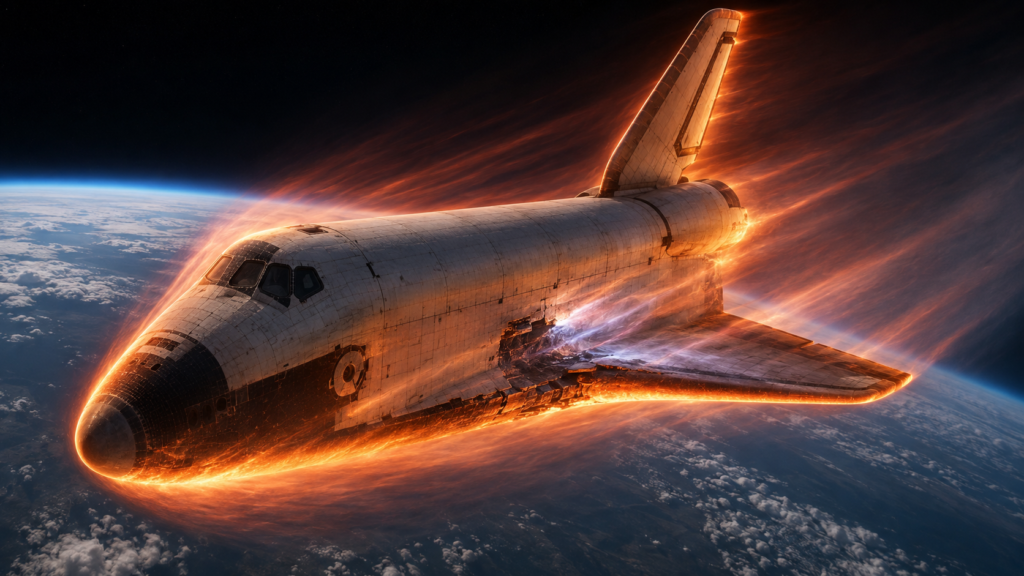
During normal re-entry, the Shuttle’s thermal protection system was designed to prevent the extreme heat surrounding the spacecraft from reaching its internal structure.
But Columbia’s left wing had been damaged.
The breach provided a pathway for superheated atmospheric gases to enter the wing.
The hot gases began damaging internal structures.
Sensors started showing unusual readings.
Temperatures in parts of the left wing began behaving differently from normal.
NASA’s chronology records increasing numbers of abnormal sensor readings as Columbia travelled across the western United States.
At this point, the spacecraft was moving extremely fast.
The problem was escalating rapidly.
The First Signs in Mission Control
The spacecraft’s sensors began producing unusual information.
The left wing showed abnormal temperature behaviour.
Hydraulic and landing-gear sensor readings began changing.
The Shuttle’s systems were beginning to experience the consequences of the damage.
Mission Control received some of these indications, but the situation developed extremely quickly.
At approximately 8:54 a.m. Central Standard Time, Mission Control became aware of multiple abnormal hydraulic sensor readings associated with the left wing.
Observers on the ground were also reporting debris leaving the orbiter.
The crew was experiencing a rapidly deteriorating situation.
But there was almost no time left.
The Loss of Columbia
At approximately 8:59:32 a.m. Central Standard Time, the final communication from the crew was received.
Seconds later, Columbia disintegrated over Texas.
The vehicle and all seven crew members were lost.
The disaster happened during a normal return from space.
The crew had completed their mission.
They were on their way home.
The physical damage that ultimately caused the accident had occurred more than two weeks earlier, during launch.
That long delay between the initiating event and the final catastrophe made Columbia particularly difficult to understand.
What Caused Columbia to Break Apart?
The Columbia Accident Investigation Board concluded that the accident began when foam separated from the External Tank and struck the left wing.
The impact damaged the wing’s RCC thermal protection system.
During re-entry, extremely hot gas entered through the damaged area.
The heat then damaged the wing’s internal structure.
As the damage progressed, Columbia lost the ability to maintain controlled flight.
The vehicle eventually broke apart.
The chain can therefore be simplified as:
Foam separation
↓
Foam strikes left wing
↓
RCC thermal protection damaged
↓
Hot atmospheric gases enter the wing
↓
Internal wing structure is damaged
↓
Vehicle control is lost
↓
Orbiter breaks apart
The important point is that the foam did not directly destroy Columbia at launch.
It created a vulnerability.
That vulnerability remained hidden until the spacecraft encountered the extreme conditions of atmospheric re-entry.
Why Was the Foam Strike So Dangerous?
The Shuttle’s wing leading edge was designed to withstand severe heating.
But its protective materials had limits.
The Columbia investigation conducted extensive testing to understand what a foam impact could actually do.
The testing demonstrated that foam could damage RCC material, with impact tests producing damage ranging from cracks to a hole measuring approximately 16 by 17 inches in some tests.
This was significant because the damage did not need to destroy the entire wing.
It only needed to create a pathway through the thermal protection system.
Once hot gas entered the structure during re-entry, the consequences could become catastrophic.
🔥 Science & Engineering Background: During re-entry, the Shuttle’s thermal protection system had to isolate the vehicle’s structure from extreme aerodynamic heating. A breach in a critical location could allow hot gas to penetrate behind the protective surface, where the internal materials were not designed to withstand those temperatures.
The Investigation Goes Beyond the Foam
Just as the Challenger investigation went beyond the O-ring, the Columbia investigation went beyond the foam.
The Columbia Accident Investigation Board (CAIB) conducted an independent investigation lasting nearly seven months.
It involved experts from numerous technical disciplines and examined both the physical accident and the organizational environment in which the Shuttle program operated.
The Board concluded that the physical cause was the foam strike and resulting breach in the left wing’s thermal protection system.
But it also identified deeper organizational causes.
NASA’s own safety materials summarize these factors as including:
- Historical compromises in the Shuttle program
- Resource constraints
- Changing priorities
- Schedule pressures
- Treating the Shuttle as an operational system rather than a developmental one
- Lack of a clear national vision for human spaceflight
This was a crucial finding.
The Columbia disaster was not simply:
“A piece of foam hit a wing.”
It was also about how an organization interpreted information, managed uncertainty, communicated concerns, and accepted risk.
The Culture of Risk
The CAIB identified similarities between Columbia and earlier NASA accidents, including concerns about normalization of deviance and organizational silence. NASA’s safety materials specifically identify these as cultural lessons from the Columbia accident.
The concept of normalization of deviance is important.
It describes a situation in which something outside the original expectations happens repeatedly without causing an immediate disaster.
Over time, people can begin treating that abnormal condition as normal.
In the Shuttle program, foam shedding had occurred before.
Because previous incidents had not destroyed an orbiter, the problem could gradually become perceived as less threatening.
But Columbia demonstrated that repeated survival does not prove that a condition is safe.
Could Columbia Have Been Saved?
This question has been examined extensively.
The investigation found that better imagery and analysis could potentially have provided more information about the damage.
The CAIB recommended significant improvements, including:
- Preventing hazardous foam loss
- Improving imaging of the Shuttle during ascent
- Developing better methods for inspecting the orbiter in orbit
- Developing the ability to repair the Thermal Protection System when necessary
The important lesson is not that there was necessarily one guaranteed rescue scenario.
Instead, it is that the system did not have an adequate way to characterize and respond to serious damage after it occurred.
That is a broader engineering lesson.
A system should not only be designed to prevent failures.
It should also be designed to detect, understand, and respond to failures when prevention doesn’t work.
🛡️ CurioReader Safety Insight: Safety engineering is not only about preventing every possible failure. It is also about detecting problems early, understanding their consequences, and maintaining options for recovery when something goes wrong.
The Seven Astronauts
The loss of Columbia’s crew was a tragedy for their families, colleagues, NASA, and people around the world.
The seven astronauts represented different backgrounds and areas of expertise.
Their mission was dedicated largely to scientific research, with experiments covering fields such as life sciences, physical sciences, and other areas of research.
The Columbia disaster therefore ended not only a spacecraft mission but also a major scientific expedition.
Remembering the crew is an essential part of understanding the accident.
The technical investigation explains how the vehicle was lost.
It does not reduce the event to engineering diagrams and failed components.
Behind every technical investigation are human lives.
Columbia’s Lasting Impact
The accident brought the Shuttle program to another standstill.
NASA began a major effort to understand the physical and organizational causes of the disaster and to implement the CAIB’s recommendations.
The External Tank was redesigned to reduce dangerous foam shedding.
NASA also improved systems for observing the Shuttle during launch and assessing potential damage while the spacecraft was in orbit.
In July 2005, Shuttle Discovery returned to flight, marking NASA’s return to human Shuttle missions after Columbia. NASA’s technical records describe significant changes to the External Tank and improvements in inspection and repair capabilities as part of the return-to-flight effort.
The Shuttle program continued for several more years.
But Columbia had demonstrated something that Challenger had already warned NASA about:
Technical capability alone cannot guarantee safety.
A sophisticated spacecraft can still be vulnerable when technical risks interact with human assumptions and organizational decisions.
And when the two disasters are placed side by side, their deeper similarities become difficult to ignore.
Challenger and Columbia failed for very different immediate technical reasons.
Yet both accidents exposed problems in how NASA understood risk.
That comparison provides some of the most important lessons of the entire Shuttle era.
What Challenger and Columbia Had in Common
At first glance, the Challenger and Columbia disasters appear to be completely different accidents.
Challenger was lost shortly after launch because of a failure involving the Solid Rocket Motor’s field joint and O-ring seals.
Columbia was lost during atmospheric re-entry after foam from the External Tank damaged its left wing.
The hardware, circumstances, and timelines were different.
Yet the investigations revealed something much more significant: both disasters involved a combination of technical vulnerability and organizational decision-making.
The most important lessons therefore go beyond rockets and spacecraft.
Two Different Technical Failures
The immediate physical causes were different.
Challenger
A critical seal in the right Solid Rocket Motor field joint failed to properly contain hot combustion gases. The unusually cold launch conditions contributed to the problem, while the underlying joint design had already demonstrated concerning behaviour on previous flights.
Columbia
Foam separated from the External Tank during launch and struck the left wing. The impact damaged the Thermal Protection System, allowing extremely hot gases to enter the wing during re-entry.
The simplified comparison is:
| Challenger | Columbia |
|---|---|
| Solid Rocket Motor joint | Orbiter wing |
| O-ring/seal problem | Thermal Protection System damage |
| Cold conditions were important | Foam impact was important |
| Failure occurred shortly after launch | Failure became catastrophic during re-entry |
| Concerns existed before launch | Concerns existed after the foam strike |
| Organizational factors contributed | Organizational factors contributed |
The technical mechanisms were different.
But the broader pattern was remarkably similar.
Warning Signs Existed Before Both Disasters
Perhaps the most important similarity is that neither accident emerged from a completely unknown problem.
Before Challenger, NASA and its contractors had already encountered evidence of O-ring erosion and other concerning behaviour.
Before Columbia, foam shedding from the External Tank had occurred on previous missions.
This created a dangerous psychological and organizational pattern.
When something happens repeatedly without producing a catastrophe, people can gradually become accustomed to it.
A problem can move from:
Unexpected
to
Known
to
Accepted
without anyone explicitly deciding that it is safe.
This is closely related to the concept known as normalization of deviance.
What Is Normalization of Deviance?
The term became particularly important in analyses of the Shuttle disasters.
In simple terms, normalization of deviance occurs when a system repeatedly operates outside its original expectations, but because nothing catastrophic happens immediately, the abnormal condition gradually becomes treated as acceptable.
Imagine a warning light appearing occasionally on a machine.
If the machine continues working every time, people may eventually stop treating the warning as serious.
The warning hasn’t become safer.
People have simply become accustomed to it.
The same principle can apply to complex engineering systems.
🧠 CurioReader Insight: A failure that has not happened yet is not necessarily a failure that cannot happen. Repeatedly surviving a risky condition can create false confidence if the underlying risk is never properly resolved.
Previous Success Can Create False Confidence
The Shuttle program’s successful missions were extraordinary achievements.
But success can have an unintended side effect.
People naturally learn from experience.
If a particular event happens repeatedly without causing an accident, they may conclude that the event is less dangerous than originally thought.
That reasoning can be understandable.
But it can also be dangerous when dealing with complex systems.
Consider the foam problem.
Foam had separated from the External Tank on previous missions.
The Shuttle had survived.
That history could encourage people to interpret another foam strike as a familiar inconvenience rather than a potentially catastrophic event.
The same principle appeared in the Challenger investigation.
Previous O-ring damage had occurred without destroying a Shuttle.
But that did not mean the system was safe under every combination of temperature, loading and operating conditions.
The crucial distinction is:
Previous survival demonstrates what happened before. It does not guarantee what will happen next.
Communication Can Become a Safety System
Both disasters also demonstrated the importance of communication.
In a complex organization, critical information may exist at several levels.
An engineer may discover a problem.
A technical team may discuss it.
A contractor may issue a recommendation.
Managers may evaluate the information.
Senior decision-makers may ultimately decide what happens.
At each stage, information can be misunderstood, weakened, delayed or separated from the context that made it important.
That makes communication part of the safety system.
A technically correct piece of information has limited value if the people responsible for making the final decision never receive it.
Challenger and the Communication Problem
The Rogers Commission found serious problems in the communication and decision-making process surrounding Challenger.
Information about the O-ring’s previous performance and the concerns surrounding cold temperatures was not adequately communicated to all relevant decision-makers.
The Commission concluded that the launch decision process was flawed.
The technical warning existed.
The problem was that the warning did not receive the level of attention it required.
Columbia and the Communication Problem
Columbia presented a different version of the same broader challenge.
People knew that foam had struck the orbiter.
The difficult question was whether the impact had created dangerous damage.
Engineers and analysts attempted to understand the situation, but the investigation later concluded that NASA’s organizational processes and culture prevented the seriousness of the risk from being adequately recognized.
In both cases, the question wasn’t simply:
“Did anyone know about the problem?”
It was:
“Did the right people understand the significance of the problem, and did the organization respond appropriately?”
That is a much more difficult question.
Engineers Need the Freedom to Challenge Decisions
Another major lesson concerns the relationship between technical experts and management.
Engineering decisions often involve uncertainty.
An engineer may not be able to say:
“This will definitely fail.”
Instead, they may say:
“We don’t have enough evidence to establish that this is safe.”
Those statements are very different.
The second statement does not predict failure.
It identifies uncertainty.
In high-risk environments, uncertainty itself can be important information.
If an engineer raises a concern, the organization needs a culture in which that concern can be examined without fear of embarrassment, punishment, or pressure.
The Challenger investigation revealed problems in the process through which technical concerns were communicated and ultimately overridden.
The Columbia investigation similarly examined organizational culture and decision-making.
🛡️ CurioReader Safety Insight: A healthy safety culture doesn’t require engineers to predict every disaster. It requires organizations to take credible concerns seriously enough to investigate them before accepting the risk.
Schedule Pressure and Organizational Pressure
Complex organizations operate under competing pressures.
NASA had ambitious scientific and exploration goals.
The Shuttle was expected to support a large number of missions.
There were schedules to maintain.
There were budgets to manage.
There were political expectations.
There were contractors and thousands of employees involved.
These pressures do not automatically cause accidents.
But they can influence how risk is perceived.
When a system is expected to operate routinely, an unusual delay can become frustrating.
A technical concern may be viewed as something that needs to be resolved quickly.
A launch schedule can create pressure to find reasons to proceed rather than reasons to stop.
The important lesson isn’t that schedules are inherently dangerous.
It is that schedule objectives must never silently redefine what is considered safe.
Complex Systems Rarely Fail Because of One Thing
This may be the biggest lesson from both Shuttle disasters.
It is tempting to look for one culprit.
For Challenger:
“The O-ring failed.”
For Columbia:
“Foam hit the wing.”
Those statements are technically useful.
But they are incomplete explanations of the disasters.
A more complete model looks like a chain.
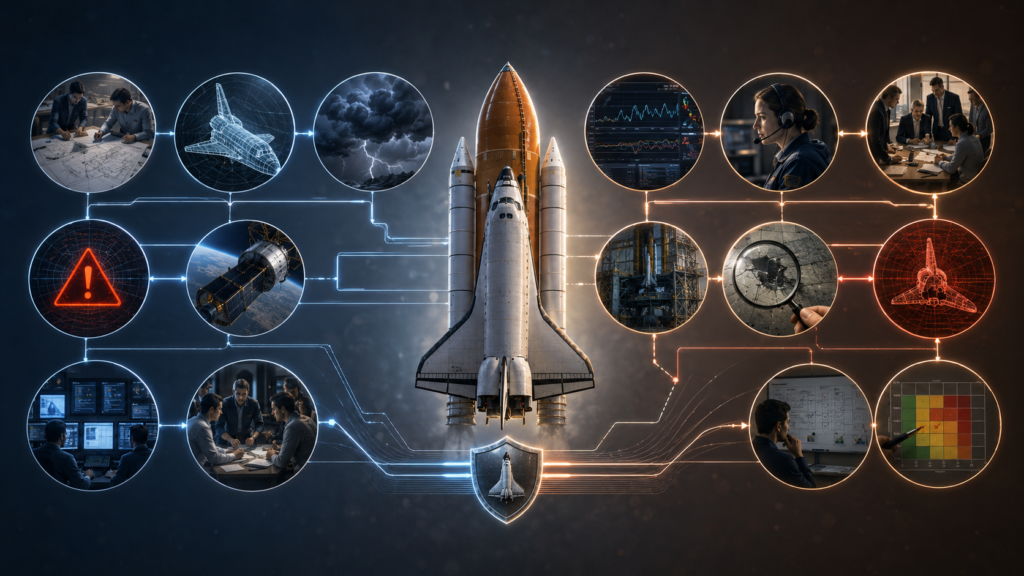
Challenger
O-ring design vulnerability
↓
Previous evidence of erosion
↓
Cold launch conditions
↓
Engineering concerns
↓
Decision-making and communication problems
↓
Launch
↓
Joint failure
↓
Vehicle destruction
Columbia
Foam shedding
↓
Previous history of foam strikes
↓
Foam impact on left wing
↓
Damage not fully characterized
↓
Organizational and communication problems
↓
Re-entry
↓
Thermal protection failure
↓
Vehicle destruction
The accident happens at the end of the chain.
But the conditions that make the accident possible can develop much earlier.
The Importance of Redundancy and Recovery
The Shuttle disasters also demonstrate that prevention is only one part of safety engineering.
A complex system should ideally have ways to:
Detect problems
Assess problems
Communicate problems
Respond to problems
Recover from problems
When something goes wrong, the organization should ask:
“What can we do now?”
rather than discovering that all possible responses have already disappeared.
Columbia made this particularly important.
Once the wing was damaged, the ability to understand the extent of the damage became crucial.
The Columbia Accident Investigation Board recommended improvements to on-orbit inspection and repair capabilities.
This reflected a broader principle:
Don’t design only for a perfect mission. Design for the possibility that something will go wrong.
Safety Must Remain Independent
Another lesson from the Shuttle investigations was the importance of independent safety oversight.
A safety organization should be capable of raising concerns without being dominated by the operational priorities of the organization it is evaluating.
This creates a healthy tension.
Operations may ask:
“Can we complete the mission?”
Safety may need to ask:
“Should we proceed?”
Those questions are not always the same.
A strong organization needs both perspectives.
Safety is not an obstacle to successful operations.
Safety is part of successful operations.
Challenger and Columbia Changed More Than NASA Hardware
After both disasters, NASA made significant technical changes.
But the lessons extended beyond physical engineering.
The organization also needed to address:
- Safety culture
- Communication
- Risk assessment
- Independent oversight
- Decision-making
- Technical dissent
- Inspection
- Emergency planning
This is important because changing a component alone cannot necessarily eliminate the conditions that allowed the component’s failure to become catastrophic.
If an organization replaces a faulty part but continues to ignore warnings, the underlying problem may remain.
In other words:
Hardware can be redesigned. Organizational behaviour must also be examined.
What These Disasters Teach Modern Organizations
The lessons from Challenger and Columbia extend far beyond spaceflight.
Aviation
Aircraft manufacturers and airlines operate complex systems where small problems can have serious consequences.
Warning signs need to be investigated rather than dismissed because previous flights were successful.
Healthcare
Medical systems depend on communication between doctors, nurses, technicians and administrators.
A warning that fails to reach the right person can become a safety issue.
Engineering
Engineers must be able to communicate uncertainty and challenge assumptions.
Technology
Software systems can also develop vulnerabilities that appear harmless until circumstances combine in an unexpected way.
Business
Companies can become vulnerable when employees stop questioning processes simply because they have always worked before.
The underlying principle is universal:
A familiar risk is still a risk.
The Human Factor in High-Technology Systems
One of the most fascinating lessons from the Shuttle disasters is that greater technological sophistication does not eliminate human responsibility.
The Shuttle was an extraordinary machine.
It contained advanced propulsion systems, computers, sensors, thermal protection, navigation systems and highly trained crews.
Yet technology alone could not guarantee safety.
People still had to:
- Design the system
- Interpret data
- Communicate concerns
- Evaluate uncertainty
- Make decisions
- Manage schedules
- Challenge assumptions
This is true of almost every complex system in modern society.
Technology can increase capability.
It can also increase complexity.
And complexity can create new ways for small problems to interact.
🔬 Science & Engineering Insight: The more interconnected a system becomes, the less useful it can be to search for a single cause. Understanding how multiple small conditions interact is often essential to understanding a major failure.
The Most Important Lesson: Listen Before the Accident
Perhaps the strongest message from Challenger and Columbia is surprisingly simple.
Listen to warnings before they become disasters.
After an accident, everyone wants to know:
“What went wrong?”
But organizations should also ask before an accident:
“What are people worried about?”
Those questions can produce very different outcomes.
A mature safety culture encourages people to raise concerns while there is still time to investigate them.
It doesn’t require certainty.
It doesn’t require proof that an accident will occur.
It requires the willingness to say:
“We don’t fully understand this risk yet.”
That statement should lead to investigation—not dismissal.
Two Disasters, One Powerful Lesson
Challenger and Columbia were separated by seventeen years.
Their technical failures were different.
Their missions were different.
The spacecraft were different.
Yet both demonstrated how technical vulnerabilities can interact with human decisions and organizational culture.
Challenger showed the consequences of launching despite serious concerns about a critical component under unusual conditions.
Columbia showed the consequences of failing to fully understand the significance of physical damage discovered during a mission.
Both demonstrated the danger of becoming accustomed to abnormal conditions.
And both showed that safety depends not only on designing reliable hardware but also on creating organizations capable of recognizing and responding to risk.
The lessons are therefore bigger than NASA.
They apply anywhere people operate complex systems.
Question assumptions.
Listen to technical experts.
Investigate recurring anomalies.
Communicate uncomfortable information.
Don’t confuse previous success with proof of future safety.
And never allow schedule or organizational pressure to quietly redefine what “safe” means.
The Shuttle program would continue after both disasters, but its future would never be quite the same.
The investigations led to significant changes in engineering, safety, inspection, and organizational practices.
And eventually, the Space Shuttle era itself would come to an end.
The next question is therefore not simply what went wrong.
It is what NASA changed after Challenger and Columbia—and what the final years of the Shuttle program looked like after these two defining tragedies.
What Changed After Challenger and Columbia?
The Space Shuttle program did not end with Challenger, and it did not end immediately after Columbia.
After each disaster, NASA investigated what had happened, redesigned hardware, changed procedures, and attempted to strengthen the way risks were identified and managed. The Shuttle eventually returned to flight after both accidents, but the program never completely escaped the lessons of its two greatest tragedies.
The changes were not limited to replacing damaged components. NASA had to reconsider how it designed, inspected, operated, and managed a complex human spaceflight system.
Rebuilding the Shuttle After Challenger
Following the Challenger accident, NASA suspended Shuttle flights while the causes were investigated and corrective measures were developed.
The Rogers Commission identified the Solid Rocket Motor field-joint problem as the technical cause of the accident and made recommendations concerning both the hardware and NASA’s management practices.
One of the most significant engineering responses was the redesign of the Solid Rocket Booster field joints.
The original configuration used two O-rings as seals. The redesigned joint incorporated changes intended to provide greater protection against the type of failure that had occurred.
NASA also introduced additional safety and management measures following the Commission’s recommendations.
The objective was not simply to make the O-rings better.
It was to create a system with greater protection against the conditions that had contributed to the accident.
🚀 Science & Engineering Background: A critical principle of safety engineering is to avoid depending on a single component behaving perfectly under every possible condition. Redesign can provide additional margins, protections, and ways to prevent one failure from escalating into a catastrophic chain.
The Return to Flight
After an extensive period of investigation and modification, the Shuttle program returned to flight.
Space Shuttle Discovery launched mission STS-26 on September 29, 1988, marking the first Shuttle mission since Challenger.
The return was about more than simply demonstrating that the redesigned hardware worked.
NASA needed to demonstrate that the organization had responded to the lessons of Challenger.
The Shuttle program continued for many years after the accident.
Discovery, Atlantis, Columbia and Endeavour would go on to fly numerous missions.
The return to flight demonstrated that the Shuttle system could be modified and operated again.
But it also created a continuing responsibility:
Safety improvements could not be treated as a one-time response.
Risk had to be reassessed continuously.
Lessons From Challenger Extended Beyond the Hardware
One of the strongest lessons from Challenger was that improving a physical component was only part of the solution.
The Rogers Commission had identified problems in NASA’s decision-making and communication.
This meant that NASA also needed to improve the organizational environment in which technical decisions were made.
A safer system requires people to be able to say:
“We have a concern.”
And the organization must have mechanisms for making sure that concern reaches the people who need to hear it.
This principle became particularly important after Columbia.
Columbia Forced NASA to Reconsider the Shuttle Again
When Columbia was lost in 2003, NASA once again suspended Shuttle operations.
The Columbia Accident Investigation Board examined both the physical cause and the organizational circumstances surrounding the accident.
The Board’s findings led to extensive recommendations.
NASA needed to reduce the likelihood of dangerous foam shedding.
But it also needed better ways to determine whether an orbiter had been damaged during launch.
That meant improving the ability to observe, inspect and respond.
Reducing Foam Hazards
The External Tank became one of the major engineering priorities after Columbia.
The investigation established that foam from the tank had struck Columbia’s wing.
NASA therefore worked to redesign and modify the tank to reduce the likelihood of significant foam debris separating during ascent.
This was a major change in thinking.
The objective was not simply to accept that foam might separate and hope that it would not cause serious damage.
The goal was to reduce the hazard itself.
That is an important general engineering principle:
When a known hazard can be eliminated or reduced, don’t simply become better at accepting it.
Better Inspection of the Orbiter
Another major change involved the ability to inspect the Shuttle.
Before Columbia, the Shuttle had limited capability to determine whether serious damage had occurred to its Thermal Protection System while in orbit.
After Columbia, NASA significantly expanded inspection capabilities.
Astronauts could use tools and cameras to examine areas of the orbiter that might have been damaged during launch.
The Shuttle program also developed procedures and equipment intended to provide better information about the condition of the spacecraft.
This addressed a fundamental problem revealed by Columbia:
What happens if you suspect that something has gone wrong but cannot determine how serious it is?
A good safety system needs an answer.
Developing the Ability to Repair Damage
Inspection is useful only if it can lead to action.
Following Columbia, NASA also considered and developed greater capabilities for repairing Thermal Protection System damage.
This changed the philosophy surrounding Shuttle missions.
The spacecraft needed not only to survive launch and re-entry under normal circumstances.
It also needed ways to respond if something went wrong.
The possibility of repairing certain types of damage could provide another layer of protection.
🛡️ CurioReader Safety Insight: The strongest safety systems don’t depend entirely on preventing mistakes. They also create opportunities to detect problems and recover before a small problem becomes an irreversible failure.
A Different Approach to Risk
Columbia also reinforced the importance of understanding uncertainty.
After the foam strike, NASA had information indicating that the orbiter had been hit.
But the organization did not have enough information to confidently determine the extent of the damage.
This created an important safety question:
When you don’t know whether something is dangerous, should you treat the uncertainty itself as a reason for further investigation?
The post-Columbia changes placed greater emphasis on gathering evidence rather than simply relying on previous experience.
That meant improving:
- Imaging
- Analysis
- Inspection
- Engineering assessment
- Communication
- Independent safety review
The objective was to make it harder for uncertainty to disappear simply because a mission needed to continue.
Strengthening Safety Culture
The lessons of Challenger and Columbia eventually became closely associated with the idea of safety culture.
Safety culture refers broadly to the attitudes, behaviours, systems and organizational practices that influence how an organization identifies and responds to risk.
A strong safety culture encourages people to report concerns.
It gives technical experts a meaningful voice.
It creates independent mechanisms for reviewing risk.
And it avoids treating safety as something that matters only after an accident.
NASA’s post-accident reforms therefore included organizational as well as technical changes.
The goal was to make safety part of everyday decision-making.
The Shuttle Became More Closely Scrutinized
After Columbia, Shuttle missions were subjected to extensive inspection and monitoring.
NASA introduced improved methods of observing the vehicle during launch.
The Shuttle could also be inspected in orbit.
Mission teams had more procedures for responding to potential damage.
This represented an important change from the earlier approach.
Instead of assuming that the spacecraft was safe unless there was evidence otherwise, NASA increasingly emphasized obtaining evidence that the spacecraft remained safe.
That distinction matters.
Assumption:
“We haven’t found a problem.”
Evidence-based approach:
“We have investigated the relevant risk and have evidence that the spacecraft is safe.”
Those statements are not equivalent.
Discovery Returns to Space
After the Columbia investigation and extensive modifications, the Shuttle returned to flight.
Space Shuttle Discovery launched STS-114 on July 26, 2005.
The mission was specifically important as NASA’s return to Shuttle operations after the Columbia accident.
But the mission itself demonstrated that the foam problem had not been completely eliminated.
During ascent, additional pieces of foam and other debris were observed.
NASA therefore continued working to understand and reduce the hazard.
This is another important lesson from complex engineering:
Fixing a problem once does not necessarily mean the problem has been completely solved.
Engineering improvement is often an iterative process.
The Final Years of the Space Shuttle
The Shuttle program continued after Columbia.
NASA’s remaining orbiters—Discovery, Atlantis and Endeavour—completed additional missions.
The program made major contributions to science and space exploration, including:
- Deployment and servicing of satellites
- Scientific research
- Construction and servicing of the International Space Station
- Deployment and servicing of the Hubble Space Telescope
- International cooperation
- Long-duration human spaceflight operations
The Shuttle program ultimately completed 135 missions.
Its final mission was STS-135, flown by Atlantis in July 2011.
Atlantis landed at Kennedy Space Center on July 21, 2011, bringing the Shuttle era to an end.
Why Did the Shuttle Program End?
The Shuttle was an extraordinary technological achievement, but it was also expensive and complex to operate.
NASA increasingly shifted its human-spaceflight strategy toward other systems and objectives.
The Shuttle’s retirement was not simply a consequence of Challenger and Columbia.
The program had already faced questions about cost, operational complexity, safety and long-term sustainability.
The two disasters nevertheless influenced how NASA viewed the risks associated with continued Shuttle operations.
By 2011, the Shuttle had completed its historic mission.
The era that began with Columbia’s first launch in 1981 had come to an end.
What Challenger and Columbia Changed Forever
The two accidents changed NASA’s understanding of risk in several important ways.
1. Known problems must remain visible
A problem shouldn’t become invisible simply because it has occurred repeatedly without causing a disaster.
2. Engineers need a voice
Technical concerns need to reach decision-makers without being weakened by organizational hierarchy.
3. Uncertainty requires investigation
Not knowing whether something is dangerous isn’t the same as knowing that it is safe.
4. Systems need multiple layers of protection
Prevention, detection, inspection and recovery should work together.
5. Safety culture matters
An organization can possess excellent technology and still make unsafe decisions.
6. Previous success is not proof of future safety
A system that has worked successfully many times can still contain hidden vulnerabilities.
🧠 CurioReader Insight: Challenger and Columbia demonstrate that safety is not a final feature added to a complex system. It is an ongoing process of questioning assumptions, examining evidence, communicating concerns and learning from experience.
The Lessons Reach Far Beyond Spaceflight
The Shuttle disasters are often studied by engineers, safety professionals and organizational researchers because their lessons apply to many other industries.
An aircraft manufacturer can learn from them.
A hospital can learn from them.
A technology company can learn from them.
A construction company can learn from them.
A government agency can learn from them.
The specific technology may change, but the underlying human challenges remain familiar.
People can become accustomed to abnormal conditions.
Warnings can fail to reach decision-makers.
Successful experience can create excessive confidence.
Organizational pressure can influence risk decisions.
And complex systems can fail through combinations of seemingly manageable problems.
That is why Challenger and Columbia remain relevant decades after their accidents.
The Most Important Lesson Is About Listening
Perhaps the deepest lesson from both disasters is not about rockets, O-rings or foam.
It is about listening.
Listening to engineers.
Listening to data.
Listening to people who raise uncomfortable questions.
Listening when something doesn’t behave as expected.
And listening even when the evidence doesn’t yet provide a complete answer.
A warning doesn’t need to predict a disaster with certainty to deserve attention.
A concern doesn’t need to be proven correct before it is investigated.
A recurring anomaly doesn’t become safe simply because people have become familiar with it.
The safest organizations are not those that never encounter problems.
They are organizations that are willing to recognize problems early and respond before those problems become irreversible.
Remembering Challenger and Columbia
The history of the Space Shuttle cannot be told only through launches, scientific achievements and technological milestones.
It must also remember the fourteen astronauts who lost their lives.
The Challenger crew:
- Francis R. Scobee
- Michael J. Smith
- Ronald E. McNair
- Ellison S. Onizuka
- Judith A. Resnik
- Gregory Jarvis
- Christa McAuliffe
And the Columbia crew:
- Rick D. Husband
- William C. McCool
- Michael P. Anderson
- Kalpana Chawla
- David M. Brown
- Laurel B. Clark
- Ilan Ramon
They were not simply names associated with two accidents.
They were astronauts, scientists, engineers, educators, pilots and explorers who accepted the risks of human spaceflight in pursuit of exploration and discovery.
The lessons learned from their missions continue to influence how complex systems are designed and operated.
From Tragedy to Learning
The Shuttle program’s history contains an important paradox.
It demonstrated what humans can achieve through engineering, science and international cooperation.
It also demonstrated the limits of technology.
Challenger showed that a relatively small component and an unfavorable environment could become catastrophic when combined with weaknesses in decision-making.
Columbia showed that a relatively small piece of debris could create hidden damage that remained invisible until the spacecraft entered one of the most demanding phases of flight.
Neither disaster can be adequately explained by saying that one component failed.
The deeper stories involve technology, people, communication, organizational culture and decisions.
That is why these accidents continue to matter.
🔬 CurioReader Science & Engineering Insight: The greatest value of studying a catastrophic failure is not simply discovering what broke. It is understanding why the system allowed the failure to develop, why warning signs were missed or underestimated, and what can be changed so that similar conditions do not produce another tragedy.
The Space Shuttle era eventually ended in 2011, but its legacy continues.
Its successes helped shape modern space exploration.
Its failures changed the way NASA approached risk.
And the lessons of Challenger and Columbia remain relevant wherever humans depend on complex systems that must work correctly under extreme conditions.
The final lesson is perhaps the simplest:
Technology can be extraordinarily reliable without ever being perfectly safe.
Safety depends not only on building better machines.
It depends on building organizations capable of questioning them, monitoring them, and responding when something doesn’t look right.
Frequently Asked Questions
What caused the Space Shuttle Challenger disaster?
Challenger was lost 73 seconds after launch on January 28, 1986. The immediate technical cause was the failure of a pressure seal in the field joint of the right Solid Rocket Motor. The unusually cold launch conditions contributed to the failure, while the investigation also identified problems with the joint design, communication, and launch decision-making.
What caused the Space Shuttle Columbia disaster?
Columbia was lost during atmospheric re-entry on February 1, 2003. During launch, a piece of insulating foam separated from the External Tank and struck the orbiter’s left wing. The impact damaged the wing’s Thermal Protection System. During re-entry, extremely hot atmospheric gases entered through the damaged area, eventually causing the spacecraft to break apart.
How many astronauts died in the Challenger and Columbia disasters?
Seven astronauts died in the Challenger accident and seven in the Columbia accident, resulting in the loss of 14 crew members in total.
Was the Challenger disaster caused only by cold weather?
No. Cold weather was an important contributing factor, but it was not the entire explanation. The investigation identified weaknesses in the Solid Rocket Motor joint and O-ring design, along with organizational and decision-making problems. The accident resulted from several interacting factors rather than a single cause.
Could NASA have known that Columbia was in danger?
NASA knew that foam had struck Columbia during launch. The major difficulty was determining how serious the resulting damage was. The Columbia Accident Investigation Board concluded that NASA’s processes and organizational culture did not adequately recognize and respond to the potential significance of the foam strike.
What did NASA change after the two Shuttle disasters?
NASA made substantial technical and organizational changes. These included redesigning the Solid Rocket Booster joints after Challenger, reducing External Tank foam hazards after Columbia, improving launch observation and imaging, expanding on-orbit inspection capabilities, developing repair capabilities, and strengthening safety and risk-management practices.
What is “normalization of deviance”?
Normalization of deviance describes a situation in which something outside expected conditions occurs repeatedly without causing an immediate catastrophe. Over time, people can begin treating that abnormal condition as normal or acceptable.
The concept became particularly important in discussions of the Shuttle disasters because both accidents involved problems that had appeared before without immediately destroying a spacecraft.
When did the Space Shuttle program end?
The Space Shuttle program ended in 2011. Space Shuttle Atlantis flew the final mission, STS-135, and landed at Kennedy Space Center on July 21, 2011.
Key Takeaways
- The Space Shuttle was one of the most complex technological systems ever developed for human spaceflight.
- Challenger and Columbia were caused by different technical failures.
- Challenger involved the failure of a Solid Rocket Motor field-joint seal.
- Columbia involved damage to the orbiter’s left wing after an External Tank foam impact.
- Neither disaster can be fully understood by looking at the immediate physical failure alone.
- Both investigations identified important organizational and decision-making problems.
- Previous successful missions can create dangerous confidence if recurring anomalies are treated as acceptable.
- Engineers and technical specialists need effective channels for communicating safety concerns.
- Uncertainty about a potential hazard should encourage investigation rather than automatically being interpreted as evidence of safety.
- Complex systems need ways to prevent, detect, assess, and respond to failures.
- Safety culture can be just as important as hardware design.
- The lessons from Challenger and Columbia apply beyond spaceflight to aviation, engineering, healthcare, technology, and other complex industries.
- The Shuttle program continued after both disasters and eventually completed 135 missions before its retirement in 2011.
🧠 CurioReader Insight: The most valuable lesson from a disaster is not simply identifying the component that failed. It is understanding the chain of decisions and conditions that allowed that failure to become catastrophic.
Conclusion: What the Space Shuttle Disasters Really Teach Us
The stories of Challenger and Columbia are among the most important chapters in the history of human spaceflight.
They contain extraordinary engineering achievements, scientific discoveries, human courage—and two devastating failures.
Challenger demonstrated how a relatively small engineering vulnerability could become catastrophic when combined with environmental conditions, incomplete understanding of risk, and weaknesses in organizational decision-making.
Columbia demonstrated a different version of the same broader problem. A piece of foam struck the spacecraft during launch, creating damage that remained hidden until the vehicle encountered the extreme environment of atmospheric re-entry.
The two accidents therefore had different technical causes.
But their deeper lessons overlap.
A warning should not become less important simply because nothing went wrong last time.
A recurring problem should not automatically become an accepted problem.
A lack of evidence that something is dangerous is not necessarily evidence that it is safe.
And perhaps most importantly, people must be able to communicate uncomfortable information before a decision becomes irreversible.
🚀 CurioReader Science & Engineering Insight: Complex systems are rarely protected by one perfect component or one perfect decision. Safety comes from layers of engineering, monitoring, communication, independent review, preparation, and the willingness to question assumptions.
The Space Shuttle program ultimately continued for many years after both disasters.
NASA returned the Shuttle to flight after Challenger.
It returned again after Columbia.
The spacecraft were redesigned, inspection procedures were strengthened, and new approaches to risk management were introduced.
The program eventually completed its final mission in 2011.
But the legacy of Challenger and Columbia is not measured only by the number of missions that followed them.
It is also measured by what engineers, scientists, managers, astronauts, and organizations learned from the failures.
That is perhaps the most meaningful way to remember the fourteen astronauts who lost their lives.
Not by treating their deaths as simply historical events, but by continuing to learn from the circumstances that led to them.
The Shuttle era showed that humans can build machines capable of travelling beyond Earth, conducting complex scientific missions, and returning safely through the atmosphere.
It also showed that advanced technology does not eliminate human responsibility.
People still have to question.
People still have to listen.
People still have to investigate.
People still have to make difficult decisions when the evidence is incomplete.
And people must be willing to stop and reconsider when something doesn’t look right.
That lesson reaches far beyond space exploration.
Whether the system is a spacecraft, aircraft, hospital, power station, software platform, or industrial facility, the same principle applies:
Safety depends not only on how well a system is designed, but also on how seriously people respond when that system begins telling them something is wrong.
Challenger and Columbia were tragedies.
But they also became powerful lessons in engineering, leadership, communication, and organizational responsibility.
Their stories remind us that progress is not simply about building more powerful technology.
It is about becoming better at understanding its limitations—and having the courage to act when those limitations become visible.
The greatest lesson from the Space Shuttle disasters is simple: listen to the warning before the warning becomes the accident.
Further Reading & Resources
Continue your learning journey with more expert guides and insightful articles from CurioReader. Explore related topics below to deepen your understanding and discover new perspectives.
Related CurioReader Articles
- The History of Moon Exploration (1959–Present): From Apollo to Artemis.
- The Complete Guide to the Universe: Everything We Know About Space.
Recommended External Resources