Introduction
The History of Moon Exploration. For thousands of years, the Moon was an object of observation, mythology and scientific curiosity. Humans could study its changing phases and movements, but the lunar surface remained completely inaccessible.
That changed in the second half of the 20th century.
Beginning with robotic spacecraft in the late 1950s, humanity gradually transformed the Moon from a distant object in the night sky into a world that could be photographed, mapped, measured and eventually visited.
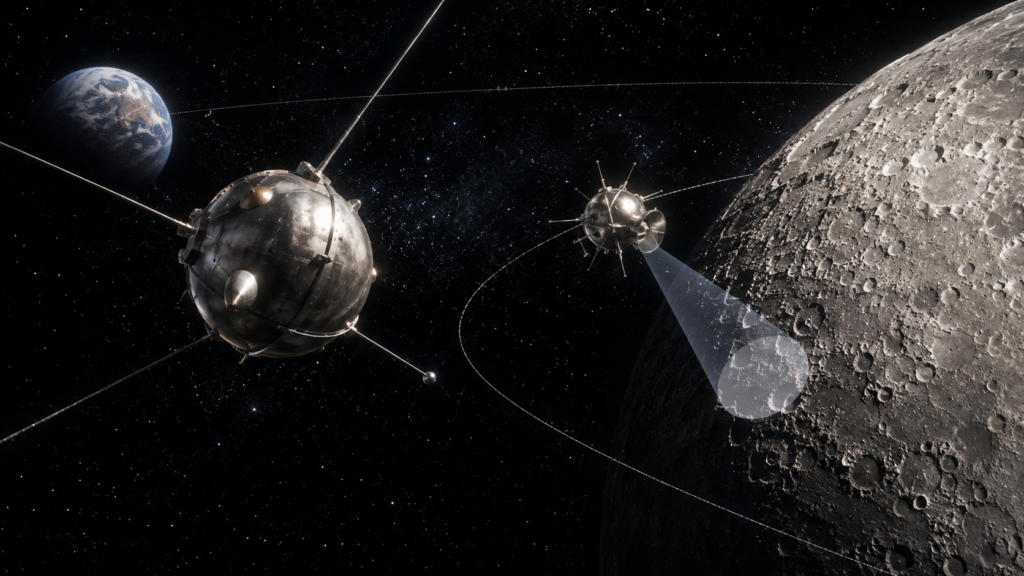
The first major breakthroughs came during the Cold War, when the United States and Soviet Union competed for technological and political prestige. The Soviet Luna 1 became the first spacecraft to fly past the Moon in 1959, followed by Luna 2’s impact and Luna 3’s first photographs of the lunar far side.
A decade later, Apollo 11 carried the first humans to the lunar surface.
The Apollo program achieved six successful crewed lunar landings between 1969 and 1972, with 12 astronauts walking on the Moon and bringing approximately 382 kilograms of lunar rocks and soil back to Earth.
After Apollo ended, lunar exploration entered a quieter period. Robotic spacecraft gradually returned to the Moon, revealing new information about its geology, gravity, surface composition and polar regions.
Today, lunar exploration is entering another major phase.
NASA’s Artemis program, together with missions from other countries and private companies, aims to establish a sustained human and robotic presence around and on the Moon.
The history of lunar exploration is therefore not simply a story about reaching the Moon.
It is a story about how our understanding of another world has changed—and why humanity is preparing to return.
The First Race to the Moon: 1959–1966
The modern era of lunar exploration began during the early Space Age.
After the Soviet Union launched Sputnik 1 in 1957, both superpowers began developing spacecraft capable of reaching the Moon.
The Soviet Union achieved several historic firsts.
In January 1959, Luna 1 became the first spacecraft to fly past the Moon. It did not hit its intended target, but it successfully entered an orbit around the Sun and demonstrated that spacecraft could travel beyond Earth’s immediate neighbourhood.
Later that year, Luna 2 became the first spacecraft to reach the lunar surface by impacting it.
Then came Luna 3.
In October 1959, Luna 3 photographed the Moon’s far side for the first time.
This was an extraordinary achievement because the far side of the Moon cannot be seen directly from Earth.
The photographs revealed a landscape that looked surprisingly different from the familiar near side, with fewer of the large dark maria that dominate the visible hemisphere.
The United States responded with its own series of robotic missions, including the Ranger, Surveyor and Lunar Orbiter programs.
These missions were crucial because landing humans on the Moon required much more than a powerful rocket.
Engineers and scientists needed to understand the lunar surface.
Was it covered in deep dust?
Could spacecraft land safely?
What were the rocks like?
Where were suitable landing sites?
Robotic missions gradually answered these questions.
Surveyor 1, which landed in 1966, returned images and scientific measurements from the lunar surface. The Lunar Orbiter missions then photographed and mapped potential landing sites for future Apollo missions.
The Moon was no longer an unknown destination.
It was becoming a place that could be explored.
The Moon Race and the Road to Apollo
The lunar race accelerated dramatically in the 1960s.
In 1961, after Soviet cosmonaut Yuri Gagarin became the first human to orbit Earth, U.S. President John F. Kennedy challenged the United States to land a human on the Moon and return them safely before the end of the decade.
Achieving that goal required enormous technological development.
NASA developed the Mercury, Gemini and Apollo programs.
Mercury demonstrated that humans could survive and operate in space.
Gemini developed important techniques such as orbital rendezvous, docking and long-duration spaceflight.
These capabilities were essential for Apollo.
The Apollo spacecraft consisted primarily of a command module, service module and lunar module.
The astronauts would travel to lunar orbit, separate the lunar module, descend to the surface and then launch back into lunar orbit to reunite with the command module.
Every stage had to work.
The consequences of failure were potentially fatal.
By the end of the 1960s, NASA had developed the technology and experience needed for the final step.
Several hours later, Armstrong climbed down the ladder of the lunar module and became the first human to set foot on the Moon. As he placed his boot onto the dusty lunar surface, he spoke the now legendary words:
“That’s one small step for man, one giant leap for mankind.”
A few minutes later, Buzz Aldrin joined him outside. Together, the astronauts spent about two and a half hours exploring the Moon. They collected 21.5 kilograms (47.5 pounds) of lunar rocks and soil, deployed scientific instruments to study the Moon’s environment, and planted the American flag. They also left behind a commemorative plaque that read, “We came in peace for all mankind,” symbolizing that the mission represented a triumph for humanity as a whole rather than a single nation.
Meanwhile, Michael Collins continued orbiting the Moon alone aboard Columbia. Although he never walked on the lunar surface, his role was essential. He operated the command module, monitored spacecraft systems, and ensured that Armstrong and Aldrin would have a safe vehicle waiting for their return. Without his precision and expertise, the mission could not have succeeded.
Apollo 11 proved that humans could safely travel to another celestial body and return to Earth. Building on this success, NASA carried out five more successful lunar landing missions between 1969 and 1972: Apollo 12, Apollo 14, Apollo 15, Apollo 16, and Apollo 17. (Apollo 13 famously suffered an in-flight accident and returned safely without landing.) Across these missions, twelve astronauts walked on the Moon, collecting 382 kilograms (842 pounds) of lunar rocks and soil. They installed long-term scientific experiments, drove the Lunar Roving Vehicle across the surface during the later missions, and transformed scientists’ understanding of the Moon’s geology, formation, and history. The Apollo program remains one of humanity’s greatest achievements and continues to inspire new generations of explorers as space agencies prepare for a return to the Moon through the Artemis program.
A New Era of Robotic Exploration
After the Apollo program ended, human missions to the Moon paused for decades. However, robotic exploration continued.
Countries including the United States, China, India, Japan, and the European Space Agency launched orbiters, landers, and rovers to study the lunar surface in greater detail. These missions discovered evidence of water ice trapped inside permanently shadowed craters near the Moon’s poles, a finding that could support future human settlements.
Private companies have also begun developing lunar landers, opening new opportunities for commercial exploration.
Artemis and the Return to the Moon
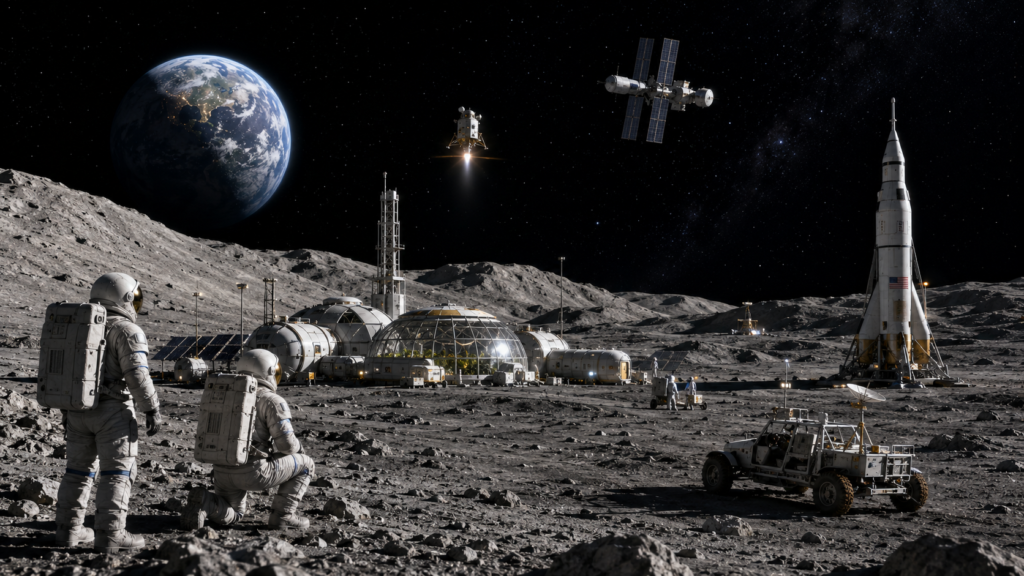
NASA’s Artemis program aims to return astronauts to the Moon for the first time since 1972. Unlike Apollo, Artemis focuses on long-term exploration rather than short visits.
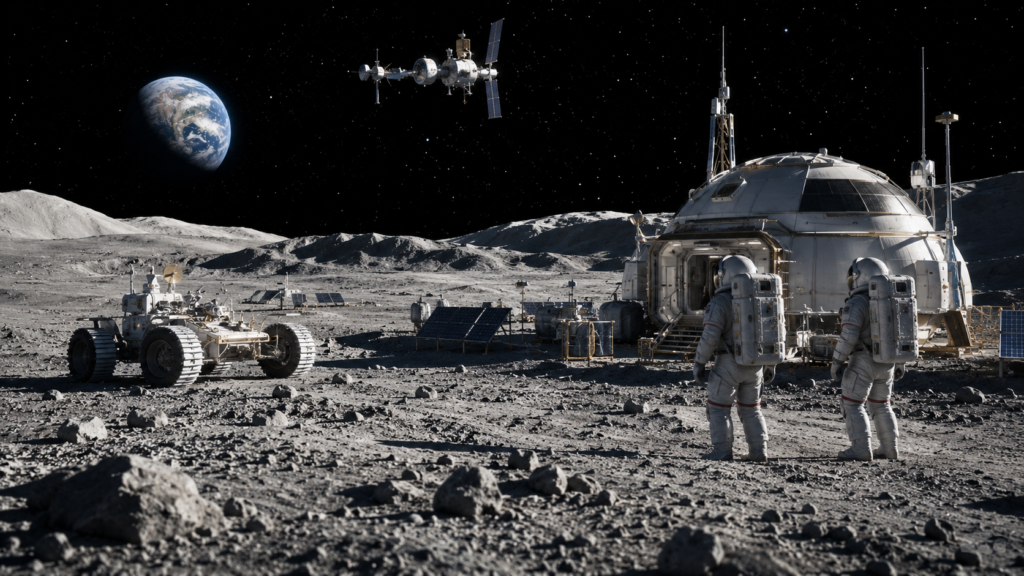
The program plans to land the first woman and the first person of color on the lunar surface while building infrastructure for future missions. Projects such as the Lunar Gateway space station and planned lunar habitats are expected to support scientific research and prepare astronauts for future missions to Mars.
Many international partners are contributing to Artemis, making it one of the largest collaborative space projects ever undertaken.
Apollo 8: Humans Reach the Moon
Before humans landed on the Moon, they first had to travel around it.
That happened with Apollo 8 in December 1968.
Astronauts Frank Borman, James Lovell and William Anders became the first humans to travel beyond low Earth orbit and orbit another world.
They spent approximately 20 hours orbiting the Moon.
The mission demonstrated that humans could travel to the Moon, operate a spacecraft there and return safely.
It also produced one of the most famous photographs in space history: Earthrise, showing Earth appearing above the lunar horizon.
Apollo 8 proved that a crewed lunar mission was no longer simply an engineering ambition.
It was achievable.
Apollo 11: The First Human Landing
On 20 July 1969, Apollo 11 achieved the goal that had seemed almost impossible only a decade earlier.
Astronauts Neil Armstrong and Buzz Aldrin descended toward the lunar surface in the lunar module Eagle, while Michael Collins remained in lunar orbit in the command module.
The landing occurred in the Sea of Tranquility.
Armstrong and Aldrin became the first humans to walk on another world.
They collected lunar samples, photographed the surface and deployed scientific instruments.
The mission lasted only a short time on the surface, but its scientific significance was enormous.
The returned samples showed that the Moon had a complex geological history.
Scientists discovered evidence that the Moon had once been much hotter and that volcanic activity had shaped large areas of its surface.
The mission also demonstrated that humans could operate outside Earth in a completely different environment.
🌕 CurioReader Insight: Apollo 11 was not simply a race to place a human footprint on the Moon. It transformed the Moon from an astronomical object into a place where humans could conduct scientific fieldwork.
Apollo 12–17: Science Takes Center Stage
Apollo 11 proved that humans could land on the Moon.
The later missions focused increasingly on science.
Apollo 12 demonstrated more precise landing capabilities and landed near the earlier Surveyor 3 spacecraft.
Apollo 14 explored the Fra Mauro region.
Apollo 15 introduced the Lunar Roving Vehicle, allowing astronauts to travel much farther from their landing module.
Apollo 16 explored the lunar highlands.
Finally, Apollo 17 landed in December 1972.
It was the final Apollo lunar landing and included geologist Harrison Schmitt, the only professional scientist to walk on the Moon during the Apollo missions.
Across the Apollo program, astronauts collected hundreds of kilograms of lunar material.
These samples became some of the most important geological evidence ever obtained from another world.
They helped scientists understand the Moon’s formation, volcanic history, impact history and relationship with Earth.
By the end of Apollo 17, however, the political urgency that had driven the Moon race had declined.
The United States had achieved Kennedy’s goal.
The question became:
What should come next?
Why Apollo Ended
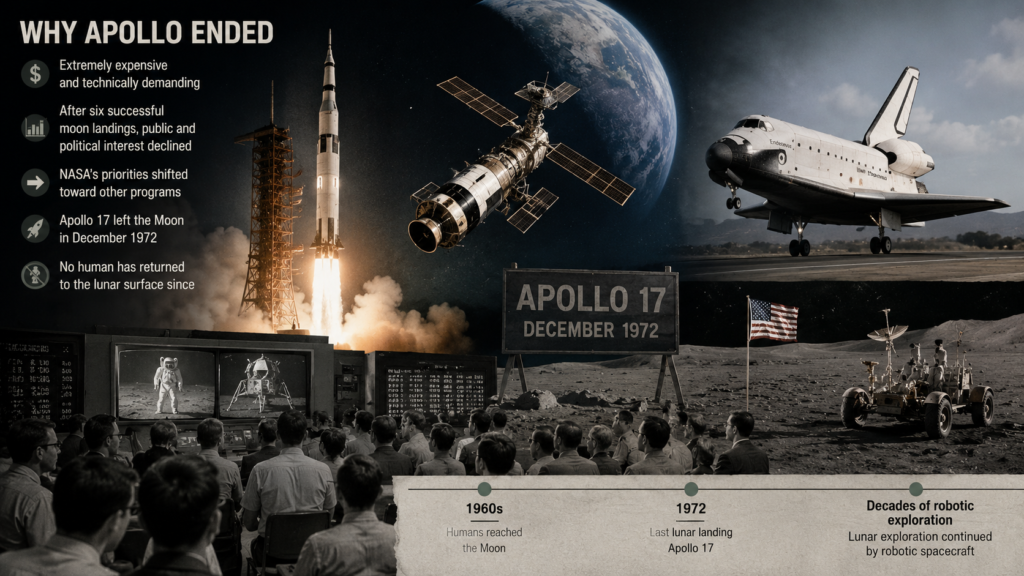
Apollo was enormously expensive and technically demanding.
After six successful lunar landings, public and political interest declined.
NASA’s priorities shifted toward other programs, including Skylab and eventually the Space Shuttle.
Apollo 17 left the Moon in December 1972.
No human has returned to the lunar surface since.
This created a remarkable gap in human exploration.
Humans had reached the Moon in the 1960s and early 1970s, but for decades afterwards, lunar exploration was conducted almost entirely by robotic spacecraft.
The Return of Robotic Exploration
Although humans stopped travelling to the Moon, scientific exploration did not stop completely.
Robotic missions gradually returned.
The Soviet Union’s Luna program had already demonstrated the value of robotic exploration, including the Lunokhod rovers.
Later missions from the United States and other countries expanded lunar science.
NASA’s Clementine mission in the 1990s helped map the lunar surface.
The Lunar Prospector mission, launched in 1998, studied the Moon’s composition, gravity and magnetic environment.
It also detected enhanced hydrogen concentrations near the lunar poles, strengthening interest in the possibility of water ice.
This discovery would become increasingly important to future lunar exploration.
Discovering Water and the Modern Moon
For much of the 20th century, scientists regarded the Moon as an extremely dry world.
The Apollo samples contained very little evidence of accessible surface water.
But later missions changed the picture.
Scientists discovered strong evidence for water ice in permanently shadowed regions near the lunar poles.
These areas can remain extremely cold because sunlight never reaches them directly.
Water on the Moon could be scientifically valuable and potentially useful for future exploration.
It could theoretically provide resources for drinking water, oxygen and hydrogen-based propellant after processing.
The discovery helped transform the Moon from simply a destination into a potential base for future exploration.
The Rise of International Lunar Exploration
Lunar exploration is no longer a two-country competition.
The 21st century has seen increasing participation from countries including China, India, Japan and European nations, as well as commercial companies.
China’s Chang’e program has achieved a series of major milestones, including lunar orbiters, landers, rovers and sample-return missions.
In 2019, China’s Chang’e 4 mission achieved the first soft landing on the Moon’s far side and deployed the Yutu-2 rover.
In 2020, Chang’e 5 returned lunar samples to Earth.
India also achieved an important milestone with Chandrayaan-3, which successfully landed near the lunar south polar region in 2023.
These missions demonstrate that lunar exploration has become a truly international scientific and technological activity.
Artemis: Returning Humans to the Moon
The next major chapter is the Artemis program.
NASA announced the Artemis initiative as a new effort to return humans to the Moon and establish a foundation for longer-term exploration.
Unlike Apollo, Artemis is designed around a broader and more sustained approach.
The program involves the Space Launch System (SLS) rocket, the Orion spacecraft, lunar landing systems, surface technology and international and commercial partnerships.
Artemis I launched in November 2022 as an uncrewed test mission.
Orion travelled around the Moon and returned to Earth, testing the spacecraft and other systems required for future crewed missions.
The next major milestone came with Artemis II.
In April 2026, four astronauts—NASA’s Reid Wiseman, Victor Glover and Christina Koch, along with Canadian Space Agency astronaut Jeremy Hansen—flew around the Moon and returned safely to Earth.
It was the first crewed lunar-distance mission since Apollo 17 in 1972.
Artemis III plans have subsequently evolved. NASA’s current plan for 2027 involves a crewed Earth-orbit demonstration to test rendezvous and docking capabilities with commercial lunar landing systems, with a later mission intended to carry astronauts toward the lunar south polar region.
This illustrates an important difference between Apollo and Artemis.
Artemis is being developed as a longer-term exploration architecture, rather than a short campaign designed primarily to win a geopolitical race.
Why We Are Going Back
There are several reasons for returning to the Moon.
Science
The Moon preserves evidence of the early history of the Solar System.
Unlike Earth, its ancient surface has not been extensively reshaped by oceans, atmosphere and plate tectonics.
Studying the Moon can therefore help scientists understand how Earth and other rocky worlds developed.
Technology
The Moon provides a nearby environment in which technologies for deep-space exploration can be tested.
Future missions can develop systems for life support, surface operations, communications, power generation and resource use.
Water and Resources
Lunar water ice could potentially become an important resource for future missions.
Processing water into oxygen and hydrogen could eventually support life-support systems and spacecraft operations.
Human Exploration
The Moon is also a stepping stone toward more ambitious destinations.
Technologies developed around the Moon could contribute to future human missions to Mars and beyond.
The Future of Lunar Exploration
The next era of Moon exploration is likely to be more diverse than the Apollo era.
Governments, international partners and private companies are increasingly involved.
Robotic landers may explore difficult regions before humans arrive.
New instruments could study lunar resources in greater detail.
Future missions may investigate permanently shadowed craters, build communications infrastructure and test technologies for surviving the harsh lunar environment.
The lunar south pole is particularly important because of its permanently shadowed regions and potential water ice.
The long-term objective is not simply to repeat Apollo.
It is to develop the knowledge and infrastructure needed for sustained exploration.
🚀 CurioReader Insight: Apollo proved that humans could visit the Moon. Artemis and the missions around it are attempting to answer a different question: Can humanity learn to operate there for the long term?
Key Takeaways
- Modern lunar exploration began with robotic missions in the late 1950s.
- Luna 1, Luna 2 and Luna 3 achieved historic Soviet milestones in 1959.
- The United States developed the Ranger, Surveyor and Lunar Orbiter programs to prepare for human missions.
- Apollo 8 carried the first humans around the Moon in 1968.
- Apollo 11 achieved the first human lunar landing in 1969.
- Six Apollo missions successfully landed humans on the Moon between 1969 and 1972.
- Apollo astronauts returned approximately 382 kilograms of lunar rocks and soil.
- Later robotic missions revealed new information about lunar composition, gravity and polar water.
- Lunar exploration is now an international effort involving multiple countries and commercial organizations.
- Artemis I successfully tested NASA’s new deep-space exploration system.
- Artemis II carried four astronauts around the Moon in 2026.
- Artemis is intended to establish a foundation for longer-term lunar exploration.
Frequently Asked Questions
When did Moon exploration begin?
Modern lunar exploration began with robotic spacecraft in the late 1950s. The Soviet Union’s Luna 1 became the first spacecraft to fly past the Moon in January 1959.
Who was the first person to walk on the Moon?
Neil Armstrong became the first person to walk on the Moon during Apollo 11 on 20 July 1969. Buzz Aldrin followed shortly afterward.
How many people have walked on the Moon?
Twelve American astronauts walked on the lunar surface during six successful Apollo landing missions between 1969 and 1972.
When was the last human mission to the Moon?
The last crewed lunar landing was Apollo 17, which took place in December 1972. Artemis II in 2026 returned humans to the lunar vicinity but was a crewed flyby mission rather than a lunar landing.
Why is the Moon important for future space exploration?
The Moon is relatively close to Earth and provides an environment where technologies for longer-duration space exploration can be tested. Its polar regions may also contain water ice that could become a useful resource.
What is the Artemis program?
Artemis is NASA’s current human lunar exploration program. It is designed to return astronauts to the Moon while developing capabilities and partnerships for longer-term exploration.
Has another country besides the United States landed humans on the Moon?
No. The United States remains the only country to have landed humans on the Moon. However, several countries have successfully landed robotic spacecraft there. NASA notes that the USSR, United States, China and India have achieved successful lunar landings.
Conclusion
The history of Moon exploration is a story of extraordinary technological progress.
In 1959, the Moon was first reached by robotic spacecraft. Within a decade, humans had travelled across the distance separating Earth from its nearest celestial neighbour.
Apollo transformed lunar exploration.
The program demonstrated that humans could survive the journey, land on another world, conduct scientific research and return safely to Earth.
But Apollo was only the beginning.
After the final landing in 1972, robotic spacecraft continued to reveal new aspects of the Moon. Scientists discovered evidence of water ice, mapped its surface in unprecedented detail and developed a much deeper understanding of its geological history.
The Moon also became increasingly international.
China, India, Japan, Europe, the United States and other partners have contributed to a new generation of lunar exploration.
Now Artemis is beginning another chapter.
Artemis I tested the new generation of crewed deep-space hardware. Artemis II carried astronauts around the Moon in 2026, marking humanity’s return to the lunar vicinity after more than five decades.
The next objective is not simply to plant another flag.
The goal is to develop the knowledge, technology and partnerships required for a more sustained human presence around and eventually on the Moon.
That could include scientific stations, robotic infrastructure, resource investigations and technologies that may eventually support missions to Mars.
The Moon has therefore changed from a distant object of curiosity into something much more significant.
It is a scientific laboratory, a technological proving ground and a potential gateway to deeper space.
From Luna 1 to Apollo 11, from robotic rovers to Artemis, the history of lunar exploration demonstrates how quickly human capability can advance when curiosity, science and engineering come together.
The next great chapter may not be about simply reaching the Moon.
It may be about learning how to stay, explore and use what we discover there—while preparing humanity for its next giant step beyond Earth.
Further Reading & Resources
Continue your learning journey with more expert guides and insightful articles from CurioReader. Explore related topics below to deepen your understanding and discover new perspectives.
Related CurioReader Articles
Recommended External Resources